
A desert sandstorm begins with a plain recipe: dry ground, loose particles, and wind strong enough to lift them. In desert regions such as the Sahara, Arabian Desert, Gobi, Taklamakan, Sonoran, Mojave, and parts of Central Asia, those conditions can turn a clear horizon into a dense cloud of sand and dust. The event may last only minutes near the ground, or it may feed a dust plume that travels far beyond the desert where it started.
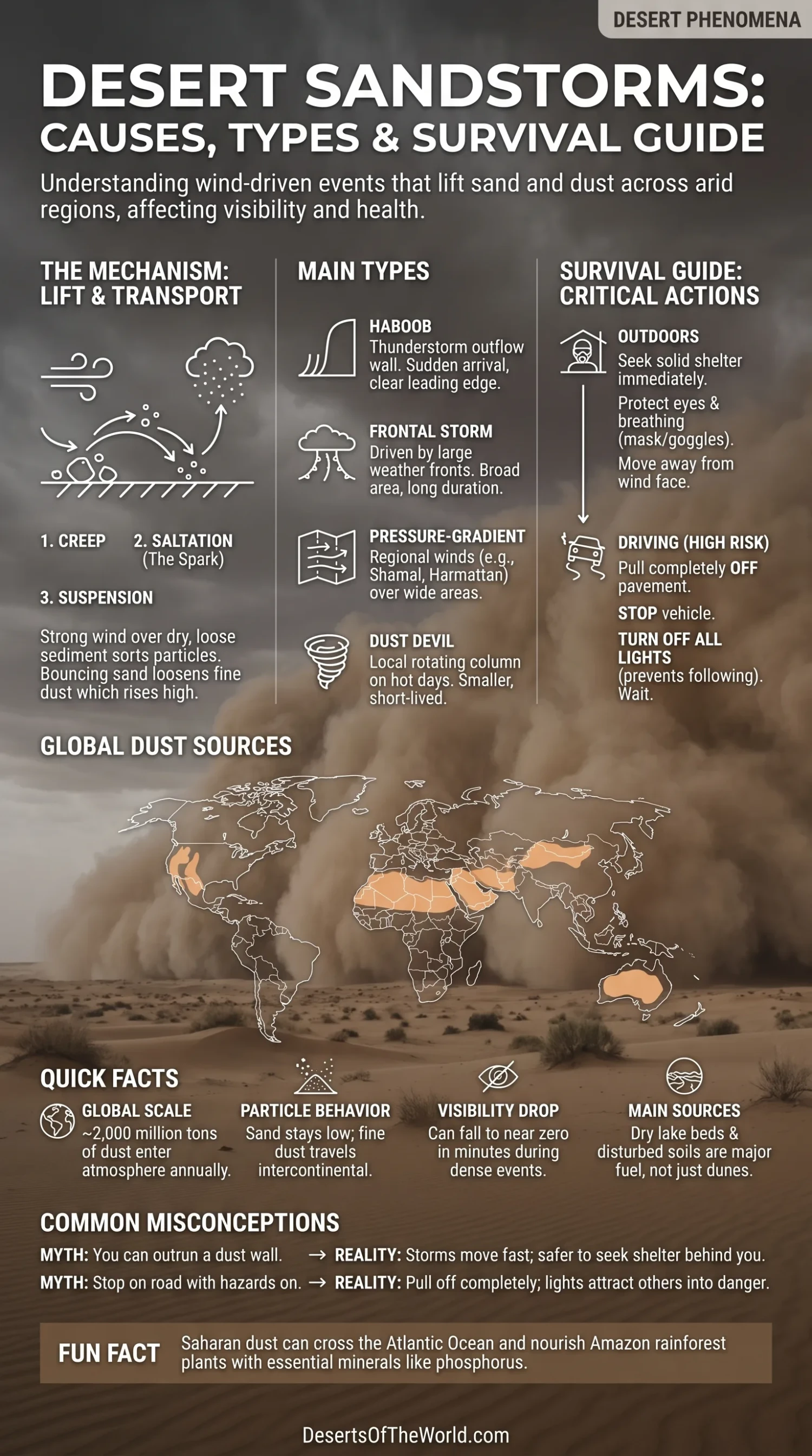
Desert Sandstorms: Causes, Types and Survival Guide
A sandstorm is a wind-driven event in which sand and dust rise from dry land and reduce visibility. The word “sandstorm” often sounds simple, but the air inside one can hold several particle sizes at once. Larger sand grains tend to bounce and skim close to the surface. Finer dust can rise higher, stay airborne longer, and travel across regions, seas, and even oceans.
That difference matters. A low sandstorm may sting the skin and sweep across dunes or dry plains. A fine dust storm may dim daylight, coat buildings, affect air quality, and move far from the source area. In many desert settings, both happen together.
| Topic | What It Means |
|---|---|
| Main Trigger | Strong, turbulent wind moving across dry, loose sand, silt, clay, or exposed lakebed sediment. |
| Common Desert Sources | Dune fields, dry lake beds, bare alluvial plains, overgrazed drylands, dry riverbeds, and disturbed soil. |
| Particle Behavior | Sand usually stays closer to the ground, while fine dust can rise higher and travel much farther. |
| Visibility | Visibility can fall sharply, and in dense dust it may approach zero for short periods. |
| Best Immediate Response | Get indoors or into a vehicle, protect eyes and breathing, stop travel when visibility drops, and wait for safer conditions. |
| Global Scale | The World Meteorological Organization estimates that roughly 2,000 million tons of sand and dust enter the atmosphere each year. |
What Causes Desert Sandstorms?
Desert sandstorms form when wind overcomes the grip that holds particles on the ground. That grip may come from moisture, plant roots, surface crust, gravel cover, or the weight of the particles themselves. When the ground is dry and bare, less force is needed to move it.
Wind does not lift all particles in the same way. Particle size, weight, surface conditions, and turbulence affect how each grain moves.
- Creep: larger grains roll or slide along the ground.
- Saltation: sand-sized grains hop in short arcs, hit the surface, and knock other grains loose.
- Suspension: fine dust rises into the air and may remain there long after the strongest gust has passed.
In a desert, saltation often starts a chain of particle movement. Bouncing sand grains strike the ground and loosen finer particles. The dust then rises into turbulent air. Once dust is aloft, it can darken the sky while the heavier sand stays near the surface.
Dry Surface Sediment
Loose material is the fuel. Freshly dried mudflats, dry lake beds, floodplains, and open plains can release dust when the surface breaks apart. In many deserts, the most active dust sources are not the tall dunes people imagine first. They are often flat basins where fine sediment has collected over time.
The Bodélé Depression in Chad is a well-known example within the Sahara system. Its fine mineral dust can join larger Saharan plumes. Some of that dust later crosses the Atlantic, showing how a desert basin can connect distant ecosystems.
Strong Pressure Differences
Wind strengthens when air moves from higher pressure toward lower pressure. In deserts, this can happen along weather fronts, around low-pressure systems, or through mountain gaps. A flat basin may look calm in the morning and turn dusty by afternoon when regional winds rise.
Pressure-gradient winds can build wide dust areas rather than a single wall. These storms may last longer than a short thunderstorm outflow. They can also move dust far downwind, especially when fine particles reach higher air layers.
Thunderstorm Outflow
Many sudden desert dust walls come from thunderstorms. Rain-cooled air sinks fast inside a storm cloud, spreads outward when it reaches the ground, and pushes into loose desert sediment. The front edge can become a dense wall of dust. This type is often called a haboob.
Not every thunderstorm in a desert produces heavy dust. The ground must offer loose particles, and the downdraft must be strong enough. When those pieces line up, the storm can arrive fast. The sky ahead may look like a wall, not a cloud.
Hot Ground and Local Turbulence
Desert surfaces heat unevenly. Dark gravel, pale sand, rock, and dry clay warm at different rates. Rising warm air can create small whirlwinds and gusty pockets near the ground. Most are brief. Some lift dust high enough to be seen from far away.
Small does not always mean harmless. A dust devil is not the same as a regional sandstorm, but it can still throw sand into the eyes, tip light objects, and confuse travelers on open flats.
Human-Changed Drylands
Sand and dust storms are natural desert events, but exposed soil can make them easier to start. Bare fields, unpaved roads, construction zones, poorly protected dry soils, and damaged vegetation can add loose material to the wind. In dry regions, land cover matters. A thin plant cover can act like a net over the soil. Remove that net, and the wind has more to lift.
Sandstorm and Dust Storm Differences
The terms are often used together, and official weather language may group them as dust or sand storms. The practical difference comes down to particle size and travel distance.
USDA soil classes place sand from 0.05 millimeter to 2 millimeters in diameter. Silt is smaller, from 0.002 to 0.05 millimeter, and clay is smaller again. Other sediment scales place the sand boundary slightly differently, but the idea stays the same: sand is heavier; dust is finer.
| Feature | Sandstorm | Dust Storm |
|---|---|---|
| Main Particle | Sand grains, often with some dust mixed in. | Silt, clay, and other fine mineral particles. |
| Typical Height | Often strongest close to the ground. | Can rise much higher in turbulent air. |
| Travel Distance | Usually shorter because heavier grains settle faster. | Can cross regions, seas, and oceans when lifted high enough. |
| Main Problem For People | Stinging sand, poor visibility, surface abrasion, and navigation trouble. | Air quality, reduced visibility, dust coating, and breathing discomfort. |
| Common Setting | Dunes, sandy plains, desert tracks, and open basins. | Dry lake beds, bare soils, floodplains, and broad arid basins. |
In the field, the boundary is rarely clean. A storm may begin with a sand blast near the surface and still carry fine dust high into the sky. For safety, treat both as visibility and air-quality hazards.
Main Types of Desert Sandstorms
Desert sandstorms can be grouped by how they form, what they carry, and how far they move. The names below help explain the weather pattern behind the dust, not just the look of the storm.
Haboob
A haboob is a dust or sand wall created by thunderstorm outflow. It often has a clear leading edge. From a distance, it may look like a tall brown or orange curtain moving across the land.
Haboobs are known from North Africa, the Middle East, the Arabian Peninsula, Australia, and the dry Southwest of the United States. They often arrive suddenly. Rain may follow, but in very dry air the rain can evaporate before reaching the ground, while the outflow wind keeps moving dust forward.
Frontal Dust Storm
A frontal dust storm forms when a cold front or other air-mass boundary pushes strong winds across dry land. These storms can cover a broad area and may travel along the front. They are not always shaped like a single wall, yet visibility can still fall fast.
This type is common where dry basins sit near active weather systems. It can affect highways, airports, farms, solar facilities, and settlements along the downwind path.
Pressure-Gradient Sandstorm
Some desert winds build because of strong pressure differences over a wide region. The result may be a longer dusty period rather than one sudden blast. In the Arabian Peninsula, shamal winds can raise dust and sand under the right surface conditions. In North and West Africa, Harmattan winds can carry dry Saharan dust toward lower latitudes.
These named winds are part of regional climate. They show why a sandstorm is not only a local event. The resulting dust transport can extend across an entire region.
Convective Dust Plume
Strong surface heating can help dust rise in columns and plumes. These events may start small, then merge with larger wind flows. The plume may look patchy from the ground, but from above it can form a long pale trail.
Satellite imagery often reveals these patterns better than a person standing on the surface. That is why desert dust forecasting uses both ground reports and remote sensing.
Dust Devil
A dust devil is a rotating column of air that lifts dust and sand on sunny, dry days. It is usually smaller and shorter-lived than a sandstorm. It forms from local heating and rotation near the ground, not from a large storm front.
Dust devils are part of desert weather, but they should not be confused with haboobs or regional dust outbreaks. Still, on a bare desert plain, even a brief vortex can make walking, filming, or driving unpleasant.
Where Desert Sandstorms Are Most Common
Sand and dust storms favor drylands with exposed sediment. The strongest source areas are often in arid and semi-arid belts rather than only inside classic dune deserts.
Sahara and North African Deserts
The Sahara is one of Earth’s largest dust source regions. WMO notes that much of the global dust budget comes from North African and Middle Eastern deserts. Fine Saharan dust can move west across the Atlantic, north toward Europe, or south into the Sahel depending on season and wind pattern.
NASA’s CALIPSO observations found that wind and weather carry an average of about 182 million tons of dust each year past the western edge of the Sahara. A smaller share reaches the Amazon Basin, where mineral nutrients such as phosphorus can help replace nutrients lost through heavy rain and runoff. This does not make dust “good” or “bad” by itself. It makes it part of a wider Earth system.
August 2026 example: On August 14, 2026, a massive dust cloud spread across south-central Algeria. NASA’s Terra satellite observed a plume covering about 127,000 km², and across most of that area the dust was dense enough to obscure the ground from view. NASA linked the event to abundant Saharan sand sources and hot conditions that destabilized near-surface air, allowing winds to lift large amounts of mineral dust.
Arabian Desert and Middle East Drylands
The Arabian Desert and nearby drylands can produce intense sand and dust events, especially during strong seasonal winds and frontal passages. Fine dust may affect cities, roads, oil and gas sites, airports, and solar-energy fields.
Surface type matters here. Gravel plains, dry basins, construction areas, and disturbed soils can all feed dusty air when wind rises.
Gobi, Taklamakan, and Central Asian Basins
The Gobi and Taklamakan sit in a region where strong winds, cold-season fronts, high mountains, and dry basins can create dust outbreaks. Dust from Asian deserts may travel toward eastern China, Korea, Japan, the North Pacific, and beyond.
The Taklamakan is ringed by mountains, which can trap and steer air. The Gobi has broad stony and sandy areas where wind can sweep across open ground. Different landscapes, same basic trigger: dry sediment plus wind.
Southwestern North America
The Sonoran, Mojave, Chihuahuan, and Great Basin drylands can all produce dust or sand events. Haboobs in Arizona and neighboring regions often relate to summer thunderstorm outflows. Dry lake beds, farmland edges, unpaved roads, and desert construction zones can add local dust sources.
The main danger here is often transport. A dust wall crossing a highway can turn clear driving into near-zero visibility within moments.
Australia, Southern Africa, and South American Drylands
Australia has large interior drylands where drought, bare ground, and strong winds can send dust over long distances. Southern African dry basins and South American arid zones can also produce dust under dry, windy conditions.
Deserts differ in color, mineral content, and surface texture. The storm physics remain familiar: loosen, lift, transport, settle.
Why Some Sandstorms Become So Dense
A dense sandstorm is not only “more wind.” It usually means several conditions overlap.
- Fresh loose sediment: recently dried mud, broken crust, disturbed soil, or fine basin deposits.
- Strong gusts: especially from thunderstorm outflows, fronts, or gap winds.
- Turbulent air: churning motion that keeps particles suspended.
- Low vegetation cover: fewer roots and stems to slow wind near the ground.
- Long open fetch: wind has room to gather and carry particles across flat ground.
Fine particles require less force to remain suspended than coarse grains once wind has lifted them. Natural desert surfaces contain a mixture of particle sizes, so the same wind event can move coarse sand near the ground while carrying finer mineral dust much higher.
What It Feels Like Inside a Sandstorm
Conditions vary, but several sensations are common. Light drops. The horizon fades. Fine dust may give the air a yellow, brown, gray, or reddish tone, depending on local minerals and sun angle. Sand grains can strike exposed skin. Breathing may feel dry or gritty, especially without face protection.
Sound changes too. Wind can mask normal distance cues. A nearby vehicle, person, or building may become hard to judge. On open desert ground, direction can feel strangely unreliable. Landmarks disappear, and the simplest route becomes harder to read.
This is why waiting is often safer than pushing forward. In many cases, the storm passes before a risky move becomes worthwhile.
Desert Sandstorm Safety: What To Do Outdoors
If a sandstorm approaches while you are outside, the main goal is to reduce exposure and avoid disorientation.
- Move toward solid shelter if it is nearby: a building, visitor center, ranger station, or enclosed vehicle.
- Protect your eyes with wraparound glasses or goggles. Ordinary sunglasses help less when dust comes from the side.
- Cover your nose and mouth with a fitted respirator if available. A cloth is not equal to a respirator, but it may reduce larger sand contact for a short time.
- Face away from the strongest wind while moving. Keep low if blowing sand is strongest near the surface.
- Stay with your group. Use voices, touch, or a short rope in organized field settings where visibility is poor.
- Avoid dune crests and exposed ridges. Wind is usually stronger there.
- Do not rely on distant landmarks once visibility drops. Use a compass, GPS track, or marked route only if you can move safely.
In a remote desert, the right action may be to stop, sit with your back to the wind, protect your face, and wait. Moving blindly wastes energy and can lead away from shelter.
What To Do If You Are Driving
Driving is one of the highest-risk situations during a dust or sandstorm because visibility can fall faster than traffic can react. The National Weather Service gives clear road guidance for dust storms and haboobs: avoid entering the dust if possible, and if dense dust reaches the road, pull off the pavement as far as you safely can.
- Check traffic around you and slow down smoothly.
- Leave the travel lane. Do not stop on the roadway.
- Pull completely off the paved surface when a safe place exists.
- Stop the vehicle and set the parking brake.
- Turn off lights once parked off the road, including brake lights if possible, so other drivers do not follow your lights into the shoulder.
- Keep seat belts on and wait until visibility improves.
If you cannot safely leave the road, drive slowly for the visibility, use lights while moving, follow lane markings with care, and look for a safe exit. Never stop in the travel lane. Not even for a minute.
What To Do Indoors or at Camp
Inside a building, tent, or vehicle, the task changes from escape to exposure control.
- Close windows, doors, vents, and roof openings.
- Set ventilation to recirculate when possible.
- Move away from gaps where dust enters.
- Keep drinking water covered.
- Store cameras, phones, lenses, and navigation devices inside sealed bags.
- Use a damp cloth for cleanup after the storm rather than sweeping dry dust back into the air.
A tent is weaker shelter than a vehicle or building. If wind rises before the storm arrives, secure loose fabric, poles, and gear early. Once visibility is poor, chasing loose items is not worth it.
Health and Air Quality Concerns
Desert dust is mineral matter, but it is not just “clean sand.” Fine particles can irritate eyes, throat, nose, and lungs. People with asthma, heart or lung conditions, older adults, children, and pregnant people may need extra care during dusty air episodes.
Fine dust is the part to respect most. Sand grains usually settle fast. Dust can stay suspended and enter indoor spaces through gaps. In some dry regions, soil dust may also carry natural biological material. Local public-health advice should be followed when officials issue dust or air-quality alerts.
Simple actions help:
- Stay indoors when dust levels are high.
- Keep windows and doors closed.
- Use a well-fitting respirator when outdoor exposure cannot be avoided.
- Limit heavy outdoor activity until the air clears.
- Rinse irritated eyes with clean water and avoid rubbing grit into them.
Anyone with chest pain, severe breathing trouble, or symptoms that do not ease should seek local medical help. Dust is common in deserts. Breathing distress should not be treated as normal desert discomfort.
How To Prepare Before Desert Travel
Preparation should fit the desert. A paved roadside viewpoint near a city needs less planning than a long route through an open basin. Still, the same basics apply.
| Item | Why It Helps |
|---|---|
| Weather Forecast and Alerts | Dust warnings, high-wind alerts, and thunderstorm forecasts can reveal risk before travel begins. |
| Wraparound Eye Protection | Goggles or close-fitting glasses reduce sand contact from side winds. |
| Respirator or Protective Mask | A well-fitting respirator reduces inhalation of fine particles during unavoidable exposure. |
| Water and Covered Containers | Dust dries the mouth and contaminates open bottles, cups, and cooking gear. |
| Offline Map and Compass | Visibility loss can hide tracks, signs, and landmarks. |
| Sealable Bags | Fine dust can damage cameras, phones, lenses, and charging ports. |
| Vehicle Air Filter Awareness | Dusty routes can load filters faster than normal road driving. |
For guided desert trips, ask how the operator handles wind alerts, road closures, and shelter timing. Checking warnings and shelter options before travel reduces avoidable exposure.
Common Mistakes During Sandstorms
Many sandstorm mistakes come from treating the event like ordinary wind. It is not. Visibility loss changes the rules.
- Trying to outrun a dust wall: the storm may cross roads faster than expected, and the safest route may be behind you.
- Stopping in a traffic lane: other drivers may not see the vehicle in time.
- Leaving lights on after pulling off the road: drivers behind may follow the lights and leave the road too.
- Walking away from shelter: a short distance can become confusing when landmarks vanish.
- Rubbing eyes: grit can scratch or irritate the eye surface.
- Opening bags and electronics: fine dust gets into zippers, ports, lenses, and buttons.
- Assuming the air is safe as soon as the wind drops: fine dust may linger after heavier sand settles.
How Sandstorms Shape Desert Landscapes
Sandstorms are not only hazards. They are also part of the processes that build and modify desert landscapes. Wind moves grains from one place to another, strips fine material from exposed surfaces, polishes rocks, feeds dunes, and leaves coarser gravel behind as desert pavement.
Dunes grow when sand supply, wind direction, and obstacles line up. Ripples form on smaller scales. Fine dust can leave the desert completely and settle as loess, soil dust, or mineral input far away. This is why desert dust matters to climate, ocean nutrients, snow surfaces, and soil formation.
The Sahara-to-Amazon dust route is one of the clearest examples. Dust lifted from African source areas can cross the Atlantic and deliver mineral nutrients to South America. A desert, in that sense, is not isolated. It is connected by air.
How Desert Dust Affects Earth’s Radiation Balance
Mineral dust changes the amount of energy entering and leaving Earth’s atmosphere. In sunlight, dust can scatter and absorb shortwave radiation. It also interacts with longwave radiation—the infrared energy emitted by Earth’s surface and atmosphere toward space. These two effects can work in opposite directions, so the climate influence of desert dust cannot be described as simply warming or cooling the planet.
A study published in Nature Communications on 28 April 2026 used a data-driven analytical model constrained by observations to estimate the global annual mean all-sky longwave direct radiative effect of desert dust at the top of the atmosphere. The estimate was +0.25 ± 0.06 W/m² (90% confidence interval). A compilation of 24 global climate-model results had a median value of about +0.13 W/m², with a reported range of 0.09–0.23 W/m².
| Measure | Reported Value | What It Shows |
|---|---|---|
| Observationally Constrained All-Sky LW DRE | +0.25 ± 0.06 W/m² | Estimated global annual mean longwave heating effect at the top of the atmosphere. |
| Climate-Model Median | +0.13 W/m² | About half the observationally constrained estimate; the compiled model range was 0.09–0.23 W/m². |
| Main Model Gaps | LW scattering and super-coarse dust | Most global models omit longwave scattering and many underestimate or omit dust particles larger than 10 μm. |
| Net Dust Effect | Still uncertain | Longwave heating is partly offset by shortwave cooling, so these longwave results do not mean desert dust has a simple net warming effect worldwide. |
The study found that longwave scattering accounts for more than half of the estimated global mean longwave direct radiative effect. Coarse and super-coarse mineral dust also contribute heavily because larger particles interact strongly with infrared radiation. Many global models represent these larger particles poorly, which helps explain the lower modeled value.
The spatial pattern is not uniform. Longwave heating is strongest near major dust-source regions, while shortwave cooling can be stronger over oceans and other darker surfaces downwind. The study therefore does not show that desert dust, taken as a whole, warms Earth. Its net direct radiative effect depends on the balance between longwave heating and shortwave cooling, and the global sign of that combined effect remains uncertain.
Sandstorm Forecasting and Warning Signs
Forecasting sand and dust storms combines weather models, satellite imagery, surface observations, and local knowledge. Meteorologists watch for strong winds, thunderstorms, dry fronts, unstable air, and known dust source areas.
On the ground, several signs can warn of worsening conditions:
- A brown, tan, gray, or reddish wall along the horizon.
- Sudden gusts ahead of a thunderstorm.
- Dust streamers crossing open ground or roads.
- Fast loss of distant landmarks.
- Weather alerts mentioning blowing dust, dust storm, haboob, or low visibility.
Forecasts are helpful, but dust can be local. A dry field, bare basin, or unpaved track may produce a hazard even when the wider region looks calm. Local surface conditions decide a lot.
FAQ
Are Sandstorms and Dust Storms the Same Thing?
They overlap, but they are not exactly the same. Sandstorms carry heavier sand grains that usually stay closer to the ground. Dust storms carry finer particles that can rise higher and travel farther. Many real desert storms contain both.
Can a Sandstorm Happen Without Rain?
Yes. A sandstorm can form from dry regional wind, a front, or pressure differences without rain. Haboobs often come from thunderstorm outflow, but rain may evaporate before reaching the ground in very dry desert air.
How Long Does a Desert Sandstorm Last?
Some dense dust walls pass in minutes. Broader dusty wind events can last for hours, and fine dust may remain in the air after the strongest wind has eased. Duration depends on the weather pattern, ground conditions, and particle size.
Is It Safe To Drive Through a Sandstorm?
It is safer to avoid entering a dust or sandstorm when possible. If dense dust reaches the road, the safest action is usually to pull completely off the paved surface, stop, set the parking brake, turn lights off once parked, and wait for visibility to improve.
Why Do Some Sandstorms Look Orange or Red?
Color comes from mineral content, particle size, sunlight angle, and storm density. Iron-rich dust can look reddish. Pale limestone or gypsum dust may look lighter. Low sun can make the same dust plume appear warmer in color.
Do Sandstorms Help Deserts Grow?
Sandstorms move sediment, but they do not create deserts by themselves. Desert growth depends on climate, rainfall patterns, vegetation cover, land surface, and water balance. Wind can spread dust from dry exposed land, which may make nearby surfaces dustier.
Sources
- World Meteorological Organization – Sand and Dust Storms (global dust sources, annual dust emission estimates, and broad impacts)
- World Meteorological Organization – Aviation Hazards: Dust Storms and Sand Storms (particle lifting, turbulence, visibility, and haboob explanation)
- NOAA National Weather Service – Dust Storms and Haboobs (road safety actions and dust storm behavior)
- USDA Natural Resources Conservation Service – Physical Properties (sand, silt, and clay particle-size classes)
- NASA – Satellite Reveals How Much Saharan Dust Feeds Amazon’s Plants (CALIPSO observations, Saharan dust transport, and nutrient movement)
- NASA MODIS – Dust in Algeria (August 2026 south-central Algeria dust event, plume extent, visibility, and Saharan dust-source conditions)
- CDC – Reducing Risk for Valley Fever (dust exposure precautions in affected dry regions)
- Nature Communications – Desert Dust Exerts Twice the Longwave Radiative Heating Estimated by Climate Models (2026 observationally constrained longwave radiative effect, climate-model comparison, longwave scattering, super-coarse dust, and shortwave-cooling context)