
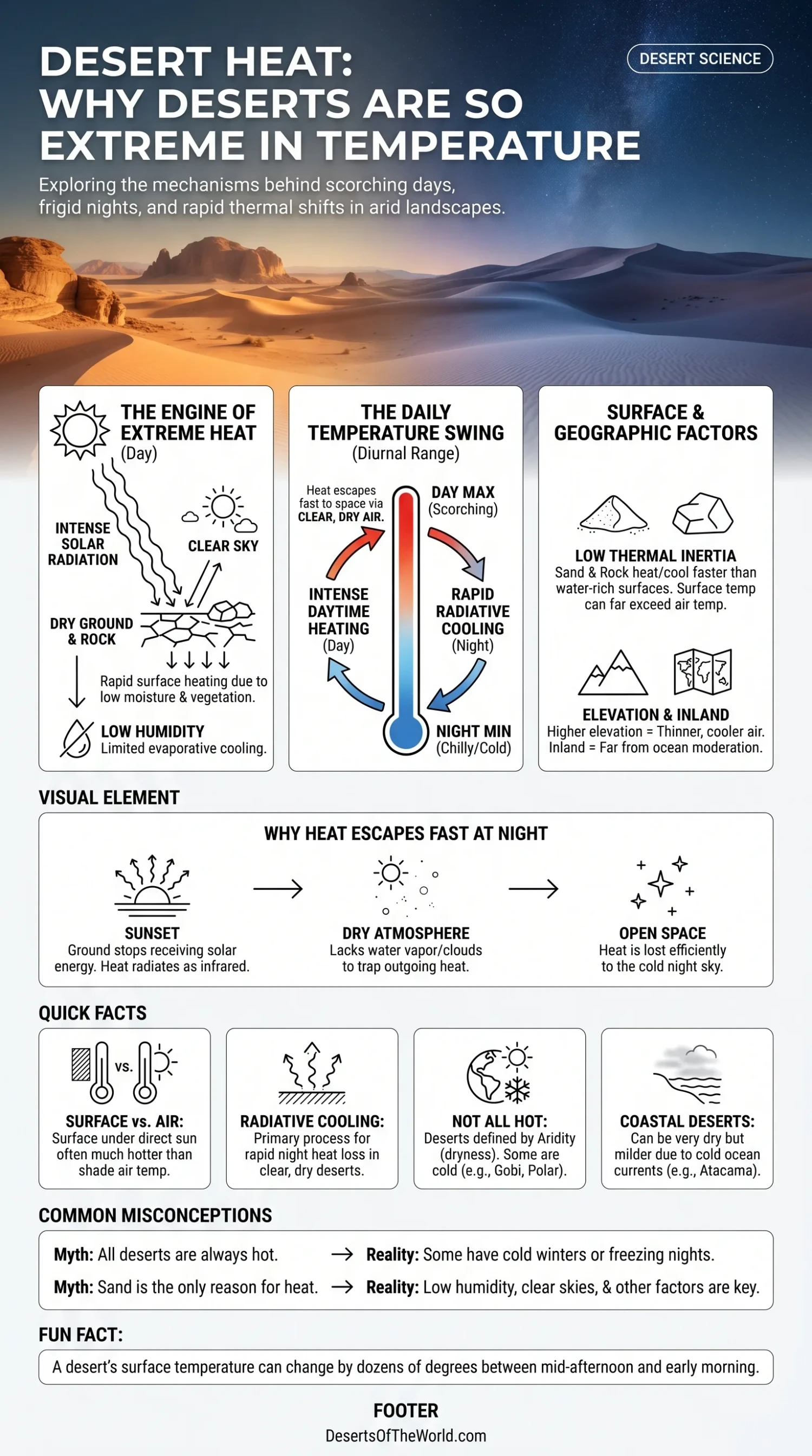
Desert heat is not just about hot afternoons. A desert can feel like an oven by day and turn sharply cold after sunset because its air, soil, clouds, moisture, and landscape all handle heat in unusual ways. The same dryness that lets sunlight strike the ground with little interruption also lets stored warmth escape fast at night. That is why many deserts are places of wide temperature swings, not simply places of constant heat.
| Desert Factor | What It Does | Temperature Effect |
|---|---|---|
| Low Humidity | Dry air contains little water vapor. | Heat builds quickly by day and escapes quickly at night. |
| Clear Skies | Many deserts have few clouds for long periods. | More sunlight reaches the surface; less heat is trapped after sunset. |
| Dry Soil and Rock | Sand, gravel, and bare rock heat faster than wet ground. | Surface temperatures can rise sharply during the day. |
| Sparse Vegetation | Little shade and limited plant cooling. | Ground and near-surface air become hotter. |
| Elevation and Inland Location | Some deserts sit high or far from oceans. | Hot days may be followed by cold nights or cold winters. |
Why Deserts Heat Up So Fast During the Day
The main reason is simple: dry land heats quickly. In humid places, a large share of the sun’s energy goes into evaporating water from soil, leaves, lakes, and other moist surfaces. In many deserts, there is little moisture available for that cooling process. More of the sun’s energy goes straight into warming the ground.
Sand, gravel, and exposed rock also have lower heat storage than water-rich surfaces. A lake warms slowly because water can absorb a lot of energy before its temperature changes much. A dry desert surface does not behave that way. It reacts fast. By midday, the upper layer of sand or stone may become much hotter than the air above it.
This is why desert heat often feels strongest close to the ground. The air temperature measured in shade may be high, but the surface under direct sun can be far hotter. Bare ground acts like a hot plate, warming the air just above it.
Sunlight Reaches the Surface With Less Interruption
Many hot deserts sit under weather patterns that favor sinking dry air. Sinking air discourages cloud formation, so the sky stays clear for long stretches. With fewer clouds, more incoming solar radiation reaches the land surface.
That does not mean every desert is sunny every day. Some deserts have seasonal cloud, fog, monsoon storms, or winter rain. Still, dryness and clear-sky conditions are common enough to shape the classic desert temperature pattern.
Dry Air Does Not Cool the Land Like Humid Air
Water vapor changes how heat moves through the lower atmosphere. Humid air can slow heat loss, soften daytime heating through evaporation, and help clouds form. Desert air often lacks that moisture buffer.
The result is direct. The land warms fast. The shade helps, but only so much. Out in the open, there is little cloud cover, little plant cover, and little evaporation to take heat away from the surface.
Why Deserts Can Become Cold at Night
Desert nights surprise many people because the heat can fade fast. Once the sun sets, the ground no longer receives new solar energy. The warm surface begins to release heat as infrared radiation.
In humid or cloudy places, some of that outgoing heat is absorbed and re-radiated by water vapor and clouds. In many deserts, the air is dry and the sky is clear. Heat slips away more easily into the open night sky. The change can be sudden.
This process is called radiative cooling. It is one of the most important reasons deserts can have large day-night temperature ranges.
Clouds Work Like a Blanket, and Deserts Often Lack That Blanket
A cloudy night usually stays warmer than a clear night because clouds absorb and return some of the heat leaving the ground. In a dry desert, the sky may be clear for hours after sunset. No blanket overhead. The surface cools quickly.
That cooling starts at the ground and spreads into the air just above it. In low spots, cold air can collect before dawn. This is why desert mornings can feel much colder than the previous afternoon suggests.
The Daily Temperature Range Can Be Very Wide
Some desert regions can shift by dozens of degrees between afternoon and early morning. The exact range depends on cloud cover, wind, humidity, season, elevation, soil type, and landscape shape. A calm, clear, dry night allows the sharpest cooling.
Not every desert night is cold. Low-elevation hot deserts in summer may stay warm after dark, especially when humidity rises during a seasonal rain period. But the desert pattern remains: with dry air and clear skies, the land can lose heat quickly.
Deserts Are Not All Hot
The word “desert” describes dryness more than heat. Some deserts are hot, some are cold, and some swing between both depending on season. This matters because temperature extremes in deserts are not only about scorching summer days.
| Desert Type | Common Setting | Temperature Character | Examples |
|---|---|---|---|
| Hot Desert | Subtropical dry zones, often near 20°–30° latitude | Very hot summers, strong sunlight, large day-night changes | Sahara, Arabian Desert, Sonoran Desert |
| Cold Desert | Higher latitudes, high plateaus, or inland basins | Cold winters, warm or hot summers in some areas | Gobi Desert, Great Basin Desert |
| Coastal Desert | Dry coasts near cold ocean currents | Milder air temperatures, frequent fog in some areas, very low rainfall | Atacama Desert, Namib Desert |
| Polar Desert | Very cold regions with low precipitation | Cold year-round, dry air, limited liquid water | Antarctic Dry Valleys, parts of the Arctic |
A desert can be freezing and still be a desert. Antarctica contains polar desert landscapes because precipitation is very low and liquid water is limited. On the other side, the Sahara and Arabian Desert show how intense solar heating and dry air can create some of the planet’s hottest land environments.
The Role of Low Humidity
Humidity is one of the quiet controls behind desert heat. Water vapor absorbs and emits infrared radiation. It also supports cloud formation and helps reduce temperature swings through evaporation and condensation.
When humidity is low, several things happen at once:
- Evaporative cooling is limited because there is little water at the surface.
- Cloud cover is often reduced, allowing stronger sunlight by day.
- Night heat loss is faster because dry air traps less outgoing infrared energy.
- Sweat evaporates more easily, which can make dry heat feel different from humid heat, even when the thermometer is high.
This is why desert heat can be intense but also deceptive. Dry air may feel less heavy than humid air, yet the body can still lose water quickly. In temperature terms, dryness is the engine behind both hot afternoons and cold nights.
Why Sand and Rock Matter
Desert ground is often made of sand, gravel, bare soil, salt flats, or exposed bedrock. These surfaces absorb and release heat differently from forests, wetlands, or oceans.
Sand has many tiny air spaces. It heats quickly near the surface, but heat does not move deeply through it very well. Touch the top layer under strong sun and it may feel extremely hot; a short distance below, it can be much cooler. This shallow heating helps create a sharp daily rhythm.
Thermal Inertia in Simple Terms
Thermal inertia means how slowly or quickly a material changes temperature. Water has high thermal inertia. It resists fast temperature change. Dry sand and rock have lower thermal inertia, so they warm and cool more quickly.
A useful comparison is a pot of water and a dry metal pan. The pan heats fast and cools fast. The water changes more slowly. Desert ground behaves more like the pan than the pot.
Color, Texture, and Surface Cover
Not all desert surfaces heat the same way. Dark volcanic rock can absorb more solar energy than pale sand. Salt flats can reflect more sunlight. Pebble-covered pavements, clay pans, dunes, and rocky slopes each create their own near-ground temperature pattern.
That is why two places in the same desert can feel different on the same afternoon. A shaded canyon wall, a pale dune, and a black lava field do not handle sunlight in the same way.
How Elevation Changes Desert Temperatures
Elevation adds another layer. High deserts often have thinner, cooler air than low deserts. They may still receive strong sunlight, but nights can become cold because the air holds less heat and the land loses warmth quickly after sunset.
The Great Basin Desert in the western United States is a good example of a cold desert pattern. The Gobi Desert also shows how inland position and elevation can produce hot summers, cold winters, and sharp seasonal contrast.
Low deserts are different. Areas below or near sea level can build intense heat because dense air, low elevation, and strong sun combine over dry land. In places like Death Valley, the landscape shape also matters because surrounding mountains and basin floors influence air movement and heat storage.
Why Inland Deserts Often Have Bigger Extremes
Oceans moderate temperature. Coastal regions warm and cool more slowly because nearby water stores heat. Interior deserts lack that ocean influence. Far from large bodies of water, land temperatures can rise and fall more sharply.
This is why continental deserts often show strong seasonal and daily contrast. Summer may bring intense heat. Winter may bring cold nights or snow in higher areas. Dryness sets the stage, but distance from the sea often turns the contrast up.
Desert Heat Is Not Only Air Temperature
Weather reports usually give air temperature measured in shade above the ground. Desert experience includes more than that. Surface temperature, reflected sunlight, wind, humidity, and shade all shape how hot a place feels.
Air Temperature
Air temperature describes the measured heat of the air. It is useful, but it does not fully show what the ground, rocks, or human body experience under direct sunlight.
Surface Temperature
Surface temperature can be far higher than air temperature when sunlight strikes bare ground. Sand, asphalt-like dark rock, and dry soil may become uncomfortable or unsafe to touch during hot afternoons.
Radiant Heat
Radiant heat comes from sunlight and from hot surfaces around you. In open desert, heat can arrive from above and below. A person standing on bare ground receives direct sun, reflected light, and warmth radiating upward from the surface.
Wind
Wind can cool the body by moving air across skin, but it can also carry hot dust and dry the body faster. In a desert, wind does not always feel refreshing. Sometimes it feels like air passing over warm stone.
Why Some Deserts Are Hotter Than Others
Deserts share dryness, but their temperature patterns differ. Several land and climate controls decide how extreme the heat becomes.
- Latitude: Many hot deserts lie near subtropical high-pressure belts where dry air descends.
- Cloud cover: Fewer clouds allow stronger daytime heating and faster night cooling.
- Elevation: Low basins often become hotter; high plateaus often cool more at night.
- Distance from oceans: Inland deserts usually have sharper temperature swings.
- Cold ocean currents: Coastal deserts may stay dry without reaching the same daytime heat as inland hot deserts.
- Surface material: Sand, rock, salt, clay, and gravel each absorb and release heat differently.
- Vegetation: Sparse plant cover means less shade and less cooling from plant water loss.
Hot Deserts, Cold Deserts, and Coastal Deserts
Hot Subtropical Deserts
Hot subtropical deserts often form where dry air sinks under persistent high pressure. The Sahara, Arabian Desert, and Australian deserts show this pattern. Skies are often clear, rainfall is limited, and solar heating can be intense.
These deserts are the classic image of desert heat: bright ground, strong sun, and large open spaces with little shade.
Cold Interior Deserts
Cold deserts often sit far inland or at higher elevation. They may have hot days in summer, but they also have cold winters and chilly nights. The Gobi and Great Basin are strong examples.
Here, the word “desert” can confuse people. The land is dry, not always hot.
Coastal Deserts
Coastal deserts can be very dry without being extremely hot every day. The Atacama and Namib are shaped partly by cold ocean currents. Cool marine air can limit rainfall by stabilizing the lower atmosphere, while fog may appear near the coast.
These deserts teach an important point: aridity has more than one cause. Heat is common in many deserts, but dryness is the defining thread.
How Plants and Animals Reflect Desert Temperature Extremes
Desert life shows how demanding the temperature pattern can be. Plants and animals do not only adapt to lack of water. They also adapt to heat, cold, sun exposure, and rapid daily change.
Plant Responses
Many desert plants reduce water loss through small leaves, waxy surfaces, spines, deep roots, or water-storing tissues. Shade is precious, even when it is made by a thin stem or a low shrub.
Some plants avoid the hottest part of the year by staying dormant until rain arrives. Others keep a slow, careful rhythm, using water only when conditions allow.
Animal Responses
Many desert animals avoid daytime heat by using burrows, rock shade, or nighttime activity. Nocturnal behavior reduces exposure to hot surfaces and direct sun. Small animals may spend the hottest hours below ground, where temperature changes are gentler.
In deserts, survival often depends on timing. Move at the wrong hour, and heat becomes costly. Move when the land cools, and the same place feels different.
Common Misunderstandings About Desert Heat
“All Deserts Are Hot”
No. Deserts are defined mainly by dryness. Some are cold year-round, and others have freezing winters. Hot deserts are only one part of the desert family.
“Deserts Stay Hot All Night”
Some low deserts stay warm during summer nights, especially during humid seasons. Yet many deserts cool fast after sunset because dry air and clear skies allow heat to escape.
“Sand Is the Main Reason Deserts Are Hot”
Sand matters, but it is not the whole story. Low humidity, cloud cover, latitude, elevation, vegetation, wind, and surface color all play a role. Rocky deserts can be just as harsh as sandy ones.
“A Desert Must Have Dunes”
Dunes are only one desert landform. Many deserts are rocky plains, gravel surfaces, salt flats, mountain basins, clay pans, or polar dry valleys. Temperature extremes can occur across all of these settings.
Useful Terms for Understanding Desert Temperature
| Term | Meaning | Why It Matters |
|---|---|---|
| Aridity | Long-term dryness caused by low precipitation or high evaporation. | It defines desert conditions more than heat does. |
| Diurnal Range | The difference between daytime high and nighttime low temperature. | Deserts often have wide day-night swings. |
| Radiative Cooling | Heat loss from the ground to the sky, especially after sunset. | It helps explain cold desert nights. |
| Thermal Inertia | A material’s resistance to temperature change. | Dry sand and rock heat and cool faster than water. |
| Albedo | The share of sunlight a surface reflects. | Pale sand, salt, dark rock, and soil heat differently. |
| Evaporation | The change of liquid water into vapor. | It cools surfaces, but many deserts have little water to evaporate. |
How Desert Temperature Shapes the Landscape
Temperature swings help shape desert surfaces over long periods. Repeated heating and cooling can stress exposed rock. In cold deserts, freeze-thaw cycles can also affect ground texture when water enters cracks and freezes.
Wind, rare rain, salt, and temperature work together. Desert landforms are not made by heat alone, but heat affects how surfaces expand, contract, dry, and break down. Slowly, the landscape records the climate.
Why Shade Changes Everything
In a humid forest, shade and open ground may differ, but moisture and vegetation soften the contrast. In a desert, shade can create a sharp boundary. A rock overhang, canyon wall, shrub, or dune face can be noticeably cooler than nearby sunlit ground.
Small patches matter. For plants, animals, and people, desert shade is not just comfort. It changes the local temperature balance.
Why Desert Heat Feels Different From Humid Heat
Dry heat and humid heat affect the body in different ways. In dry air, sweat evaporates more readily, which can cool skin. That is why a dry 38°C day may feel different from a humid 38°C day.
But dry heat still places stress on the body. Evaporation removes water from skin and breath. Thirst may lag behind water loss. The air feels lighter, but the body is still working.
From a climate viewpoint, this same dryness explains the desert’s temperature rhythm. Dry air allows fast heating, fast cooling, and strong surface contrasts.
Where the Strongest Desert Temperature Swings Occur
The widest day-night swings often appear where several conditions overlap:
- clear skies for most of the day and night
- very low humidity
- dry bare ground
- little vegetation
- light wind at night
- high elevation or inland location
A high desert basin under a clear sky can cool sharply before dawn. A low desert basin under summer sun can build severe afternoon heat. Different setting, same principle: dry landscapes respond quickly to energy gain and loss.
FAQ
Why Are Deserts So Hot During the Day?
Deserts often heat quickly because they have dry air, clear skies, little surface moisture, and sparse vegetation. Without much evaporation or cloud cover, more solar energy warms the land surface.
Why Do Deserts Get Cold at Night?
Many deserts cool quickly at night because dry air and clear skies allow heat to escape from the ground as infrared radiation. With few clouds and little water vapor, less warmth is held near the surface.
Are All Deserts Hot?
No. Deserts are mainly dry places. Some are hot, some are cold, and some have hot summers with freezing winters. Polar deserts and high deserts can be very cold.
Can Desert Temperatures Change by Dozens of Degrees in One Day?
Yes. In some deserts, the difference between afternoon heat and early morning cold can be very large. The exact change depends on humidity, wind, elevation, clouds, and surface type.
Why Is Sand So Hot in the Desert?
Dry sand heats quickly because it has low heat storage compared with water-rich surfaces. The top layer absorbs strong sunlight and can become much hotter than the shaded air temperature.
Do Coastal Deserts Get as Hot as Inland Deserts?
Not always. Coastal deserts may be very dry because of cold ocean currents and stable air, but nearby ocean influence can keep air temperatures milder than in inland hot deserts.
What Is the Biggest Reason for Desert Temperature Extremes?
Low moisture is the main reason. Dry air, dry soil, limited cloud cover, and little vegetation allow deserts to gain heat quickly by day and lose it quickly at night.
Sources
- U.S. Geological Survey – What Is a Desert? (desert definitions, arid land categories, and precipitation thresholds)
- NASA Earth Observatory – Desert: Mission Biomes (desert dryness, rainfall comparison, and day-night temperature change)
- National Park Service – Deserts (desert formation types, Colorado Plateau climate, and daily temperature swings)
- National Park Service – Organ Pipe Cactus Weather (Sonoran Desert seasonal heat, low humidity, and rainfall pattern)
- Lehigh University – Planetary Energy Balance: Heat Capacity (heat capacity differences between water, sand, rock, and soil)
- National Geographic Education – Desert (desert climate, low humidity, temperature extremes, and desert landforms)
- NOAA Climate.gov – Atacama Desert Rainfall Event (Hadley circulation, Humboldt Current, rain shadow, and Atacama aridity)