
Indian ricegrass is one of the characteristic perennial grasses of dry western North America. It grows as a compact bunch of narrow leaves topped by an unusually open, finely branched seed head. In desert country, that airy upper growth can look delicate, but the plant is adapted to places where moisture is brief, summer heat is intense, and sandy ground may shift around its base.
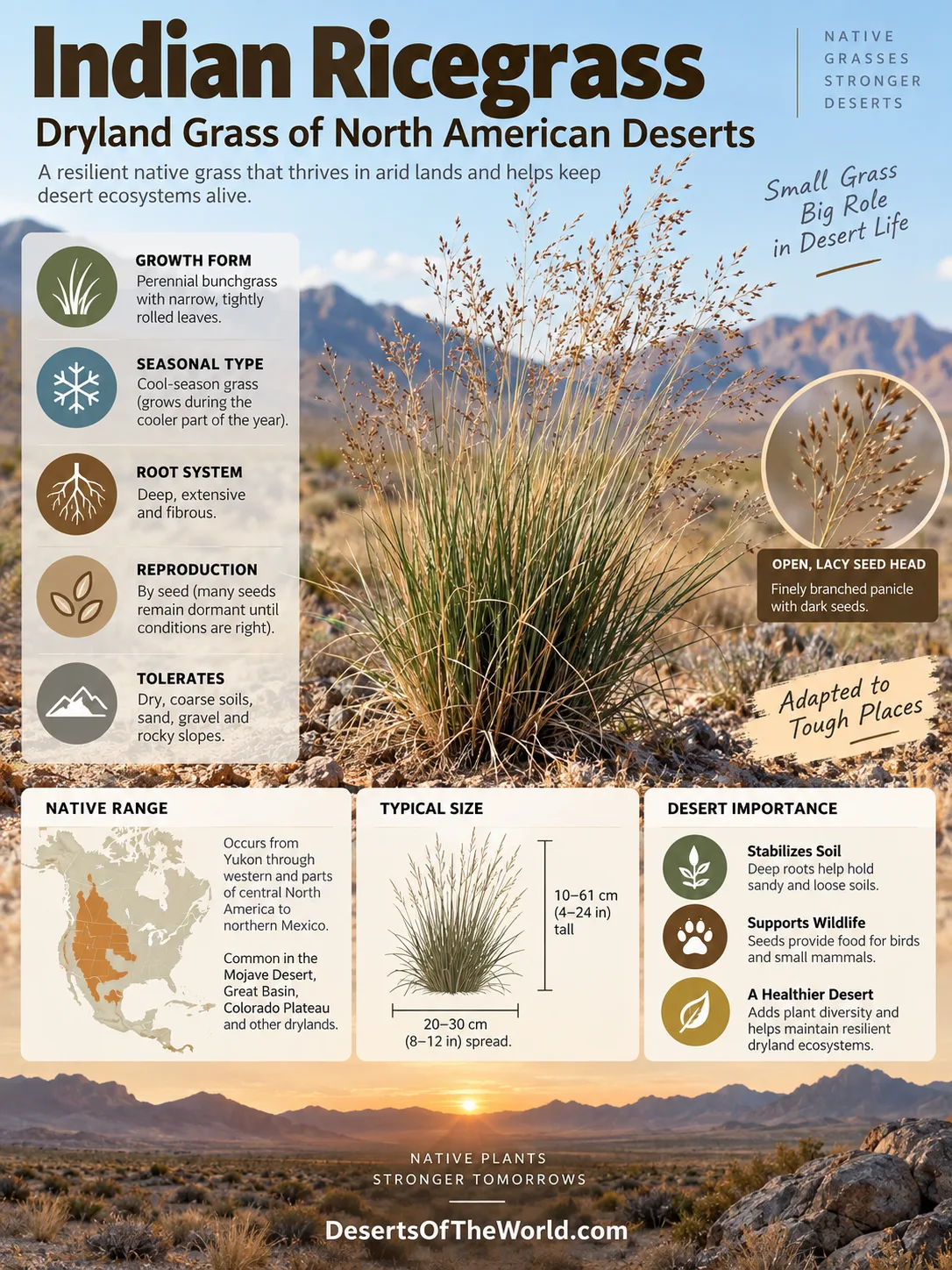
The species occurs across a much larger area than the deserts alone, extending from Yukon through western and parts of central North America to northern Mexico. Its desert presence is especially relevant in the Mojave Desert, Great Basin, Colorado Plateau drylands, salt-desert shrub communities, and sandy or gravelly parts of the Intermountain West.
Indian ricegrass does not survive by storing water in fleshy tissues. Its strategy is different: grow during the cooler part of the year, develop an extensive root system, tolerate dry coarse soils, and keep many seeds dormant until conditions favor establishment.
| Characteristic | Indian Ricegrass |
|---|---|
| Common name | Indian ricegrass |
| Accepted scientific name in Kew Plants of the World Online | Eriocoma hymenoides |
| Scientific name still widely used by U.S. agencies | Achnatherum hymenoides |
| Family | Poaceae |
| Growth form | Perennial bunchgrass |
| Seasonal type | Cool-season grass |
| Photosynthetic pathway | C3 |
| Typical height | About 10–61 cm (4–24 in), with regional variation |
| Typical plant spread | About 20–30 cm (8–12 in) |
| Root system | Deep, extensive and fibrous |
| Common dryland substrates | Sand, sandy loam, gravelly ground, rocky slopes and other well-drained soils |
| Reproduction | Seed |
Taxonomy and Field Identification
The scientific naming of Indian ricegrass deserves a short explanation because reputable references do not all display the same genus. Kew’s current taxonomic backbone accepts Eriocoma hymenoides and lists Achnatherum hymenoides as a synonym. U.S. Forest Service, National Park Service, USDA and other American resources still commonly use Achnatherum hymenoides. Older literature may also place it under Oryzopsis hymenoides or Stipa hymenoides.
These names refer to the same familiar North American bunchgrass. The common name comes from the relatively large seeds, which resemble small grains.
The Tight Leaf Bunch
Indian ricegrass grows from a dense basal clump rather than forming a continuous turf. Its leaves are narrow, stiff and commonly rolled inward along their length. Mature plants often look like a fountain of fine green or straw-colored leaves emerging from one compact crown.
This bunch-forming habit leaves open soil between individual plants, a normal pattern in many arid shrublands where vegetation does not form a closed ground layer.
The Open, Lacy Seed Head
The inflorescence is the easiest field mark when present. Thin branches spread widely from the flowering stem, producing an open, diffuse panicle. The fine branchlets make the upper part of the plant look almost transparent from a distance.
Mature florets become dark brown to nearly black and are associated with pale hairs. After seeds fall, papery glumes can remain on the panicle, so an old plant may retain its distinctive open seed-head structure well beyond the flowering period.
Distinguishing It From Similar Bunchgrasses
Needle-and-thread grass can occupy some of the same sandy environments, yet its mature seed structures look quite different. Indian ricegrass is identified more readily by its broad, airy panicle and comparatively rounded dark seed units rather than the conspicuous long, threadlike awns associated with needle-and-thread.
| Feature | Indian Ricegrass | Needle-and-Thread Type Grasses |
|---|---|---|
| Overall growth | Dense bunch | Dense bunch |
| Leaves | Narrow and commonly tightly rolled | Narrow, but identification depends more heavily on reproductive structures |
| Seed head | Very open, finely branched panicle | More conspicuous awned seed structure |
| Best field clue | Wide, lace-like panicle | Long awns on mature florets |
How Indian Ricegrass Lives in Dry Desert Country
Indian ricegrass is drought tolerant, but calling it simply a drought-tolerant grass hides the more interesting part of its ecology. Several traits operate together, and some deal with when the plant grows rather than how much heat it can endure.
Cool-Season Growth Avoids Peak Summer Stress
Indian ricegrass is a cool-season C3 perennial. Growth can begin while temperatures are still mild, allowing the plant to use late-winter and spring moisture before the most severe part of the summer dry period.
U.S. Forest Service observations show that flowering generally occurs before summer drought. In Nevada desert observations, flowering followed spring rains but did not necessarily restart after summer rain, showing how strongly its reproductive cycle can be tied to cooler seasonal conditions.
Zion National Park describes the same pattern in simpler terms: Indian ricegrass greens with spring moisture and can become dormant during summer. Dormancy reduces the need to keep actively growing leaves functioning through the driest part of the year.
The plant’s desert strategy is therefore based partly on timing. It does much of its growth and reproduction while temperatures and soil moisture are more favorable.
A C3 Grass in a Landscape With C4 Neighbors
Many warm-desert grasses use C4 photosynthesis, which performs well under high temperatures. Indian ricegrass uses the C3 pathway instead. U.S. Geological Survey research has specifically classified it as a C3 perennial in studies of Mojave Desert grasses.
That distinction fits its seasonal behavior. Indian ricegrass is active early, while warm-season C4 grasses such as some galleta grasses can make greater use of warmer growing periods. The two strategies allow different perennial grasses to occupy the same broad dryland landscape while responding differently to seasonal moisture and temperature.
Deep, Extensive Fibrous Roots
Below ground, Indian ricegrass develops a large fibrous root system. Rather than relying on one thick water-storing organ, numerous roots explore a broad volume of soil for moisture.
This is especially useful in coarse desert substrates where water can move downward quickly after rainfall. Sandy soil may hold less water near the surface than finer soil, so access to a larger soil volume helps an established perennial persist between wet periods.
Narrow Rolled Leaves
The leaf blades are narrow and strongly rolled or involute. This gives the plant relatively little exposed leaf area compared with broad-leaved vegetation. Rolled leaves are common among grasses occupying dry, exposed environments, and in Indian ricegrass they accompany its seasonal dormancy and extensive roots rather than acting as a stand-alone drought solution.
Where Indian Ricegrass Grows in North American Deserts
Indian ricegrass is not restricted to deserts. Kew records its native distribution from Yukon south through western and central parts of the United States into northern Mexico. Within that broad range, it becomes a familiar grass of several arid and semi-arid landscapes.
Mojave Desert
The Bureau of Land Management includes Indian ricegrass among the native plants of the Mojave Desert. Here it occurs in a landscape where annual rainfall is low, summers are hot, and soils can be coarse, rocky or sandy.
Its presence in the Mojave also illustrates an important point about desert grasses. Not every successful warm-desert plant needs to carry out most of its growth during extreme heat. Indian ricegrass can use the cooler portion of the Mojave growing season and reduce above-ground activity as summer conditions become harsher.
Great Basin Desert
Indian ricegrass is strongly associated with dry Intermountain landscapes, including parts of the Great Basin Desert. It can occur among sagebrush, shadscale, winterfat and other vegetation characteristic of cold-desert and salt-desert shrub communities.
The Great Basin adds winter cold to the usual challenges of aridity. A cool-season perennial is well suited to exploit moisture when temperatures rise enough for growth in spring but before the dry summer has fully developed.
Colorado Plateau and Canyon Country
Indian ricegrass is also common in the dry country of Utah, Arizona, Colorado and New Mexico, including sections of the Colorado Plateau. National Park Service records place it in landscapes associated with blackbrush and shadscale, while USDA soil descriptions record it with galleta grass, fourwing saltbush, sand dropseed and other dryland plants.
It can occupy sandy benches, open shrublands, canyon country, dry slopes and pinyon-juniper transitions. The species therefore crosses several vegetation zones rather than belonging to one narrowly defined desert community.
| Dryland Region | Typical Setting | Plants Commonly Associated With the Same Broad Communities |
|---|---|---|
| Mojave Desert | Dry sandy or rocky desert terrain and open shrubland | Blackbrush and other Mojave shrubs and grasses |
| Great Basin Desert | Cold-desert shrublands, sandy plains, slopes and open sagebrush country | Sagebrush, shadscale, winterfat, squirreltail |
| Colorado Plateau | Sandy benches, canyon country, semi-desert shrubland and open uplands | Galleta grass, blackbrush, shadscale, fourwing saltbush |
| Desert-to-Woodland Transition | Higher or somewhat cooler dry sites | Pinyon-juniper and open ponderosa pine communities in parts of its range |
Why Sandy Ground Suits Indian Ricegrass
Indian ricegrass is especially associated with coarse, well-drained ground. Sandy and gravelly sites are common habitat, although the species can occur on a wider range of soils when local moisture conditions permit.
This relationship with sand is more interesting than simple drought tolerance. Moving sand can partly bury a small grass, change the position of the soil surface and cover portions of its lower stems.
Adjusting to Shifting Sand
Indian ricegrass has a structural response that helps it persist on unstable sandy sites. Botanical work summarized by USDA sources describes plants responding to burial by elongating basal internodes and forming adventitious roots from buried nodes. New roots can therefore develop where portions of the plant come into contact with freshly deposited sand.
That makes the species well matched to sandy drylands where the ground surface is not completely fixed. It also helps explain its occurrence on blowouts and loose sand as well as more stable sandy soils.
Drainage Matters More Than Simply Having Dry Soil
Good drainage is a recurring feature of Indian ricegrass habitat. A plant adapted to drought is not automatically suited to waterlogged ground. Coarse soils drain rapidly and maintain the aerated root conditions typical of its natural sites.
The species also occurs in salt-desert vegetation and can tolerate some saline conditions, yet it should not be treated as an extreme salt specialist. Its range includes neutral and mildly alkaline or mildly saline soils as well as many non-saline sandy sites.
Seed Dormancy Spreads Germination Across Better Years
The seed biology of Indian ricegrass is one of its most useful desert adaptations. Producing a seed does not mean producing a seedling at the next rainfall.
Indian ricegrass seeds can remain dormant because germination is restricted by more than one mechanism. Research on the species has described both mechanical constraints around the seed and physiological dormancy within the seed. Fresh seed can therefore remain viable without germinating immediately.
Mechanical and Physiological Dormancy
The hard lemma and palea surrounding the seed can physically restrict germination. At the same time, newly produced seed may possess physiological dormancy that gradually changes during storage or after exposure to suitable environmental conditions.
Different seeds within the same population can also vary in size, structure and degree of dormancy. A single seed crop therefore does not behave like a batch of agricultural grain designed to germinate uniformly.
For a desert grass, that irregularity can be useful. If every seed germinated after the first small rain, an abrupt return to dry conditions could remove much of a year’s recruitment. Dormancy spreads opportunity through time.
Wet Springs Can Produce Recruitment Pulses
Field observations compiled by the U.S. Forest Service show that numerous Indian ricegrass seedlings can appear during wet springs while establishment may be sparse during dry springs. April precipitation has also been associated with changes in abundance in parts of its range.
This produces a population pattern familiar in deserts: mature plants may persist through many ordinary seasons, while successful recruitment arrives in pulses during unusually favorable moisture windows.
Dormant Seeds Can Remain Viable for Years
Storage research illustrates how persistent Indian ricegrass seed can be. U.S. Forest Service summaries report viable seed after at least 14 years of cool, dry storage, and one cited test recorded germination from a portion of seed stored for 20 years.
Those storage results should not be read as a fixed lifespan for every seed buried in desert soil. Field conditions vary greatly. They do show that delayed germination is a real part of the species’ biology rather than a short pause after seed fall.
The Seasonal Cycle From Green Growth to Summer Dormancy
The timing of Indian ricegrass changes with elevation, latitude, precipitation and local temperature, so a single calendar cannot describe every population. The general sequence is more useful.
| Seasonal Stage | Typical Response |
|---|---|
| Late winter to early spring | Established plants begin active growth as conditions become suitable |
| Spring | Leaf production increases and flowering stems develop |
| Late spring to early summer | Open panicles mature and seeds develop |
| Dry summer period | Above-ground growth declines and plants may become dormant |
| Following cool, moist periods | Established plants resume growth; some dormant seeds may become capable of germinating |
Flowering dates vary markedly across the range. Pipe Spring National Monument in the Southwest records flowering from April to June, while Forest Service records from cooler states place flowering later, extending into July in some locations. In favorable years, flowering can continue longer than the usual early-season pattern.
Indian Ricegrass in the Desert Food Web
A bunch of Indian ricegrass is more than vegetation between shrubs. Its green shoots and seeds enter several dryland food chains.
The plant can produce fresh growth earlier than many other native grasses, making its leaves available during late winter and spring in some western ranges. Its foliage is eaten by wild herbivores as well as grazing animals.
The seeds are especially useful to smaller animals. U.S. Forest Service records describe Indian ricegrass seed consumption by kangaroo rats, pocket mice, deer mice and other rodents, while several bird species feed on seeds that fall to the ground.
Rodents Can Both Eat and Move the Seeds
Seed-eating rodents do not always consume every seed immediately. Some cache seeds underground. That behavior can move Indian ricegrass seed into small buried microsites where moisture and temperature conditions differ from the exposed soil surface.
Research summarized by the Forest Service has linked rodent caching with favorable conditions for seedling recruitment. The relationship is therefore not simply plant versus seed predator; some seeds that are transported and left uneaten may end up in suitable places for later germination.
Documented Indigenous Food Use
The relatively large seeds also have a documented human history. National Park Service and USDA sources record the collection of Indian ricegrass seeds by Indigenous peoples of western North America.
At Pipe Spring National Monument, the National Park Service notes use by Paiute people and other Native American communities, with seeds ground into flour or meal. Other ethnobotanical records document seed use among several peoples of the Great Basin and Southwest.
This history also explains why the plant’s grain-like seed has attracted more attention than the tiny seeds of many neighboring desert grasses.
Erosion Control and Dryland Restoration
Indian ricegrass is used in restoration because it is native across a large part of western North America, grows on dry coarse soils and develops an extensive root system. U.S. agencies have included it in revegetation work on arid and semi-arid land, and the National Park Service continues to collect native Indian ricegrass seed for restoration programs in western parks.
Useful on Sandy Ground, but Not a Complete Dune Stabilizer
Its association with sand can lead to an overly broad claim that Indian ricegrass simply “stabilizes dunes.” The ecological picture is narrower.
Forest Service assessments describe the species as useful for surface erosion control and desert revegetation while also noting that it is not especially effective at stopping active sand movement by itself. Sparse bunches do not create the continuous surface cover needed to immobilize every moving dune.
Its value is better understood as one component of a native plant community on suitable sandy sites.
The Same Dormancy That Helps in Nature Can Complicate Restoration
Seed dormancy benefits wild populations by delaying germination, but restoration projects often seek predictable establishment within a limited period. That creates a practical mismatch.
Indian ricegrass seed lots may contain seeds with different dormancy levels, and emergence can be uneven. Cold, moist conditions can reduce part of the physiological dormancy, while mechanical restrictions around the seed can remain. This helps explain why seeded stands sometimes develop slowly even where the mature species is well adapted to local climate and soil.
Modern restoration programs also pay close attention to seed origin. Populations across the species’ large geographic range are not identical, and using plant material suited to local environmental conditions can matter for long-term establishment.
Responses to Fire and Grazing Vary With Timing and Site
Indian ricegrass does not have one universal response to disturbance. Fire studies have produced outcomes ranging from limited damage to reduced plant cover, depending on season, fire conditions and the vegetation community.
After fire, Indian ricegrass can reappear from seed dispersed from nearby surviving populations. Some studies have also recorded relatively rapid post-fire growth. The U.S. Forest Service therefore treats its fire response as variable rather than assigning the species a simple “fire resistant” or “fire sensitive” label.
Early-Season Grazing Can Affect Reproduction
The tender early growth that makes Indian ricegrass attractive as forage can also expose plants to pressure during the same period when they are producing leaves and flowering stems. Several western studies have linked heavy early-spring grazing with reduced plant vigor, basal area or seed production.
Other long-term studies have found weaker grazing effects in some locations. Local rainfall, grazing season, intensity and existing plant condition all change the response, so observations from one desert range should not automatically be applied to the entire native distribution.
Drought Tolerance Does Not Mean Unlimited Drought Resistance
Indian ricegrass can persist in very dry environments, yet it still depends on moisture arriving during useful parts of its seasonal cycle.
A recent Colorado Plateau field experiment compared the C3 Indian ricegrass with the warm-season C4 grass Pleuraphis jamesii under several years of altered seasonal precipitation followed by recovery years. Indian ricegrass showed less flexibility in its seasonal development and greater mortality under the experimental drought treatments than the C4 comparison species.
The result does not mean Indian ricegrass is poorly adapted to deserts. It shows that desert adaptation is tied to a particular moisture schedule. A cool-season grass can tolerate low annual precipitation while still responding strongly when cool-season moisture becomes scarce.
This distinction matters in North American drylands because total yearly rainfall alone does not describe the water available to plants. A centimeter of rain arriving during a useful cool growing period can have a different biological effect from the same amount falling during hot weather when a cool-season species is largely dormant.
What Indian Ricegrass Reveals About North American Desert Vegetation
Indian ricegrass shows why desert vegetation cannot be understood only by looking for water-storing plants. Its leaves are thin, its seed heads are delicate, and it has none of the fleshy tissues associated with cacti or many succulents.
Its adaptations operate through another combination: cool-season activity, extensive fibrous roots, tolerance of coarse dry substrates, the ability to respond to sand burial, and seeds that do not all germinate at once.
That combination allows the grass to occupy environments ranging from the warm Mojave to the colder Great Basin and the elevated drylands of the Colorado Plateau. The same species can appear beside blackbrush in one landscape, shadscale in another, and pinyon-juniper vegetation farther upslope.
The open spaces between desert shrubs can therefore contain a perennial grass with a life cycle closely tuned to short periods of favorable moisture. When spring conditions cooperate, Indian ricegrass grows, flowers and sets seed. When the landscape dries, established plants reduce activity while another part of the population remains below ground as dormant seed, waiting for a more suitable season.
Sources
- Royal Botanic Gardens, Kew – Plants of the World Online: Eriocoma hymenoides (accepted scientific name, synonyms and native distribution)
- U.S. Forest Service – Fire Effects Information System: Indian Ricegrass (botany, seasonal growth, seed ecology, wildlife use, fire, grazing and restoration)
- Bureau of Land Management – Mojave Desert Native Plants Guide (Mojave Desert occurrence and native-plant context)
- National Park Service – Zion National Park: Native Desert Grasses (summer dormancy, spring growth, seed characteristics and desert habitat)
- National Park Service – Pipe Spring National Monument: Rice Grass (flowering period and documented Indigenous seed use)
- Oregon State University Extension – Northern Great Basin Grass Identification (field identification, leaf form and seed-head characteristics)
- U.S. Geological Survey – Root Growth and Function of Three Mojave Desert Grasses (C3 classification and Mojave Desert physiology)
- PubMed Central – Seasonal and Multiyear Drought Responses in Southwestern Perennial Grasses (Colorado Plateau drought experiment comparing Indian ricegrass with a C4 dryland grass)