
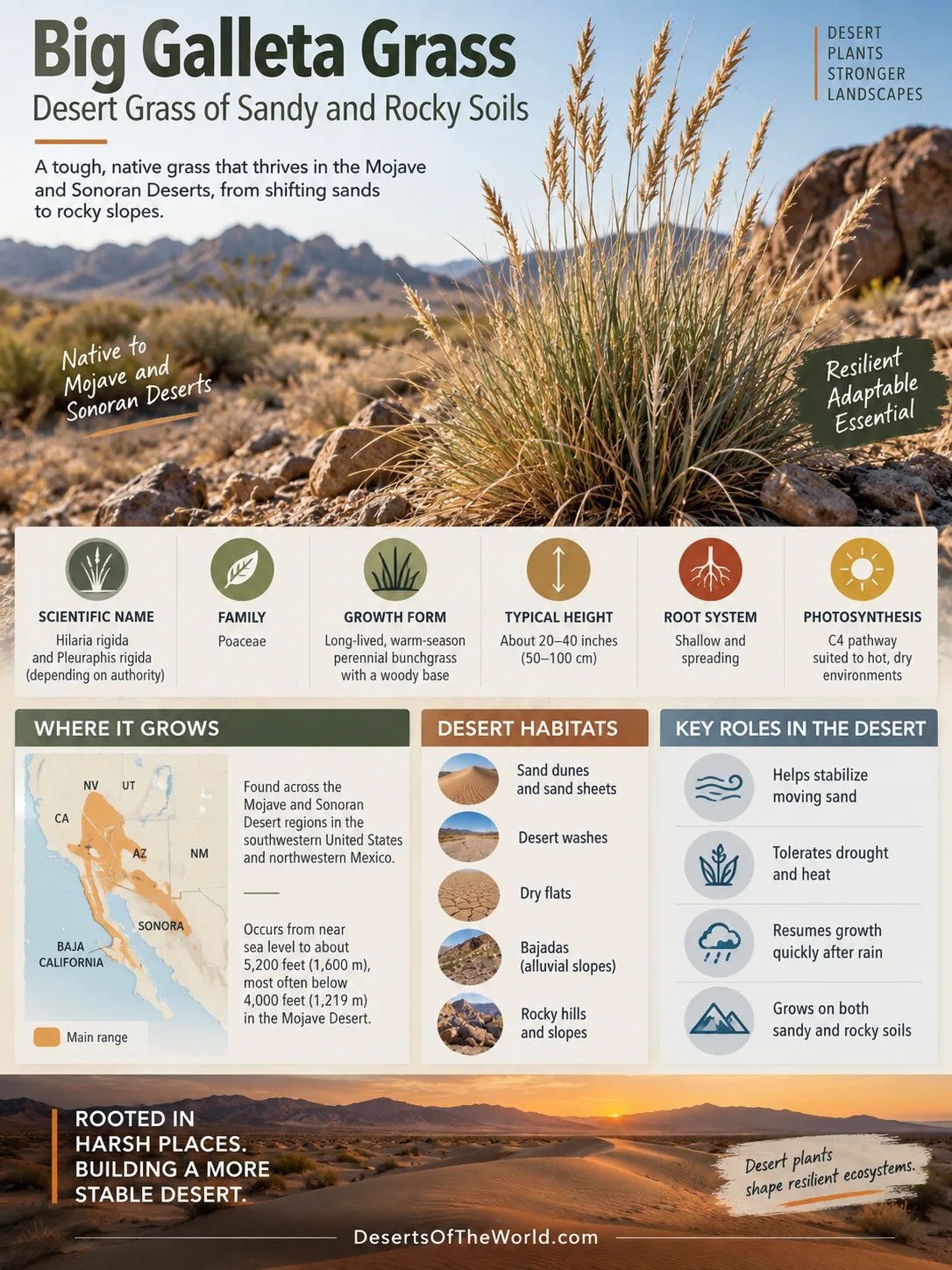
Big galleta grass is one of the native perennial grasses able to form conspicuous clumps across parts of the Mojave and Sonoran Deserts. It is especially associated with open desert ground where water disappears quickly: dunes, sandy washes, dry flats, bajadas, gravelly slopes, and rocky hills. Unlike many desert plants that depend on a narrow substrate type, big galleta can occupy both loose sand and stony terrain.
Its success comes from a combination of traits rather than one extreme adaptation. Big galleta is a warm-season C4 grass with a hard rhizomatous base, a shallow spreading root system, strong drought tolerance, and the ability to resume growth rapidly when rain returns. On sandy ground, its clumped form and underground growth also help slow moving sand and stabilize exposed surfaces.
| Feature | Big Galleta Grass |
|---|---|
| Scientific names | Hilaria rigida and Pleuraphis rigida, depending on the taxonomic authority |
| Family | Poaceae |
| Growth form | Long-lived, warm-season perennial bunchgrass with a woody, rhizomatous base |
| Typical height | About 20–40 inches (50–100 cm) in the USDA plant description |
| Root pattern | Shallow and spreading |
| Main habitats | Sand dunes, washes, dry flats, bajadas, plains, stabilized sand sheets, rocky slopes, and desert hills |
| Photosynthesis | C4 pathway suited to hot, dry environments |
| Main desert range | Mojave and Sonoran Desert regions of the southwestern United States and northwestern Mexico |
| Typical reproduction | Vegetative spread through rhizomes and tillers, with additional reproduction by seed |
Scientific Name and Botanical Placement
Big galleta belongs to the grass family, Poaceae. Its scientific name can look confusing because major botanical and land-management sources do not all use the same genus.
Scientific-name note: Kew’s Plants of the World Online accepts Hilaria rigida. USDA Natural Resources Conservation Service publications and many U.S. desert restoration documents use Pleuraphis rigida. Both names refer to big galleta grass.
The difference matters when looking through field records, ecological studies, or restoration documents. An older or agency-specific source may place the species in Pleuraphis, while another botanical database may list it under Hilaria.
Big galleta can also hybridize naturally with James’ galleta, commonly listed as Hilaria jamesii or Pleuraphis jamesii. First-generation hybrids may backcross with either parent. That helps explain why individual plants in areas where both species occur can sometimes show intermediate features.
Where Big Galleta Grows in the Mojave and Sonoran Deserts
Big galleta is centered on the hot desert landscapes of southwestern North America. USDA records place it in the Mojave and Sonoran Desert regions of southern California, Nevada, southern Utah, Arizona, New Mexico, Sonora, and Baja California. More recent Mojave Desert plant records are especially concentrated in southern California, Arizona, Nevada, and northwestern Mexico.
Its distribution follows suitable desert climate and terrain rather than a single landscape form. A plant may be growing in fine windblown sand in one location and among gravel and exposed rock in another.
Big galleta has been documented from near sea level to roughly 5,200 feet (1,600 m). Within the Mojave Desert, it occurs most often below about 4,000 feet (1,219 m), placing much of its habitat within hot lowland and lower-elevation desert environments.
Dunes, Washes, Bajadas, and Rocky Hills
The species occupies several landforms that handle water in very different ways:
- Sand dunes and sand sheets: loose mineral surfaces with rapid drainage and frequent wind movement.
- Desert washes: normally dry channels that receive short pulses of runoff after rain.
- Dry flats: open low-relief terrain exposed to high solar heating.
- Bajadas: broad aprons of sediment at mountain fronts, usually formed where neighboring alluvial fans merge.
- Rocky slopes and hills: sites where soil may occur mainly between stones, fractures, and patches of gravel.
This habitat range is one reason big galleta is more useful as an indicator of hot arid conditions than of one exact soil texture.
Why Big Galleta Can Grow in Sandy and Rocky Soils
Big galleta is strongly associated with sand, but calling it only a sand-dune grass would be misleading. Federal Mojave Desert plant material describes populations growing on loam, sandy loam, sand, bedrock, and rocky substrates. The same material reports a soil pH tolerance of approximately 6.5 to 8.7.
USDA’s earlier plant guide describes big galleta as occurring across a broad range of soil textures. More detailed Mojave restoration material adds an important distinction: the grass can occur across that wide range but tends to perform poorly on heavy clay soils.
| Ground Type | Main Physical Challenge | How Big Galleta Fits the Site |
|---|---|---|
| Loose sand | Rapid drainage, wind movement, unstable surface | Clumped growth, rhizomes, and spreading roots help maintain the plant and trap moving sand |
| Sandy wash | Long dry periods interrupted by short runoff events | Rapid growth response allows the grass to use temporary soil moisture |
| Bajada | Coarse alluvial sediment with fast infiltration | Drought tolerance allows persistence between irregular rainfall events |
| Gravel and rock | Limited fine soil, strong surface heating, and low water storage | Roots spread through available soil spaces rather than depending on a deep, permanently moist layer |
| Heavy clay | Slow drainage and different soil-water behavior | Recorded as a less favorable substrate in Mojave plant-material guidance |
Big Galleta on Windblown Sand
Some of the clearest big galleta landscapes occur on semi-active dunes and sand sheets. USDA ecological-site descriptions from the Mojave region document places where it becomes the dominant perennial grass on very deep fine sands formed from windblown deposits.
Sand presents two problems at once. Water moves downward quickly, while the surface itself can move sideways under wind. Big galleta does not solve this by growing a massive deep taproot. Its root system is described instead as shallow and spreading.
The plant forms a persistent base while roots and rhizomes occupy the surrounding surface soil. Above ground, the dense clump interrupts wind near the ground. Sand can accumulate around the plant rather than continuing across an entirely bare surface.
Big Galleta on Rocky and Gravelly Ground
Rocky desert soil creates a different water problem. Rain may infiltrate quickly through gravel or run across exposed stone, while usable fine soil occurs in irregular pockets. Surface temperatures can also rise rapidly in direct sun.
Big galleta can occupy these sites because it does not require permanently moist soil or a deep layer of fine sediment. Its spreading root system can exploit available moisture after rain, and the established perennial base remains in place during the dry interval that follows.
This flexibility allows the same species to appear on a sandy desert flat, a gravel-covered bajada, and a rocky hillside without each site functioning in exactly the same way.
How Big Galleta Handles Desert Heat and Drought
Big galleta survives hot desert conditions through several linked traits. Heat-tolerant photosynthesis allows active growth during warm periods. Its roots can use water from drying surface soil. Rhizomes preserve living tissue below the exposed shoots. When rainfall returns, the plant can shift from a dry-looking clump to active growth without beginning again from a new seedling.
C4 Photosynthesis in High Temperatures
Big galleta uses the C4 photosynthetic pathway, a common adaptation among warm-season grasses living in hot environments. C4 plants concentrate carbon dioxide within specialized leaf tissues before it enters the main carbon-fixation cycle.
This reduces photorespiration, which becomes more costly for many C3 plants as temperatures rise. In practical desert terms, big galleta can maintain active photosynthesis under high temperatures while keeping water loss relatively low for the amount of carbon it fixes.
C4 metabolism does not make the grass independent of water. Growth still follows moisture availability closely. It simply allows the plant to use warm conditions more effectively once water is available.
Shallow Roots and a Rhizomatous Base
Many desert-plant descriptions focus on deep roots, but big galleta follows another strategy. USDA describes its roots as shallow and spreading. This places much of the root system where short rainfall events can temporarily wet desert soil.
The base of the plant is hard, somewhat woody, and rhizomatous. Rhizomes are underground stems capable of producing new shoots. They let an established clump maintain and expand living tissue without depending entirely on successful seed germination.
That matters in a place where the surface can become suitable for germination after rain and then dry again before a young seedling has developed enough roots to survive.
Growth Follows Desert Rainfall Pulses
Big galleta does not follow a single rigid growing season throughout its range. Rainfall timing changes across the Mojave and Sonoran Deserts, and the grass responds accordingly.
Federal Mojave plant research describes two main periods of growth associated with the region’s winter precipitation and summer monsoon moisture. Flowering is also strongly responsive to rainfall.
The USDA plant guide gives a broad flowering period from February through September depending on location. Mojave-focused records show that flowering can occur after rain outside that interval as well, although specimens with flowers are especially common from roughly February through June in the Mojave.
| Desert Condition | Typical Plant Response |
|---|---|
| Extended dry period | Growth slows and older shoots may dry while the perennial base persists |
| Winter rainfall | Soil moisture can trigger renewed vegetative growth |
| Warm-season rain | Rapid growth may follow when temperature and moisture coincide |
| Suitable post-rain period | Flowering and seed development can occur |
| Return of dry conditions | Above-ground activity declines while established underground structures remain |
How to Recognize Big Galleta Grass
A mature big galleta plant usually looks more substantial than a soft lawn-type grass. It forms a coarse perennial clump that can appear almost shrub-like, particularly when old stems remain around the woody base.
Useful identification features include:
- A dense, perennial bunchgrass form.
- A hard, woody, rhizomatous base.
- Numerous firm stems that may grow upright or spread outward.
- Narrow leaves, with woolly or felted tissue often visible around parts of the lower stems and leaf sheaths.
- A dense, narrow flower spike at the end of the stem.
- Spikelets arranged in groups of three at the nodes of the flowering structure.
- A distinctive zigzag rachis left behind after the mature spikelet units detach.
The zigzag seed stalk is especially useful on a mature dry plant. Once the reproductive units have fallen, the exposed central axis has a jointed, angular appearance rather than a smooth continuous spike.
Big Galleta and James’ Galleta
Big galleta should not automatically be treated as the same species as James’ galleta. They are close relatives, and both names may appear in older material simply as “galleta.”
The distinction becomes more complicated because the two species can hybridize where their ranges overlap. Intermediate plants can occur, and those hybrids may reproduce again with either parent species. For casual desert identification, habitat, plant size, stem texture, and reproductive structures should therefore be considered together rather than relying on the common name alone.
Big Galleta in Desert Plant Communities
Big galleta can occur as scattered clumps, but in favorable terrain it may become a dominant or co-dominant perennial grass. Named vegetation communities containing big galleta occur in the Mojave Desert, including grasslands, shrub-grass mosaics, and Joshua tree settings.
Plants recorded with it include:
- creosote bush (Larrea tridentata)
- white bursage (Ambrosia dumosa)
- Joshua tree (Yucca brevifolia)
- Mojave yucca (Yucca schidigera)
- ocotillo (Fouquieria splendens)
- desert globemallow (Sphaeralcea ambigua)
- brittlebush (Encelia farinosa)
- ephedra species
- Indian ricegrass (Achnatherum hymenoides)
- bush muhly (Muhlenbergia porteri)
The mix changes with elevation, soil, rainfall, and desert region. A sandy lowland dominated by big galleta will not have the same plant community as a rocky slope containing scattered clumps.
What Big Galleta Does in the Desert Ecosystem
Big galleta affects the ground around it as well as occupying it. A mature clump changes wind speed near the soil surface, provides physical cover, holds plant litter, and creates a different microenvironment from the adjacent bare ground.
Holding Moving Sand on Open Ground
The combination of a clumped growth form, spreading roots, and rhizomes makes big galleta useful on sandy desert surfaces. The shoots interrupt wind close to the ground while underground growth holds portions of the surface layer in place.
USDA ecological-site descriptions specifically note its ability to stabilize blowing sand. Big galleta can also colonize disturbed sandy ground and dunes in the Mojave and Sonoran Deserts.
This does not mean every dune becomes fixed when big galleta appears. Dune movement depends on wind, sediment supply, plant cover, and other local conditions. The grass acts locally, forming patches where moving sediment encounters living vegetation.
A Nurse Plant for Desert Seedlings
Established big galleta clumps can create microsites used by other desert plants. Studies have documented this nurse-plant relationship with desert agave, cholla, and California barrel cactus.
In one desert agave study, seedlings occurred almost entirely beneath big galleta canopies, especially around the center and north-facing portions of the grass clumps. Soil nitrogen beneath big galleta was measured at about 60% higher than soil beside exposed agave seedlings in that study.
The grass canopy can also reduce direct exposure around a young cactus or agave. The relationship is not necessarily permanent. A cactus that grows above the grass may later cast enough shade to reduce the big galleta beneath it.
Food and Cover for Desert Animals
Fresh big galleta growth can be more palatable than its older, rigid stems. The grass is used by grazing mammals and also provides structural cover for small mammals and birds.
It occurs in bighorn sheep habitat and has been recorded in their diet. Research has also documented its use by the Mojave desert tortoise, although the amount eaten differs strongly among locations. That variation is expected in a desert herbivore whose available food changes with rainfall, season, and local vegetation.
The grass is now included in restoration work aimed at improving native desert-tortoise habitat as well as revegetating disturbed Mojave Desert ground.
Why Rhizomes Matter More Than Seedlings
Big galleta can reproduce by seed, and its seeds can be dispersed by wind and animals. Yet established populations rely heavily on vegetative reproduction through rhizomes and tillers.
That distinction is well suited to desert conditions. Seed production can be low, the seed bank appears to be short-lived, and natural seedling establishment has been described as uncommon. A rhizome does not face the same starting conditions as a newly germinated seed: it remains connected to an established perennial plant with an existing root system.
Vegetative growth therefore helps maintain clumps across repeated dry periods even when a particular year produces few surviving seedlings.
Life Below the Big Galleta Clump
The soil beneath a desert bunchgrass is not simply bare mineral material with roots passing through it. Mojave Desert research has found big galleta associated with mycorrhizal fungi, microorganisms that form relationships with plant roots.
Soil collected near the base of big galleta in one Mojave study had a mycorrhizal inoculum potential close to 50%. This measurement reflects the presence and activity of fungal propagules rather than meaning that half of the soil was fungal material.
Together with trapped litter, altered shade, and root activity, these belowground relationships help explain why the soil immediately beneath a mature grass clump can differ from the open desert surface only a short distance away.
How Big Galleta Responds to Fire and Disturbance
Fire response in big galleta depends on the plant’s condition when burning occurs. Dry plants may suffer heavy damage to above-ground shoots and living centers. Green plants can receive less severe damage, and surviving plants may resprout from rhizomes.
Vegetation structure also matters. Many big galleta communities are naturally open, leaving gaps between plants that can limit continuous fuel. Dense grass in swales or other favorable sites can create a more connected layer of dry vegetation.
Recovery after disturbance should therefore not be described with a simple label such as fire-tolerant or fire-sensitive. Plant moisture, fire intensity, surviving rhizomes, subsequent rainfall, and the condition of the surrounding desert vegetation can all change the result.
Why Big Galleta Is Used in Desert Restoration
Big galleta combines several traits useful in restoration: native desert origin, drought tolerance, perennial growth, rhizomatous spread, value as wildlife habitat, and an ability to occupy exposed sandy ground.
Federal restoration programs have continued evaluating the species for disturbed Mojave Desert landscapes and native plant-material development. It is also treated as a priority species in work associated with Mojave desert tortoise habitat.
Establishing a new stand is harder than the durability of an old clump might suggest. Seed heads may have poor fill, seeds do not all mature at the same time, and natural seedling establishment can be limited. Restoration results therefore depend heavily on seed quality, timing, soil conditions, and moisture after planting.
This contrast is part of the species’ desert strategy: an established big galleta clump can be remarkably persistent, while creating that established clump from seed is a much less predictable process.
Why Big Galleta Stands Out Among Desert Grasses
Big galleta occupies a position that few visitors associate with grasses. It can become one of the dominant perennial plants on open desert sand while also surviving in gravel, bedrock, and rocky hills. Its physiology is suited to heat, yet its growth is closely tied to short periods when desert soil contains usable water.
The grass also modifies the terrain it occupies. Mature clumps slow wind near the surface, catch sediment, provide animal cover, and create sheltered microsites used by other desert plants. Below ground, spreading roots and rhizomes allow one perennial plant to persist through conditions that make establishment difficult for new seedlings.
A dry big galleta clump can look inactive for much of the year. After suitable rain, the same plant can produce new foliage, flower, and resume its role in the surrounding desert community. That cycle makes big galleta a characteristic grass of sandy and rocky landscapes across the Mojave–Sonoran desert region.
Sources
- U.S. Bureau of Land Management — Mojave Desert Native Plants: Big Galleta (taxonomy, morphology, soils, climate, reproduction, ecology, wildlife interactions, and restoration)
- USDA Natural Resources Conservation Service — Big Galleta Plant Guide (plant description, distribution, habitat, C4 adaptation, roots, associated plants, and revegetation use)
- Royal Botanic Gardens, Kew — Hilaria rigida (accepted botanical name, classification, morphology, and distribution)
- USDA Forest Service — Pleuraphis rigida, Big Galleta (desert ecology, plant associations, fire response, succession, and wildlife use)
- USDA Ecological Site Description — Mojave Desert Sandy Ecological Site (fine-sand habitat, dune dynamics, vegetation composition, and big galleta dominance)
- USDA NRCS — Plant Materials Centers and the National Seed Strategy (ongoing evaluation of big galleta for native plant-material and restoration work)