
The Mojave and the Sonoran sit close enough on the map to look related, and they are. Both belong to the drylands of western North America. Both carry creosote flats, thorny shrubs, wide washes, and mountain-ringed basins. Still, on the ground they do not feel the same. The Mojave is usually the higher, cooler, more winter-shaped desert. The Sonoran is the warmer desert, built around bimodal rainfall and a broader mix of cactus, shrubs, and desert trees. Put simply: one is ruled more by winter moisture and frost, the other by heat, summer storms, and long growing windows.
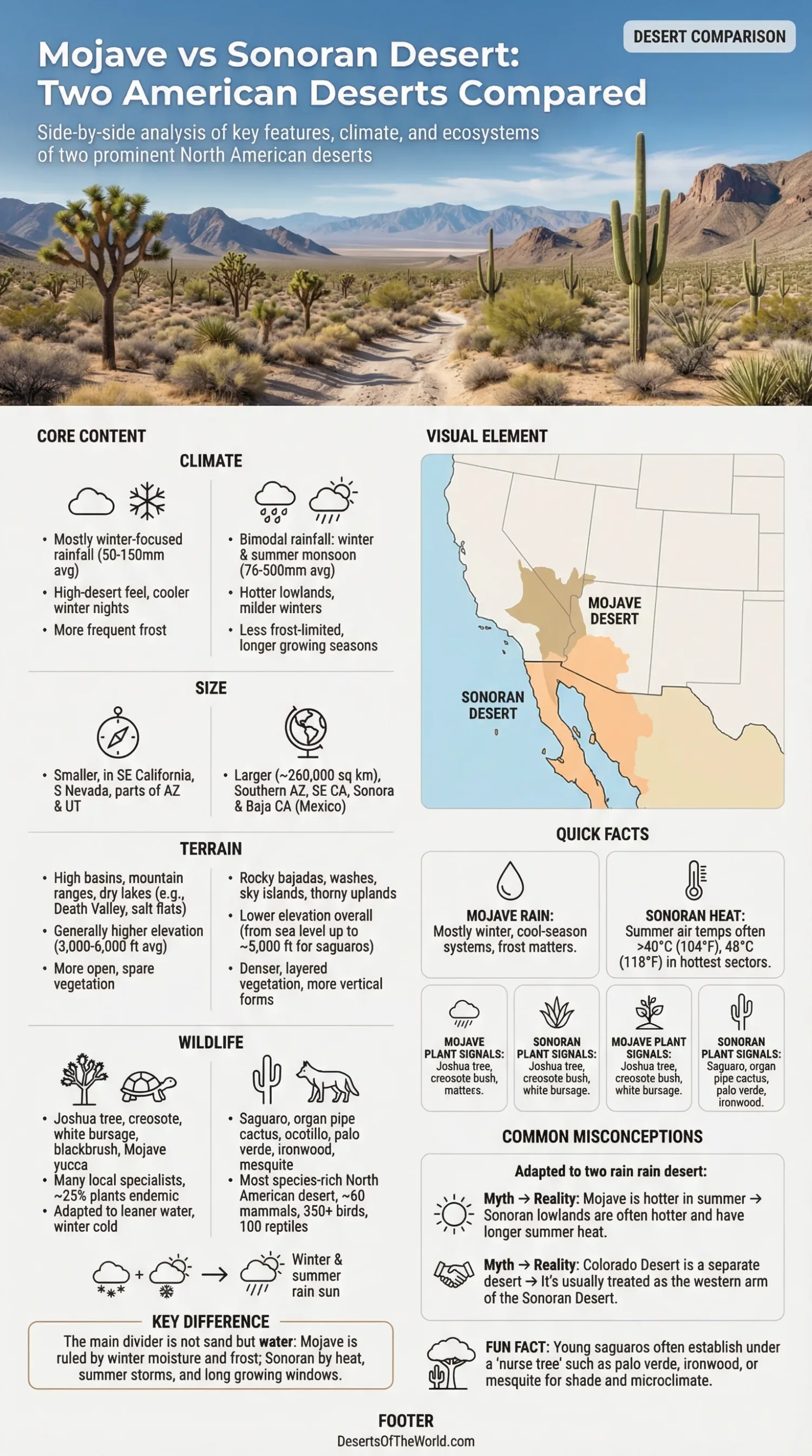
Mojave vs Sonoran Desert: Two American Deserts Compared
| Measure | Mojave Desert | Sonoran Desert |
|---|---|---|
| General Reach | Southeastern California with parts of Nevada, Arizona, and Utah | Southern Arizona, southeastern California, and large areas of Sonora and Baja California in Mexico |
| Overall Size | Smaller desert; published boundaries vary by map and method | Much larger desert; commonly placed around 260,000 square km, with broader definitions extending beyond that |
| Rain Pattern | Mostly winter-focused, with local summer influence in some eastern sections | Two rainfall seasons: winter rain plus summer monsoon storms |
| Typical Feel | High-desert look, colder winter nights, more frequent frost | Hotter lowlands, milder winters, denser cactus-and-tree structure in many areas |
| Plant Signals | Joshua tree, creosote bush, white bursage, Mojave yucca | Saguaro, organ pipe cactus, ocotillo, palo verde, ironwood, mesquite |
| Famous Landscapes | Death Valley, salt flats, broad basins, volcanic fields, Joshua tree woodlands | Saguaro slopes, rocky bajadas, desert washes, sky-island mountains, thorny uplands |
Where Each Desert Sits
The Mojave stays within the United States. Most of it lies in southeastern California and southern Nevada, with smaller parts reaching into Arizona and Utah. The Sonoran spreads wider and farther south. It covers much of southern Arizona, reaches into southeastern California, and extends across Sonora and much of the Baja California Peninsula.
That difference matters. The Mojave is more tightly linked to the rain-shadow interior of the American Southwest. The Sonoran opens toward the Gulf of California and subtropical moisture routes. Same broad region, different weather engine.
One more detail is worth knowing: the Colorado Desert of southern California is not a separate desert in the same way the Mojave is. It is usually treated as the western arm of the Sonoran Desert. That is why Joshua Tree National Park shows such a clean transition. Its higher western half carries Mojave vegetation, while its lower southern and eastern sections lean Sonoran.
The Main Divider Is Not Sand but Water
People often compare deserts by heat alone. Better to compare them by when water arrives.
Mojave Desert Rain Calendar
The Mojave gets most of its moisture from cool-season systems. Standard summaries place average yearly precipitation around 50 to 150 mm in many lower parts, while mountain zones can receive more. In the Mojave National Preserve, lower areas near Baker average about 3.37 inches a year, while higher mountain areas receive around 9 inches. Across the wider Mojave, published estimates also show very dry sectors and wetter highlands, which is why local climate can shift so sharply over short distances.
This winter bias shapes the whole scene. Spring annuals respond to cooler-season moisture. Frost matters. So does elevation. Even flowering in Joshua trees is linked to the cold season.
Sonoran Desert Rain Calendar
The Sonoran runs on two wet pulses. Winter storms bring gentle rain to many northern and western sectors. Then summer monsoon storms arrive, often from July into September, with fast, localized downpours and bursts of humidity. Depending on location and elevation, yearly precipitation ranges from roughly 76 to 500 mm.
That split rain pattern changes everything. Plants do not need to survive on one short moisture window alone. Many can use winter rain, summer rain, or both. The result is a fuller-looking desert, especially where legume trees and columnar cacti share the same slopes and washes.
Elevation, Temperature, and Frost
The Mojave is often called a high desert, and for good reason. Many Mojave surfaces lie higher than Sonoran lowlands. In Joshua Tree National Park, Mojave elevations are generally between 3,000 and 6,000 feet, though the wider desert also includes extremes such as Badwater Basin in Death Valley at 282 feet below sea level and Telescope Peak at 11,049 feet. So yes, the Mojave holds the hottest famous basin in North America. Yet average conditions across the desert are still cooler than in the Sonoran because of latitude and elevation.
The Sonoran is a hot desert in the plainest sense of the phrase. Summer air temperatures often exceed 40°C (104°F), and 48°C (118°F) is not unusual in the hottest sectors. Valley floors are often frost-free or nearly so, while nearby mountains can hold snow. The desert is not flat and uniform; far from it. Still, lowland winter cold is usually less limiting there than in the Mojave.
Higher, colder, and more frost-shaped is the Mojave. Hotter, longer-season, and less frost-limited is the Sonoran. That one contrast explains a surprising amount of the plant map.
Plants That Tell You Which Desert You Are In
Some deserts announce themselves with one plant. These two do that better than almost any others in North America.
Mojave Plant Signals
The Joshua tree is the plant most people connect with the Mojave, and that link is fair. It is a defining indicator of the desert. Creosote bush and white bursage dominate large areas, with Mojave yucca, blackbrush, and scattered cacti adding texture. The spacing often feels wide. Shrubs sit apart. Open ground shows through.
That open spacing is part of the Mojave look. Stand on a basin floor and the vegetation often reads as low, spare, and evenly spread. It is not empty. It is just more understated.
Sonoran Plant Signals
The Sonoran has a different signature. Here the eye catches vertical forms: saguaro, organ pipe cactus, ocotillo canes, palo verde branches, ironwood crowns, mesquite in washes. In many places the plant structure stacks upward and outward at the same time. A wash can hold shrubs, nurse trees, cactus, and seasonal herbs all in one narrow corridor.
Saguaros matter for more than appearance. They grow only in the Sonoran Desert, and freezing temperatures sharply limit their range. They are usually found from sea level to about 4,500 feet, with some reaching roughly 5,000 feet on warmer slopes. Young saguaros often establish under a “nurse tree” such as palo verde, ironwood, or mesquite. That partnership says a lot about the Sonoran: shade, timing, and microclimate matter almost plant by plant.
| Plant Theme | Mojave Desert | Sonoran Desert |
|---|---|---|
| Best-Known Indicator | Joshua tree | Saguaro cactus |
| Dominant Visual Pattern | Low shrubs with broad spacing | Columnar cacti mixed with shrubs and desert trees |
| Cold Sensitivity | Many communities tolerate colder winters and more frost | Lowland communities are less frost-tolerant; freeze limits saguaros |
| Rain Response | Cool-season growth is more pronounced | Growth can track both winter rain and summer monsoon moisture |
Wildlife and Habitat Variety
The Sonoran is widely regarded as the most species-rich desert in North America. National Park Service summaries list at least 60 mammal species, more than 350 bird species, around 100 reptiles, 20 amphibians, about 30 native fish, and more than 2,000 plant species across the region. Its mix of subtropical warmth, two rain seasons, varied geology, and sky-island topography opens many habitat niches.
The Mojave works differently. Its appeal is not about bulk alone. It is about adaptation to a leaner water schedule, more frequent winter cold, and strong elevation shifts. Nearly one quarter of Mojave Desert plants are considered endemic in National Park Service summaries. That tells you how distinctive the flora can be. The desert may look simpler from a roadside turnout. Look closer, and it is full of local specialists.
So which desert looks more alive? Usually the Sonoran. Which one feels more austere and spare? Often the Mojave. Neither impression is the whole story, though. They simply express dryness in different ways.
Landforms and Surface Pattern
The Mojave is a desert of basins, ranges, fans, lava fields, dry lakes, and salt flats. Death Valley is the most famous example, with Badwater Basin lying 282 feet below sea level and salt flats spreading across a huge closed basin. Broad valley floors and long mountain fronts give the Mojave a stretched, open geometry.
The Sonoran shares Basin and Range roots, yet its scenery often feels more broken up and layered. Rocky bajadas descend from isolated ranges. Washes cut through thorny flats. Sky islands rise above the desert floor and create fast shifts in temperature, soil, and plant cover. A slope facing north can behave very differently from one facing south, even when they stand on the same mountain.
That is one reason the Sonoran carries so much variety over short distances. In a single day, the ground can shift from cactus lowlands to oak woodland or conifer forest on higher terrain. The Mojave changes with elevation too, but the Sonoran often shows the contrast more sharply.
Why These Deserts Diverge So Strongly
The short answer is geography.
- The Mojave sits farther north and, in many sectors, higher up.
- It is strongly shaped by rain-shadow effects and cool-season moisture.
- The Sonoran sits closer to subtropical heat and summer moisture routes tied to the North American monsoon.
- Its lowlands stay milder in winter, which allows frost-sensitive plants to hold ground.
Different rainfall calendars lead to different soils, plant timing, flowering cycles, and wildlife use of space. Different winter temperatures filter which species can survive. Then topography adds another layer. Desert ecology can look subtle from a distance. Up close, it is very exact.
Where the Boundary Blurs
Desert borders are not painted lines. They are transition zones, sometimes narrow, sometimes broad. This is where many simple comparisons fall short.
The Mojave and Sonoran can meet almost imperceptibly in parts of southern California and western Arizona. Joshua Tree National Park is one of the best places to understand that blend: Mojave vegetation dominates the higher ground, while the Colorado Desert section carries Sonoran signals such as ocotillo, ironwood, palo verde, and teddy bear cholla. Even Joshua trees, though strongly linked with the Mojave, can grow alongside saguaros in parts of western Arizona.
That overlap does not erase the difference. It makes the difference more interesting. Desert identity is often clearest in the center of each region and most nuanced near the edges.
Which Desert Feels Tougher
That depends on what you mean by tough.
If you mean colder winter nights, wider temperature swings, more frost, and an emptier visual pattern, the Mojave usually feels harsher. If you mean hotter lowlands, summer heat that presses hard, and vegetation built to use both winter rain and monsoon pulses, the Sonoran can feel more demanding. One is not a stronger version of the other. They are separate dryland systems with their own rhythm.
The clearest way to compare them is this: the Mojave is the desert of higher basins, winter moisture, frost limits, and Joshua tree country; the Sonoran is the desert of heat, two rain seasons, nurse trees, and saguaro country.
Sources
- National Park Service — Deserts at Joshua Tree National Park (Mojave elevation, temperature pattern, and vegetation traits)
- National Park Service — Plants at Joshua Tree National Park (Mojave–Colorado Desert transition and plant communities)
- National Park Service — Sonoran Desert Climate (Sonoran rainfall range, heat, and frost pattern)
- National Park Service — Sonoran Desert Network Ecosystems (size, biodiversity, sky islands, and bimodal rainfall)
- Arizona-Sonora Desert Museum — Sonoran Desert Region (extent, plant structure, rainfall seasonality, and subdivisions)
- National Park Service — The Saguaro Cactus (saguaro range, frost sensitivity, and nurse-tree relationship)
- U.S. Geological Survey — Introduction to the Special Issue on the Changing Mojave Desert (Mojave extent, elevation range, and precipitation pattern)
- National Park Service — Badwater Basin (lowest point in North America and Mojave salt-flat setting)