
Sahara vs Gobi Desert is a useful comparison because these two deserts sit at opposite ends of the desert spectrum. The Sahara is the world’s largest hot desert, spread across much of North Africa. The Gobi is one of the best-known cold deserts, stretching across southern Mongolia and northern China. Both are dry. Both can look empty from a distance. Still, they differ in size, temperature pattern, ground cover, wildlife, and even the way their dust moves across nearby regions and seas.
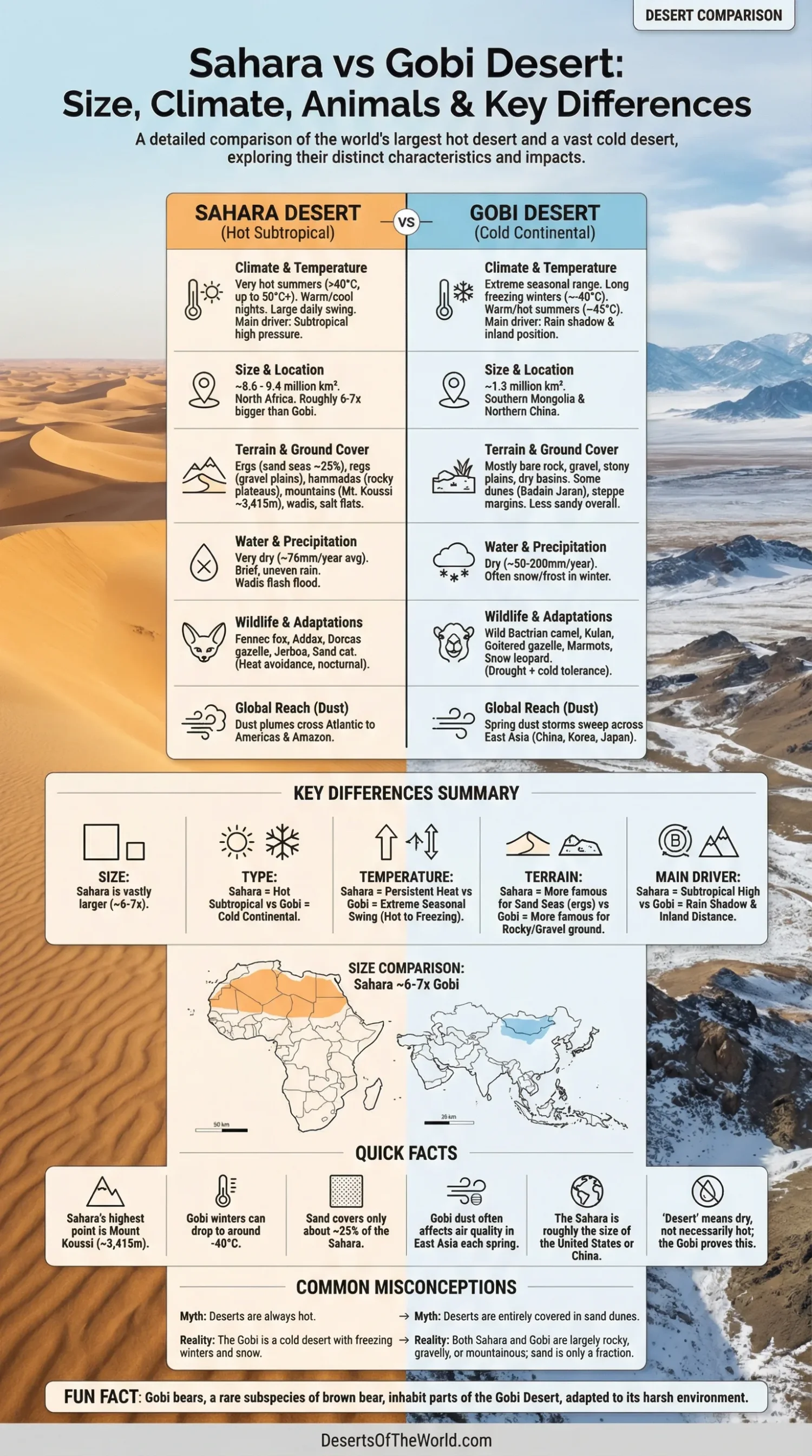
Sahara vs Gobi Desert in One View
| Feature | Sahara Desert | Gobi Desert |
|---|---|---|
| Desert Type | Hot subtropical desert | Cold continental desert |
| Approximate Area | About 8.6 million sq km in many standard references, with broader boundary estimates reaching around 9.4 million sq km | About 1.3 million sq km |
| Location | North Africa | Southern Mongolia and northern China |
| Main Climate Driver | Subtropical high-pressure belt and very dry descending air | Rain shadow effect, inland continental position, cold Siberian air in winter |
| Typical Annual Precipitation | About 76 mm on average across the desert, though local totals vary | Roughly 50 to 200 mm, depending on the part of the desert |
| Temperature Pattern | Very hot summers, warm to cool nights, big daily swings | Long freezing winters, warm to hot summers, very wide seasonal range |
| Ground Cover | Gravel plains, rocky plateaus, mountains, salt flats, wadis, and sand seas | Mostly bare rock, gravel, stony plains, dry basins, with some dune fields and steppe margins |
| Sand Share | Famous for dunes, yet sand covers only about a quarter of the surface | Often imagined as sandy, but much of the desert is rocky rather than dune-covered |
| Well-Known Animals | Fennec fox, addax, dorcas gazelle, jerboa, sand cat | Wild Bactrian camel, kulan, goitered gazelle, marmots, reptiles, snow leopard on mountain margins |
| Dust Reach | Dust often crosses the Atlantic and can reach the Caribbean and the Americas | Spring dust commonly moves across eastern China, the Korean Peninsula, and Japan |
How Much Bigger Is the Sahara Than the Gobi?
By area, the Sahara is not just larger. It is far larger. Using a common estimate of about 8.6 million square kilometers for the Sahara and about 1.3 million square kilometers for the Gobi, the Sahara is roughly six to seven times bigger.
That difference changes everything. A desert on the scale of the Sahara can contain mountain massifs, vast gravel plains, dune seas, deep depressions, and long belts of transition into the Sahel. The Gobi is also huge by any normal standard, yet it feels more broken into basins, rocky plains, plateaus, and mountain-bordered sectors.
So when people ask which desert is “larger,” the answer is simple. The Sahara wins by a wide margin.
Climate: Why One Burns and the Other Freezes
The word desert does not mean hot. It means dry. That point matters here.
The Sahara is the classic hot desert because dry air sinks over the subtropics, clouds stay limited, and the sun has free rein for much of the year. The Gobi is dry for a different reason. It lies deep inside Asia, away from ocean moisture, and much of it sits in the rain shadow of the Himalayas and nearby mountain systems. Add cold winter air pouring south from Siberia, and you get a desert that can freeze hard.
Sahara Climate
The Sahara is built around heat, strong sunshine, and very low rainfall. In many standard references, average precipitation across the desert is about 76 mm per year, though totals change sharply from one part to another. Some sectors can go long stretches with little rain at all.
Summer daytime temperatures often sit around 40°C, and some places can rise above 50°C. Nights cool quickly because dry air and clear skies allow heat to escape fast. That daily swing is one of the Sahara’s defining traits. Hot by day. Noticeably cooler after sunset.
Rain, when it comes, can be brief and uneven. Dry channels called wadis may stay empty for long periods, then suddenly carry water after storms. It happens fast.
Gobi Climate
The Gobi is dry too, but its climate works on a different rhythm. It is a cold desert with a very large annual temperature range. Standard climate references place January averages near -40°C in the coldest sectors and July highs near 45°C in the hottest periods. Annual precipitation usually runs from less than 50 mm in the west to more than 200 mm in the northeast.
This means the Gobi is not mild at all. It is dry, windy, and sharply seasonal. Frost and snow can appear. Spring is often dusty. Summer brings heat, but winter shapes the desert just as much as summer does.
That is the real climate contrast: the Sahara is ruled by persistent heat, while the Gobi is ruled by extremes across the whole year.
Surface and Landforms: Not All Desert Means Sand
One of the most common mistakes in desert writing is to treat deserts as endless dune fields. Neither of these deserts fits that picture cleanly.
The Sahara Is More Than Dunes
The Sahara is famous for ergs, the great sand seas that fill travel photography and maps. Yet dunes and sand sheets cover only about a quarter of the desert’s surface. Much of the rest is made of regs (gravel plains), hammadas (rocky plateaus), mountains, dry basins, salt flats, and oasis depressions.
That mix matters. It explains why one part of the Sahara may be a sea of dunes, while another is a hard stone platform or a wind-polished gravel plain. The desert’s highest point, Mount Koussi in Chad, rises to 3,415 meters. Even in a desert known for flat horizons, relief can be sharp.
The Gobi Is Mostly Rock and Gravel
The Gobi often surprises readers because much of it is not sandy at all. Large stretches are bare rock, gravel, chalky plains, and sedimentary surfaces. Geologists often describe parts of it as a gravel desert. Dunes exist, and some are huge, especially in places such as the Badain Jaran area, but they do not define the whole desert.
Some sectors also grade into dry steppe. So the Gobi can shift from stony emptiness to sparse grassland margins without ever stopping being arid land. Strange to some eyes, natural to the region.
Animals and Plant Life
Both deserts support life, though the survival strategies differ. The Sahara pushes animals toward heat avoidance and water conservation. The Gobi demands drought tolerance too, but it also asks animals to deal with long cold seasons and fierce temperature swings.
Animals of the Sahara
Well-known Sahara animals include:
- Fennec fox — large ears help release body heat; it is mostly active at night
- Addax — one of the desert antelopes most closely adapted to dry conditions
- Dorcas gazelle — light build, fast movement, well suited to open arid ground
- Jerboa — small hopping rodent, often active after dark
- Sand cat — adapted to hot ground and dry hunting terrain
Plant life is sparse, but not absent. Around oases, wadis, and slightly wetter margins, you may find date palms, acacias, tamarisk, salt-tolerant shrubs, and short-lived plants that appear after rain. In the driest core zones, vegetation thins out fast.
Animals of the Gobi
The Gobi has a different cast of animals:
- Wild Bactrian camel — one of the best-known animals of the region, built for dry, cold, and windy terrain
- Kulan — the Asiatic wild ass of open arid plains
- Goitered gazelle — a swift grazer and browser of dry lowland habitats
- Marmots and gophers — small mammals tied to burrows and sparse steppe-desert ground
- Snow leopard — found mainly on the mountain edges and rocky uplands linked to the wider Gobi region
Vegetation in the Gobi often includes wormwood, salt-tolerant shrubs, saxaul, and low grasses in the more open steppe-like parts. The plant cover is still thin, just not always as sparse as the hottest Sahara core.
Why the Gobi Can Be Colder Yet Still Be a Desert
This is the point many readers miss.
The Gobi is a desert because precipitation stays low, not because the air stays hot. Its cold winters come from latitude, inland position, and the sweep of cold air from Siberia. Its dryness comes largely from blocked moisture and distance from oceans. In other words, the Gobi proves that snow and desert can exist together.
The Sahara shows the opposite pattern. It is dry because descending subtropical air suppresses cloud formation and rain over a huge belt of North Africa. Heat is part of the picture, yes, but dryness comes first. Desert status always starts there.
Dust, Air, and Reach Beyond the Desert Itself
These deserts do not keep their influence to themselves.
Saharan Dust
The Sahara is one of Earth’s major dust sources. Each year, vast quantities of mineral dust are lifted into the atmosphere and carried west across the Atlantic. That dust can reach the Caribbean and the Americas. It also helps deliver minerals to distant ecosystems, including parts of the Amazon basin.
So the Sahara is not only a landform. It is also an atmospheric source region.
Gobi Dust
The Gobi plays a similar regional role in East Asia. In spring, strong dust plumes often move from the Gobi and nearby deserts across eastern China, the Korean Peninsula, and Japan. These episodes are part of the seasonal rhythm of the region.
Same process in broad terms. Different map.
Key Differences That Matter Most
- Size: The Sahara is vastly larger.
- Desert Type: The Sahara is a hot subtropical desert; the Gobi is a cold continental desert.
- Temperature Logic: The Sahara is dominated by persistent heat, while the Gobi swings from deep winter cold to summer heat.
- Surface: The Sahara has famous dune seas but also large rocky and gravel sectors; the Gobi is even more strongly tied to bare rock and gravel terrain.
- Rain Pattern: Both are dry, though the Gobi usually receives a bit more precipitation in some sectors than the driest Sahara core.
- Wildlife: Sahara fauna lean toward heat-avoidance strategies; Gobi fauna must survive drought and hard winter conditions together.
- Geographic Reach: Saharan dust often crosses the Atlantic, while Gobi dust shapes spring skies across parts of East Asia.
Which Desert Is Hotter, Colder, and Drier?
Hotter: The Sahara.
Colder in Winter: The Gobi.
Larger: The Sahara.
More Famous for Rocky Ground: The Gobi.
More Famous for Sand Seas: The Sahara.
Drier is the trickier one because both deserts contain wetter and drier subregions. On broad annual averages, the Sahara is usually treated as the drier desert overall, especially in its core sectors, though parts of the Gobi are also extremely dry. The better way to phrase it is this: the Sahara is hotter and more continuously arid-looking, while the Gobi is more seasonal and more thermally extreme.
Two Deserts, Two Very Different Systems
The Sahara and the Gobi are often grouped together because both are iconic deserts. Yet they are not versions of the same place. The Sahara is a vast North African heat desert shaped by subtropical dryness, dune seas, gravel plains, mountain massifs, and long belts of near-rainless land. The Gobi is a colder, rockier, more seasonal desert shaped by continental distance, mountain rain shadow, winter air from the north, and a strong mix of desert and steppe margins.
Put simply, the Sahara represents the classic image of a hot desert. The Gobi reminds us that a desert can freeze, carry snow, and still remain unmistakably desert.
Sources
- Britannica – Sahara (area, landforms, major physical features)
- Britannica – Sahara Climate (average precipitation, seasonal temperature pattern)
- Britannica – Gobi Desert (area, rocky surface, regional geography)
- Britannica – Gobi Climate (temperature range, annual precipitation, fauna notes)
- National Geographic Education – Deserts (Sahara size range, rocky Sahara and Gobi, rain-shadow note)
- NASA Earth Observatory – Tracking Dust Across the Atlantic (Saharan dust movement and Atlantic transport)
- NASA Earth Observatory – A Wall of Dust Over the Korean Peninsula (Gobi dust transport across East Asia)
- University of Michigan Animal Diversity Web – Addax nasomaculatus (Sahara antelope adaptation to very dry habitats)
- University of Michigan Animal Diversity Web – Camelus bactrianus (Bactrian camel range and habitat in the Gobi region)
- National Geographic – Fennec Fox (Sahara animal adaptations to heat and low water conditions)