
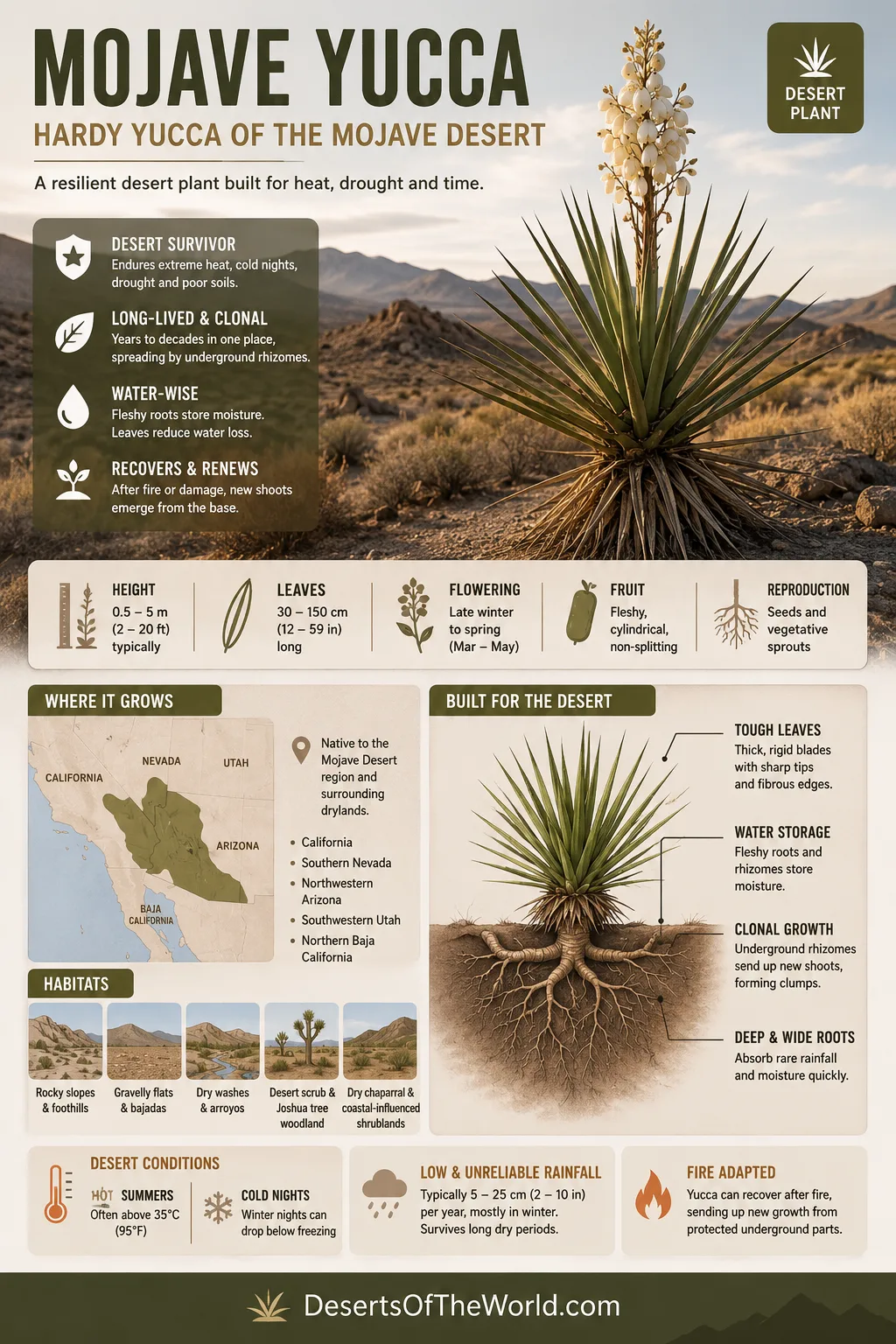
Across the Mojave Desert, low shrubs often shape the horizon. Creosote bush, white bursage, blackbrush and scattered grasses stay close to the ground, while Mojave yucca rises above them in rigid green crowns. Its height makes it easy to notice, yet its real desert strategy is largely hidden. A mature clump may contain stems of different ages, short underground connections, old central growth and young shoots expanding around the edge.
Yucca schidigera, commonly called Mojave yucca, is a slow-growing evergreen native to the drylands of the southwestern United States and northwestern Mexico. It survives long dry intervals, intense summer heat, cold desert nights and irregular rainfall. That endurance comes from several traits working together: durable leaves, controlled growth, clonal sprouting, fleshy rhizomes, long-lived stems and the ability to replace aboveground growth after damage.
The plant belongs to the Mojave landscape, though its range crosses desert boundaries and reaches dry chaparral and transitional shrublands. It is also easy to confuse with Joshua tree or banana yucca. Leaf width, marginal fibers, growth form, fruit type and branching pattern reveal the difference.
Mojave Yucca Profile
| Feature | Mojave Yucca |
|---|---|
| Scientific Name | Yucca schidigera Roezl ex Ortgies |
| Other Common Names | Mohave yucca, Spanish dagger |
| Plant Family | Asparagaceae, subfamily Agavoideae; older references often use Agavaceae |
| Growth Form | Evergreen shrub or small tree, usually with several stems |
| Common Mature Height | About 0.5–5 m (2–20 ft), with taller outliers recorded |
| Leaf Length | About 30–150 cm (12–59 in) |
| Flowering Period | Usually late winter through spring; often March to May depending on elevation and location |
| Fruit | Fleshy, cylindrical and non-splitting at maturity |
| Main Reproduction | Seed production and vegetative sprouting, with clonal growth often dominant |
| Core Habitat | Rocky slopes, gravelly flats, bajadas, dry washes, desert scrub and dry chaparral |
| Native Range | California, southern Nevada, northwestern Arizona, southwestern Utah and northern Baja California |
A Distinct Yucca of Southwestern Drylands
Mojave yucca is an accepted species within the genus Yucca. Current botanical databases place the genus in the asparagus family, Asparagaceae, within the agave subfamily Agavoideae. Many park records and older botanical studies use Agavaceae. That difference reflects a change in classification rather than disagreement about the plant itself.
The name Yucca schidigera was published in 1871. Historical names include Yucca mohavensis, which explains why both “Mojave” and “Mohave” appear in common usage. Spanish dagger is another common name, drawn from the stiff leaf blades and pointed tips.
Yucca is also different from “yuca,” the common name used for cassava in many regions. Cassava is Manihot esculenta, a tropical crop in an unrelated plant family. Mojave yucca is a desert monocot with fibrous leaves, rosette growth and a close pollination relationship with yucca moths.
Where Mojave Yucca Grows
The species is centered on the Mojave Desert but extends beyond its strict geographic outline. Its distribution includes southeastern California, southern Nevada, northwestern Arizona, southwestern Utah and northern Baja California. Western populations approach the Pacific side of Baja California and southern California, where desert vegetation blends into dry coastal and chaparral communities.
This range places Mojave yucca across several ecological transitions:
- Mojave desertscrub dominated by creosote bush and white bursage
- Joshua tree woodland and blackbrush scrub at higher desert elevations
- Rocky foothills and dry mountain slopes
- Desert washes that receive brief pulses of runoff
- Dry chaparral and coastal-influenced shrublands near the western edge of the range
Rocky Slopes, Flats and Dry Washes
Mojave yucca commonly occupies well-drained ground. Gravel, coarse sand, rocky alluvium and shallow soils over bedrock all suit its growth pattern. It appears on open flats, sloping bajadas, canyon margins and dry channels. These sites differ in surface texture, exposure and access to runoff, so the plant does not depend on one narrow soil type.
Dry washes can offer more moisture than surrounding flats after storms, but they also experience erosion and sediment movement. Rocky slopes shed water quickly, while fractures and pockets can hold moisture below the surface. Mojave yucca uses both settings. Its distribution reflects access to occasional water rather than a need for permanently moist ground.
Climate and Elevation Across the Range
The Mojave Desert receives little and irregular precipitation. Many valley areas receive roughly 5–25 cm (2–10 in) a year, with much of the moisture arriving during winter and smaller, less dependable summer storms. Local totals vary sharply with elevation, mountain barriers and position within the desert.
Mojave yucca occurs from low desert ground to mountain slopes. Botanical treatments commonly place most populations below about 1,800 m (5,900 ft), while some records extend higher. Joshua Tree National Park lists the species below 2,500 m. These ranges should not be treated as a single hard boundary. Exposure, slope direction, soil depth and local rainfall can shift where healthy stands occur.
Altitude also affects flowering time. Lower, warmer populations may flower earlier, while higher populations can bloom later in spring. For this species, elevation can explain seasonal timing better than latitude alone.
The Architecture of a Mojave Yucca
A Mojave yucca is often described as one plant, but a mature clump may be a group of connected stems. The visible crown is only the current outer form of a much older growth system. Stems emerge near one another, grow slowly, age, and may eventually die while younger shoots continue around them.
Stems, Trunks and Old Leaf Skirts
Mature plants commonly have several upright stems. Four to seven stems per clump have often been reported, though both single-stemmed plants and much larger clusters occur. Branching is sparse compared with the spreading crown of an old Joshua tree.
The trunk can remain wrapped in old, downward-curving leaves. On other plants, the lower leaves fall away and expose rough, furrowed bark. The trunk looks woody, yet yucca tissue is softer and more spongy than the dense wood of many desert trees.
Common mature height ranges from about 0.5 to 5 m (2–20 ft). An unusual eastern Mojave specimen was estimated near 9 m (30 ft), but such height is not a normal field expectation. Most plants remain much shorter and form compact or irregular clumps.
Rigid Leaves with Fibrous Margins
The leaves form dense rosettes at stem tips. Individual blades usually measure about 30–150 cm (12–59 in) long and 2–11 cm (0.8–4.3 in) wide. They are stiff, broadest near the middle and finished with a hard terminal point.
Loose, curling fibers along the leaf margins are among the best field marks. They often remain visible even when the plant is viewed from several steps away. The leaves are also generally longer and broader than those of Joshua tree.
The rosette arrangement packs many leaves around a short growing point. Older blades remain below the active crown, while new leaves emerge from the center. This gives each stem a layered record of recent and past growth.
Flower Clusters and Fleshy Fruit
Mojave yucca produces rounded to bell-shaped flowers in a dense panicle. The flower stalk rises through or above the leaf crown and commonly measures about 0.5–1.3 m (1.6–4.3 ft). Creamy white flowers appear in late winter or spring, often from March through May.
A flower stalk flowers once. The whole plant does not die after flowering because the clump retains other stems and growing points. A stem may also continue vegetative growth, depending on its condition and branching pattern.
The fruit is fleshy, cylindrical and remains closed rather than splitting open when mature. It is usually about 5–11 cm (2–4.3 in) long. Inside are thick, rough, dark seeds. The fleshy fruit separates Mojave yucca from dry-fruited yuccas and links it more closely with banana yucca.
Short Rhizomes and a Hidden Water System
Below the surface, Mojave yucca develops fleshy rhizomes that connect nearby sprouts. These structures are short rather than long-running. New stems therefore appear close to the parent growth, creating a clustered form instead of a distant colony.
Research at desert sites has found roots at depths around 75 cm (30 in), though the full root pattern changes with soil and rock structure. Some roots can move water upward toward drier surface layers while leaf pores are closed. Fleshy rhizomes also lose volume during dry periods and regain firmness after water becomes available.
The plant does not behave like a barrel cactus filled with a large central water reserve. Its drought response relies on distributed storage, controlled gas exchange, durable tissues and restrained growth.
How Mojave Yucca Endures Desert Conditions
“Hardy” can hide more than it explains. Mojave yucca does not survive because of one exceptional feature. Its endurance comes from a set of modest advantages that reduce water demand, preserve living tissue and spread risk across several stems.
Long-Lived Leaves Reduce Replacement Costs
Leaves are expensive to build in a dry environment. Mojave yucca keeps them for long periods rather than replacing an entire canopy each season. The tough surface limits damage, while the narrow blade shape and controlled stomatal activity reduce moisture loss.
Evergreen growth also lets the plant respond when conditions improve. After winter rain or a summer storm, existing leaves can resume active photosynthesis without waiting for a new seasonal canopy.
Slow Growth Matches an Unreliable Water Supply
Measured height growth is often around 1–2.6 cm (0.4–1 in) per year, though rates differ among sites and years. Warmth alone does not produce much growth. Moisture must also be available. New leaf production can rise after summer storms, while stem growth remains limited.
Flowering carries a visible cost. One field observation found that a non-irrigated stem produced very few new leaves during the four years after it flowered. The plant can invest in reproduction, but that investment slows other growth.
Several Stems Spread Risk Across the Plant
A single growing point is vulnerable to physical damage, browsing and fire. A multi-stemmed clone has several. If an old central stem declines, younger outer stems can remain alive. If aboveground growth is removed, buds near the root crown or rhizomes may produce new shoots.
This pattern does not make each stem permanent. It keeps the genetic individual present while its visible parts change. Desert endurance here means continuity across replacements.
Why Mojave Yucca Age Is Difficult to Measure
Mojave yucca lacks the clear annual rings used to age many woody trees. Researchers instead estimate age through height, leaf production, vascular bundles and observed growth rates. Each method carries uncertainty because growth changes with rainfall, temperature, flowering and site quality.
Single stems in Nevada have been estimated at up to about 200 years. Whole clones may be older because new stems replace old ones while remaining connected to the same expanding plant. At the Deep Canyon Desert Research Center, growth-based estimates placed many clones between roughly 300 and 600 years, with some estimates above 500 years.
These numbers are modelled ages, not ring counts. A young-looking shoot can belong to an old clone, while a tall isolated stem may represent a much younger genetic individual. Height alone cannot settle the question.
Flowering Does Not Follow a Simple Annual Cycle
Mature Mojave yuccas do not necessarily flower every spring. Blooming depends on plant size, stored resources, recent moisture, temperature and elevation. A healthy stand may show many flower stalks in one season and very few in another.
Research at Deep Canyon recorded two years without flowering in a monitored plot. Only two stems flowered in the following year, and neither produced fruit. Flowering was more frequent at higher nearby elevations. This shows why the presence of flowers cannot be predicted from season alone.
Young plants also need time to reach reproductive size. One estimate places maturity near 35 years, while field observations link flowering with minimum stem diameter and trunk height rather than a fixed age. Growth history matters.
The Mojave Yucca and Its Yucca Moth
Yucca flowers do not rely on casual pollen transfer alone. Female yucca moths actively gather pollen, carry it to another flower and place it on the receptive floral structure. The moth then lays eggs in the ovary. As the fruit develops, the larvae eat part of the seed crop.
Older references often group the pollinator under Tegeticula yuccasella. Later taxonomic work separated several moth species and identified Tegeticula mojavella as the pollinator associated with Mojave yucca. The relationship is highly specialized: the plant gains pollination, and the moth gains a nursery and food for its larvae.
The exchange is not perfectly uniform. Some fruits contain no surviving larvae even when flower tissues show signs of moth activity. Moth density, egg survival, plant responses and local conditions can all alter the outcome. Fruit production can also fail after flowering.
Only a portion of the seeds is normally consumed. In two San Diego County populations, larval feeding removed a small share of the seed crop, and many fruits contained no larvae. The exact balance varies from place to place.
Seeds Can Germinate, Yet Seedlings Remain Rare
Mojave yucca seeds can germinate well under controlled moisture and temperature. Field establishment is much harder. Seeds face drying soil, high surface temperatures, shifting sediment, seed-eating animals and long gaps between suitable wet periods.
Greenhouse tests have produced high germination, while seeds planted at native desert sites have sometimes failed completely. Field observers have also found remarkably few seedlings even where adult plants were common. One interpretation is that successful establishment may require several consecutive years with favorable moisture.
This creates a sharp divide between seed viability and population recruitment. A living seed may be capable of germination, yet the landscape may rarely provide enough time for a seedling to build a durable root system.
Fruit Movement by Desert Mammals
The fleshy fruits can be eaten, carried or stored by mammals. Seeds may move away from the parent clump through feeding and caching. This offers dispersal, though it also exposes seeds to predation.
Seed movement therefore creates opportunity rather than guaranteed recruitment. Most adult stands persist through existing clones while rare seedlings add new genetic individuals during suitable periods.
Outward Growth Through Basal Sprouting
Vegetative reproduction is common. Short rhizomes produce shoots beside existing stems, and the clump slowly expands outward. Old central stems die and decay, leaving mature growth around the perimeter. On level ground, an old clone can develop a roughly circular form.
In one monitored population, 59 of 66 plants had two to fourteen stems, while careful searches found no seedlings. That pattern explains the patchy age structure of many stands: numerous visible stems may represent far fewer genetic individuals.
Fire Removes the Crown Before the Root System Responds
Mojave yucca is usually top-killed by fire. Leaves, flowering stalks and exposed stems can be lost even when underground tissues survive. New shoots may then emerge from the root crown or rhizomes.
Postfire sprouts have appeared within two months in some studies and during the second growing season in others. Early regrowth often gives the plant a low, shrubby form with several fresh leaf clusters around burned stems.
Resprouting Is Only the First Stage of Recovery
A green shoot after fire shows that part of the plant survived. It does not show that the old structure, height or ecological role has returned. New sprouts remain close to the ground and can be heavily browsed by rabbits and woodrats. Tall perches and nesting sites may take many years to reappear.
Severe burns tend to produce larger and longer-lasting reductions in yucca cover. Recovery also depends on rainfall after the fire, the condition of the surviving root crown and the interval before another burn.
Why Repeated Fire Creates a Different Test
Open Mojave shrublands historically contained broad gaps between perennial plants. Those gaps limited the continuous movement of flame across many areas. Dense annual grasses can fill the spaces and connect separate shrubs into a more continuous fuel layer.
Mojave yucca can survive one fire through sprouting, yet repeated burns at short intervals may arrive before new stems rebuild reserves and height. The species should therefore be described as capable of postfire sprouting, not as unharmed by fire.
A Tall Habitat Structure in Low Desert Scrub
Mojave yucca often stands above neighboring shrubs. That vertical position creates habitat that cannot be measured by plant cover alone. A small number of tall clumps can add perches, nest sites, shade and sheltered ground-level spaces to an otherwise low landscape.
Perches, Roosts and Nesting Sites for Birds
Birds use Mojave yucca for hunting, resting and nesting. The rigid crown offers protected support, while old stems can provide cavities. Studies have recorded use by American kestrels, screech owls, ladder-backed woodpeckers, ash-throated flycatchers, cactus wrens and other desert birds.
A study comparing harvested and unharvested stands found fewer tall stems where yucca had been removed, along with fewer bird species and individuals. The result reflects structure as much as plant abundance. Removing the tallest stems changes the usable vertical space.
Food, Nest Material and Shelter Near the Base
Woodrats use yucca fibers in their nests and often build shelters near the base of clumps. Merriam’s kangaroo rats, antelope squirrels, rabbits and other small mammals consume flowers, fruit, seeds or fresh sprouts. Moist plant tissue may also serve as a water source during dry periods.
Desert spiny lizards often climb Mojave yucca trunks and crowns. The plant gives them an elevated surface above hot ground and low shrubs. Fallen leaves and dense bases also create shaded pockets used by small desert animals.
Visually Dominant Does Not Mean Most Abundant
Mojave yucca may define the appearance of a plant community even when shorter shrubs provide more total cover. A creosote bush or blackbrush stand can contain many more individual shrubs, yet the yucca crowns draw the eye because they rise above the surrounding vegetation.
Ecologists sometimes describe Mojave yucca as a visual dominant for this reason. The distinction matters. Density, ground cover, biomass and visual presence measure different parts of a plant community.
The same distinction helps explain wildlife value. A few tall yuccas may add more nesting height than a much larger number of low shrubs. Losing those plants can alter habitat structure without causing a large change in total vegetation cover.
Mojave Yucca Compared with Similar Desert Yuccas
| Feature | Mojave Yucca | Joshua Tree | Banana Yucca | Chaparral Yucca |
|---|---|---|---|---|
| Scientific Name | Yucca schidigera | Yucca brevifolia or Yucca jaegeriana | Yucca baccata | Hesperoyucca whipplei |
| Typical Form | Multi-stemmed shrub or small tree | Tree-like, often strongly branched with age | Low rosette or short-stemmed clump | Usually a basal rosette with a very tall flower stalk |
| Leaf Margins | Conspicuous curling fibers | Usually lacks the same long, loose marginal fibers | Often strongly fibrous | Finely toothed rather than fibrous-shredding |
| Leaf Shape | Long, broad and rigid | Shorter and narrower | Broad, stiff and often blue-green | Narrow, sharp and densely packed |
| Fruit | Fleshy and cylindrical | Dry to somewhat spongy | Large, fleshy and banana-shaped | Dry capsule |
| After Flowering | The clump survives and continues through other stems | Branches and the whole plant remain alive | The clump remains perennial | The flowering rosette normally dies after reproduction |
| Best Field Clue | Tall clump with broad leaves and curling edge fibers | Distinct tree form with irregular branches | Low, heavy rosette with large fleshy fruit | Basal rosette beneath a towering narrow flower stalk |
Mojave Yucca and Joshua Tree
These species often grow near one another. Mojave yucca usually has longer, broader leaves with obvious fibers peeling from the margins. It commonly forms a cluster of upright stems with limited branching. Joshua tree develops a more open crown and irregular branching as it ages.
Young Joshua trees can remain unbranched, so silhouette alone may mislead. Close inspection of the leaf edges offers a better clue.
Mojave Yucca and Banana Yucca
Banana yucca is generally lower and produces thick, banana-shaped fruit. Its leaves also carry marginal fibers, which makes the two species harder to separate where their ranges overlap. Natural hybrids occur and can show intermediate stem, leaf and fruit traits.
In overlap zones, identification may require several characters rather than one leaf or one photograph. Growth form, fruit shape, flower structure and local flora all help.
Fiber, Food and Cleansing Materials
Indigenous communities of the Southwest used Mojave yucca as food and as a source of strong fiber. Uses differed among peoples and locations, so they should not be reduced to one universal practice.
Leaves, Fibers, Fruit and Roots
Leaf fibers were made into rope, cord, sandals, basket materials, bowstrings, brushes and bindings. Whole leaves could secure structural poles, while dried leaves served as torches. Archaeological finds from Gypsum Cave in southern Nevada include sandals and cords made with yucca fiber.
Fruits were eaten raw, roasted, cooked or ground into meal. Some southern California communities collected fruit during spring and roasted it. Root shavings mixed with water created a cleansing wash because yucca tissues contain saponins, compounds that foam in water.
These practices relied on detailed knowledge of season, plant part, preparation and local abundance. The usefulness of the plant came from its physical traits: long fibers, fleshy fruit and saponin-bearing tissues.
Modern Yucca Extracts and Commercial Products
Mojave yucca extracts are used in several industries. Saponins can act as foaming agents and surfactants, while plant extracts also appear in animal feed products, cosmetics, soil products and odor-control formulations.
These industrial uses should remain separate from medical claims. Evidence from a feed additive, laboratory test or animal study does not establish a treatment effect in people. A botanical profile can describe documented uses without turning the plant into a health product.
Drought Tolerance Does Not Guarantee Fast Recovery
Mojave yucca can remain stable through very dry years, yet disturbed soil presents a different problem. Grading, compaction and removal of the upper soil layer can erase root systems, seed microsites and the slow clonal structure that took decades to form.
Studies in the eastern Mojave found no Mojave yucca recolonization in some sites disturbed five, ten or forty years earlier. Roads, cleared areas and heavily compacted ground remained without the species even when undisturbed land nearby supported adult plants.
Transplanting can save individual plants from a site scheduled for disturbance, but survival varies. Nursery success also does not recreate an old desert clump immediately. A transplanted rosette lacks the height, dead wood, cavities, soil relationships and age structure of a long-established clone.
Natural recovery is slow for three connected reasons:
- Height growth is measured in centimeters per year.
- Seedling establishment occurs only during uncommon favorable periods.
- Clonal spread adds new stems close to existing plants rather than rapidly colonizing distant bare ground.
What Mojave Yucca Reveals About Its Desert Setting
A healthy Mojave yucca stand often points to long continuity in the landscape. Large clumps, tall stems, old leaf skirts and dead central trunks take time to develop. Their presence can indicate that the site has retained stable patches of soil and vegetation through many dry cycles.
The surrounding plant community gives further context. In lower desert scrub, Mojave yucca may rise among creosote bush, white bursage, brittlebush and cholla. At higher or cooler sites, it can occur with blackbrush, big galleta and Joshua trees. Near the western range edge, it enters dry chaparral and coastal-influenced shrublands.
The plant is therefore a Mojave emblem without being confined to one neat desert boundary. It follows dry habitats, rocky ground and suitable seasonal moisture across an ecological gradient.
Endurance Through Stems, Seasons and Time
Mojave yucca persists through continuity rather than rapid replacement. Long-lived leaves reduce the need for constant rebuilding. Slow stems preserve resources. Rhizomes hold the clump together. Basal shoots replace older growth. Yucca moths make seed production possible, while rare wet sequences allow an occasional seedling to begin a new genetic line.
The visible plant can change greatly without the whole individual disappearing. Fire may remove every green crown and leave blackened stems, followed later by low sprouts. A central trunk may decay while outer shoots remain healthy. A flowering season may end without fruit, followed by years of vegetative growth.
That life pattern fits the Mojave Desert. Rain is brief, establishment windows are narrow and recovery is measured over long periods. Mojave yucca meets those conditions by keeping several paths open at once: seed when conditions allow, sprouts when stems are lost, and durable living tissue through the years between them.
Sources
- U.S. Forest Service — Yucca schidigera, Mojave Yucca (species biology, distribution, growth, pollination, wildlife use, disturbance and fire response)
- National Park Service — Yucca schidigera (Joshua Tree National Park flowering period, elevation and native growth form)
- National Park Service — Joshua Trees (field differences between Mojave yucca and Joshua tree)
- Kew Science — Plants of the World Online: Yucca schidigera (accepted name, family and native distribution)
- Jepson eFlora — Yucca schidigera (California botanical description and identification characters)
- Bureau of Land Management — Mojave Desert Seed and Seedling Guide (Mojave native plant identification and habitat context)