
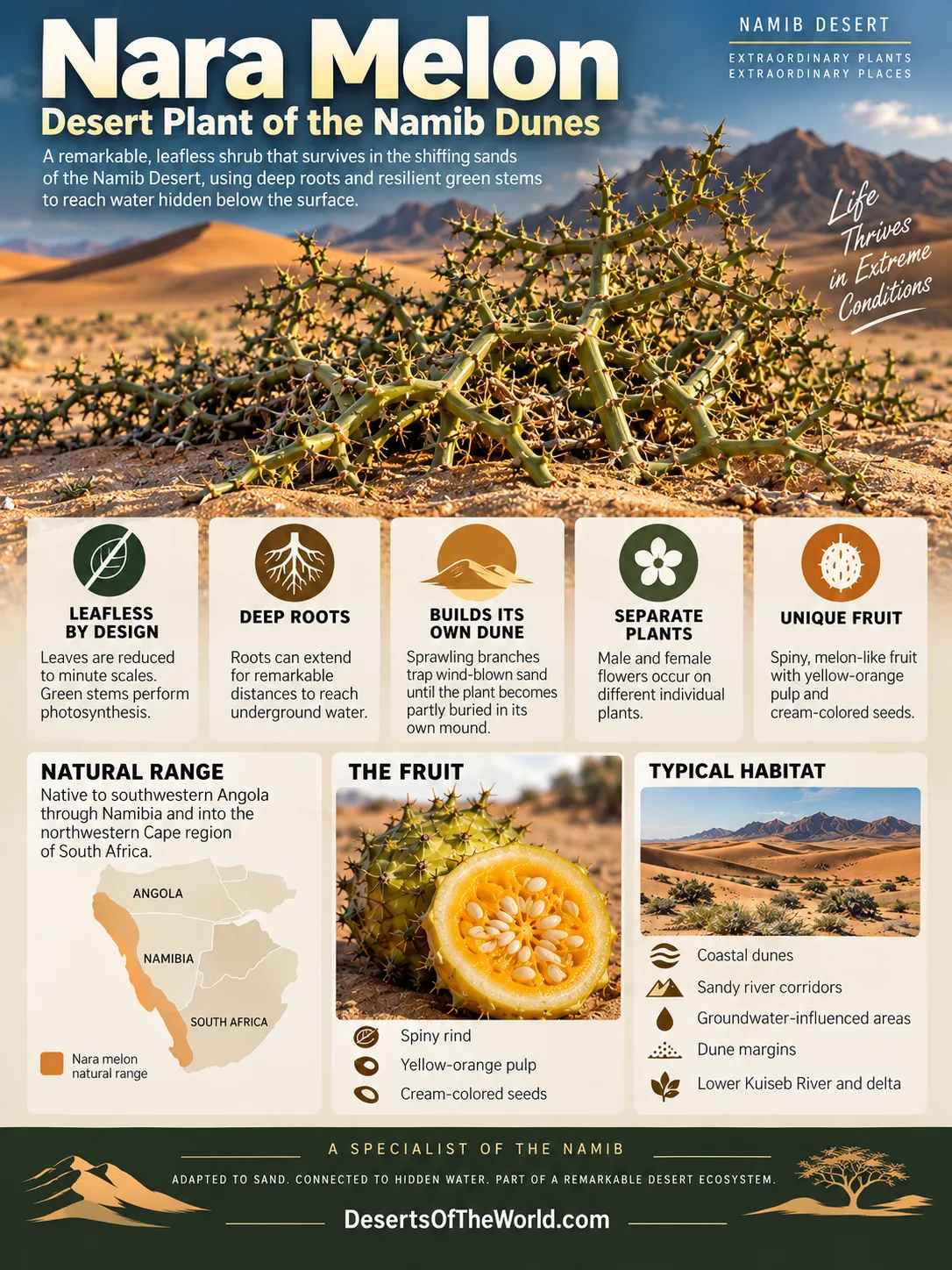
Nara melon (Acanthosicyos horridus) is a leafless, thorny shrub of the Namib Desert that grows where shifting sand meets hidden water below the surface. Its green stems carry out photosynthesis, its roots can extend for remarkable distances through desert sand, and its sprawling branches trap wind-blown sediment until the plant becomes partly buried inside its own dune-like mound.
The species is closely associated with the coastal Namib, especially sandy areas linked to groundwater. Its natural range extends from southwestern Angola through Namibia into the northwestern Cape region of South Africa. That distinction matters: Nara is a Namib Desert specialist, not a plant restricted to the country of Namibia.
| Feature | Nara Melon |
|---|---|
| Scientific name | Acanthosicyos horridus |
| Plant family | Cucurbitaceae |
| Growth form | Perennial, strongly branched thorny shrub |
| Natural range | Southwestern Angola, Namibia and northwestern South Africa |
| Main habitat | Namib dunes, sandy river corridors and groundwater-influenced desert areas |
| Leaves | Reduced to minute scales; the plant appears leafless |
| Photosynthetic tissue | Green stems |
| Flowers | Male and female flowers occur on separate plants |
| Fruit | Spiny, melon-like fruit with yellow-orange pulp and cream-colored seeds |
| Water strategy | Deep root system with access to underground water |
What Kind of Plant Is Nara?
Nara belongs to the Cucurbitaceae, the same plant family that includes cucumbers, pumpkins, squashes and many melons. Its appearance is quite different from the familiar trailing vines found in cultivated fields.
A mature Nara forms a dense mass of pale green to yellow-green branches armed with paired spines. Botanical descriptions report shrubs about 1 meter tall, while old and spreading individuals may occupy roughly 15 meters or more across; exceptionally broad plants have been described at greater widths.
The stems are longitudinally grooved, and the paired spines are commonly around 2–3 centimeters long. True leaves are reduced to tiny scales and may be almost impossible to notice.
This gives Nara one of its most recognizable adaptations: the green stems perform the photosynthetic work normally associated with leaves. Maintaining broad leaves in exposed desert air would create a much larger surface through which water could be lost.
Why Nara Is Almost Leafless
Nara does not simply shed normal leaves during a drought. Its leaf reduction is a permanent feature of the plant’s structure. The photosynthetic stems remain available while the area devoted to ordinary leaves is extremely small.
That combination suits the Namib’s coastal desert environment, where rainfall can be scarce and unreliable even though atmospheric moisture and underground water may be present. Nara therefore represents a different desert strategy from a fleshy cactus that stores large amounts of water above ground.
Claims that every desert plant uses the same water-saving photosynthetic pathway should also be avoided. Nara’s visible adaptations are well documented, but its leafless form alone should not be used as proof that it relies on CAM photosynthesis.
Where Nara Grows in the Namib Desert
Acanthosicyos horridus has a narrow geographic relationship with the Namib Desert region. Royal Botanic Gardens, Kew records its native range from southwestern Angola to the northwestern Cape region, covering Angola, Namibia and South Africa.
Within that range, Nara is not spread evenly across every dune field or gravel plain. It favors sandy environments where its root system can reach dependable subsurface moisture.
Typical settings include:
- active and partly stabilized coastal dunes;
- sand near ephemeral river systems;
- old drainage routes beneath desert sediment;
- dune margins influenced by shallow or reachable groundwater;
- parts of the lower Kuiseb River and Kuiseb Delta.
The Kuiseb system is especially closely associated with Nara. The ephemeral Kuiseb reaches the Namib between gravel plains and the great dune fields farther south, creating a complex underground water environment even where the surface may remain dry for long periods.
This explains why apparently similar stretches of Namib sand can support very different vegetation. A bare dune and a Nara-covered dune may receive similarly little rain, yet the water available below them can be very different.
How Nara Builds Hummocks in Moving Sand
A large Nara plant does more than occupy a dune. Its branches can change the shape of the sand around them.
Wind moving across an open dune carries grains close to the surface. When that flow reaches a dense Nara thicket, stems and spines slow the air and intercept some of the moving sand. Sediment begins accumulating within and around the shrub.
The plant keeps growing while parts of its older structure become buried. More sand arrives. Over time, the interaction can create an elevated vegetated mound commonly described as a Nara hummock.
| Stage | What Happens |
|---|---|
| 1. Plant growth | Dense thorny branches spread across exposed desert sand. |
| 2. Wind interception | Branches slow sand-moving air near the surface. |
| 3. Sand accumulation | Wind-blown grains collect among stems and around the plant. |
| 4. Continued growth | New stems remain exposed while older portions become partly buried. |
| 5. Hummock formation | A raised plant-and-sand mound develops around the thicket. |
The relationship works in both directions. The plant changes wind flow and captures sand, while the accumulated sand changes temperature, moisture and shelter around the plant.
Nara is therefore useful when studying desert dunes because it connects vegetation, wind transport, groundwater and dune morphology within the same small area.
The Root System Reaches Water Beneath the Dunes
The green plant visible above the sand tells only part of the story. Nara survives because much of its water-gathering system lies below ground.
The species is strongly associated with places where underground water is available. It is often described as a phreatophytic desert plant: a plant whose roots can obtain water from the groundwater zone or from persistent moisture connected with it.
Very long roots have been recorded. Historical field descriptions report root lengths of about 40 meters. This figure needs careful interpretation. It does not mean every Nara plant sends a perfectly vertical taproot 40 meters downward. Root paths vary with sediment, groundwater position and local hydrology, and a measured root length is not automatically the same as vertical depth.
Nara’s main water story is underground. Coastal fog is part of the Namib environment, but Nara should not be described simply as a plant that survives by drinking fog. Access to subsurface water is central to where established plants can persist.
Fog, Dew and Water Vapor Around Nara Hummocks
The Namib is one of the world’s best-known coastal fog deserts. Cold Atlantic conditions associated with the Benguela Current help create moist marine air and frequent fog near the coast, even though rainfall remains very low.
Nara grows within this unusual moisture system, but recent research has shown why fog should not be treated as the only non-rain source of water.
A field study of a Nara hummock in the Namib Sand Sea measured moisture accumulation during February 2020 using temperature and humidity observations together with 14 micro-lysimeters. Researchers separated three forms of non-rainfall water input:
- fog — suspended droplets carried through the desert air;
- dew — liquid water that condenses on a sufficiently cool surface;
- water-vapor adsorption — water molecules moving from humid air into the surface of the sand.
During the measured nights, water-vapor adsorption occurred repeatedly and accounted for at least half of the total measured non-rainfall water accumulation, including on nights when fog occurred.
The result adds an important layer to the ecology of the Namib Sand Sea. Moisture can move into dune sand without rain and without appearing as obvious drops of fog water.
A useful distinction: the experiment measured water accumulation in and around the hummock soil. It does not prove that Nara obtains all of that atmospheric moisture directly through its stems. The plant’s established root system and groundwater access remain separate parts of its water supply.
Male and Female Nara Plants Produce Different Flowers
Nara is dioecious. Male flowers and female flowers grow on separate individual plants rather than on different parts of the same shrub.
Its flowers are pale yellow to yellow-green and form among the thorny branches. Male plants supply pollen, while female plants can develop fruit after successful pollination.
This reproductive system means a fruiting Nara population depends on more than the survival of a single isolated shrub. Male and female plants must occur within a landscape where pollen can move between them. Insects are associated with the flowers and are considered part of this pollination system, although it is better not to assign the entire process to one specific insect without local evidence.
What Nara Fruit Looks Like
The fruit explains the common name Nara melon. It is roughly spherical, melon-like and covered with short spiny projections. Botanical descriptions record fruits reaching about 20 centimeters in diameter.
Young fruits are green. As they mature, the interior develops yellow to orange-yellow pulp containing numerous hard, cream-colored seeds.
The seeds are relatively large for a desert shrub, commonly around 12–16 millimeters long in botanical descriptions. They are sometimes known in English as butterpips.
| Fruit Part | Description |
|---|---|
| Outer fruit | Round to slightly globose, firm and covered with spiny projections |
| Color | Green when developing, becoming paler as the fruit ripens |
| Pulp | Yellow to orange-yellow when ripe |
| Seeds | Numerous, hard, cream-colored and rich in seed oil |
| Typical maximum diameter | About 20 cm in botanical descriptions |
Nara and the Topnaar of the Lower Kuiseb
Nara is also a food plant with a long relationship to the Topnaar communities of the lower Kuiseb area. Ethnobotanical research in the region records detailed knowledge of harvesting, processing and using both the pulp and seeds.
Ripe fruits can be collected and softened before processing. Traditional preparation documented in ethnobotanical sources includes peeling or opening the fruit, cooking the pulp until the seeds loosen, separating the seeds, and concentrating the remaining fruit material.
The thickened pulp can then be dried into a durable food product. Seeds are dried separately and may be eaten, ground or processed for their oil.
The value of the plant is therefore not limited to fresh fruit. Pulp, seeds and seed oil represent different usable products from the same desert species.
Why the Seeds Matter
Nara seeds contain substantial oil, which has attracted both food and cosmetic research. Scientific analysis of Namibian Nara seed oil has examined its fatty-acid composition and physical properties, while traditional use predates modern laboratory interest.
This is one reason descriptions of Nara merely as an “edible desert melon” miss much of the plant’s relationship with people. The seeds can remain useful after the seasonal fruit pulp has been processed or consumed.
How Nara Changes Its Local Desert Habitat
Large Nara thickets create patches of structure in a landscape that may otherwise consist mainly of exposed sand. Their effect extends beyond the plant itself.
The branches trap sediment and form hummocks. The dense thorny growth creates shade and physical shelter. Flowers, fruit and seeds add concentrated food resources to an environment where plant production is highly patchy.
Researchers have also found differences in soil microbial communities associated with Nara plants. A study of Namib dune soils found that microbial community patterns varied with environmental conditions and with characteristics of the Nara plants growing above them.
The hummock can therefore function as a small ecological patch with conditions unlike those of nearby open sand.
Animals may interact with these patches through feeding, shelter, seed movement and movement between vegetated sites. In this way, a Nara thicket acts as both a plant and a physical feature of the dune landscape.
Why Groundwater Conditions Matter to Nara
A plant that depends on hidden water is naturally tied to the hydrology beneath the desert surface. Changes that lower accessible groundwater can affect Nara even if the dunes above appear unchanged.
The South African National Biodiversity Institute notes reports of Nara decline around Walvis Bay and Swakopmund associated with groundwater extraction. This relationship makes sense biologically: mature shrubs can withstand extremely dry surface conditions only while their roots continue to reach dependable subsurface moisture.
Ephemeral rivers also matter. A river such as the Kuiseb can remain dry at the surface for long periods yet still influence groundwater recharge and underground flow. Desert hydrology cannot be understood from visible water alone.
For Nara, the relevant chain is often:
episodic water input → groundwater recharge → subsurface storage → root access → long-term plant survival.
This is why the species is common in some sandy corridors but absent from nearby dunes that look similar from above.
Nara Conservation Status Needs Geographic Context
Nara does not have one simple conservation label that can be applied to every part of its range.
Kew’s Plants of the World Online currently includes a model-based Angiosperm Extinction Risk Prediction that predicts the species as not threatened. That prediction is a research model and should not be presented as though it were a formal global IUCN Red List assessment.
South Africa provides a different example. SANBI’s current national plant assessment lists Acanthosicyos horridus as Data Deficient – Insufficient Information. The assessment notes that the species is widespread and common in Namibia but that the status of its South African population is poorly known. Historical assessments used more severe categories, which explains why older references can show a different status.
| Source or Area | What the Current Record Means |
|---|---|
| Kew extinction-risk prediction | Model predicts the species as not threatened; this is not a formal global IUCN category. |
| South African national assessment | Data Deficient – Insufficient Information |
| Namibian populations | Nara remains a characteristic plant of suitable coastal Namib habitats, especially where groundwater is accessible. |
The most useful conservation question is therefore not simply “Is Nara endangered?” It is which population, in which country, and under which assessment?
The Adaptations That Let Nara Live in Namib Dunes
Nara survives through several connected traits rather than one desert trick.
- Reduced leaves: true leaves are reduced to tiny scales, limiting exposed leaf surface.
- Photosynthetic stems: green stems continue carbon fixation without a normal leafy canopy.
- Long roots: the underground system can extend far through sand toward dependable moisture.
- Groundwater dependence: established plants are concentrated where subsurface water remains accessible.
- Dense branching: thorny branches intercept wind-driven sand and help form hummocks.
- Perennial growth: the same plant can persist instead of relying on a complete life cycle after every rare rain event.
- Dioecious reproduction: separate male and female plants form a reproductive population across the dune landscape.
- Large fruits and seeds: Nara produces concentrated food resources in an otherwise sparsely vegetated habitat.
These traits make Nara different from the simplified image of a desert plant waiting for rainfall. Much of its biology is tied to processes that are easy to miss from the surface: groundwater beneath the dune, atmospheric moisture moving into sand, and wind continually rebuilding the hummock around the plant.
Why Nara Is So Closely Tied to the Namib
The Namib is a coastal desert where very low rainfall exists beside regular inputs of moist Atlantic air. Enormous dune fields, ephemeral rivers, groundwater corridors and fog-influenced habitats occur close together.
Nara fits this landscape unusually well. Its roots connect the plant to underground water. Its exposed stems tolerate a landscape where ordinary leaves would carry a high water cost. Its branches interact directly with moving sand, eventually producing vegetated hummocks that become visible features of the dunes themselves.
That makes Nara more than a plant that happens to grow in a desert. Its form reflects the way the Namib Desert functions as a system of wind, sand and scarce water. Above the surface, a thorny green thicket catches moving grains. Below it, roots search through deep sediment for water that may never appear as a permanent stream or pool.
Sources
- Royal Botanic Gardens, Kew — Plants of the World Online: Acanthosicyos horridus (accepted taxonomy, family and native distribution)
- Royal Botanic Gardens, Kew — Nara General Information (current model-based extinction-risk information)
- South African National Biodiversity Institute — Red List of South African Plants (South African status, habitat, groundwater dependence and assessment history)
- Journal of Hydrology — Daily Water Vapor Adsorption on a Nara Hummock (fog, dew and water-vapor measurements in the Namib Sand Sea)
- Journal of Arid Environments — Soil Microbial Communities Associated With Nara (Nara hummock soil ecology and plant-related microbial patterns)
- Environmental Information Service Namibia — The Ethnobotany of the Topnaar (Kuiseb ethnobotany, plant uses and traditional knowledge)
- PROTA — Acanthosicyos horridus (botanical morphology, fruit, seeds and traditional processing)