
The Sonoran Desert is often called North America’s most biodiverse desert because it holds an unusually wide mix of mammals, birds, reptiles, amphibians, fish, insects, and pollinators inside one dry region. It is not a lifeless stretch of sand. It is a living desert made of cactus forests, rocky slopes, sandy flats, desert washes, spring-fed pockets, and mountain edges where animals use shade, timing, movement, burrows, and plant relationships to survive.
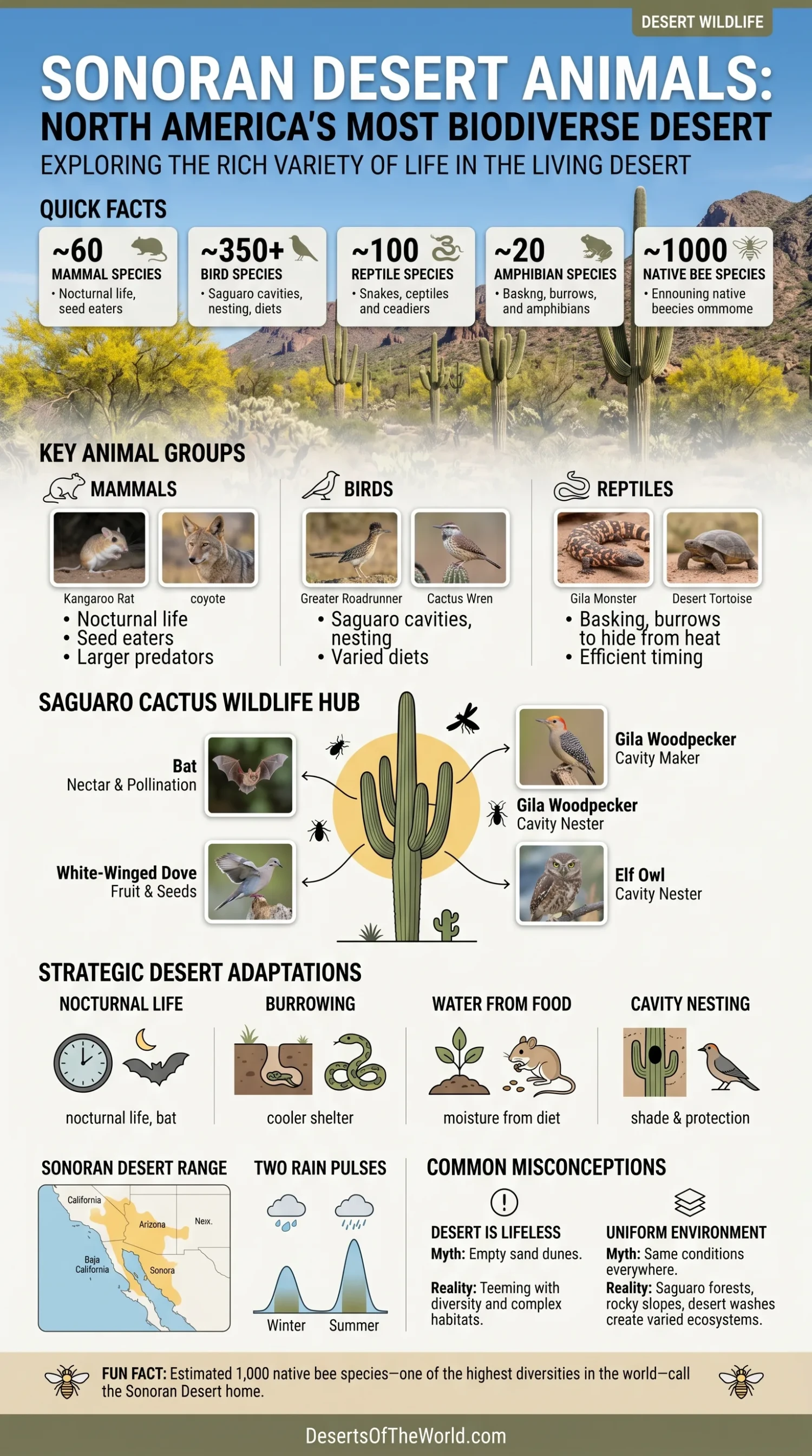
This animal life is tied closely to place. The Sonoran Desert reaches across southwestern Arizona, southeastern California, much of Sonora, and parts of Baja California and Baja California Sur. Its warm winters, two rainy seasons in many areas, and varied terrain give it more biological variety than colder or drier North American deserts nearby.
| Topic | What It Means |
|---|---|
| Desert Region | Southwestern United States and northwestern Mexico, including Arizona, California, Sonora, Baja California, and Baja California Sur. |
| Animal Richness | Official park sources describe at least 60 mammal species, more than 350 bird species, about 100 reptiles, 20 amphibians, and about 30 native fish species in the Sonoran Desert region. |
| Main Animal Habitats | Saguaro cactus forests, creosote flats, palo verde and ironwood slopes, desert washes, rocky hills, riparian corridors, springs, and higher mountain margins. |
| Well-Known Animals | Gila monster, greater roadrunner, cactus wren, desert tortoise, kangaroo rat, bobcat, coyote, collared peccary, elf owl, western diamondback rattlesnake, and lesser long-nosed bat. |
| Why It Stands Out | The desert has heat, dryness, seasonal rain, varied elevation, and many plant-animal links packed into a relatively tight area. |
Why the Sonoran Desert Supports So Many Animals
The Sonoran Desert works differently from a cold, sparse desert. It has intense heat, yes, but it also receives moisture in more than one season across much of its range. Winter rain can support cool-season annual plants. Summer monsoon storms can wake insects, toads, reptiles, and flowering plants almost overnight.
That rhythm creates food at different times of year. Seeds follow flowers. Insects follow rain. Birds and mammals follow both. In the desert, timing is survival.
The land itself also changes quickly. A flat valley may be covered with creosote bush and bursage. A nearby slope may hold saguaros, ocotillos, palo verde, mesquite, and ironwood. A wash may carry deeper soil and taller vegetation. A rocky hill may shelter lizards, snakes, owls, and small mammals. These small habitat shifts explain why animal diversity can change within a short walk.
Warm Winters Matter
The Sonoran Desert is hot, but its winter warmth is part of the story. Many species can remain active during cooler months, especially during mild days. Reptiles may bask, birds forage among fruiting plants, and mammals use the more forgiving temperatures to move with less water stress.
In summer, the same desert becomes much harder. National Park Service climate information notes that summer air temperatures in the Sonoran Desert routinely exceed 40°C (104°F) and can often reach 48°C (118°F). Animals do not “beat” that heat by being tough all day. They avoid it.
Two Rain Seasons Create Two Pulses of Life
In many parts of the Sonoran Desert, winter storms and summer monsoon rain bring different kinds of growth. That matters for animals because the food supply does not arrive in one single burst.
- Winter and spring moisture can support wildflowers, seeds, nesting activity, and nectar sources.
- Summer storms can trigger insect activity, amphibian breeding, fresh plant growth, and more surface movement by reptiles.
- Dry spells push many animals back into shade, burrows, cavities, or night activity.
Seen this way, the Sonoran Desert is less like a static landscape and more like a clock with several hands. Each group of animals reads that clock differently.
The Main Animal Groups of the Sonoran Desert
Mammals
Sonoran Desert mammals range from tiny seed-eating rodents to larger animals that use wide home ranges. Many are nocturnal or crepuscular, meaning they are most active at night, dawn, or dusk.
Kangaroo rats are classic desert survivors. They live on seeds, spend hot hours underground, and conserve water with unusual efficiency. Packrats build stick houses around cactus, mesquite, and rocky cover. Desert cottontails and black-tailed jackrabbits use speed, ears, and shade to manage open ground.
Larger mammals include coyotes, bobcats, gray foxes, kit foxes, mule deer, desert bighorn sheep, and collared peccaries (often called javelinas). These animals do not all use the desert in the same way. Bighorn sheep favor rugged slopes and escape terrain. Javelinas often move through washes, cactus-rich areas, and neighborhoods at the desert edge. Bobcats use cover. Coyotes use almost everything.
Bats deserve their own mention. Nectar-feeding bats, including the lesser long-nosed bat, help pollinate night-blooming cacti such as saguaro and organ pipe cactus. Insect-eating bats also feed heavily when warm nights bring flying insects into the air.
Birds
Bird life is one of the clearest signs that the Sonoran Desert is not empty. Greater roadrunners move across open ground. Cactus wrens nest among thorny cholla and cactus cover. Gila woodpeckers and gilded flickers carve cavities in saguaros, and those cavities later shelter other birds.
Some birds are strongly tied to cactus flowers and fruits. White-winged doves feed on saguaro fruit and help move seeds. Hummingbirds visit desert flowers when nectar is available. Verdin, phainopepla, curve-billed thrasher, Gambel’s quail, elf owl, Harris’s hawk, and turkey vulture all fit into different parts of the desert food web.
The elf owl is a good example of how a small animal can depend on a large plant. It often nests in old woodpecker holes or other cavities in saguaros and trees. The cactus becomes a high-rise apartment, built slowly by the desert itself.
Reptiles
Reptiles are a natural fit for the Sonoran Desert, though even they avoid the worst heat. Lizards may bask in the morning, vanish under shrubs by midday, and return when surfaces cool. Snakes often move at night during warm months.
Well-known reptiles include the Gila monster, desert tortoise, western diamondback rattlesnake, sidewinder, chuckwalla, desert iguana, zebra-tailed lizard, whiptail lizards, and horned lizards. The Gila monster is one of the most recognized Sonoran reptiles. It is the largest lizard in the United States and is seen only rarely because it spends much of its life out of sight.
The desert tortoise shows a different strategy. It uses burrows to avoid heat and dry air, then becomes more visible during milder periods and after seasonal rain. Slow, quiet, and well suited to its habitat, it reminds us that desert survival is often about patience.
Amphibians and Native Fish
Amphibians may seem out of place in a desert, but the Sonoran Desert has toads and frogs that respond quickly to rain. Spadefoots and toads can remain hidden through dry weather, then emerge after summer storms to breed in temporary pools. Their season can be short. Very short.
Native fish live in the wetter pieces of the desert: springs, streams, cienegas, and remaining aquatic habitats. Desert pupfish and other native fish show how the Sonoran Desert includes more than sand and cactus. Water is rare, so the places that hold it carry high ecological value.
Insects, Bees, and Other Small Animals
Small animals carry much of the desert’s daily work. Ants move seeds. Beetles break down plant material. Bees pollinate flowers. Moths feed bats and birds. Spiders and scorpions live in burrows, crevices, and leaf litter.
The Sonoran Desert region is especially known for native bee diversity. University of Arizona sources describe estimates of up to about 1,000 native bee species in the region. Many are solitary bees, not honey-making hive bees, and many appear with certain flowers, soils, and seasons.
Representative Sonoran Desert Animals
| Animal | Group | Typical Habitat | Desert Role or Trait |
|---|---|---|---|
| Gila Monster | Reptile | Rocky slopes, desert scrub, washes | Slow-moving lizard that spends much of its time sheltered underground or under cover. |
| Greater Roadrunner | Bird | Open desert, scrub, edges of washes | Ground-foraging bird that feeds on insects, small reptiles, and other desert prey. |
| Cactus Wren | Bird | Cholla, prickly pear, thorn scrub, cactus-rich slopes | Uses thorny plants for nesting shelter and is one of the desert’s most familiar voices. |
| Kangaroo Rat | Mammal | Sandy flats, desert scrub, seed-rich open areas | Seed eater with strong water-saving adaptations and mostly night activity. |
| Desert Tortoise | Reptile | Desert scrub, rocky washes, burrow-friendly soils | Uses burrows to avoid heat and conserve moisture. |
| Collared Peccary | Mammal | Washes, cactus flats, mesquite and palo verde areas | Plant eater that feeds on prickly pear, roots, fruits, and other desert vegetation. |
| Lesser Long-Nosed Bat | Mammal | Caves, roost sites, cactus bloom corridors | Pollinates night-blooming cacti and follows seasonal flower resources. |
| Elf Owl | Bird | Saguaro cavities, tree cavities, desert woodlands | Tiny nocturnal owl that often uses old woodpecker holes for nesting. |
| Western Diamondback Rattlesnake | Reptile | Desert scrub, rocky ground, washes | Predator of rodents and other small animals; often avoids daytime heat. |
| Desert Bighorn Sheep | Mammal | Rocky mountains, steep slopes, desert ranges | Uses rugged terrain, keen vision, and efficient movement across dry mountain habitat. |
| White-Winged Dove | Bird | Cactus forests, desert washes, towns near desert habitat | Feeds on saguaro fruit and can help move seeds across the landscape. |
| Sonoran Desert Toad | Amphibian | Washes, temporary rain pools, low desert areas | Often emerges after summer rain when breeding conditions appear. |
Animal Adaptations to Heat, Dryness, and Distance
Sonoran Desert animals do not share one single survival method. Some hide from heat. Some store water. Some move at night. Some follow flowers across the landscape. The best desert adaptation is often a mix of body design and behavior.
| Adaptation | Animals That Show It | How It Helps |
|---|---|---|
| Night Activity | Kangaroo rats, many snakes, bats, scorpions, some foxes | Reduces exposure to hot surfaces and dry daytime air. |
| Burrowing | Desert tortoise, kangaroo rats, pocket mice, toads | Underground spaces stay cooler and often hold more moisture than the surface. |
| Water From Food | Kangaroo rats, some insects, seed-eating rodents | Allows animals to live where open water is rare or absent. |
| Seasonal Activity | Toads, spadefoots, many insects, reptiles | Lets animals use rain pulses and avoid long dry periods. |
| Cavity Nesting | Elf owls, Gila woodpeckers, gilded flickers, small desert birds | Provides shade, shelter, and safer nesting space in saguaros and trees. |
| Efficient Movement | Roadrunners, jackrabbits, bighorn sheep, lizards | Helps animals cross open ground, reach shade, or move through rugged terrain. |
The Saguaro Cactus as a Wildlife Hub
The saguaro is more than a desert symbol. It is a living structure that feeds and shelters animals through different stages of its life. The cactus grows only in the Sonoran Desert, though not in every part of it. That restricted range makes saguaro-based wildlife relationships a special part of this desert.
Flowers provide nectar and pollen for bats, bees, moths, and birds. Fruit feeds doves, woodpeckers, insects, rodents, foxes, and other animals. Cavities made by Gila woodpeckers and gilded flickers can later be used by elf owls, small birds, and other cavity nesters.
Old saguaros continue to matter after they die. Their woody ribs, fallen stems, shaded bases, and nearby soil can become part of the shelter and nutrient cycle. One plant can affect many lives. Quietly, over decades.
Habitats That Shape Sonoran Desert Animal Life
Many short animal lists miss the habitat side of the Sonoran Desert. A species list tells only part of the story. Animals are where food, shelter, temperature, and water fit their needs.
| Habitat Type | What It Looks Like | Animals Often Linked With It |
|---|---|---|
| Saguaro Cactus Forest | Slopes and bajadas with saguaros, palo verde, cholla, prickly pear, and desert shrubs. | Cactus wren, Gila woodpecker, elf owl, white-winged dove, bats, lizards, packrats. |
| Desert Wash | Dry stream channel that may carry stormwater and support denser trees and shrubs. | Javelina, coyote, bobcat, quail, thrashers, toads after rain, insects. |
| Creosote Flat | Open valley floor with creosote bush, bursage, sandy or gravelly soil, and wide spacing. | Kangaroo rats, jackrabbits, sidewinders, ants, beetles, roadrunners. |
| Rocky Slope | Boulder fields, cliffs, canyon edges, and mountain foothills. | Chuckwallas, bighorn sheep, Gila monsters, rattlesnakes, rock wrens, raptors. |
| Spring or Riparian Pocket | Rare wet habitat with standing water, seepage, or streamside vegetation. | Native fish, amphibians, dragonflies, bats, birds, mammals seeking water. |
| Mountain Edge | Higher, cooler ground where desert meets woodland, grassland, or oak-pine zones. | Mule deer, black bear in some ranges, birds of prey, hummingbirds, seasonal migrants. |
Seasonal Patterns in Sonoran Desert Animals
Spring
Spring can be one of the most active periods for visible animal life. Flowers attract bees, butterflies, hummingbirds, and nectar-feeding birds. Many birds nest when food is more available. Reptiles become easier to see on mild mornings and warm afternoons.
Saguaro flowering also begins in the warmer part of spring, linking bats, bees, birds, and fruit-eating animals to the cactus cycle.
Dry Early Summer
Before the summer rains, heat often controls the day. Animals retreat to shade, burrows, cactus cavities, rock gaps, or nighttime schedules. Open desert can look still at noon, yet life continues under the surface and inside shelter.
That is the trick of the Sonoran Desert: the quiet parts are often the most active, just hidden.
Summer Monsoon
When summer storms arrive, the desert can change quickly. Toads call from temporary pools. Flying insects appear. Reptiles move more often during warm, humid nights. Plants put out new growth, and birds and mammals use the brief abundance.
Not every storm reaches every valley. Rain can be patchy. One wash may bloom with insects while another nearby slope stays dry.
Fall and Winter
Cooler months reduce heat stress. Birds become easier to watch during the day, mammals may move more comfortably, and reptiles may bask when conditions allow. Some migratory birds pass through or spend winter in the region, adding another layer to the desert’s animal mix.
Predators, Pollinators, and Seed Movers
Animal life in the Sonoran Desert is not just about survival. It also keeps the desert functioning.
Predators
Coyotes, bobcats, foxes, owls, hawks, snakes, and roadrunners help shape populations of rodents, insects, reptiles, and other small animals. Predation is part of balance. It is not a side story.
Pollinators
Native bees, hummingbirds, moths, butterflies, and nectar-feeding bats connect flowering plants to future seeds and fruit. The lesser long-nosed bat is especially tied to night-blooming cactus flowers. Bees are just as important in daylight, often working flowers that many visitors barely notice.
Seed Movers
White-winged doves, cactus wrens, rodents, foxes, coyotes, and other fruit-eating or seed-caching animals help move seeds away from parent plants. Some seeds are eaten. Some are stored and forgotten. Some pass through animals and end up in a new place with a small chance to grow.
In a dry land, even a small chance matters.
Animals People Often Associate With the Sonoran Desert
Gila Monster
The Gila monster has a heavy body, bead-like scales, and black markings mixed with orange, pink, or yellowish color. It is venomous, but it is not an animal that seeks contact with people. Most of its life is spent hidden, especially during harsh heat. Seeing one in the wild is uncommon.
Greater Roadrunner
The greater roadrunner fits the open desert. It runs across bare ground, moves through scrub, and feeds on a wide variety of small animals and insects. It is one of the easiest Sonoran Desert birds to recognize because of its long tail, raised crest, and ground-based movement.
Cactus Wren
The cactus wren is closely tied to thorny desert plants. Its bulky nests are often tucked into cholla or other spiny vegetation, where thorns help protect the nest site. Its raspy calls are part of the soundscape of cactus-rich parts of the desert.
Kangaroo Rat
Kangaroo rats show how small mammals can thrive where open water is scarce. They feed heavily on seeds, stay in burrows during hot hours, and emerge mostly at night. Their long hind legs give them a hopping movement that helps them escape danger.
Collared Peccary
The collared peccary, or javelina, is often mistaken for a pig, but it belongs to a different animal family. It moves in groups and feeds on desert plants such as prickly pear, roots, fruits, and other vegetation. In cactus-rich country, it is one of the more visible medium-sized mammals.
Lesser Long-Nosed Bat
This nectar-feeding bat follows flowering resources across desert and semi-desert landscapes. In the Sonoran Desert, it helps pollinate saguaro and organ pipe cactus flowers. It is a night worker in a desert where many of the most important events happen after sunset.
Why Biodiversity Is Uneven Across the Desert
The phrase “Sonoran Desert animals” can make the region sound uniform. It is not. Some animals are common in one part of the desert and rare or absent in another. Elevation, rainfall, soil, plant cover, rock, and nearby water all change the animal community.
A saguaro-covered slope near Tucson does not match a low creosote flat in the Colorado Desert section. A spring-fed oasis does not match a dry bajada. A canyon mouth does not match an open valley floor. This unevenness is exactly why the desert holds so much life.
For readers trying to understand the Sonoran Desert, habitat is the missing piece. Name the animal, then ask where it lives, when it is active, what it eats, and what shelter it uses. The desert starts to make sense.
How Sonoran Desert Animals Avoid Water Loss
Water is the main limit for many desert animals, but not every species solves the problem the same way.
- Burrow users avoid dry air and hot surfaces by staying underground during difficult hours.
- Seed specialists can get moisture from food and reduce the need for open water.
- Reptiles often reduce water loss through skin structure, behavior, and careful timing.
- Birds use shade, flight, food choice, and activity timing to manage heat and thirst.
- Large mammals may travel to water, feed on moisture-rich plants, or use cooler parts of the day.
These are not tricks. They are ordinary life in a desert where every exposed hour costs energy and moisture.
Why Small Animals Matter So Much
Large animals are easier to remember, but small animals do much of the work. Native bees pollinate flowers. Ants and rodents move seeds. Termites and beetles break down dead plant material. Moths and flies feed birds, bats, spiders, and reptiles.
Even the soil has animal activity. Burrows change air flow and moisture. Seed caches affect where plants may sprout. Insect tunnels and rodent digging mix organic matter into dry ground. The desert is built in small movements.
Responsible Wildlife Watching in the Sonoran Desert
Sonoran Desert animals are best observed with space. Many species rest during the day, avoid heat, or use hidden shelter. Chasing, feeding, touching, or moving animals can stress them and can also put people too close to wildlife that needs distance.
- Watch from a respectful distance, especially around reptiles, nests, dens, and young animals.
- Do not feed wild animals; desert diets are specialized and human food can cause harm.
- Stay on marked routes where required, since crusts, burrows, seedlings, and nests can be hard to see.
- Use binoculars for birds, mammals, and animals resting in cactus cavities.
- Leave tortoises, lizards, snakes, insects, and other animals where they are unless an official park or wildlife authority gives different instructions.
A quiet viewer sees more. The Sonoran Desert rewards patience, not speed.
Sources
- National Park Service: Sonoran Desert Network Ecosystems (animal diversity figures and ecosystem overview)
- National Park Service: Sonoran Desert Network Climate (temperature, heat, and monsoon context)
- U.S. Geological Survey: The Iconic Giant Saguaro Cactus in the Sonoran Desert (saguaro range and wildlife value)
- National Park Service: Animals of Saguaro National Park (examples of Sonoran Desert wildlife)
- National Park Service: Gila Monster (Gila monster description and desert behavior)
- National Park Service: Lesser Long-Nosed Bats in Organ Pipe Cactus National Monument (bat pollination and cactus flower links)
- University of Arizona News: The Desert Is Abuzz With Bees (native bee diversity in the Sonoran Desert)
- Britannica: Sonoran Desert (regional location and desert area)