
People often treat polar desert and cold desert as if they were the same label. They overlap, but they are not twins. A polar desert is usually a high-latitude type of cold desert, while cold desert is the wider term and can also cover dry inland basins, plateaus, and rain-shadow regions away from the poles. The cleanest way to remember it is simple: cold desert is the broader bucket. Polar desert sits inside it. And one rule matters more than any other: dryness, not heat, defines a desert.
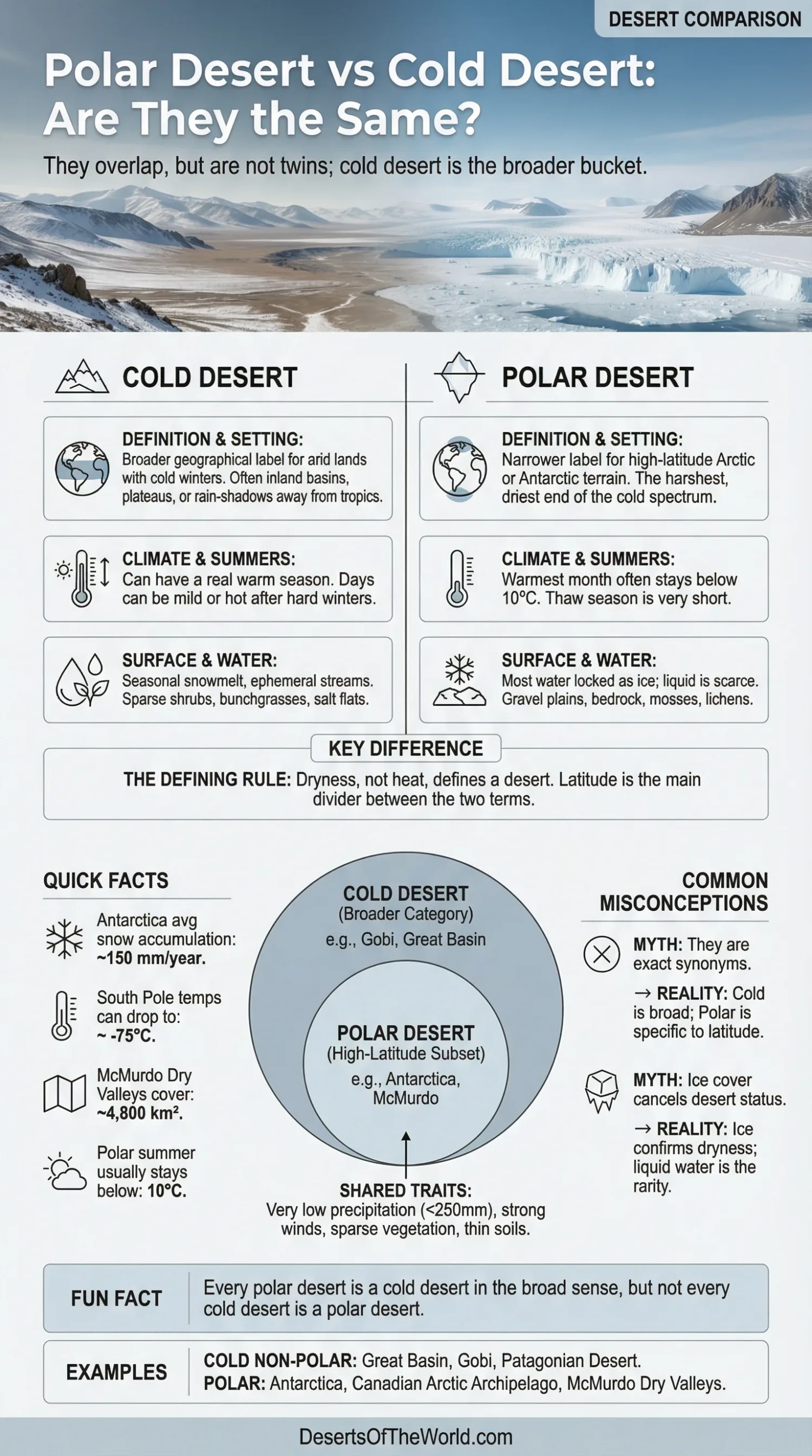
| Point of Comparison | Cold Desert | Polar Desert |
|---|---|---|
| Basic Meaning | A dry desert with cold winters, often outside the tropics | A very cold desert found at high latitudes in the Arctic or Antarctic |
| Relationship Between the Terms | Broader category | Usually treated as one type of cold desert |
| Typical Setting | Interior basins, plateaus, mountain rain shadows, high elevations | Polar regions, ice-free valleys, polar coasts, interior polar plateaus |
| Summer Conditions | Can be mild or even warm for a short season | Warmest month often stays below 10°C |
| Water on the Surface | Snowmelt, seasonal streams, short wet periods | Most water stays locked as ice; liquid water is scarce and brief |
| Examples | Great Basin, Gobi, Patagonian Desert | Antarctica, parts of the Arctic, McMurdo Dry Valleys |
What These Terms Actually Mean
Cold desert is a broad geographic label for arid land where low precipitation meets cold conditions. In many mid-latitude settings, that means a place with below-freezing winters, modest snowfall, and a short growing season. Some cold deserts sit deep inside continents. Others form in mountain rain shadows, where air loses moisture on one side of a range and arrives dry on the other. The Great Basin in North America is a textbook case. The Gobi is another well-known example.
Polar desert is a narrower label. It refers to desert terrain in the far north or far south, where temperatures stay very low and moisture is limited for most of the year. Antarctica is the clearest example. Parts of the Arctic also fit the label, especially the driest landscapes of the Canadian Arctic Archipelago and some ice-free polar ground where plant cover remains thin.
So, are they the same? No. They are related terms, not perfect substitutes.
Why The Confusion Happens
The mix-up comes from the way people use the word desert in everyday writing, climate science, and ecology. In plain geography, a polar desert is often described as one kind of cold desert. That is accurate enough for most readers. Yet in climate classification, the picture gets more precise.
Many non-polar cold deserts are grouped under the Köppen code BWk, the cold arid desert climate. Polar landscapes, by contrast, are often mapped as ET (tundra) or EF (ice cap), not BWk. That is why two statements can both be true at once:
- Polar deserts are cold deserts in a broad descriptive sense.
- Polar deserts are not always the same thing as BWk cold deserts in a climate-map sense.
That small distinction clears up most of the confusion. Miss it, and the terms start to blur.
Where They Overlap
Cold deserts and polar deserts share a core set of features:
- Very low precipitation, often around 250 mm a year or less in many desert definitions
- Strong winds and surface moisture loss from exposed ground, snow, or ice
- Sparse vegetation
- Thin, weakly developed soils or bare rock and gravel
- Short periods when meltwater or moisture becomes available
They can also look more alike than many people expect. Both may have gravel plains, salt-rich soils, patterned ground, dry stream channels, and large open surfaces with little plant cover. Sand is not required. In fact, plenty of cold deserts are mostly rock, silt, or stony plain.
Where The Boundary Appears
Latitude and Setting
Latitude is the first clear divider. Polar deserts belong to the Arctic and Antarctic. Cold deserts do not have to. Many sit in the middle latitudes or at high elevation, far from warm oceans and often behind mountain barriers. A place can be cold, dry, and windy without being polar. The Great Basin shows that well.
Summer Warmth
Another divider is summer. Non-polar cold deserts may still get a real warm season. Days can turn pleasantly mild, sometimes quite hot under strong sun, even after a hard winter. Polar deserts usually do not get that sort of summer. In many of them, the warmest month stays under 10°C, which keeps tree growth out of the picture and limits thaw.
Water State
In both environments water is scarce. In polar deserts, though, much of the water budget is trapped as ice for most of the year. That changes everything. Melt may appear for only a brief window, and some ground remains dry because the atmosphere is cold and holds little moisture to begin with. You see a frozen landscape, but hydrologically it can still behave like a desert.
Surface Cover
Cold deserts outside the polar zones often show open shrubland, bunchgrasses, salt flats, and wide alluvial fans. Polar deserts lean more toward ice sheets, gravel, exposed bedrock, fellfields, frost-shattered debris, and small ice-free pockets where life hangs on in sheltered spots. Bare ground, often. Barely any liquid water, too.
Why Antarctica Settles The Debate
Antarctica makes the distinction easy to see. It is a polar desert on a continental scale. Average snow accumulation across the continent is roughly 150 mm water equivalent per year, while the high interior plateau receives less than 50 mm in some areas. Near the coast, totals rise and can exceed 200 mm, with wetter pockets going much higher. Dry on average, but unevenly so.
That surprises many readers because Antarctica is covered in ice. Yet ice cover does not cancel desert status. It confirms a different kind of dryness. Snow falls, compacts, and stays. At the South Pole, air temperature can drop to around -75°C. Liquid water is the rare thing.
Inside Antarctica, the McMurdo Dry Valleys push the point even further. This ice-free region covers about 4,800 square kilometers and includes exposed soils, ephemeral meltwater streams, perennially ice-covered lakes, and valley floors that are among the driest places on the planet. During the austral summer, some streams run for only a few weeks. Then the landscape tightens back into cold dryness.
Cold Desert Does Not Always Mean Polar
Now flip the picture. The Great Basin Desert in the western United States is cold, arid, and shaped by rain shadow. Most precipitation arrives in the cool season, much of it as snow. Winters can be hard. Still, this is not a polar desert. It sits in the mid-latitudes, has a different seasonal rhythm, and supports a broader spread of shrubs and grasses than most polar desert terrain.
The same logic applies to the Gobi. It is famous for cold winters, dry air, and wide temperature swings, but it is not polar. Its dryness comes from continental position and mountain barriers rather than polar latitude. A snow-covered dune field may look polar for a moment. Geography says otherwise.
That is why using cold desert and polar desert as exact synonyms creates problems. One term tells you more about temperature and aridity. The other tells you temperature, aridity, and place on the globe.
How Plants, Soils, and Life Tend To Differ
Life is sparse in both settings, though the pattern shifts. In many non-polar cold deserts, shrubs, grasses, and seasonal wildflowers appear where snowmelt or rare rain can reach the soil. Root systems spread wide, leaves stay small, and growth moves fast when moisture arrives.
Polar deserts strip that pattern down even more. In the harshest sites, vascular plants may be absent or nearly so. Lichens, mosses, algae, microbes, and a few hardy invertebrates take over the biological story. The limit is not only cold air. It is the shortage of usable liquid water, the short thaw season, and soils that may contain salts, ice, or both.
Soils tell part of the story as well. Many cold deserts have immature, mineral-rich soils with patchy organic matter. Polar desert soils often show frost-driven structure, dry permafrost, salt buildup, and weak horizon development. Freeze-thaw action writes the surface. Quietly, but clearly.
Polar Desert and Tundra Are Not The Same Either
Another source of confusion sits right next door: tundra. Tundra and polar desert can look similar because both are cold, treeless, and low in precipitation. Still, tundra usually supports more continuous plant cover and a more active summer thaw layer. Polar desert is drier and barer. Think of tundra as a cold plain with a short living season; think of polar desert as the drier, harsher end of that cold spectrum.
On real ground, the line is not always sharp. Landscapes grade into each other. A polar region can hold ice cap, polar desert, and tundra within the same wider area. Labels help, but nature does not always draw them with a ruler.
The Cleanest Way To Use The Terms
- Use cold desert when talking about dry deserts with cold winters or low annual temperatures.
- Use polar desert when the desert is part of the Arctic or Antarctic environment.
- If the discussion uses climate maps, remember that many cold deserts are BWk, while polar terrains often fall under ET or EF.
- If the discussion is broad and descriptive, calling a polar desert a type of cold desert is fair.
So the best answer is not a flat yes or no. It is more precise than that. Every polar desert is a cold desert in the broad geographic sense, but not every cold desert is a polar desert. That difference may look small on the page. On the ground, it changes climate, ecology, surface water, and the way the landscape works.
Sources
- U.S. National Park Service — Deserts, Great Basin National Park (cold desert definition, rain shadow setting, Great Basin example)
- NOAA JetStream — Köppen-Geiger Climate Subdivisions (BWk, ET, and EF climate labels)
- National Snow And Ice Data Center — Arctic Weather and Climate (Arctic polar desert conditions)
- National Snow And Ice Data Center — Why The Cryosphere Matters (Antarctica as a polar desert and ice sheet context)
- British Antarctic Survey — Antarctic Factsheet and Geographical Statistics (Antarctica as a desert, snowfall and temperature figures)
- Australian Antarctic Program — Antarctic Weather (continent-wide precipitation pattern and wind conditions)
- NASA — Frequently Asked Questions About Antarctica (why Antarctica counts as a desert and what lives there)
- McMurdo Dry Valleys LTER — Overview (largest relatively ice-free area in Antarctica and dry valley ecology)