
Atacama Vs Namib Desert is a comparison between two deserts that are often placed side by side for one reason: dryness. Yet they do not function in the same way. The Atacama in Chile is a higher, more mineral, more rain-starved desert tied closely to the Andes. The Namib on the Atlantic side of southern Africa is a longer coastal desert shaped by dunes, fog, and moving sand. Dry, yes. Identical, no.
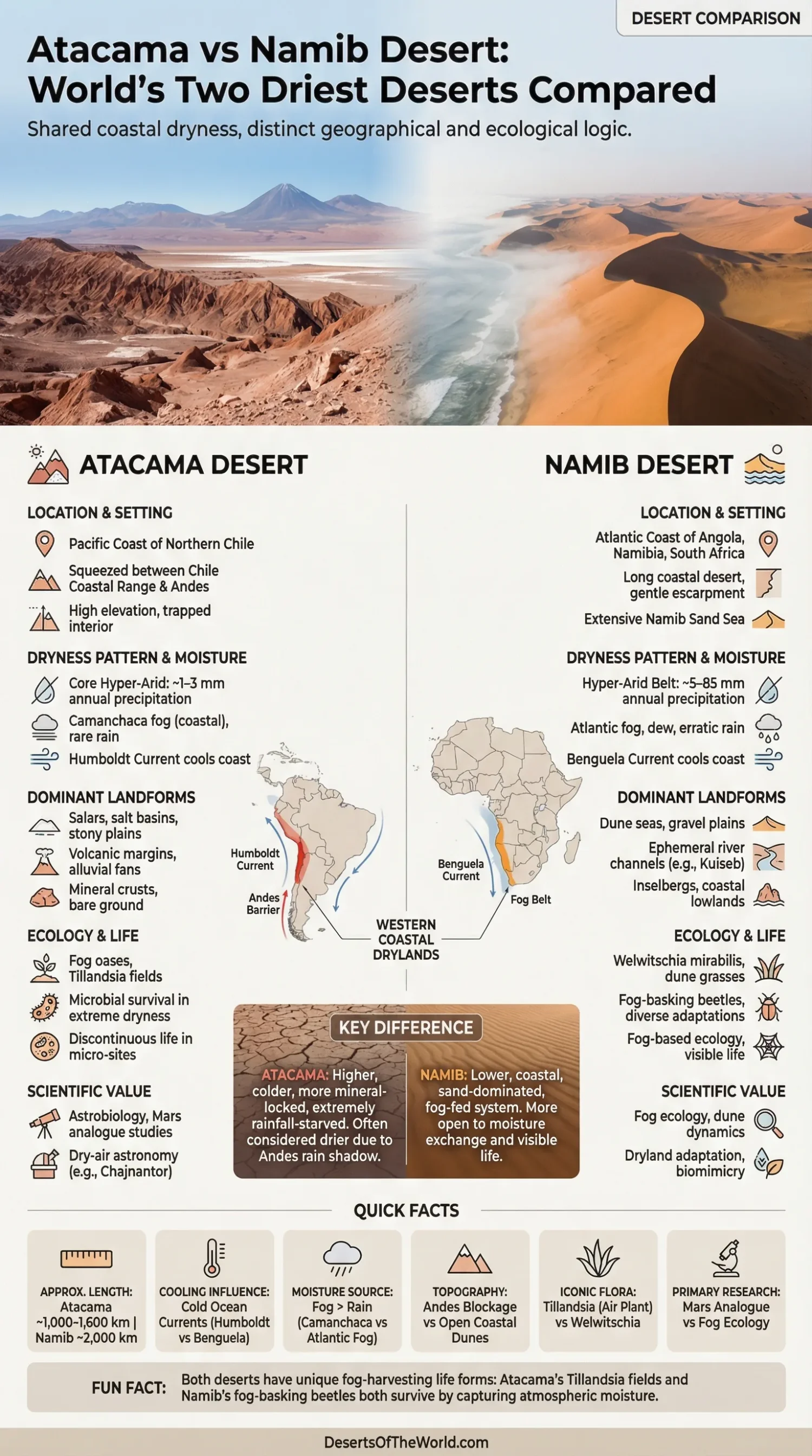
That difference matters. It explains why the Atacama is usually treated as the drier of the pair, why the Namib supports such a visible fog-based ecology, and why the ground itself looks so different in each place. One desert is known for salars, stony plains, volcanic margins, and Mars-like research sites. The other is known for dune seas, gravel plains, ephemeral river corridors, and plants that live inside a fog belt.
The figures below are approximate, because both deserts can be defined narrowly or broadly depending on whether the focus is climate, landforms, or ecological region.
| Feature | Atacama Desert | Namib Desert |
|---|---|---|
| Coast | Pacific Coast Of Northern Chile | Atlantic Coast Of Angola, Namibia, And South Africa |
| Approximate Length | Roughly 1,000–1,600 Km, Depending On Definition | About 2,000 Km Along The Coast |
| Dryness Pattern | Core Hyper-Arid Areas Can Fall To About 1–3 Mm Of Annual Precipitation | Hyper-Arid Belt Commonly Falls In A Rough 5–85 Mm Range, With Moisture Often Coming More From Fog Than Rain |
| Main Moisture Sources | Camanchaca Fog, Rare Rain, Limited Runoff From Higher Ground In Some Basins | Atlantic Fog, Dew, Erratic Rain, And Moisture Linked To Ephemeral River Systems |
| Dominant Landforms | Salt Flats, Pebbly Plains, Alluvial Fans, Basins, Volcanic Margins | Dune Fields, Gravel Plains, Inselbergs, Dry River Channels, Coastal Lowlands |
| Ecological Signature | Fog Oases, Tillandsia Fields, Salt-Flat Wetlands, Microbial Survival At Very Low Moisture | Welwitschia, Fog-Basking Beetles, Dune Grasses, Dense Fog-Belt Adaptations |
| Scientific Value | Astrobiology, Mars Analogue Studies, Dry-Air Astronomy, Long-Term Aridification Records | Fog Ecology, Dune Dynamics, Dryland Adaptation, Biomimicry |
Shared Dryness, Different Desert Logic
Both deserts belong to the same broad family of coastal drylands. Each sits on a western continental margin. Each is influenced by a cold ocean current. Each lies under sinking subtropical air that makes rainfall hard to generate. And each can receive fog more readily than proper rain near the coast.
Even so, their dryness is not a copy-and-paste pattern. The Atacama is the more locked-down system. The Namib is the more open one. That single contrast changes almost everything.
- The Humboldt Current cools the Pacific margin beside the Atacama.
- The Benguela Current cools the Atlantic margin beside the Namib.
- Both cold currents help create marine inversions: low cool air, warmer air above, cloud and fog near the coast, but little rain.
- Both deserts stay dry not because they are always blazing hot, but because the atmosphere struggles to turn moisture into rainfall.
That last point is easy to miss. Dry does not always mean hottest. In both deserts, cold ocean water helps keep coastal air cooler than many people expect.
Why The Atacama Is Drier
Cold Currents Set The Stage
The Atacama and the Namib both owe part of their aridity to cold upwelling currents. Those currents chill the lower air, help form fog and low cloud, and reduce the atmosphere’s ability to build rain-bearing convection. So the coast may look gray or misty, while the land just inland stays dry.
Still, cold water alone does not explain why the Atacama usually comes out drier in direct comparison. For that, relief matters more. Much more.
Topography Makes The Gap Wider
The Atacama is squeezed between the Chile Coastal Range and the Andes. That creates a two-sided moisture barrier. Pacific moisture does not travel far inland, and easterly moisture from the Amazon side is largely blocked by the Andes before it can reach the desert core. What remains is a very dry interior, with some sectors receiving almost no measurable rain in ordinary years.
The Namib rises from the Atlantic coast toward the escarpment too, but its topography is gentler and more open. Because of that, seasonal moisture exchange with the interior is less tightly shut off. Research comparing the two deserts points in this direction: the Atacama’s free atmosphere is drier, while the Namib receives more inland influence during parts of the year. Small changes in air pathways can produce large differences in moisture.
Fog Reaches Each Desert In A Different Way
In the Atacama, coastal fog is famous as camanchaca. It can nourish narrow belts of life on slopes and ridges and, in some places, support fog collection for water use. Yet the deeper interior remains extremely dry. Coastal fog exists, but it does not erase the rain shadow conditions that define the desert.
In the Namib, fog is a major ecological water source. UNESCO describes the Namib Sand Sea as a coastal fog desert where fog supplies moisture for many plants and animals. So while the Atacama can be drier in the strict rainfall sense, the Namib shows more plainly how a fog-fed desert system functions.
Landforms: Salt Basins Vs Dune Seas
Atacama: Basins, Salars, And Volcanic Margins
The Atacama is not a classic sea of giant dunes. Large dunes do exist in parts of it, but the desert is better known for salt flats, stony plains, alluvial fans, and high enclosed basins framed by volcanoes and uplifted ranges. Salar de Atacama is the best-known example, but the broader pattern matters more than any single site: this is a desert of minerals, crusts, sediment fans, and bare ground.
The landscape changes through a sequence of coast, Coastal Cordillera, interior depression, Andean margin, and high plateau. Each zone records different combinations of erosion, sediment movement, tectonic uplift, and moisture.
Namib: Dunes, Gravel Plains, And Ephemeral Rivers
The Namib, by contrast, is one of the clearest dune landscapes on Earth. The UNESCO-listed Namib Sand Sea alone covers 3,077,700 hectares, and it is described as the world’s only coastal desert with extensive dune fields shaped by fog. The sand system itself is built by a long sequence of river transport, ocean-current movement, and wind reworking.
There are dune ridges, interdune corridors, gravel plains, rocky outcrops, and dry river channels such as the Kuiseb and other ephemeral systems that can create narrow life corridors. The Atacama’s most familiar surfaces are crusted, pebbly, and basin-like. The Namib’s are often more strongly dominated by mobile and wind-shaped sand.
Life At The Dry Limit
Atacama Life
The Atacama has a reputation for lifelessness, but that needs a careful reading. The hyper-arid core can press life to very low levels, and that is one reason it attracts astrobiology research. Yet the desert is not uniformly barren. Life clusters where moisture appears in usable form: fog oases near the coast, river-fed pockets, higher-elevation margins, and saline wetlands near some salt flats.
One of the best examples of this pattern is Tillandsia, an air plant that can survive largely on fog moisture with little dependence on soil water. In parts of the coastal Atacama, these plants form fields positioned to intercept incoming moisture. Elsewhere, microbial communities persist in soils, rocks, and salt-rich niches under extremely dry conditions.
The Atacama therefore supports life unevenly. Its ecology is strongly tied to small areas where moisture becomes available.
Namib Life
The Namib’s ecology is easier to see because fog is woven into everyday survival. Welwitschia mirabilis, the plant most closely tied to the Namib in the public imagination, grows within the dry western part of southern Africa and receives moisture from both rainfall and fog.
The Namib is also known for fog-basking darkling beetles. Some species use body position and fog-laden winds to collect condensed water. Dune grasses such as Stipagrostis sabulicola add another layer, creating small patches of habitat within sandy environments.
Why Scientists Study Both Deserts
The Atacama matters to science for several reasons. Its hyper-arid soils and very low biological activity make it a widely used Mars analogue for astrobiology. Its high elevation, low humidity, and dry air also make parts of northern Chile suitable for astronomy, including the Chajnantor region where major observatories operate.
The Namib is widely studied for fog ecology, dune movement, moisture capture, and long-term dryland adaptation. Research on Namib organisms has also contributed to studies of biological water collection and surface design.
Atacama Aridification May Reach Back To The Eocene
Earlier interpretations often placed the development of widespread hyper-arid conditions in the Atacama within the Miocene, with some records linking stronger regional aridity to Andean uplift and the development of the modern ocean-atmosphere system along the Pacific coast. A 2026 Nature Communications study provides evidence that intense drying in the desert’s present hyper-arid core began much earlier.
The study examined cosmogenic 21Ne concentrations in 135 locally derived quartz clasts from low-relief surfaces in the Coastal Cordillera of northern Chile. Thirty-two clasts produced modelled exposure durations of Oligocene age or older. Most of the older clasts recorded surface-exposure histories of roughly 20–40 million years, while two exceptional samples produced modelled durations of about 47 and 62 million years.
The abundance of clasts with Middle to Late Eocene exposure durations indicates that fluvial activity and landscape modification in what is now the hyper-arid core had already declined strongly by that time. Their long preservation requires extremely slow landscape change, consistent with very dry conditions developing earlier than previously assumed.
This does not mean every part of the Atacama became uniformly hyper-arid during the Eocene. Geological records farther east in the Precordillera and Andean foothills still indicate later changes, including expansion of strong aridity during the Miocene. The evidence points instead to an older hyper-arid core in the Coastal Cordillera, followed by the development or strengthening of aridity across other parts of the desert.
The timing also changes how the causes of Atacama dryness are interpreted. The authors conclude that aridification in the core began before major Andean uplift and before development of the modern Humboldt Current. They identify global cooling after the Early Eocene Climatic Optimum as one possible driver. An earlier proto-Humboldt circulation may also have contributed to cooling along the Chilean coast, but that mechanism remains part of the interpretation rather than a settled single cause.
The Atacama and Namib therefore remain old coastal desert systems, but a simple statement that the Atacama’s hyper-arid history begins in the Late Miocene is no longer adequate. The 2026 evidence places the beginning of intense aridification in the present Atacama core on an Eocene to Oligocene timescale, while later tectonic and oceanographic changes helped shape the desert’s present regional pattern.
If the question is simply which desert is drier, the Atacama takes that point. If the question is which desert shows the fuller expression of a fog-dependent coastal desert, the Namib often makes the clearer case. Their similarities come from coastal aridity; their differences come from topography, atmospheric circulation, landforms, and ecological response.
Sources
- Nature Communications – Evidence For Eocene Aridification Of The Atacama Desert’s Hyperarid Core (cosmogenic exposure records, Eocene–Oligocene aridification, Andean uplift and Humboldt Current timing)
- Encyclopaedia Britannica – Atacama Desert (location, relief, coastal inversion, Humboldt Current, basic physical geography)
- NASA Earth Observatory – Rare Snow In Atacama Desert, Chile (rainfall figures for very dry parts of the Atacama)
- NASA Earth Observatory – Salt Flats, Mountains, And Moisture (Andes rain shadow, salars, Atacama as a Mars analogue)
- UNESCO World Heritage Centre – Namib Sand Sea (fog as a water source, dune systems, protected area size, landform diversity)
- NASA JPL – Namib Desert (rainfall range, dune height, age notes, Namib-Naukluft setting)
- University Of Cologne AWARES – Atacama Desert Research Notes (Atacama–Namib atmospheric comparison, topography, water-vapor pathways, rainfall seasonality)
- South African National Biodiversity Institute – Welwitschia Mirabilis (distribution and ecology of Welwitschia in the Namib region)
- European Southern Observatory – Snow Comes To The Atacama Desert (dry-air conditions, rainfall and humidity context for astronomy sites in the Atacama)