
People often picture deserts as endless dunes. The ground tells a different story. On Earth, sandy surfaces cover only a smaller share of desert land, while gravel plains, stone-strewn flats, and bare rock make up far more of it. That is why the contrast between erg and reg matters: one points to broad dune country, the other to stony desert ground shaped by wind, runoff, and time.
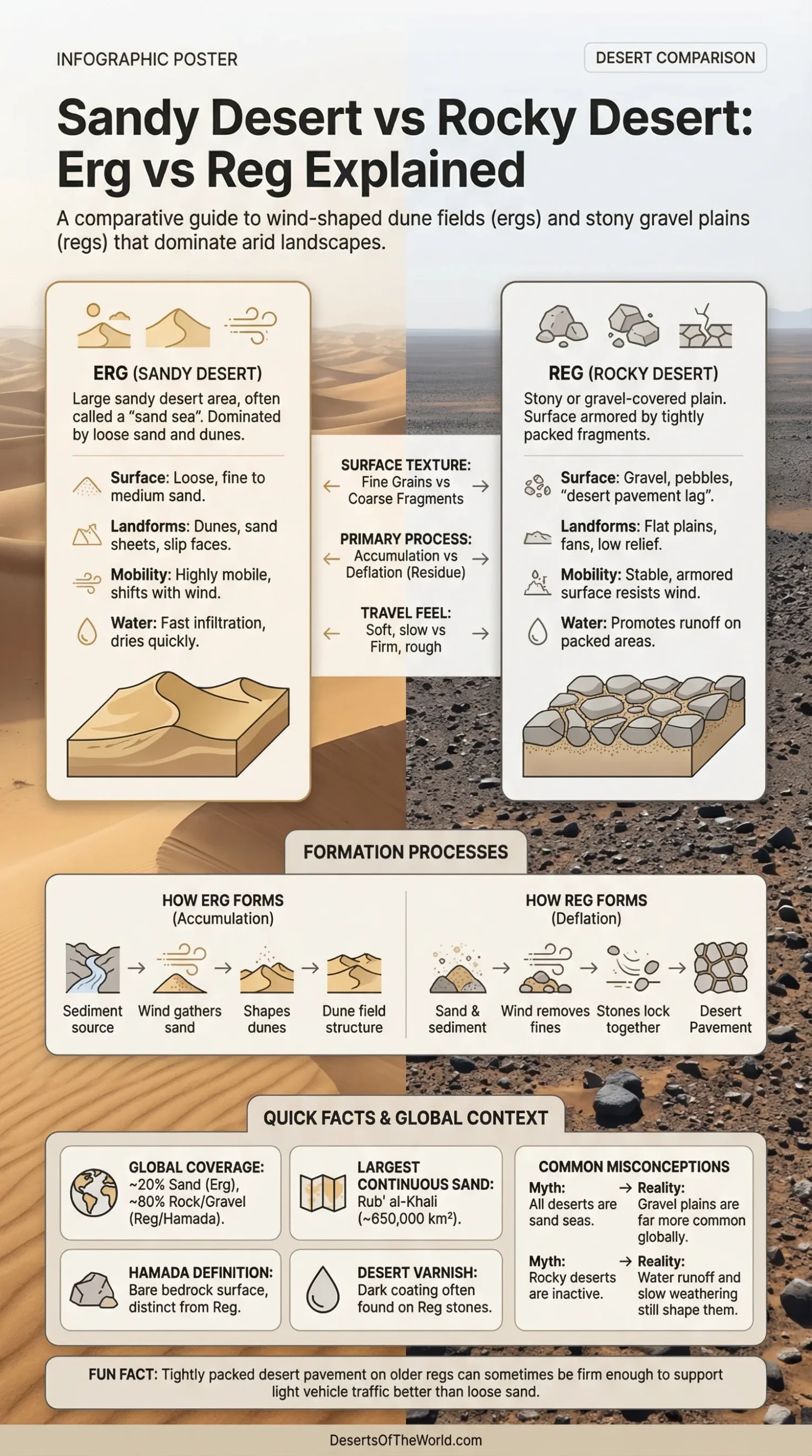
| Term | What It Means | Main Surface | How It Forms | Typical Look |
|---|---|---|---|---|
| Erg | Large sandy desert area, often called a sand sea | Loose sand, dunes, sand sheets | Wind gathers and reshapes abundant sand over long periods | Ridges, dune chains, crests, slip faces, interdune flats |
| Reg | Stony or gravel-covered desert plain | Pebbles, gravel, tightly packed surface stones | Wind removes finer grains and leaves a lag of coarser fragments | Firm flats, desert pavement, dark varnished stones, low relief |
| Hamada | Bare rock desert surface | Bedrock, larger rock fragments | Fine material is stripped away, exposing hard rock | Rock plateaus, hard surfaces, broken outcrops |
What Erg and Reg Mean
An erg is a wide sandy tract where wind-blown sand dominates the landscape. It may contain active dunes, older fixed dunes, and flatter sand sheets between dune belts. In plain terms, an erg is dune country on a large scale.
A reg is different underfoot and different in origin. It is a gravelly or stony desert plain, often coated with desert pavement, a close-packed layer of pebbles and small stones. From a distance a reg can look empty and flat. Up close, it is a carefully sorted surface left behind after finer sediment has been removed.
That last point matters. “Rocky desert” is a loose phrase in everyday English. In geomorphology, it helps to separate two surfaces:
- Reg: gravel or pebble plains
- Hamada: harder, barer rock surfaces and plateaus
So, a rocky desert is not always a reg. Sometimes it is a hamada. Sometimes both lie in the same desert basin, with dunes nearby. Side by side, they often sit.
Why Most Deserts Are Not Seas of Sand
The old postcard image misses the real balance of desert terrain. Sand covers only about one-fifth of Earth’s deserts, while nearly half of desert surfaces are gravel plains exposed by deflation, the wind-driven removal of finer material. That is why regs are more common than ergs on a global scale.
Wind can move silt and sand with ease. Pebbles and cobbles are harder to lift, so they stay behind. Over time the surface becomes armored. Water helps too. Brief runoff sorts sediment, shifts fines downward or away, and leaves coarser fragments locked together near the top. The result is a firmer, tighter ground surface than many people expect from a desert.
This is also why two desert surfaces that sit a few kilometers apart can feel like different worlds. One may be soft, rippled, and mobile. The other may be hard, gravelly, and almost road-like.
How an Erg Forms
Sand Supply Comes First
An erg does not form just because a place is dry. It needs a large supply of sand. Rivers, alluvial fans, dry lake basins, older sedimentary deposits, and weathered bedrock can all feed that supply. Wind then gathers, sorts, and drives the sand into dune fields.
Without enough sediment, there is no true sand sea. Dryness alone is not enough.
Wind Regime Shapes the Dunes
Once sand is available, wind direction and wind strength start to organize it. In one erg, dunes may line up in long parallel ridges. In another, crescent dunes may migrate across open flats. Elsewhere, multi-armed star dunes rise where winds arrive from several directions across the year.
That is why ergs are not featureless. They have internal structure:
- dune crests and slip faces
- interdune corridors
- sand sheets with lower relief
- local crusts or stabilized patches where moisture or plants reduce movement
Large ergs also store climate history. Buried dune sets, older surfaces, and changing dune patterns can reflect shifts in wind regime, sediment supply, and aridity over very long spans.
Ergs Are Mobile, But Not Uniformly So
Some dune faces shift readily. Other parts of the same erg may be partly fixed by moisture, salts, or sparse vegetation. So a sandy desert is not always a moving sea of sand. In many places, movement is patchy. One ridge migrates; the next sits more quietly.
How a Reg Forms
Deflation Leaves the Coarse Fraction Behind
A reg forms when fine grains are stripped from the surface and coarser fragments remain. This leftover gravel is often called a lag. Over time, that lag can tighten into desert pavement, a mosaic of interlocking stones spread across flats, fans, bajadas, and old terraces.
The process sounds simple. The finished surface is not. Wind removes fine sediment, brief rains sort and settle material, salts may cement grains below the surface, and repeated dry-wet cycles help stabilize the upper layer.
Desert Pavement Is More Than Loose Gravel
Well-formed desert pavement is not just scattered stones. It is commonly a packed surface of pebbles and gravel over finer sediment below. In many regs the stones carry dark coatings called desert varnish, giving the ground a brown-black sheen.
These surfaces tend to form on level or gently sloping terrain. Once tightly packed, they resist further wind stripping better than loose sand does. Firmer the ground becomes, and quieter the surface looks.
Water Still Matters in a Stony Desert
Regs may look dry in a very simple way, but hydrology still shapes them. Research on desert pavement landscapes shows that stony surfaces can reduce infiltration and push rainfall as runoff toward nearby bare patches or shrub mounds. That helps explain why plants in rocky deserts often appear clustered rather than evenly spread.
In short, a reg is not “dead ground.” It is a surface with its own water logic.
Sandy Desert vs Rocky Desert: The Main Differences
| Feature | Sandy Desert (Erg-Dominated) | Rocky Desert (Reg-Dominated) |
|---|---|---|
| Surface Texture | Loose, fine to medium sand | Gravel, pebbles, stone lag, desert pavement |
| Landform Style | Dunes, sand sheets, interdune flats | Plains, fans, terraces, low stony expanses |
| Mobility | Often mobile, especially on exposed crests | Usually more stable at the surface |
| Walking And Vehicle Feel | Soft, sinking, slower travel | Firmer, rougher, often easier to cross |
| Water Behavior | Fast infiltration, low water holding near the surface | More runoff on armored patches, moisture contrasts across micro-sites |
| Vegetation Pattern | Patchy, often tied to moisture depth and dune stability | Patchy, often clustered where runoff and finer soil gather |
| Typical Misconception | “All deserts look like this” | “This is just barren rock with no process behind it” |
Erg, Reg, and Hamada: Do Not Blend Them Together
This is one of the most missed parts of the topic.
An erg is sandy. A reg is gravelly or stony. A hamada is mostly bare rock. All three are desert surfaces, yet they are not interchangeable. A broad desert region may contain all of them within the same wider system.
The Sahara is a good example. It is famous for dunes, yet much of it is made of regs and hammadas rather than giant sand seas. The Arabian Desert shows the same pattern: huge sand bodies in some sectors, gravel plains and rock elsewhere.
That layered reality gives a better reading of desert geography. Deserts are mosaics, not single-texture landscapes.
Where Erg and Reg Landscapes Appear
Sahara
The Sahara contains famous ergs such as the Grand Erg Oriental and Grand Erg Occidental, but it also includes wide reg surfaces and rocky plateaus. This mix is one reason the Sahara cannot be reduced to “a dune desert.” It is better understood as a vast arid region with several surface types arranged by sediment supply, topography, and wind history.
Arabian Desert
The Arabian Desert includes some of the planet’s best-known sand bodies. The Rubʿ al-Khali alone covers about 650,000 square kilometers and is often described as the largest continuous sand area in the world. Yet outside the main sand accumulations, gravel plains and rocky tracts are common.
Central Asia
The Takla Makan is one of the largest sandy deserts on Earth, with an area of roughly 320,000 square kilometers. It shows how basin setting, sediment input, and long-term aridity can produce a very large erg-like sandy system. Around and beyond such sand bodies, stonier desert surfaces still appear.
Desert Margins and Basin Floors
Regs are especially common where wind has had time to winnow fine sediment from plains, terraces, and piedmonts. Ergs often gather where sand can accumulate in basins, along major transport paths, or downwind of strong sediment sources. A desert margin may grade from alluvial fan to reg, then to sand sheet, then to dunes. Gradual the shift can be.
Water, Soil, and Life on Sand and Stone
How Water Moves
Water behaves differently on sand and on armored gravel surfaces.
- In sandy terrain, water often infiltrates quickly, yet the upper layer also dries fast.
- In reg terrain, tightly packed surface stones can limit infiltration in some patches and redirect runoff to nearby microsites.
That difference shapes the small-scale ecology of each surface. On dunes, roots may chase moisture deeper into the sand. On regs, shrubs may favor zones where runoff and fine sediment collect.
Plant Distribution
Vegetation in both settings is sparse, though not random. Sandy areas may support grasses, shrubs, or dune-adapted plants where crests are stable enough. Rocky and gravel deserts often show plant islands separated by open pavement. The open spaces can look empty, yet they are part of the system that feeds water and sediment to the planted patches.
Animal Use
Animals also respond to surface texture. Burrowing is easier in softer substrates. Movement may be easier on firmer reg surfaces. Surface temperature, shelter, and food distribution vary as well. So the sandy-versus-rocky split is not just visual. It changes habitat.
Which Surface Changes Faster
At first glance, the answer seems obvious: sand changes faster. Often it does. Dune crests, ripples, and slip faces can shift after strong wind events. Tracks may vanish quickly.
Regs change more slowly at the surface, especially where desert pavement is mature and tightly packed. Yet they are not static. Runoff can cut channels nearby, salts can build in the soil, and fine dust can still move through the system. Over long periods, a reg records a long history of sorting, weathering, and surface stabilization.
So the contrast is not “active sand” versus “inactive rock.” It is a contrast in rate, surface mobility, and dominant process.
Common Misunderstandings
- “Every sandy desert is an erg.”
Not quite. Smaller dune fields and sand sheets may be sandy without being treated as full ergs. - “Every rocky desert is a reg.”
No. Some are hammadas, where exposed bedrock is the main surface. - “Sand means a harsher desert.”
Not automatically. Sandy and stony deserts each create their own limits and niches. - “One desert has one ground type.”
Rarely. Many deserts include ergs, regs, hammadas, playas, wadis, and alluvial fans in one wider setting.
Why the Erg vs Reg Distinction Is Worth Knowing
The terms sharpen the picture. They explain why one desert horizon rises in dunes while another spreads out as gravel plain. They also explain why many travel routes, plant patches, drainage patterns, and soil surfaces behave the way they do.
If the surface is dominated by mobile sand, the landscape speaks the language of dunes, slip faces, and sediment supply. If the ground is armored with gravel, the language changes to deflation, desert pavement, runoff concentration, and surface stability.
That is the heart of the comparison: erg is a desert of accumulation; reg is a desert of residue.
Sources
- USGS Desert Features (surface proportions of sandy and gravel desert terrain, plus desert soils and landforms)
- U.S. National Park Service: Aeolian (Dunes) Landforms (wind-shaped landforms, dune processes, and desert pavement in arid settings)
- USGS Ecosystems We Study: Deserts (desert climate threshold and biodiversity context)
- University of California Riverside / Desert Research Institute: Surface Control of Desert Pavement Pedologic Process and Landscape Function (desert pavement, infiltration, runoff, and vegetation patterns)
- University of Wyoming: Aeolian Transport and Depositional Processes in Deserts (erg formation, sediment supply, wind regime, and dune environments)
- Britannica: Erg (definition and geomorphic meaning of erg)
- Britannica: Reg (definition of reg and relation to desert pavement and stony plains)
- Britannica: Desert Pavement (formation of interlocking gravel surfaces by wind and water)
- Britannica: Hammada (bare rock desert surface and how it differs from reg)
- Britannica: Rubʿ Al-Khali (area and description of the world’s largest continuous sand area)
- Britannica: Takla Makan Desert (size and setting of one of the largest sandy deserts)