
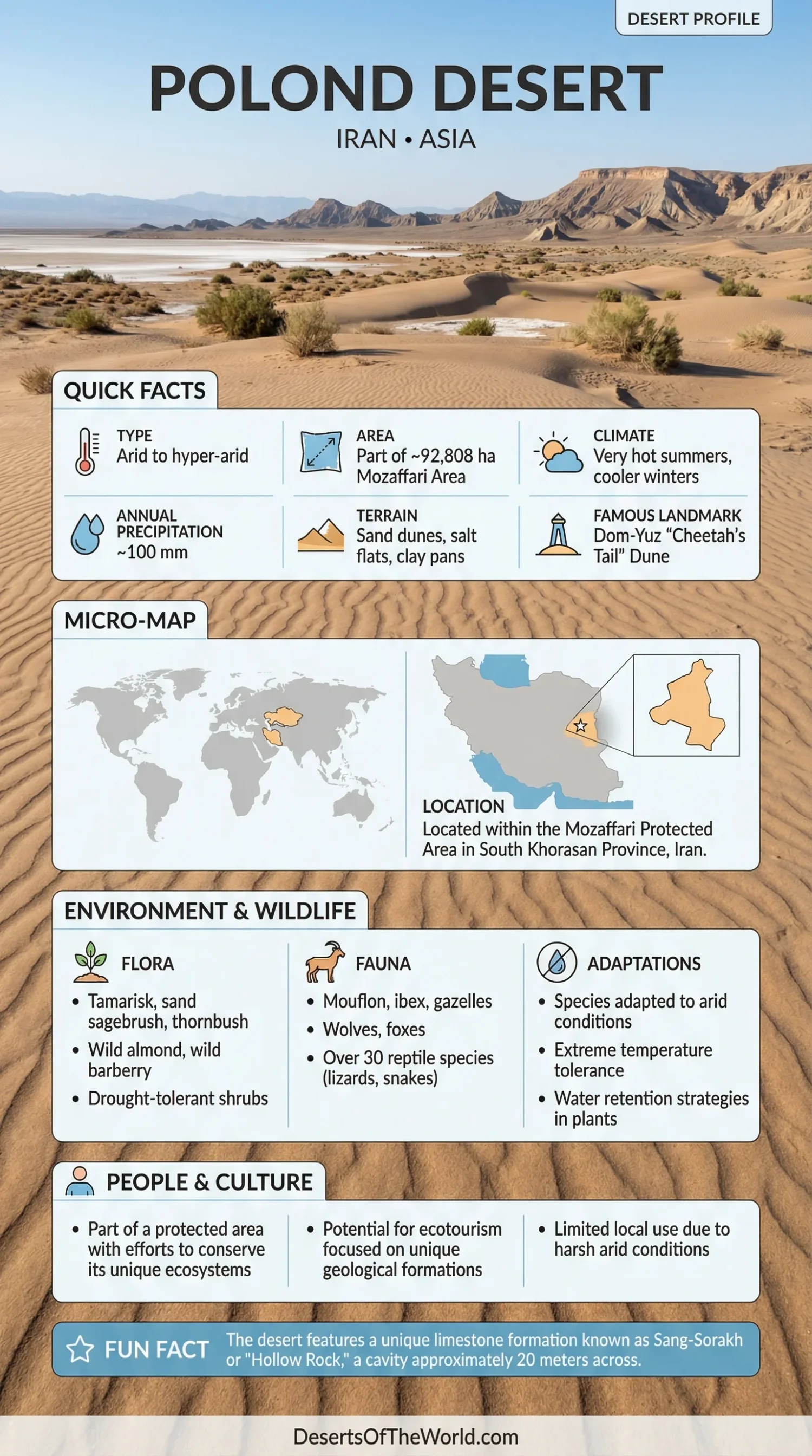
Location & Continent
Continent: Asia
Country: Iran
Region: South Khorasan Province, within Mozaffari Protected Area
Coordinates: ~34.16°N, 57.70°E
Physical Features
Protected Area: Part of the Mozaffari Protected Area, which covers about 92,808 ha
Landscape: Sand dunes, sandy plains, clay pans, salt-affected ground, foothills, and adjacent mountain terrain
Elevation: Around 1,000 m in parts of the desert plain, rising toward the surrounding uplands
Climate & Precipitation
Climate: Arid continental desert climate with hot summers and cold winter nights
Precipitation: Low and irregular, with occasional storms capable of producing short-lived runoff and flash flooding
Ecological Features
Biogeographic Realm: Palearctic
Biome: Deserts and xeric shrublands
Landscape Context: Iranian Plateau desert basin with adjoining foothill and mountain habitats
Flora & Fauna
Flora: Tamarisk, desert shrubs, wild almond, wild barberry, wormwood, camelthorn, ephedra, and other drought-tolerant vegetation
Fauna: Wild sheep, wild goats, gazelles, wolves, foxes, jackals, birds of prey, desert birds, lizards, snakes, and tortoises
Geology & Notable Features
Geology: Wind-shaped sand deposits, clay-rich desert surfaces, salt-affected plains, rocky foothills, and eroded limestone formations
Notable Features: Dom-Yuz dune, known as the “Cheetah’s Tail,” and Sang-Sorakh, a large natural rock cavity also known as Ferdows Hole-in-the-Rock
Introduction to the Polond Desert
The Polond Desert, also known as Kavir-e Polond or the Mozaffari Desert, lies west of Ferdows in South Khorasan Province, Iran. It forms part of the Mozaffari Protected Area, where sandy desert, open plains, foothills, and mountain terrain occur within a relatively compact area. Dunes, salt-affected surfaces, dry channels, and rocky formations give Polond a more varied landscape than a continuous sand sea.
Geography of the Polond Desert
Polond lies about 40 kilometers west of Ferdows within the 92,808-hectare Mozaffari Protected Area. The desert occupies the lower, drier parts of a landscape that also contains foothills and low mountain ranges.
Sand does not cover the entire area. Dune fields occur alongside hard desert surfaces, clay pans, salt-affected ground, dry drainage channels, and rocky terrain. This transition between open desert and uplands creates a wider range of habitats than would be found in a uniform dune field.
One of the best-known landforms is Dom-Yuz, a dune whose shape has been compared to a cheetah’s tail. Another local feature is Sang-Sorakh, or Ferdows Hole-in-the-Rock, a naturally eroded opening in a rocky formation within the protected area.
Climate Conditions
Polond has an arid continental climate shaped by its inland position on the Iranian Plateau. Summers are hot and dry, while winter nights can become cold. Daily temperature differences can also be large, especially under clear desert skies.
Rainfall is scarce and irregular. Short storms may send water through normally dry channels and across low-lying desert surfaces, but persistent surface water is uncommon. Vegetation is therefore concentrated where soil, runoff, and local topography provide enough moisture.
Seasonal Weather Patterns
| Season | Typical Conditions | Rainfall Pattern |
|---|---|---|
| Winter | Cool days with cold nights; frost can occur in the wider upland region | Low, with occasional precipitation |
| Spring | Mild to warm, with rapid temperature changes between day and night | Irregular showers may produce temporary runoff |
| Summer | Hot, dry, and usually clear | Very limited rainfall |
| Autumn | Warm early in the season, becoming cooler toward winter | Low and variable |
Flora and Fauna of the Polond Desert
The mixture of sandy plains, shrubland, rocky slopes, and mountain margins supports wildlife associated with both desert and upland habitats. Plant cover is generally sparse on exposed desert surfaces and becomes denser where soils retain more moisture or near foothills and drainage routes.
Vegetation
Vegetation in the Polond and wider Mozaffari area includes plants adapted to low rainfall, saline soils, and long dry periods:
- Tamarisk: Occurs in dry and salt-affected environments and can tolerate poor soils.
- Desert Shrubs: Drought-tolerant shrubs help stabilize sandy and gravelly ground.
- Wild Almond and Wild Barberry: Found mainly in suitable foothill and upland habitats rather than on bare dune surfaces.
- Wormwood, Camelthorn, and Ephedra: Typical dryland plants recorded in the wider protected landscape.
Wildlife
The broader Mozaffari Protected Area supports mammals, birds, and reptiles using different parts of the desert–mountain landscape:
- Wild Sheep and Wild Goats: Associated mainly with rocky slopes and mountainous sections of the protected area.
- Gazelles: Use open plains and desert-steppe habitats where vegetation and water conditions permit.
- Predators: Wolves, foxes, jackals, and other small carnivores occur within the wider protected landscape.
- Birds: Falcons, eagles, partridges, sandgrouse, and other birds of dry open country have been recorded in the area.
- Reptiles: Lizards, monitor lizards, several snake species, and terrestrial tortoises occur in desert and rocky habitats.
Protected Area and Environmental Pressures
Polond lies inside the Mozaffari Protected Area, which protects desert plains together with foothill and mountain habitats. This mixed terrain provides feeding, shelter, and movement areas for wildlife that would not be supported by bare dunes alone.
Dryland habitats in the wider region are sensitive to prolonged drought, heavy grazing, disturbance, and excessive use of groundwater and other limited water sources. Roads can also affect desert wildlife, particularly reptiles and small animals moving across open ground.
Mozaffari Protected Area
The protected area covers approximately 92,808 hectares. More than half of its terrain consists of desert, arid plains, and rolling dry hills, while the remainder includes mountain landscapes.
Protection of this wider area is especially relevant to Polond because the desert is connected ecologically with the surrounding slopes and rocky habitats. Animals can move between open plains and higher ground according to food, temperature, shelter, and water availability.
Polond within the Mozaffari Landscape
The Polond Desert is a relatively small desert tract within a much larger protected landscape in South Khorasan. Its defining features include the Dom-Yuz dune, salt- and clay-affected plains, rocky foothills, and the Sang-Sorakh formation. The meeting of desert and mountain terrain also explains why the Mozaffari area supports wild sheep, wild goats, gazelles, predators, birds, and reptiles alongside sparse desert vegetation.
Polond is therefore best described in relation to the Mozaffari Protected Area rather than as a vast independent desert covering tens of thousands of square kilometers. Its geography is based on the close transition between dunes, open arid plains, and the surrounding Iranian Plateau uplands.