
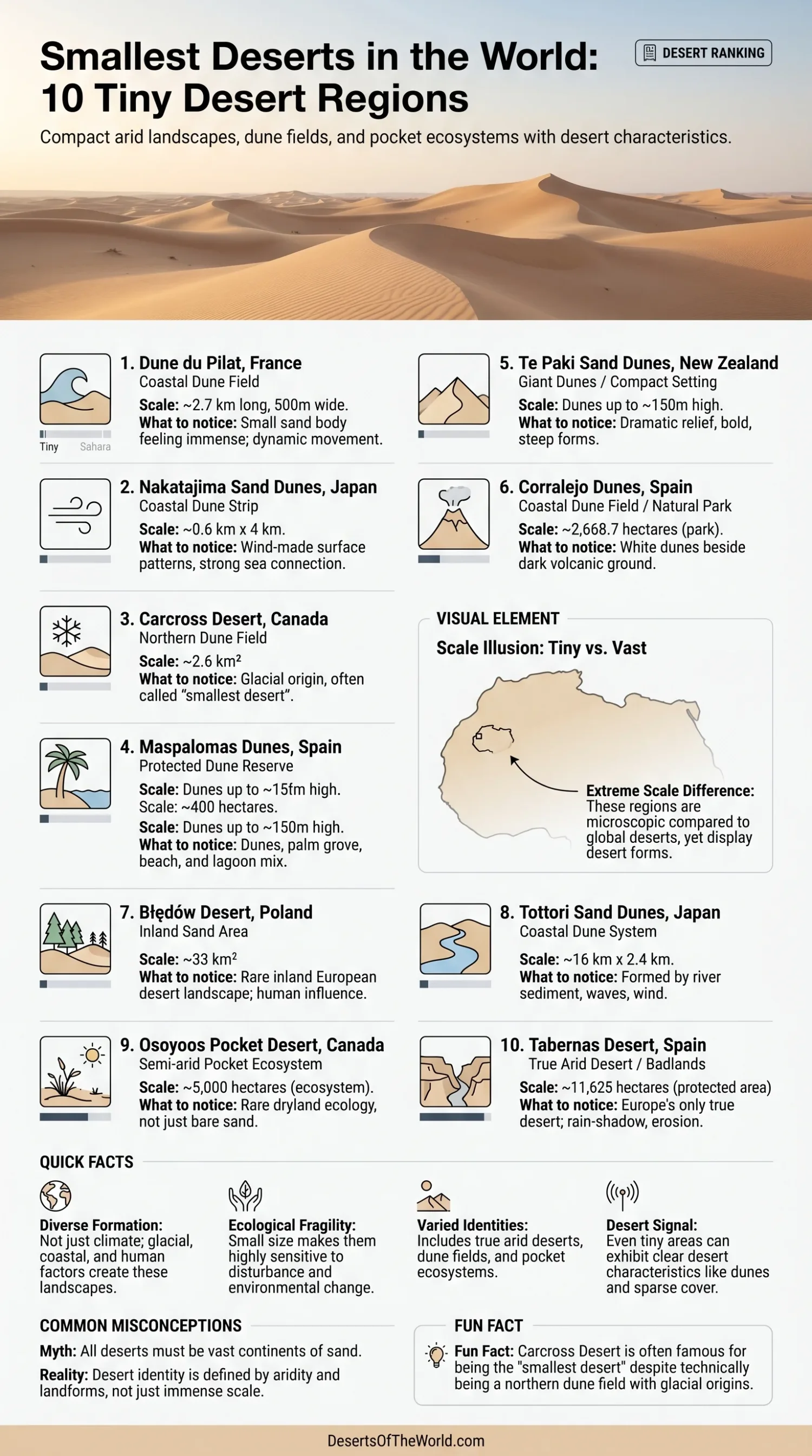
 When people search for the smallest deserts in the world, they usually expect a clean global ranking. Geography does not cooperate that neatly. Some places below are true arid deserts. Others are compact dune fields or pocket desert ecosystems that look and behave like deserts in the landscape, even if they do not fit every climatic definition. That distinction matters, especially with tiny regions where scale, rainfall, geology, and vegetation do not always line up in the same way.
That is also what makes these places worth studying. Small desert regions show desert formation in a tighter frame: glacial leftovers, coastal drift, rain-shadow dryness, exposed inland sand, and semi-arid shrubland can all produce land that feels stripped down, open, and wind-shaped. Tiny on the map, yes. Simple, no.
A Short Comparison
| Region | Country or Territory | Approximate Scale | Landscape Type | Main Reason It Stands Out |
|---|---|---|---|---|
| Dune du Pilat | France | About 2.7 km long and 500 m wide | Coastal dune mass | A very small sand body with a strong desert look |
| Nakatajima Sand Dunes | Japan | About 0.6 km by 4 km | Coastal dunes | Compact dune zone beside the Pacific |
| Carcross Desert | Yukon, Canada | About 1 square mile (2.6 km²) | Northern dune field | Often called the world’s smallest desert |
| Maspalomas Dunes | Gran Canaria, Spain | About 400 hectares | Coastal dune reserve | Desert-and-oasis mix in a very small area |
| Te Paki Sand Dunes | New Zealand | Dunes around 150 m high | Giant dunes in a compact reserve setting | Strong desert appearance at the far north of New Zealand |
| Corralejo Dunes | Fuerteventura, Spain | Natural park of 2,668.7 hectares | Coastal dune field | Large by island standards, still tiny beside major deserts |
| Błędów Desert | Poland | About 33 km² | Inland sand area | Rare European desert landscape away from the sea |
| Tottori Sand Dunes | Japan | About 16 km east-west and 2.4 km north-south | Coastal dune system | Japan’s best-known desert-like sandscape |
| Osoyoos Pocket Desert | British Columbia, Canada | About 5,000 hectares of antelope-brush ecosystem remain | Semi-arid pocket desert ecosystem | Canada’s best-known desert pocket |
| Tabernas Desert | Spain | Protected area about 11,625 hectares; broader desert area often treated as larger | True arid desert and badlands | Often described as Europe’s only true desert |
10 Tiny Desert Regions
1) Dune du Pilat, France
- Type: Coastal dune field
- Scale: About 2.7 km long and 500 m wide
- What to notice: a small sand body that still feels immense on foot
Dune du Pilat is not a desert in the climatic sense, yet it belongs in this conversation because it shows how a relatively small sand mass can produce a full desert impression. The surface is open, bright, steep in places, and always in motion. On the ground, its size feels larger than the numbers suggest. That mismatch between map scale and lived scale is part of what makes small desert landscapes so interesting.
Its setting is also unusual. Atlantic forest on one side, ocean on the other, and a moving wall of sand between them. In bigger deserts, movement can be hard to see unless the time span is long. Here, change is more visible. The dune keeps edging inland, reshaping its profile and reminding visitors that sand landscapes are never fixed for long.
2) Nakatajima Sand Dunes, Japan
- Type: Coastal dune strip
- Scale: About 0.6 km north-south and 4 km east-west
- What to notice: wind-made surface patterns and the strong sea connection
Nakatajima is a compact example of how a desert-like landscape can form right beside water. The dunes sit on the Pacific coast near Hamamatsu, and the wind draws delicate ridges and ripples across the sand. Those surface patterns matter. On a small dune field, they reveal the work of air movement with unusual clarity.
What sets Nakatajima apart is proportion. It is not a continental desert, not even close. Yet it still reads as a self-contained sand landscape with its own shape, ecology, and coastal rhythm. The sea is always nearby, but the eye often reads the ground first. Sand does that. It simplifies a scene.
3) Carcross Desert, Canada
- Type: Northern dune field often labeled a desert
- Scale: About 1 square mile (2.6 km²)
- What to notice: glacial origin, active sand supply, and the famous “smallest desert” label
Carcross is probably the first name many readers meet when they look up the world’s smallest desert. That reputation comes from its modest area and its striking contrast with the surrounding Yukon landscape. Snow-capped mountains, forest, glacial history, and bare sand appear in one frame. Oddly placed, it is. That is exactly why it stays in memory.
Scientifically, Carcross is better read as a northern dune field than as a textbook desert. The sand is linked to glacial deposits, and winds from Bennett Lake continue to move fresh material into the system. Even so, it earns its place here because it captures the main idea behind tiny desert regions: a very small area can still hold a clear desert identity, both visually and geologically.
4) Maspalomas Dunes, Spain
- Type: Protected dune reserve
- Scale: About 400 hectares
- What to notice: dunes, palm grove, beach, and lagoon in one compact setting
Maspalomas is one of the most concentrated desert-like landscapes in the Atlantic islands. In a small area, it brings together shifting sand, a brackish lagoon, beach edge, and palm grove. That mix gives it an oasis quality without turning it into a cliché. It really is a rare meeting point of dry sand forms and wetland life.
Its small size makes its ecological balance easy to disturb and easy to observe. Sand movement, vegetation spread, and visitor pressure all show up quickly in a place like this. That is another lesson small desert regions teach well: scale may be limited, but the environmental story is often sharp and readable.
5) Te Paki Sand Dunes, New Zealand
- Type: Giant dunes within a compact desert-like setting
- Scale: Dunes around 150 m high
- What to notice: dramatic relief compressed into a relatively small northern landscape
Te Paki feels larger than many entries on this list because the dunes rise so boldly. Height changes the experience. A modest desert region can seem huge when the sand lifts sharply and the slopes dominate the eye. That is the case here. The forms are clean, steep, and strongly sculpted by wind.
This landscape also broadens the usual idea of a tiny desert. Small does not have to mean flat, and it does not have to mean weakly defined. Te Paki shows the opposite. The area is compact enough to read as a distinct unit, yet bold enough to feel almost oversized.
6) Corralejo Dunes, Spain
- Type: Coastal dune field in a natural park
- Scale: Natural park of 2,668.7 hectares; coastal zone about 2.5 by 10.5 km
- What to notice: white dunes beside volcanic ground
Corralejo is a fine example of contrast doing the heavy lifting. On one side, bright dune fields. On the other, volcanic terrain in darker tones. That meeting of textures gives the area far more character than a simple “small desert” label suggests. It is not merely a pile of sand near the sea. It is a meeting point between two sharply different surfaces.
By global desert standards, Corralejo is still quite small. That is worth remembering. Large dune fields inside island landscapes can feel broad, but they remain tiny beside continental deserts measured in tens or hundreds of thousands of square kilometres. Small desert geography often works through this scale illusion.
7) Błędów Desert, Poland
- Type: Inland sand area
- Scale: About 33 km²
- What to notice: one of Europe’s strangest inland desert scenes
Błędów looks improbable because it sits far from the usual desert image. Forested Europe is not where most readers expect open drifting sand. Yet there it is: a broad inland sand surface often called the “Polish Sahara.” The name is playful, but the landscape itself is real and very unusual in context.
Its story also helps correct a mistake common in short desert articles. Not every desert-like landscape is purely a climate story. In Błędów, glacial deposits matter, but land use matters too. Forest removal and changes in groundwater helped expose the sands and keep the area open. In a small region, human influence can be easier to trace.
8) Tottori Sand Dunes, Japan
- Type: Coastal dune system
- Scale: About 16 km east-west and 2.4 km north-south; the best-known visitor zone is smaller
- What to notice: a long dune belt shaped by river sediment, waves, currents, and wind
Tottori is larger than the first places on this list, but it still belongs among small desert regions when measured against the world’s major deserts. What makes it so useful is not only size. It is the clarity of its formation story. Sand from the Sendai River system moved to the coast, waves and coastal currents reworked it, and wind shaped it into the dune forms seen today.
That layered origin explains why Tottori feels more complex than a simple beach dune strip. River, sea, and wind all leave their mark. The result is a desert-like landscape that is compact in global terms but remarkably rich in process. It is one of the clearest places on Earth for seeing how a coastal sandscape becomes a cultural landmark without losing its geological identity.
9) Osoyoos Pocket Desert, Canada
- Type: Semi-arid pocket desert ecosystem
- Scale: About 5,000 hectares of antelope-brush ecosystem remain relatively undisturbed, with only a small portion protected
- What to notice: rare dryland ecology rather than only exposed sand
Osoyoos is useful because it shifts the discussion away from bare dunes and toward desert ecology. This is not the classic picture of endless open sand. It is a small semi-arid ecosystem centered on antelope-brush, dry soils, and species adapted to heat and limited moisture. That makes it a better example of a living desert pocket than many dune-only sites.
It also shows why the smallest desert regions deserve more respect than they usually get. Small dry ecosystems can hold dense biological value. In Osoyoos, the story is not just visual dryness. It is habitat rarity, plant community structure, and the survival of species that need exactly this kind of ground and climate. Less showy than a giant dune wall, perhaps. More informative, often.
10) Tabernas Desert, Spain
- Type: True arid desert and badlands landscape
- Scale: Protected natural area about 11,625 hectares; the broader desert landscape is commonly treated as larger
- What to notice: a compact true desert with ravines, badlands, and strong rain-shadow conditions
Tabernas is the entry that brings this list back to a more formal desert definition. It is often described as Europe’s only true desert, and its landforms make the point quickly: badlands, ravines, sparse cover, pale sedimentary ground, and a dry basin feel shaped by erosion more than by vegetation. Even so, it remains very small beside the famous deserts that dominate school maps.
Tabernas matters because it proves that a true desert does not need giant scale to be unmistakable. The forms are enough. So is the climate setting. Surrounded by mountain barriers and known for its dry conditions, it offers a compact but very readable desert landscape. Not vast, but unmistakably desert.
Why Small Desert Regions Matter
Size Can Mislead
A tiny desert region may look trivial on a world map, yet still carry a full desert signal in the field. Bare sediment, low plant cover, strong wind action, dune movement, exposed mineral surfaces, and sharply focused local ecology can all appear in a very small space. That is why list articles built only around area often miss the point. Sand landscapes are experienced through form as much as through scale.
Formation Tells the Real Story
These ten places did not all form in the same way. Carcross ties back to glacial deposits and lake-fed sand movement. Tottori and Nakatajima depend on river sediment, wave action, and coastal winds. Corralejo and Maspalomas are island dune systems shaped by marine and wind processes. Osoyoos is a dry ecosystem story. Błędów shows how human land use can expose and maintain desert-like ground. Small deserts make these pathways easier to separate and understand.
Ecology Is Often More Delicate in Small Regions
Large deserts can absorb local disturbance without changing their identity overnight. Tiny desert regions usually cannot. When the area is limited, small shifts in vegetation, visitor traffic, water balance, or sand movement can alter the whole look of the place. That is one reason protected status appears so often in the sources behind these regions. Their scale makes them readable. It also makes them easier to lose.
The Label “Desert” Is Not Always Exact
That does not make the label useless. It just means it should be handled with care. Some readers want the strict climate definition. Others are really searching for the smallest desert-looking places on Earth. Both instincts are valid. The best way to handle the topic is not to force every site into one box, but to say clearly what each place is: true desert, dune field, pocket desert ecosystem, or desert-like sandscape.
Sources
- Destination Canada – A Quick Guide to Carcross (Carcross Desert size and glacial-dune description)
- Travel Yukon – Carcross (regional context and note on glacial-lake origin)
- Osoyoos Desert Centre – Restoration (remaining antelope-brush habitat figures)
- Osoyoos Desert Centre – Home (Canada’s pocket desert and ecological context)
- Turismo de Almería – Tabernas Desert (regional identity of Tabernas)
- Andalusia Tourism – Desierto de Tabernas (protected area scale and official tourism description)
- Visit Małopolska – Błędowska Desert (area and location of the Polish desert landscape)
- Tottori Tourism Guide – Tottori Sand Dunes (dimensions and landscape overview)
- Japan Tourism Agency – The Sand Dunes in Geologic, Historical, and Present-Day Times (formation history of Tottori dunes)
- Hamamatsu Tourism – Nakatajima Sand Dunes (dimensions and dune characteristics)
- iN Hamamatsu – Nakatajima Dune (wind patterns and coastal setting)
- Spain.info – Corralejo Nature Reserve (official natural park area)
- Visit Fuerteventura – Corralejo Natural Park (dimensions and dune-volcanic contrast)
- Hello Canary Islands – Maspalomas Dunes Nature Reserve (400-hectare dune, lagoon, and palm grove system)
- Official Gran Canaria Tourism – Masdunas Project (dune conservation and sand-loss context)
- New Zealand Department of Conservation – Te Paki Sand Dunes (official description and dune height)
- Dune du Pilat Official Site – Natural Site (dimensions and movement of the dune)