
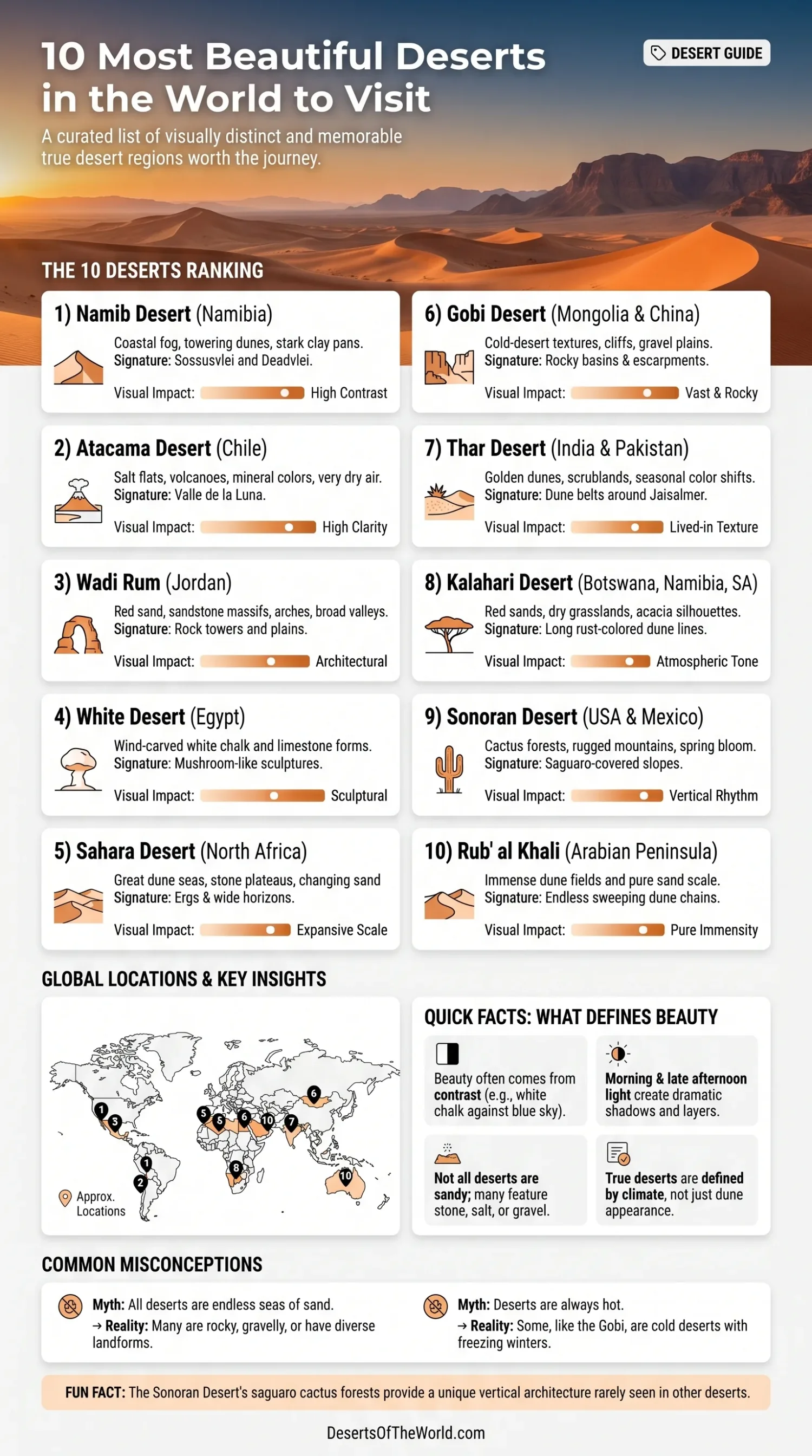
No ranking of beautiful deserts can ever be final. Light shifts, seasons alter the ground, and every desert has its own kind of beauty: some rely on height, some on color, some on silence, and some on the strange way rock and sky seem to meet without a seam. This list stays with true deserts and desert regions, not every dune landscape that only looks like one for a season. Each place below earns its place because it offers a visual character that feels distinct, memorable, and worth the journey.
| Desert | Region | What Makes It Beautiful | Best-Known Visual Signature |
|---|---|---|---|
| Namib Desert | Namibia | Coastal fog, towering dunes, stark clay pans | Sossusvlei and Deadvlei |
| Atacama Desert | Chile | Salt flats, volcanoes, mineral colors, very dry air | Valle de la Luna and high Andean basins |
| Wadi Rum | Jordan | Red sand, sandstone massifs, arches, broad valleys | Rock towers and open desert plains |
| White Desert | Egypt | Wind-carved white chalk and limestone forms | Mushroom-like rock sculptures |
| Sahara Desert | North Africa | Great dune seas, stone plateaus, changing sand tones | Ergs, oasis edges, and wide horizons |
| Gobi Desert | Mongolia and China | Cold-desert textures, cliffs, gravel plains, open sky | Rocky basins and pale escarpments |
| Thar Desert | India and Pakistan | Golden dunes, scrublands, seasonal color shifts | Dune belts around Jaisalmer |
| Kalahari Desert | Botswana, Namibia, and South Africa | Red sands, dry grasslands, acacia silhouettes | Long rust-colored dune lines |
| Sonoran Desert | USA and Mexico | Cactus forests, rugged mountains, spring bloom | Saguaro-covered slopes |
| Rub’ al Khali | Arabian Peninsula | Immense dune fields and pure sand scale | Endless sweeping dune chains |
What Makes a Desert Beautiful to Visit
Desert beauty is not just about dunes. That is where many short travel pieces lose the plot. Some of the finest desert scenery comes from contrast: white chalk against a blue sky, black rock beside orange sand, a cactus forest rising from dry ground, or fog softening a coast that should feel harsh but somehow does not. In one place the land looks sculpted. In another it looks painted.
Sand, Stone, Salt, and Light
The best desert landscapes usually combine more than one surface. A dune field alone can be beautiful, yes, but a dune field beside a clay pan, volcanic ridge, canyon wall, salt flat, or dry grass plain stays in the mind longer. Desert light matters too. Morning brings relief and shadow. Midday sharpens edges. Late afternoon turns ridges and slipfaces into layers.
Why This List Favors True Deserts
Some famous places look desert-like without actually being deserts in the climatic sense. They may still be lovely, but this list stays close to landscapes that are widely recognized as deserts or desert regions. That makes the comparison cleaner, and frankly, more useful.
10 Most Beautiful Deserts in the World to Visit
1) Namib Desert, Namibia
If one desert had to stand for pure visual identity, the Namib would be hard to beat. It is a coastal desert, and that changes everything. Fog drifts inland from the Atlantic, softening the edges of an otherwise severe landscape. Then the light lifts, and the dunes turn from muted brown to copper, then to deep burnt orange. Few deserts shift mood so quickly.
The Namib is also a place of clean shapes. The dune faces are high and smooth, the clay pans are pale and flat, and the dead camel thorn trees at Deadvlei look almost drawn by hand. There is barely any visual clutter. That is part of the effect. The scenery feels edited down to line, color, and scale. Visit enough deserts and one thing becomes clear: not all dune fields are equal. The Namib’s are among the most elegant on Earth.
Its beauty comes from restraint. Nothing looks accidental here.
2) Atacama Desert, Chile
The Atacama does not rely on softness. It wins through sharpness. This is one of the driest non-polar deserts on Earth, and the dryness shows in every surface: crusted salt pans, mineral-stained ravines, dusty plains, and volcanoes that seem to float behind heat shimmer. The palette is wider than many expect. Beige, rust, ash gray, ivory, and faint green all appear, sometimes in a single view.
What makes the Atacama especially beautiful is its vertical range. In a short mental sweep, the eye can move from a salt flat to a red canyon wall to a snow-dusted volcanic cone. The air often feels very clear, so distances look almost unreal. Valle de la Luna is famous for good reason, but the desert’s appeal runs deeper than one viewpoint. It is a land of texture and horizon, severe but never dull. At sunset, the ground seems to hold light rather than reflect it. A strange effect. A fine one.
3) Wadi Rum, Jordan
Wadi Rum proves that a desert does not need endless dunes to feel grand. Its beauty comes from the meeting of sandstone, granite, and open space. Massive rock walls rise from broad sandy valleys. Natural arches appear where you do not expect them. Narrow gorges cut into the stone, then open suddenly into silence and distance. The whole place feels architectural, though nothing about it is man-made.
Color does much of the work here. The sand can carry red, rose, or amber tones depending on the hour, while the cliffs shift from warm gold to mauve shadow. That play of color gives Wadi Rum a cinematic quality, but the land itself is older and more grounded than any film image. It is not a dune sea. It is a rock desert with moments of sand, and that distinction matters. The scenery has weight, shape, and vertical drama. When the late sun catches the cliff faces, very little else looks like it.
4) White Desert, Egypt
The White Desert stands apart because it looks unlike the desert most people picture first. Instead of orange dunes or dark gravel plains, it offers chalk and limestone forms carved by wind into towers, caps, bulges, and odd balanced shapes. Some resemble giant mushrooms. Others suggest animals, tents, or frozen clouds. It is one of those places where geology does half the storytelling before a guide even says a word.
Its beauty lies in contrast. The ground can be pale cream or bright white, the sky often a clean blue, and the shadows surprisingly cool in tone. That gives the landscape an almost sculptural clarity. Yet it never feels artificial. These formations are the product of erosion, patience, and old marine sediments from a much earlier natural history. The result is a desert that feels airy rather than heavy. Many deserts impress through mass. The White Desert impresses through form.
5) Sahara Desert, North Africa
The Sahara is so large and so famous that it is often flattened into a single image: one endless sea of sand. Beautiful, yes, but incomplete. The Sahara is more varied than that. It holds ergs, rocky plateaus, gravel plains, dry valleys, oasis belts, and isolated mountain massifs. That variety is one reason it belongs on any serious list of beautiful deserts. Beauty here is not only about dunes. It is also about change across distance.
Even within the sandy parts, the Sahara does not repeat itself as much as casual lists suggest. Some dunes are rounded and soft. Others are steep, high-crested, and sharply lit. Their color can lean gold, apricot, rose, or a darker orange-brown depending on the minerals and the hour. The Sahara’s strongest visual quality may be its scale. Not just large, but expansive in a way that recalibrates the eye. The farther you look, the more minimal the land becomes. Few places make emptiness look this full.
6) Gobi Desert, Mongolia and China
The Gobi is one of the best reminders that deserts are not always sandy and not always hot. In fact, much of the Gobi is a cold desert marked by bare rock, gravel plains, dry basins, and cliffs rather than classic dune seas. That is exactly why it deserves a place here. Its beauty is quieter at first glance, then richer the longer you look.
Where the Namib speaks in curves, the Gobi often speaks in surfaces. The land can appear blunt, open, and pale under a hard sky. Then the detail arrives: layered escarpments, isolated outcrops, distant mountain margins, and vast stony plains that seem almost lunar. The color range is subtle but real, from dusty tan and soft gray to iron-red bands in exposed rock. The Gobi has room in it. A lot of room. That breadth gives even small landforms unusual presence. Nothing needs to be huge to matter there.
7) Thar Desert, India and Pakistan
The Thar is one of the most visually lively deserts on this list. It does not depend on emptiness alone. Instead, it mixes dune belts, open scrub, dry grass, thorny vegetation, and settled edges that give the landscape a lived-in texture. That combination makes the Thar feel warmer and more layered than many desert stereotypes allow.
Its dunes are often golden rather than red, and the terrain changes more often than first-time readers of the map might expect. Light winds can redraw small ridges quickly, while the broader pattern of sand, scrub, and dry plain holds together. This is part of the Thar’s charm: it feels active without feeling chaotic. There is also a softer visual rhythm here. Acacia forms, patches of hardy grass, and low undulations break up the horizon in a way that keeps the eye moving. A desert, yes, but never monotonous.
8) Kalahari Desert, Botswana, Namibia, and South Africa
The Kalahari is beautiful in a more understated way. It does not announce itself with the tallest dunes or the strangest geology. What it offers instead is tone: long red sand ridges, pale grasses, scattered shrubs, and acacia silhouettes against an enormous sky. The colors feel dry but alive. Not lush, yet not empty either.
That mixture gives the Kalahari a distinct personality. Many deserts separate sand from life quite clearly. The Kalahari lets them overlap. Red ground carries grasses. Trees punctuate the distance. Wildlife is part of the visual field rather than a separate story. The result is a desert that feels open, breathable, and deeply atmospheric. When the sun lowers, the red sand darkens and the grass takes on a silver cast. Then the whole place seems to widen. Beautifully so.
9) Sonoran Desert, USA and Mexico
The Sonoran Desert may be the strongest answer for anyone who thinks deserts lack plant architecture. Here the famous saguaro cactus forests give the land a vertical rhythm that few other deserts can match. Add mountain backdrops, rocky slopes, ocotillo, palo verde, and spring bloom in good years, and the Sonoran starts to feel less like a blank dry zone and more like a carefully spaced natural garden.
Its beauty is especially clear because it combines landform and life so well. Broad valleys sit beside rugged ranges. Green punctuates tan and rust. The silhouettes are instantly recognizable. No other desert looks quite like a hillside covered in mature saguaros under low desert light. That image belongs to the Sonoran almost alone. It is also one of the easiest deserts to underestimate in print. On the ground, though, the balance of cactus, stone, and sky is striking.
10) Rub’ al Khali, Arabian Peninsula
If the Namib is sculptural and the White Desert is strange, the Rub’ al Khali is pure immensity. Often called the Empty Quarter, it contains one of the greatest continuous sand expanses on Earth. Here beauty comes from repetition at a scale so large that repetition becomes variation. Dune after dune, ridge after ridge, the land keeps unfolding.
Yet the Empty Quarter is not visually simple. The dunes rise in long lines and broad swells, then break into sharper crests and smoother backs. Wind leaves fine patterns across the surface. In some light the sand looks pale gold. In other light it turns deeper, almost bronze. The strongest impression is spatial. Few deserts convey sand as a total environment the way this one does. There is almost no competition for the eye. Just form, distance, and the logic of the wind written across the ground.
Why These Deserts Stay in the Memory
The deserts above are not beautiful for the same reason. The Namib has fog and line. The Atacama has dryness and mineral color. Wadi Rum rises vertically. The White Desert feels sculpted. The Sahara expands in every direction. The Gobi strips the land back to stone and sky. The Thar carries a living texture. The Kalahari glows red. The Sonoran frames beauty through cactus forms. The Rub’ al Khali reduces the world to sand and scale.
That range matters. It shows that desert beauty is not a single category but a family of forms. Visit enough of them and one lesson keeps returning: what looks empty from far away is often full of pattern once you stand inside it.
Sources
- UNESCO: Namib Sand Sea (official page on the fog-influenced coastal desert, dune systems, and site scale)
- NASA Earth Observatory: Atacama Desert, Chile (official overview of the Atacama’s dryness, salt pans, gorges, and volcanic backdrop)
- UNESCO: Wadi Rum Protected Area (official page on Wadi Rum’s cliffs, arches, gorges, and protected desert landscape)
- Egypt State Information Service: White Desert Reserve (official page on the White Desert protected area and its natural setting)
- Egyptian Environmental Affairs Agency: White Desert Protected Area PDF (official material on the limestone erosional features and landscape character)
- Britannica: Sahara (topic page on the Sahara’s geography, landforms, and regional extent)
- Britannica: Gobi (topic page explaining why much of the Gobi is rocky rather than sandy)
- UNESCO Tentative List: Desert National Park (topic-specific page used for Thar Desert ecology and landscape context)
- Botswana Tourism: Kalahari Desert (official page on the Kalahari’s red sands, plateau setting, and natural character)
- U.S. National Park Service: Sonoran Desert National Monument (official page on Sonoran biodiversity and the extensive saguaro cactus forest)
- Visit Saudi: The Majestic Dunes of Saudi Arabia (official travel page on Rub’ al Khali dune forms and desert scenery)
- NASA Earth Observatory: Empty Quarter, Arabian Peninsula (official page on the scale and sand extent of Rub’ al Khali)