
Some sand dunes look like hills, while a few rise on the scale of mountains. Rankings of the tallest sand dunes in the world vary because sources do not always measure the same feature. One source may use base-to-crest relief, another may report summit elevation above sea level, and another may separate free-standing dunes from dunes that climb against a mountain front.
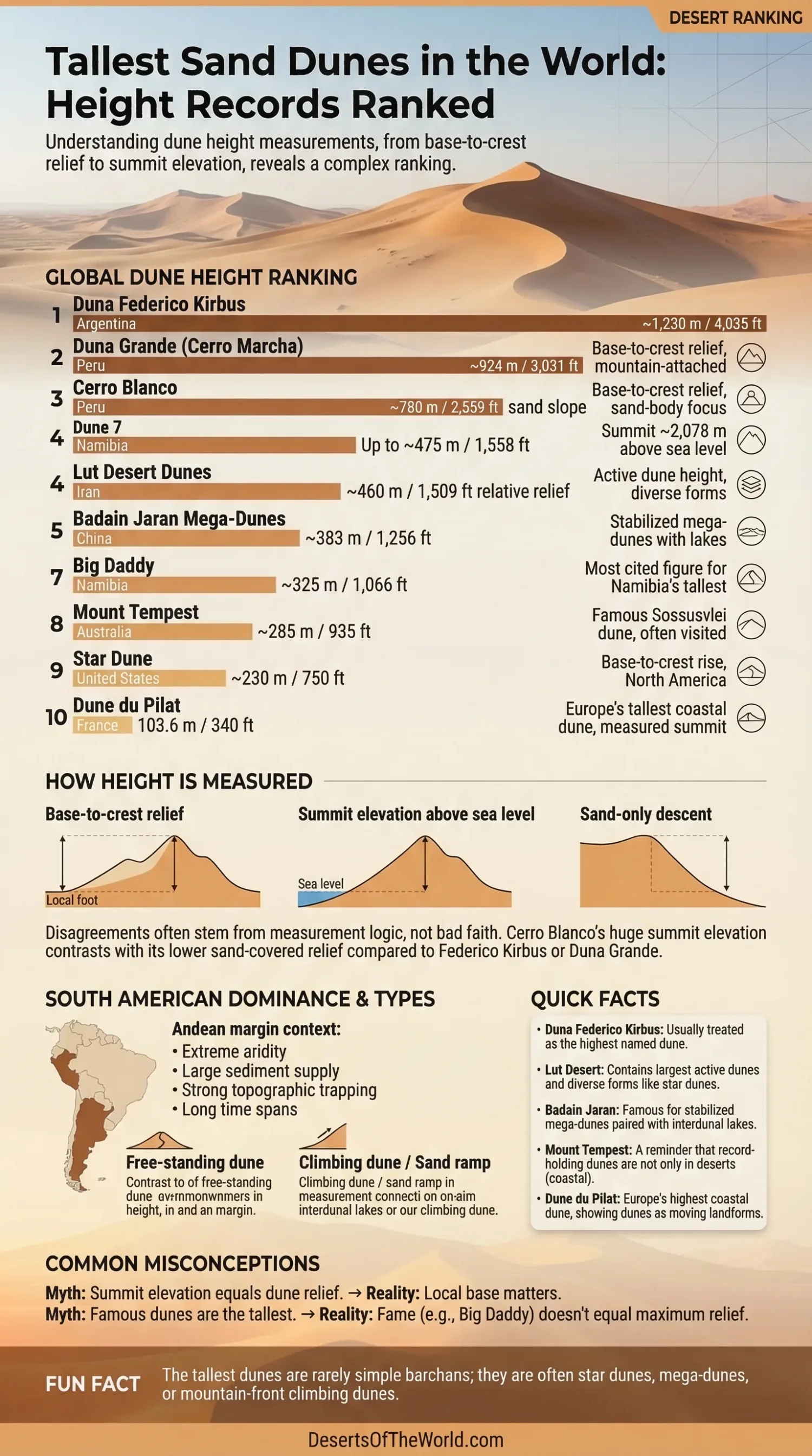
These distinctions can change the order of a ranking. The table below uses the most widely cited public height figures for named dunes or dune systems and identifies the measurement method attached to each figure.
| Rank | Dune Or Dune System | Country | Cited Height | What That Figure Usually Means |
|---|---|---|---|---|
| 1 | Duna Federico Kirbus | Argentina | About 1,230 m / 4,035 ft | Base-to-crest relief, usually treated as the highest named dune on Earth |
| 2 | Duna Grande (Cerro Marcha) | Peru | About 924 m / 3,031 ft | Base-to-crest relief, widely cited in specialist dune rankings |
| 3 | Cerro Blanco | Peru | About 780 m / 2,559 ft sand slope; summit around 2,078 m above sea level | Summit elevation and sand-body relief are often confused; the sandy descent is lower than the summit figure |
| 4 | Lut Desert Dunes | Iran | Up to about 475 m / 1,558 ft | Active dune height in the UNESCO-listed Lut Desert |
| 5 | Badain Jaran Mega-Dunes | China | About 460 m / 1,509 ft relative relief | Stabilized mega-dune relief; widely described among the tallest stationary mega-dunes |
| 6 | Dune 7 | Namibia | About 383 m / 1,256 ft | Most cited public figure for Namibia’s tallest named dune |
| 7 | Big Daddy | Namibia | About 325 m / 1,066 ft | Height commonly given for the tallest dune in the Sossusvlei area |
| 8 | Mount Tempest | Australia | About 285 m / 935 ft | Usually described as the highest coastal sand dune or highest stabilized coastal sand dune |
| 9 | Star Dune | United States | About 230 m / 750 ft | Base-to-crest rise; one of North America’s tallest dunes |
| 10 | Dune du Pilat | France | 103.6 m / 340 ft in the latest public site measurement | Current measured summit height of Europe’s tallest coastal dune |
How Sand Dune Height Is Measured
Differences between dune rankings usually come from the measurement method. A dune can be measured in at least three common ways:
- Base-to-crest relief: how much the dune rises from its local foot to its crest.
- Summit elevation above sea level: how high the top sits in an absolute sense.
- Sand-only descent or slip-face height: how much true sandy vertical drop exists on the rideable or visible face.
Cerro Blanco shows how these methods produce different results. Its summit stands high above sea level, while the actual sand-covered relief is lower. Rankings based on local relief usually place it below Duna Federico Kirbus and often below Duna Grande.
A separate classification issue concerns free-standing dunes, climbing dunes, and sand ramps. Guinness treats these as distinct record categories. Several South American giants accumulate against pre-existing Andean topography, producing very high local relief in a mountain-front setting.
Why the Highest Recorded Dunes Cluster in South America
The tallest named dune records cluster in Argentina and Peru because desert landscapes on the Andean margin combine several conditions that favor very large aeolian landforms:
- Extreme aridity, so sand is dry and mobile for long periods.
- Large sediment supply, much of it reworked from old basin deposits and desert plains.
- Strong topographic trapping, where wind-driven sand piles against mountain fronts and basin edges.
- Long time spans with repeated reworking rather than short-lived dune building.
Many of the largest South American dunes are mountain-edge accumulations rather than isolated dunes on flat plains. Their position in very dry basins allows sand to build high against existing slopes and basin margins.
Duna Federico Kirbus, Argentina
Duna Federico Kirbus, in the Bolsón de Fiambalá of Catamarca Province, is the dune most often listed as the highest named sand dune in the world. Public figures usually place its relief at about 1,230 meters, with the crest near 2,845 meters above sea level.
It sits in a dry intermontane setting where wind, loose sediment, and Andean relief combine. From a distance, the dune appears more like a sandy mountain wall than a classic crescent. Its form reflects a basin-and-slope setting rather than an isolated ridge on level ground.
Geomorphically, it is usually described as a fixed or mountain-attached dune form, with a surface that remains subject to wind reworking even though the full landform does not migrate like a smaller barchan. The recorded height is only meaningful when the dune’s landform type is also identified.
Duna Grande, Peru
Duna Grande, also called Cerro Marcha in some references, is widely cited at about 924 meters of relief. In many specialist dune rankings, it sits just behind Duna Federico Kirbus and ahead of Cerro Blanco when the focus is on sand-body relief.
Peru has several giant dunes in the Nazca-Ica desert belt, and their names are often mixed together. Cerro Blanco receives more attention from trekkers and sandboarders, while Duna Grande is commonly placed higher when rankings use sand-body relief rather than summit elevation.
When the comparison is based on visible relief from the local desert floor, Duna Grande belongs near the top of the list.
Cerro Blanco, Peru
Cerro Blanco, near Nazca, is one of the best-known giant dunes on the planet. Peru’s tourism inventory lists it at about 2,078 meters above sea level. That absolute elevation is part of why it appears in so many “highest dune” claims.
The sandy descent commonly cited for Cerro Blanco is around 780 meters, because the base of the sandy section already lies far above sea level. Its sand-only vertical relief is therefore much lower than the summit elevation of 2,078 meters.
Cerro Blanco illustrates why dune rankings must distinguish summit elevation from sand-body relief. Its position changes according to the measurement used.
Lut Desert Dunes, Iran
The Lut Desert in Iran holds some of the largest active dunes on Earth. UNESCO describes dunes there reaching about 475 meters in height. The area also displays a broad spread of dune forms, including linear dunes, compound crescentic dunes, star dunes, and funnel-shaped dunes.
The variety of dune forms gives the Lut a broader geomorphic value than height alone. Its terrain records wind sorting, sediment supply, and dune construction across a large desert system.
Beyond the giant Andean climbing dunes, southwest and east Asian deserts contain several of the next-highest recorded dune systems.
Badain Jaran Mega-Dunes, China
The Badain Jaran Desert in China is one of the best-documented mega-dune landscapes. UNESCO’s World Heritage documentation gives about 460 meters of relative relief for its tallest mega-dune. Other scientific and public references place the highest forms near 500 meters.
Badain Jaran combines high dunes with interdunal lakes. The field contains stationary or stabilized mega-dunes rather than only mobile ridges, distinguishing it from coastal dunes and more mobile open-erg systems.
Badain Jaran is a well-documented example of vertical dune growth under long-lived wind regimes. Its stabilized forms are widely used to illustrate the scale and structure of mega-dunes.
Dune 7 and Big Daddy, Namibia
Namibia is closely associated with very high dunes. The Namib Sand Sea contains large shifting forms within a fog-influenced desert system described by UNESCO.
Dune 7, near Walvis Bay, is commonly cited at about 383 meters. Public figures vary slightly, as expected for shifting landforms, but it is widely treated as Namibia’s tallest named dune. Big Daddy, the best-known dune in the Sossusvlei area, is generally listed at about 325 meters.
Namibia is often associated with the world’s tallest dunes because the red dunes of the Namib are widely photographed and many have steep, clean crests. Their visibility does not place them above the highest South American dunes by measured relief. Big Daddy is among the best-known dunes, while its cited height remains below the leading record figures.
Mount Tempest, Australia
Mount Tempest on Moreton Island is usually listed at about 285 meters and is often described as the highest coastal sand dune, or the highest stabilized coastal sand dune, in the world.
The coastal category places Mount Tempest in a different geomorphic setting from the interior desert accumulations of Argentina and Peru. It rises on a large sand island where wind-built relief is tied to coastal sediment supply and older stabilized dune forms.
A height of about 285 meters places Mount Tempest among the largest coastal dunes. It also shows that very tall dunes are not limited to inland deserts. Coastal systems can build substantial relief when sediment supply, wind, vegetation history, and sea-level conditions align.
Star Dune, United States
Star Dune in Great Sand Dunes National Park rises about 750 feet, or roughly 230 meters, from base to crest. That places it among the tallest dunes in North America.
A star dune forms where winds arrive from several directions, stacking sand upward around a central peak rather than moving the whole body in one direction. USGS guidance notes that star dunes are often the largest by volume and can exceed 300 meters in height worldwide.
Many record-holders are star dunes or develop under similar conditions: multidirectional winds, abundant sand, and long periods of vertical growth.
Dune du Pilat, France
Dune du Pilat is far below the global leaders in raw height. It is included as the highest dune in Europe and as one of the most closely monitored dunes.
The official site reported a summit height of 103.6 meters. Year-to-year measurements vary as wind, erosion, accretion, and coastal processes reshape the dune.
The monitoring record at Pilat also shows that dune height changes over time. A height table records a dated measurement rather than a permanent value.
What the Tallest Dunes Have in Common
Whether the setting is Fiambalá, Nazca, Badain Jaran, the Lut, or the Namib, the tallest dunes tend to share a short list of traits:
- Persistent wind energy over long spans
- Abundant loose sand with room to accumulate
- Topographic traps such as basin margins or mountain fronts
- Low rainfall, which limits vegetation and surface binding
- Stable desert settings where dunes can grow layer by layer
The largest dunes are rarely simple barchans. Record-holders are more often star dunes, mega-dunes, or mountain-front climbing dunes. Their form reflects wind direction, sediment supply, topographic control, and the duration of accumulation.
Why Dune Height Records Disagree
Most disagreements come from three recurring classification and measurement errors.
Mixing Summit Elevation With Dune Relief
A dune crest at 2,000 meters above sea level is not automatically a 2,000-meter dune. The local base matters.
Treating Sand Ramps and Free-Standing Dunes as the Same Thing
Both are genuine aeolian landforms, but they do not belong to identical record categories. Guinness separates free-standing dunes from climbing or mountain-attached forms.
Listing Famous Dunes Instead of Tallest Dunes
Big Daddy, Dune 45, and Dune du Pilat are widely visited and photographed. Visitor recognition does not equal maximum base-to-crest relief.
Records by Region
| Region | Leading Example | Cited Height | Why It Matters |
|---|---|---|---|
| South America | Duna Federico Kirbus | About 1,230 m | Usually treated as the world record-holder among named dunes |
| Asia | Lut Desert / Badain Jaran | About 475 m / 460 m | Largest active and stabilized mega-dune figures in public heritage sources |
| Africa | Dune 7 | About 383 m | Most cited named dune height in Namibia’s dune record conversation |
| North America | Star Dune | About 230 m | Tallest dune figure clearly stated by the U.S. National Park Service |
| Europe | Dune du Pilat | 103.6 m | Best-known European dune and the continent’s highest coastal dune |
| Australia | Mount Tempest | About 285 m | Highest coastal sand dune record linked to a giant sand island |
Sources
- Guinness World Records – Tallest Sand Dunes (Free-Standing) (record category and the free-standing versus climbing-dune distinction)
- Peru Ministry of Foreign Trade and Tourism – Cerro Blanco (official Peru tourism inventory entry with summit elevation and access details)
- UNESCO World Heritage Centre – Lut Desert (official UNESCO page noting active dunes reaching about 475 m)
- UNESCO World Heritage Centre – Badain Jaran Desert: Towers of Sand and Lakes (official World Heritage entry for the dune-lake landscape)
- IUCN Evaluation for Badain Jaran Desert (relative relief figure of 460 m and the “tallest stabilized sand dunes” wording)
- U.S. National Park Service – Great Sand Dunes FAQ (Star Dune height of 750 ft from base to crest)
- U.S. National Park Service – Dune Types at Great Sand Dunes (plain-language dune morphology, including star dunes)
- U.S. Geological Survey – Sand Dunes (technical overview of dune types and the tendency for star dunes to reach great height)
- Queensland Parks – Gheebulum Kunungai (Moreton Island) National Park (official park page for the Mount Tempest setting)
- Tangalooma – Mount Tempest (topic-specific page widely citing Mount Tempest at about 285 m and its coastal dune status)
- Grand Site de la Dune du Pilat – Current Summit Measurement (official site update giving the latest published height of 103.6 m)
- Catamarca Senate Document – Duna Federico Kirbus (provincial government document citing the dune at 1,230 m of net height)
- Sand-Boarding.com – The Highest Sand Dunes in the World (specialist compiled ranking used for widely cited public figures on Duna Grande, Cerro Blanco, Dune 7, and Big Daddy)
- Sossusvlei.org – Big Daddy Dune (topic page citing Big Daddy at about 325 m in the Sossusvlei area)