
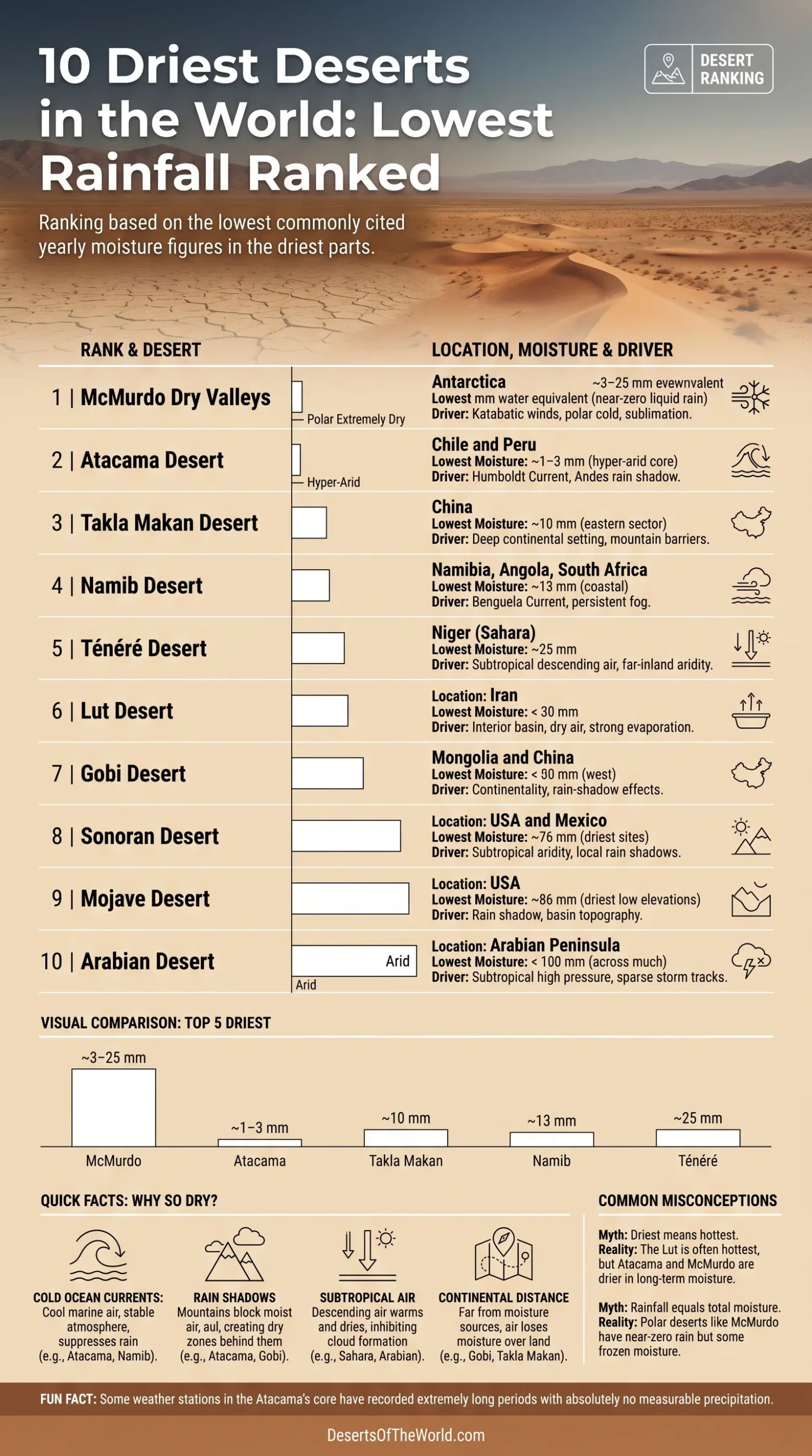
Some deserts are dry in a familiar way: hot air, bare ground, rare storms. Others are dry for colder, stranger reasons. A list like this also needs one honest note up front. A desert can have a nearly rainless core, wetter mountain edges, foggy coastal belts, and rare wet years that bend the average. So the ranking below uses the lowest commonly cited yearly moisture figures for the driest measured parts of each named desert or desert region. For polar terrain, that means water-equivalent precipitation rather than rain alone. That keeps the list closer to how dryness is actually experienced on the ground.
Rainfall Ranking Table
| Rank | Desert | Location | Lowest Commonly Cited Annual Moisture Input | Main Dryness Driver |
|---|---|---|---|---|
| 1 | McMurdo Dry Valleys | Antarctica | Near-zero liquid rainfall; roughly 3–25 mm water equivalent in many studied areas | Katabatic winds, polar cold, snow loss through sublimation |
| 2 | Atacama Desert | Chile and Peru | About 1–3 mm in the hyper-arid core | Humboldt Current and Andes rain shadow |
| 3 | Takla Makan Desert | China | About 10 mm in the eastern sector | Deep continental setting and mountain barriers |
| 4 | Namib Desert | Namibia, Angola, and South Africa | About 13 mm along the coast | Benguela Current and persistent fog |
| 5 | Ténéré Desert | Niger, within the Sahara | About 25 mm | Subtropical descending air and far-inland aridity |
| 6 | Lut Desert | Iran | Usually cited as under 30 mm | Interior basin setting, dry air, strong evaporation |
| 7 | Gobi Desert | Mongolia and China | Less than 50 mm in the west | Continentality and rain-shadow effects |
| 8 | Sonoran Desert | United States and Mexico | About 76 mm in the driest sites | Subtropical aridity, local rain shadows, high evaporation |
| 9 | Mojave Desert | United States | About 86 mm at the driest low elevations | Rain shadow and basin topography |
| 10 | Arabian Desert | Arabian Peninsula | Under 100 mm across much of the desert | Subtropical high pressure and sparse storm tracks |
The middle of this ranking can shift a little from source to source. That is normal. Some writers use whole-desert averages, others use the driest monitored core, and others still use nearby weather stations. The upper end of the list is far less disputed: McMurdo and the Atacama sit in a class of their own.
1. McMurdo Dry Valleys
The McMurdo Dry Valleys are the driest desert environment on Earth when actual available moisture is the standard. That point matters. These valleys may receive a trace of snowfall in water-equivalent terms, yet they get almost no liquid rain, and much of the snow that does fall never settles in a useful way. Strong katabatic winds sweep down from the Antarctic interior, strip loose snow from the surface, and leave behind a landscape of gravel, bare rock, patterned ground, ice-covered lakes, and saline ponds.
It is a polar desert, not a hot one. That alone separates it from nearly every listicle that treats “dry” as a synonym for “blazing.” Summer meltwater appears only briefly, feeding short-lived streams and closed-basin lakes. For most of the year, water is locked away. Even life here behaves differently: microbes persist in ice-covered lakes, within rocks, and around salty soils where tiny changes in moisture can decide what survives.
2. Atacama Desert
The Atacama Desert is the driest non-polar desert on Earth, and that is the title most readers are really looking for. In its driest core, yearly precipitation is often cited at only 1 to 3 mm, with some stations having extremely long gaps between measurable rain events. This is not a broad field of classic sand seas. The Atacama is a mosaic of salt flats, gravel plains, volcanic slopes, dry basins, alluvial fans, and high-altitude plateaus.
Why is it so dry? Two controls work together. The cold Humboldt Current cools the lower atmosphere along the Pacific margin, making it hard for moist air to rise into rain-bearing clouds. The Andes then block moist air from the east. Low cloud and fog can appear, especially along the Peruvian and northern Chilean coast, but real rainfall stays scarce. That is why the Atacama can look muted and cool in tone while remaining brutally dry. Fog moisture, known locally through forms such as garúa and camanchaca, can matter more than rain in some zones.
3. Takla Makan Desert
The Takla Makan Desert sits inside the Tarim Basin and is boxed in by high mountains: the Tien Shan to the north, the Kunlun to the south, and the Pamirs to the west. In its eastern reaches, yearly precipitation can fall to about 10 mm. That number helps explain why this desert feels so sealed off. It is inland, shielded, and hard for moisture-bearing systems to reach.
This is one of the planet’s great sand deserts, with vast dune fields, dry channels, and basin-floor deposits that record older wetter phases. Its dryness is not just a matter of latitude. It comes from geography. The surrounding mountain systems intercept or redirect moisture before it can settle over the basin, and the desert’s own continental position leaves it far from any easy ocean source. The Takla Makan is a strong reminder that deserts do not need a coastline or a subtropical belt to become very dry. A closed basin plus towering barriers can do the job just as well.
4. Namib Desert
The Namib Desert ranks high on any dry-desert list, yet it breaks the stereotype in a useful way. Along the coast, average yearly rainfall is about 13 mm. Even so, this is not a moisture-free place. Fog rolls in from the Atlantic so often that many animals and plants rely on it more than on rain. That is why the Namib is one of the best places to understand the difference between rainfall and usable moisture.
The Benguela Current cools the air above the ocean, and that stable marine layer suppresses rainfall while helping fog form. The result is a desert where beetles harvest droplets, lichens persist on coastal surfaces, and dune fields sit beside gravel plains, inselbergs, ephemeral rivers, and salt-rich flats. Dry it is. Empty, no. The Namib also shows why coastal deserts can be among the driest on Earth: an ocean nearby does not help much if the air over it stays cool and stable instead of rising into storm clouds.
5. Ténéré Desert
The Ténéré, a named desert region within the central Sahara, is often cited with annual rainfall near 25 mm. That figure is enough to place it among the driest desert regions on the planet. Large parts of the Ténéré are built from ergs and regs: dune seas in one direction, stony plains in another. Wells are scarce. Surface water is rarer still.
The wider Sahara is huge and uneven, so its averages can blur the picture. The Ténéré cuts through that blur. It shows what the Saharan core is really like when descending subtropical air, intense heating, and distance from dependable moisture all line up. Rain does fall at times, but in a thin, erratic way. A single event can leave local marks on the surface and still mean very little for the yearly water balance. That is how hyper-dry deserts work. One storm may look dramatic, while the long-term record stays stubbornly low.
6. Lut Desert
The Lut Desert in Iran is usually described with yearly precipitation under 30 mm, and it pairs that dryness with some of the hottest land-surface readings ever detected by satellite. The Lut is not only dry; it is dry under fierce evaporative stress. Broad salt flats, yardangs, stony surfaces, and dune systems help give it a stripped, mineral look that feels almost architectural.
Its dryness comes from interior location, mountain barriers around the Iranian Plateau, and the kind of air mass pattern that leaves the basin exposed to heat while offering very little dependable moisture. Strong seasonal winds also shape the surface, especially in the famous kalut yardang fields. In lists about heat, the Lut often steals the spotlight. Yet the rainfall side matters just as much. Heat alone does not make a desert rank this high. A desert reaches this level only when little rain arrives in the first place.
7. Gobi Desert
The Gobi Desert is often called a cold desert, and that label fits. In the western Gobi, annual precipitation can drop below 50 mm. That is dry enough to place it well above many better-known hot deserts. Much of the Gobi is not a sea of dunes. Instead, wide tracts are rocky, gravelly, or hard-packed, with sparse shrubs, dry basins, and long open horizons.
The Gobi’s dryness is tied to continental position and regional rain-shadow effects. Moisture weakens as air masses move deep into Asia, and surrounding mountain systems further limit what reaches the desert floor. Winters are harsh, summers are warm to hot, and much of the little precipitation that arrives may come as snow. That detail is easy to miss in simple rankings. A desert can be very dry and still be bitterly cold for much of the year. The Gobi proves that dryness is not married to tropical heat.
8. Sonoran Desert
The Sonoran Desert may surprise readers in this ranking because it is often described as the wettest of North America’s major deserts. Even so, its driest sites average under 76 mm a year, which still places it among the driest desert landscapes on Earth. The Sonoran is more biologically active than the deserts above it on this list, but that says more about timing and efficiency of moisture than about abundant rain.
This desert benefits from two seasonal rainfall windows in many areas: winter storms and the summer monsoon. That pattern helps support saguaro cactus, palo verde, ocotillo, ironwood, and a much fuller plant structure than readers might expect from a place with such low annual totals in its driest pockets. The lesson here is simple. Desert life is not only about how much water falls. It is also about when it falls, how fast it evaporates, how deep it infiltrates, and whether plants can catch it before the sun takes it back.
9. Mojave Desert
The Mojave Desert is usually cited at 50 to 150 mm a year, with the driest low elevations near the lower end of that band. In park data from low stations, yearly precipitation sits near the mid-80-millimetre mark. That puts the Mojave below the Sonoran in plant richness and above it in raw dryness at many low-elevation sites. It is the land of creosote flats, alluvial fans, playas, lava fields, and sharply defined basin-and-range relief.
The Sierra Nevada and other regional uplands help cast a rain shadow over the Mojave. Elevation also matters inside the desert itself, which is why rainfall rises in the mountains while low basins stay much drier. Joshua trees, one of the Mojave’s most familiar symbols, thrive not because the desert is moist, but because the climate, soils, winter chill, and sparse rainfall line up in a narrow ecological window. This desert is dry in a very North American way: broad, mineral, wind-worn, and broken into basins that collect salts and flash-flood sediments far more often than steady water.
10. Arabian Desert
The Arabian Desert, with the Rub’ al Khali as its most famous sand sea, stays under 100 mm of rainfall across much of its extent. Some sectors are drier than others, and the western margin of the Empty Quarter is often singled out as especially arid. This desert is vast, and that scale matters. Broad averages can soften the picture, yet many interior stretches still live under a very sparse storm regime.
Its dryness owes much to subtropical high pressure, clear skies, weak and irregular storm penetration, and long distances between reliable water sources. Wadis may carry sudden runoff after rare rain, but for most of the year they remain dry. Dew and fog can matter locally, especially toward some coasts and highlands, though they do not change the broader water budget. The Arabian Desert rounds out this list because it shows how a desert can be dry on a continental scale, not only in isolated cores or unusual basins.
Why Some Deserts Stay Drier Than Others
- Cold Ocean Currents: The Humboldt Current helps dry the Atacama. The Benguela Current does the same for the Namib. Cool marine air stays stable, cloud tops stay low, and rain formation remains weak.
- Rain Shadows: The Andes help starve the Atacama. The mountain walls around the Tarim Basin do similar work for the Takla Makan. Basin geography is often half the story.
- Subtropical Descending Air: The Sahara, Arabian Desert, and many other low-latitude deserts sit under air that tends to sink rather than rise. Sinking air dries and warms, which suppresses cloud growth.
- Continental Distance: The Gobi and Takla Makan are far from easy marine moisture. By the time air masses reach them, much of the moisture has already been lost.
- Fog, Dew, and Sublimation: Some deserts receive little rain yet still get trace moisture from fog or dew. Others, like McMurdo, lose what little snow falls before it can do much work on the ground.
What Often Gets Mixed Up in Driest-Desert Lists
- Driest desert vs. driest place: Very dry cities and weather stations such as Arica or Wadi Halfa may post lower rainfall than many full deserts, but they are not whole desert systems.
- Rainfall vs. total moisture: Polar deserts force a terminology check. McMurdo is dry in a way that rain-only tables cannot fully capture.
- Whole-desert average vs. driest core: A huge desert may have one edge that gets seasonal rain and another that is nearly rainless. Rankings move around depending on which number a writer uses.
- Dryest vs. hottest: The Lut may dominate heat records, yet the Atacama and McMurdo remain drier in the usual long-term moisture sense.
Which Desert Is Usually Counted as The Driest?
If the question includes all deserts, the answer usually points to the McMurdo Dry Valleys. If the question is about the driest hot or non-polar desert, the answer is the Atacama Desert. That split clears up a lot of confusion. Readers often see both claims and assume one must be wrong. In practice, they are answering two slightly different questions.
Sources
- National Science Foundation – The McMurdo Dry Valleys of Antarctica (polar desert conditions and water-equivalent precipitation)
- NASA Earth Observatory – Saltiest Pond on Earth (McMurdo Dry Valleys climate and lack of rain)
- NASA Earth Observatory – Snow in the Atacama Desert (1–3 mm precipitation in the driest parts)
- NASA JPL – Salar de Atacama, Chile (2 mm rain per year in a core Atacama sector)
- UNESCO World Heritage Centre – Namib Sand Sea (fog as the main water source in the Namib)
- Britannica – Takla Makan Desert (precipitation range and basin geography)
- Britannica – Ténéré (annual rainfall around 25 mm in this Saharan desert region)
- NASA MODIS – Lut Desert, Iran (very low precipitation and extreme desert setting)
- Britannica – Gobi Desert (western-sector precipitation below 50 mm)
- U.S. National Park Service – Sonoran Desert Climate (annual precipitation range and driest sectors)
- U.S. National Park Service – Mojave National Preserve Weather (low-elevation rainfall values for the Mojave)
- Britannica – Arabian Desert Climate (desert-wide rainfall under 100 mm in many areas)