
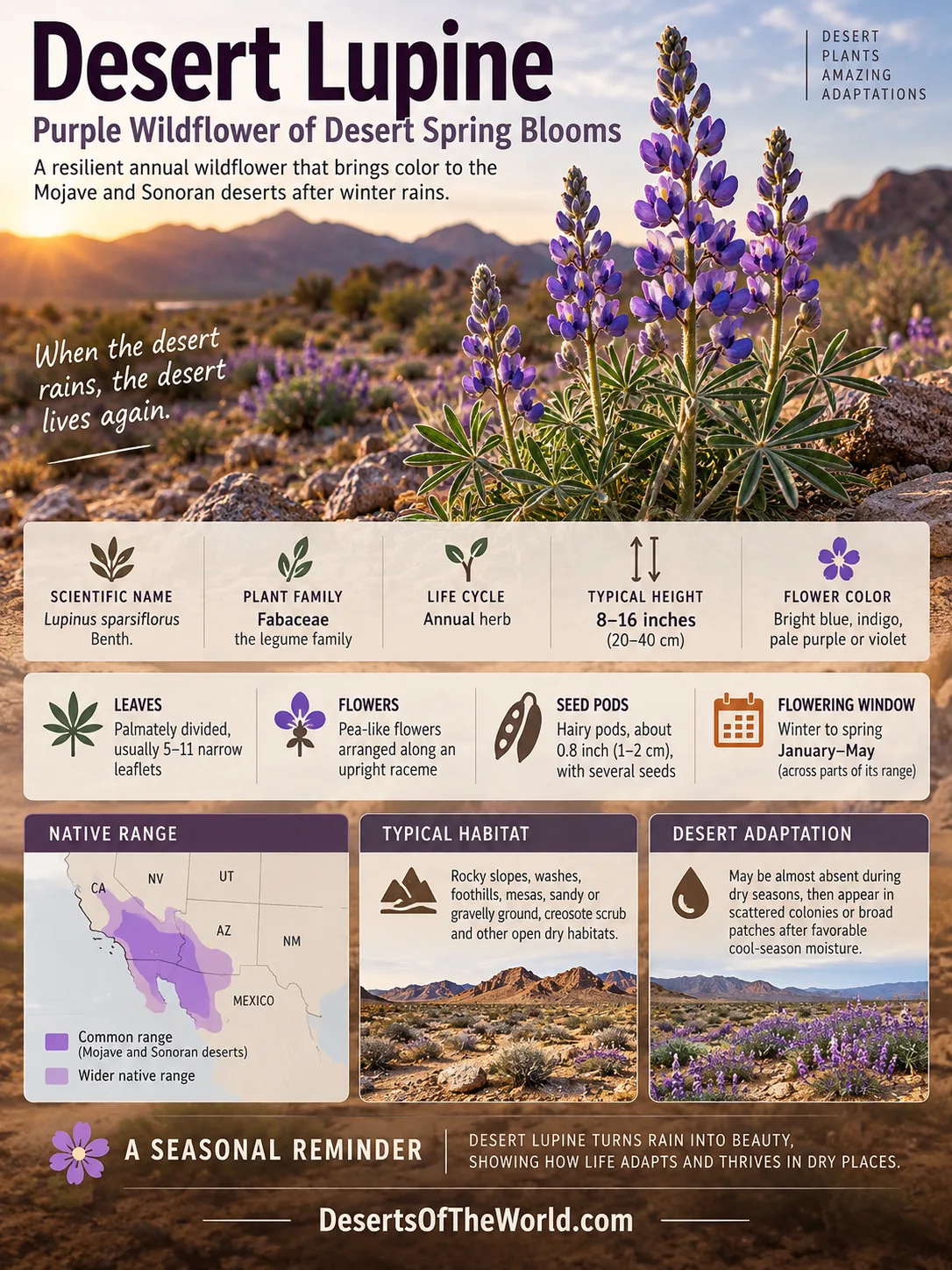
Desert lupine (Lupinus sparsiflorus) is an annual wildflower of the American Southwest, best known for its blue, indigo, violet, and purple flower spikes during the desert spring. It grows naturally in dry landscapes of the southwestern United States and northwestern Mexico, with especially strong associations with the Mojave and Sonoran deserts.
The plant may be almost absent from view during a dry season, then appear in scattered colonies or broad patches after favorable cool-season moisture. Its flowering period is not controlled by a single calendar date. Winter and spring rainfall, temperature, elevation, soil moisture, and the timing of warming all influence when the flowers appear and how dense a display becomes.
Desert Lupine Main Details
| Feature | Desert Lupine |
|---|---|
| Scientific name | Lupinus sparsiflorus Benth. |
| Plant family | Fabaceae, the legume family |
| Life cycle | Annual herb |
| Typical height | About 8–16 inches (20–40 cm) |
| Flower color | Bright blue, indigo, pale purple, violet, or related blue-purple tones |
| Leaf form | Palmately divided, commonly with 5–11 narrow leaflets |
| Flower arrangement | Pea-like flowers arranged along an upright terminal raceme |
| General flowering window | Winter to spring; January through May is reported across parts of its range |
| Main desert association | Mojave and Sonoran deserts |
| Broader native range | Southwestern United States to northwestern Mexico |
| Typical habitat | Rocky slopes, washes, foothills, mesas, sandy or gravelly ground, creosote scrub, and other open dry habitats |
The accepted botanical name is Lupinus sparsiflorus. Coulter’s lupine, Mojave lupine, Mohave lupine, sand lupine, and desert lupine are among the common names associated with the species. Because common names can be applied differently from place to place, the scientific name is the clearest identifier.
What Desert Lupine Looks Like
A flowering desert lupine has two features that stand out immediately: a slender stalk carrying blue-purple flowers and a cluster of narrow leaflets radiating from a central point. Looking at both features is far more reliable than trying to identify the plant by flower color alone.
Blue-Purple Flower Spikes
The flowers are arranged in an elongated cluster known botanically as a raceme. USDA descriptions place roughly 15–50 flowers in these spirally arranged clusters, with individual flowers around 0.4 inch (1 cm) across.
Each flower has the recognizable pea-flower form associated with the Fabaceae family. The petals can range from bright blue to pale purple, which explains why the same plant may appear strongly blue in one photograph and violet or purple in another.
One small detail is easy to miss. The upper, or banner, petal may carry a pale to yellowish spot. USDA botanical material reports that this area can shift toward a purplish-red color after manipulation by bees. Flower color is therefore more varied than the simple label “purple desert wildflower” suggests.
Palm-Shaped Leaves
The leaves provide one of the most useful field marks. Rather than forming a single broad blade, each leaf is divided into narrow leaflets that spread from the same point like the fingers of an open hand.
The National Park Service describes desert lupine at Organ Pipe Cactus National Monument as having 7–11 leaflets, while the USDA plant description gives a broader range of 5–11. The leaflets are narrow, and the overall shape is distinctly palmate.
This leaf structure helps separate a lupine from unrelated blue or purple spring flowers growing nearby.
Hairy Pods Replace the Flowers
After flowering, desert lupine develops an upright, hairy legume pod. USDA material describes pods roughly 0.8 inch (1–2 cm) long, commonly holding several seeds.
As a mature pod dries, its two sides separate and can twist apart, releasing the seeds. By this stage the bright spring display has largely disappeared, but the plant is completing the part of its annual cycle that allows another generation to wait in the desert soil.
Why Desert Lupines Can Appear So Suddenly
Desert lupine is an annual. It does not need to maintain a leafy plant through every hot, dry month. Instead, one generation germinates, grows, flowers, produces seed, and finishes its above-ground life cycle within a favorable season.
The next generation can remain represented in the soil by dormant seed until conditions allow germination. This changes the way a desert lupine population should be understood. A hillside that shows few or no flowers in one spring has not necessarily lost its lupines. Viable seed may still be present below the surface.
The basic seasonal sequence is:
- Dormant seed remains in dry soil.
- Cool-season moisture reaches the seed zone.
- Suitable seeds germinate and establish small plants.
- Leaves and stems develop while moisture remains available.
- Flower stalks rise during the favorable growing window.
- Bees move among the flowers and transfer pollen.
- Pods develop and mature.
- Seeds return to the soil before dry conditions dominate again.
This annual strategy is one reason desert wildflower displays can seem abrupt. Much of the population is visually absent until rainfall and temperature open a short growing window.
When Desert Lupine Blooms
A fixed statement such as “desert lupine blooms in March” is too narrow for a species spread across different elevations and desert climates. USDA material gives a broad January-to-May flowering period, influenced by winter and spring rainfall. A mid-March to mid-April color peak is reported for some southwestern settings, but that should not be treated as a universal peak across the entire range.
In the Sonoran Desert, spring annual displays can shift by weeks according to elevation, latitude, rainfall, and temperature. Lower, warmer sites may flower before cooler uplands, while poor cool-season moisture can leave the same landscape with only scattered plants.
| Seasonal Condition | Likely Effect on Desert Lupine |
|---|---|
| Well-timed winter moisture | Creates a better opportunity for germination and early growth |
| Moisture followed by continued mild weather | Allows seedlings more time to grow toward flowering |
| Rain followed by a long dry interval | May leave flowering sparse or highly localized |
| Rapid spring warming | Can shorten the period when soil stays favorable for annual growth |
| Lower, warmer desert terrain | Can enter its flowering period earlier than nearby cooler terrain |
| Higher or cooler terrain | May retain a later spring flowering window |
The bloom is a moving seasonal window, not a fixed date. This also explains why two sites within the same desert can look very different during the same week.
Why One Spring Has Patches and Another Has Carpets
A rainy winter does not automatically produce a continuous field of lupines. Desert annuals respond to the sequence of weather rather than to a single storm.
One site may receive enough moisture for germination but dry before seedlings become established. Another may receive repeated moisture during a mild period and support many more flowering plants. Soil texture, slope, drainage, exposure, elevation, and the local supply of dormant seed add another layer of variation.
Four broad outcomes are common:
- Very dry season: few plants emerge and much of the seed population remains dormant.
- Early moisture followed by drying: germination may occur without producing a dense flowering display.
- Well-spaced cool-season moisture: more plants may survive long enough to flower and set seed.
- Exceptional wildflower conditions: lupines can become part of broad mixed displays across suitable slopes, fans, washes, and open desert ground.
Dense wildflower years are therefore episodic. Desert lupine may be locally abundant without every part of the surrounding desert flowering at the same intensity.
Where Desert Lupine Grows
Plants of the World Online places the natural range of Lupinus sparsiflorus from the southwestern United States into northwestern Mexico and classifies it primarily within desert and dry-shrubland environments.
USDA records associate Coulter’s lupine with the Mojave and Sonoran deserts and describe a varied set of habitats rather than one narrow soil type. Recorded settings include:
- rocky slopes and foothills;
- desert washes and wash margins;
- mesas and open fields;
- sandy and gravelly ground;
- creosote bush scrub;
- Joshua tree woodland;
- roadsides and disturbed open ground;
- dry hillsides and desert slopes.
This range of habitats makes sense for an annual that depends on short windows of usable moisture. Water is distributed unevenly across a desert. A shallow wash, gravel pocket, slope base, or patch of open soil may provide better germination conditions than adjacent ground only a short distance away.
Desert Lupine in the Sonoran Desert
Desert lupine is one of the recognizable spring annuals of the Sonoran Desert. At Organ Pipe Cactus National Monument in Arizona, the National Park Service describes it as a lower-elevation spring wildflower with indigo blooms and palm-shaped leaves.
The Sonoran Desert’s cool-season rains are especially relevant to annual spring flowers. When winter moisture arrives in a useful sequence and temperatures remain suitable, annuals can occupy open spaces between long-lived desert shrubs and cacti.
The result is rarely uniform. Lupines may form visible patches along one slope or open plain while nearby ground remains dominated by gravel, creosote, bursage, or other desert vegetation.
Desert Lupine in the Mojave Desert
The Mojave is also part of the species’ established desert range. Here, desert lupine can occur on sandy or gravelly ground, dry slopes, open scrub, and around Joshua tree woodland.
Winter precipitation strongly shapes the Mojave spring annual season. Lower terrain generally warms earlier, while upland slopes and cooler locations can progress through spring later. For an annual lupine, this produces a patchwork of flowering stages across the landscape rather than a desert-wide bloom occurring on one date.
Why Desert Lupine Is Not Always Purple
Calling desert lupine a purple wildflower is useful for describing its appearance, but purple is not its only natural color impression. Reliable botanical descriptions use bright blue, indigo, pale blue, violet, and pale purple for Lupinus sparsiflorus.
Several things affect what a person sees. Flowers on the same spike are not always at the same developmental stage. Petal markings can change. Direct desert sunlight, shade, and surrounding vegetation also alter the visual contrast.
For identification, the better combination is:
- blue-to-purple pea-shaped flowers;
- an upright, loosely flowered raceme;
- palmately divided leaves;
- an annual growth form;
- a compatible southwestern desert habitat.
A flower should not be identified as Lupinus sparsiflorus from color alone. Several southwestern lupines overlap in color and geography.
Desert Lupine and Arizona Lupine Are Different Species
Lupinus sparsiflorus can be confused with Arizona lupine (Lupinus arizonicus). Current Plants of the World Online taxonomy accepts both as separate species, and both occur naturally in desert or dry-shrubland environments of the Southwest.
| Feature | Desert Lupine | Arizona Lupine |
|---|---|---|
| Scientific name | Lupinus sparsiflorus | Lupinus arizonicus |
| Life cycle | Annual | Annual |
| Typical color impression | Blue, indigo, violet, or pale purple | Often pinker, reddish-purple, or magenta in field descriptions |
| Biome | Primarily desert or dry shrubland | Primarily desert or dry shrubland |
| Identification | Flower structure, leaves, hairiness, fruit, and location should be considered together | Flower structure, leaves, hairiness, fruit, and location should be considered together |
At Organ Pipe Cactus National Monument, the National Park Service notes that visitors may encounter Arizona lupine at higher elevations than the desert lupine populations described there and points to its brighter magenta flowers as a useful local clue. That elevation pattern is best treated as a local field observation rather than a universal boundary, because the geographic ranges and elevation ranges of southwestern lupines can overlap.
Taxonomy also matters. Some older or regional treatments have grouped closely related lupines differently. Using an accepted scientific name and checking multiple plant characters avoids much of the confusion created by common names.
Native Bees and Desert Lupine Flowers
Desert lupine has a close relationship with spring pollinators. The National Park Service describes the flowers as highly dependent on native bee species for pollination.
The pea-shaped flower is built for an animal visitor rather than passive wind pollination. When a bee lands and works the flower, contact with its reproductive structures can move pollen between blooms. Successful pollination is followed by development of the flattened, hairy seed pods.
This creates a short seasonal chain:
flowering → bee visits → pollen transfer → pod formation → seed dispersal
The flower display is therefore only one stage of the plant’s spring activity. Pollination determines whether those visible flowers can produce the seeds that carry the population forward.
Desert lupine also becomes part of a wider seasonal food network. National Park Service material notes that its seeds can provide food for birds and its growth can contribute ground cover for small desert animals.
What Happens After the Purple Flowers Fade
The plant changes quickly once flowering ends. Petals drop, pods enlarge, seeds mature, and the green annual gradually dries as the favorable growing period closes.
The seed pod is not an incidental feature. It is the bridge between a brief flowering season and future populations. Mature pods split and release seeds around the parent plant, placing another generation into the patchy desert seed bank.
Above ground, the plant may then disappear completely. Below ground, its population can persist in a much less visible form.
This is why a desert lupine site can move through very different appearances:
- apparently bare ground during the dry period;
- small green seedlings after suitable moisture;
- palmate foliage during vegetative growth;
- blue-purple spikes during flowering;
- hairy pods during seed development;
- dry stems followed by another period of little visible growth.
Desert Lupine in Mixed Spring Wildflower Blooms
A purple-blue patch in the desert is rarely useful evidence that every flower present is a lupine. Productive spring conditions can activate several annual species at the same time.
In Sonoran and Mojave settings, lupines may share the flowering season with poppies, phacelias, owl-clovers, desert dandelions, desertbells, evening primroses, and other annual wildflowers. Each species responds somewhat differently to moisture, soil, temperature, and elevation, so the mixture can change across a single valley or hillside.
This produces the familiar color mosaics of a good desert spring. A distant slope may look almost entirely purple or yellow, while a closer look reveals several species growing between the dominant flowers.
Desert lupine can become one of the plants creating a broad color patch, but a dense lupine display should not automatically be described as a superbloom. Large desert flowering events depend on the abundance and distribution of many plants across the landscape, and there is no botanical threshold at which a patch of lupines becomes a superbloom.
How to Recognize Desert Lupine in the Field
Several traits together provide a stronger identification than any single feature.
- Check the overall size. Many plants fall around 8–16 inches (20–40 cm) tall, though local growing conditions create variation.
- Look for the flower stalk. The blooms form an elongated terminal cluster rather than a flat flower head.
- Examine an individual flower. It should have the pea-like structure expected of a lupine.
- Check the color range. Blue, indigo, violet, and pale purple are all compatible with desert lupine.
- Look at the leaves. Narrow leaflets should radiate from one point in a palm-like arrangement.
- Check for pods later in the season. Hairy upright legume pods replace successfully pollinated flowers.
- Consider the habitat. Open dry ground, washes, slopes, foothills, sandy or gravelly terrain, creosote scrub, and related southwestern habitats fit the species.
- Do not rely on color alone. Arizona lupine and other regional Lupinus species can create similar blue, violet, or reddish-purple impressions.
A Short-Lived Plant Built Around Desert Timing
Desert lupine does not need to stay green through the full desert year. Its annual life cycle shifts much of the long-term survival burden to seed.
That distinction explains the contrast between a dry landscape and a colorful spring. The visible plant is temporary. The population is not limited to the weeks when flowers can be seen.
When cool-season moisture, temperature, local soil conditions, and viable seed coincide, Lupinus sparsiflorus can turn previously bare-looking ground into patches of blue and purple. When those conditions do not align, the display may remain sparse and much of the next generation simply waits.
Sources
- USDA Natural Resources Conservation Service — Plant Guide for Coulter’s Lupine (Lupinus sparsiflorus) (plant description, habitat, distribution, flowering period, pollination, pods, and seed ecology)
- U.S. National Park Service — Organ Pipe Cactus National Monument, Wildflowers (Sonoran Desert habitat, plant height, leaf structure, flower color, native-bee pollination, and comparison with Arizona lupine)
- Royal Botanic Gardens, Kew — Plants of the World Online, Lupinus sparsiflorus (accepted taxonomy, annual life cycle, biome, and native range)
- Royal Botanic Gardens, Kew — Plants of the World Online, Lupinus arizonicus (current taxonomic treatment and native range of Arizona lupine)
- University of Arizona Cooperative Extension — Lupinus sparsiflorus: Coulter’s Lupine (morphology, common names, annual growth form, and southwestern plant identification)