
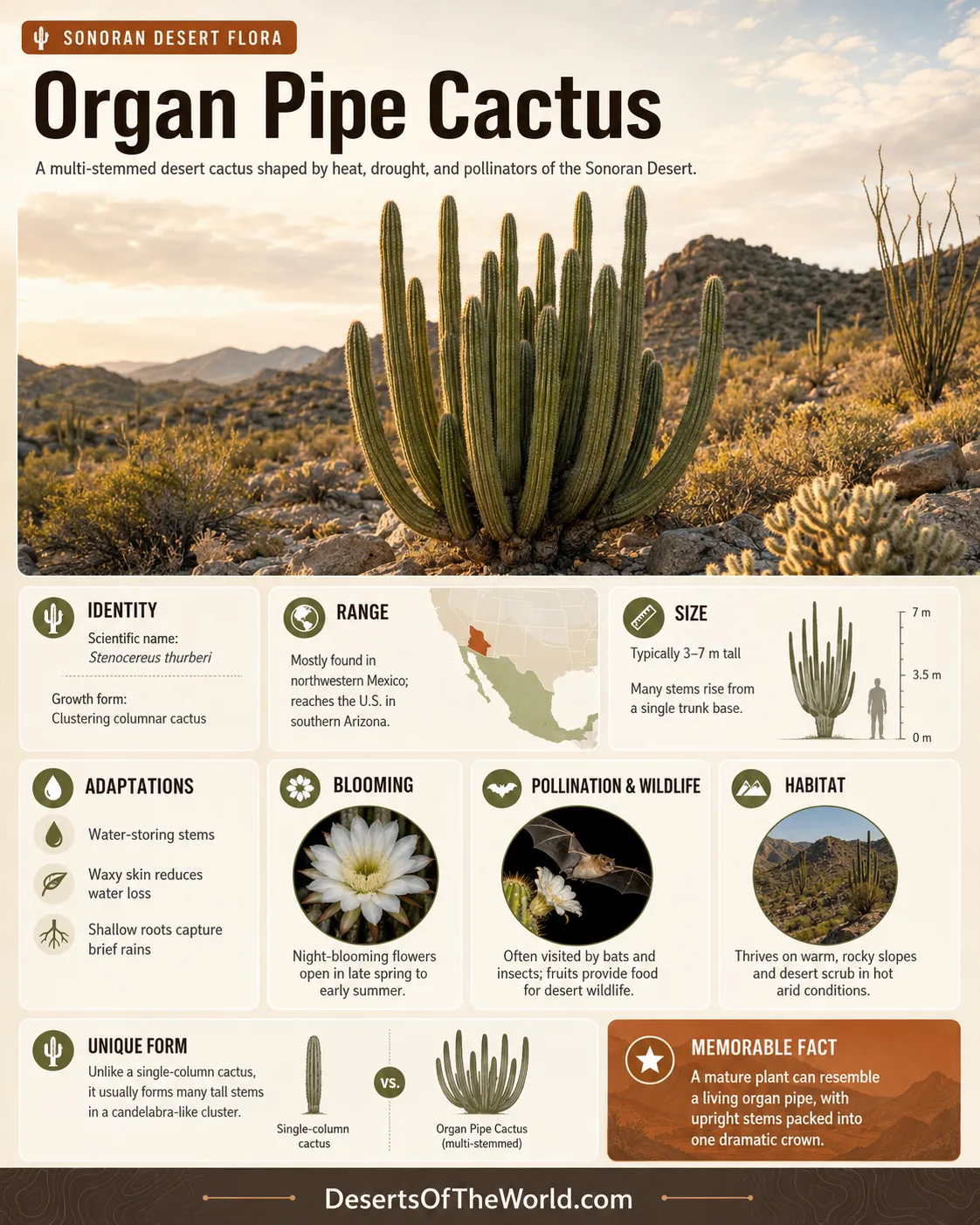
The organ pipe cactus (Stenocereus thurberi) is a many-stemmed columnar cactus of the Sonoran Desert. Instead of growing as one tall trunk, it rises from the base in green vertical stems that resemble the pipes of an old organ. That shape gives the plant its English name, but its real story belongs to warm desert slopes, summer rain, night-blooming flowers, nectar-feeding bats, and the dry borderlands of Arizona and northwestern Mexico.
This cactus is most closely linked with Organ Pipe Cactus National Monument in southern Arizona, where large natural stands are protected. Its wider range reaches far beyond that monument, especially through Sonora and nearby dry regions of Mexico. It is a desert plant, yes, but not a plant of every desert. It needs heat, rocky shelter, and enough seasonal moisture to grow slowly through long dry spells.
| Detail | Organ Pipe Cactus Information |
|---|---|
| Scientific Name | Stenocereus thurberi |
| Plant Family | Cactaceae |
| Main Desert Region | Sonoran Desert |
| Native Range | Southern Arizona and northwestern Mexico, including Sonora, Sinaloa, and Baja California |
| Typical Shape | Several upright columnar stems rising from a short base |
| Height | Can reach about 23 feet in favorable habitat |
| Stem Features | Green columns with ribs, spine clusters, and water-storing tissue |
| Bloom Season | Late spring to summer, with many flowers opening at night |
| Main Pollinators | Nectar-feeding bats, especially the lesser long-nosed bat |
| Fruit | Rounded reddish fruit with sweet pulp and many small seeds |
| Longevity | May live for more than 150 years |
Organ Pipe Cactus Identity and Scientific Name
The organ pipe cactus belongs to the genus Stenocereus, a group of columnar cacti found mainly in Mexico and nearby drylands. Its accepted scientific name is Stenocereus thurberi. Older botanical names may appear in plant records, but this name is the standard used by major plant databases.
The plant is also known as pitaya dulce in parts of its range, a name tied to its edible fruit. In O’odham cultural context, the cactus is known as chuhuis. Those names point to something the English name does not fully capture: this is not only a sculptural desert cactus. It is also a fruiting plant with long-standing ties to people, animals, and seasonal desert rhythms.
Why the Cactus Looks Like an Organ Pipe
A mature organ pipe cactus usually grows many stems from a low base. These stems stand close together, almost like a living cluster of green columns. The comparison to a pipe organ is easy to see once the plant is mature, especially when the columns vary in height.
Unlike the saguaro, which often has one main trunk with arms, organ pipe cactus has a more clustered form. Not messy. Just different. The plant spreads its living tissue across several stems, which helps it store water and continue growing even when one stem is damaged by frost, age, or weather.
Range in the Sonoran Desert and Northwestern Mexico
The organ pipe cactus is native to warm drylands from southwestern Arizona south through parts of Mexico, including Sonora, Sinaloa, and Baja California. In the United States, it is rare compared with its wider Mexican range. Large natural stands are best associated with Organ Pipe Cactus National Monument, near the northern edge of the species’ natural distribution.
Its range is not random. The cactus needs enough warmth to avoid long hard freezes, and it also depends on seasonal rain patterns. The Sonoran Desert is one of the few deserts in North America where summer monsoon moisture can support large columnar cacti. Winter rain helps the broader plant community too, but for organ pipe cactus, warm-season growth matters greatly.
Why South-Facing Rocky Slopes Matter
At the northern edge of its range, the organ pipe cactus often grows on south-facing rocky slopes. These slopes receive more sun in winter and can hold warmth into the night. Dark volcanic rock can also absorb heat during the day and release it slowly after sunset.
That extra warmth can be the difference between survival and freeze damage. A cold desert night may leave a mark on the plant’s stems. Rings, dents, or wavy growth patterns can record old frost events, almost like weather notes written into the cactus itself.
Why Mexico Holds Denser Populations
Many people first learn about this cactus through Organ Pipe Cactus National Monument, but the species is not limited to that park. In Mexico, especially in coastal thornscrub and dry forest edges of Sonora, organ pipe cactus can be more abundant. The warmer climate gives it a wider ecological comfort zone.
This point helps explain why the cactus is both a symbol of a U.S. monument and a broader Sonoran Desert species. Its protected Arizona stands are important, but its botanical center of gravity lies farther south.
Columnar Stems, Ribs, Spines, and Water Storage
Organ pipe cactus stems are green because they do much of the plant’s photosynthesis. Leaves would lose too much water in this climate, so the cactus keeps them reduced to spines. The stem takes over the work: it stores water, makes food, and expands or contracts with moisture.
Each column has vertical ribs. These ribs are not decoration. They let the stem swell after rain and shrink during drought without tearing. The ribs also cast small shadows along the stem surface, reducing direct heat load during bright desert days.
Ribs and Spines Work Together
Organ pipe cactus stems often have many ribs, with spine clusters arranged along them. The spines help shade the plant’s surface, reduce air movement near the skin, and make the cactus less inviting to animals that might damage soft tissue. They also make the plant instantly recognizable up close.
The spines are dark when young and can fade with age. Seen from a distance, a large organ pipe cactus may look smooth and architectural. Up close, it is a tough surface of ribs, areoles, and needles.
Nighttime Gas Exchange and Desert Water Saving
Like many desert cacti, organ pipe cactus uses a water-saving form of photosynthesis often called CAM photosynthesis. In simple terms, the plant opens tiny pores mostly at night, when air is cooler and water loss is lower. It stores carbon compounds overnight, then uses them during daylight while keeping those pores mostly closed.
This is one reason columnar cacti can live where ordinary leafy plants struggle. They do not beat the desert by moving fast. They survive by wasting very little.
Slow Growth and a Long Life Cycle
The organ pipe cactus grows slowly, especially in its early years. A young seedling may remain small for a long time, hidden under the shelter of a nurse plant or tucked beside rocks. During this stage, it faces heat, drought, animals, washouts from summer storms, and cold winter nights.
Maturity takes patience. The plant may not produce its first flowers until it is several decades old. In protected habitat, it can live for well over a century, building its clustered columns year by year.
Seedlings Need Shelter Before They Rise
Young organ pipe cactus plants are vulnerable. Their small bodies hold little water, and direct sun can dry them quickly. Nurse plants, rocks, and uneven ground can create small safe pockets with shade, slightly cooler soil, and reduced exposure.
This is common in the Sonoran Desert. Many large cacti begin life under the protection of shrubs or trees such as palo verde, mesquite, ironwood, or other desert plants. Later, the cactus may outlive its shelter.
Mature Stems Can Handle More Stress
Once the cactus develops tall stems, it has more stored water and more photosynthetic surface. A mature plant can endure longer dry periods than a seedling. It can also continue growing after limited stem damage, especially when the base remains healthy.
Still, “tough” does not mean invincible. Long drought, severe frost, disease, and physical damage can affect old plants. Desert survival is steady work.
Flowers, Nectar, and Bat Pollination
Organ pipe cactus flowers usually open after sunset and last into the next morning. They are pale, often white to light pink, and built for nighttime pollination. Their timing, scent, and nectar reward fit the habits of nectar-feeding bats moving through the Sonoran Desert at night.
The main pollinator associated with the plant is the lesser long-nosed bat (Leptonycteris yerbabuenae). Older references may use the name Leptonycteris curasoae yerbabuenae. As the bat reaches into a flower for nectar, pollen can dust its head and body. When it visits the next cactus, that pollen may move with it.
Why the Flowers Open at Night
Night blooming makes sense in a hot desert. Cooler air reduces water loss from delicate flower tissue, and nighttime pollinators are active when the cactus opens. By morning, bees, birds, and other daytime visitors may still find remaining nectar or pollen, but the main event often happens in darkness.
The flower is short-lived. One night, maybe part of the next day. Then it fades. For the cactus, that short window is enough if pollinators arrive.
The Lesser Long-Nosed Bat Connection
The lesser long-nosed bat has a long snout and brush-tipped tongue suited for nectar feeding. It visits desert flowers such as saguaros, agaves, cardón, and organ pipe cactus. In return, these plants receive pollination service across wide desert distances.
This relationship ties the cactus to a larger seasonal route. Flowering plants feed migrating bats; bats help those plants set fruit and seed. The link is not decorative. It is part of how the Sonoran Desert renews itself.
Fruit, Seeds, and Desert Food Webs
After successful pollination, organ pipe cactus can produce rounded reddish fruits near the upper parts of its stems. The fruit has sweet pulp with many small seeds. When ripe, it can split open and expose the red interior to animals.
Bats, birds, and other desert wildlife may eat the fruit and move seeds away from the parent plant. Seed movement matters. A seed that lands beneath a protective shrub or near a rock has a better chance than one dropped on bare exposed ground.
Animals That Use the Fruit
Organ pipe fruit can support nectar-feeding bats, fruit-eating birds, and other desert animals during a hot season when food may be scattered. This gives the cactus a role beyond its own growth. It becomes part of a desert food web that links flowers, fruit, seeds, and movement across the landscape.
Small seeds pass through animals or fall from opened fruit. Most will not become adult cacti. That is normal for desert plants. A few well-placed seedlings can carry the population forward.
Traditional Fruit Use
The fruit has long been known to Indigenous people of the region, including O’odham communities. It has been eaten fresh and prepared in preserved forms. At Organ Pipe Cactus National Monument, traditional fruit harvesting has been recognized as part of the continuing relationship between people and this plant.
This history should be understood with respect. The cactus is not just a desert landmark for visitors. It belongs to a lived landscape where plant knowledge, seasonal timing, and cultural memory are connected.
How Organ Pipe Cactus Differs From Similar Columnar Cacti
The Sonoran Desert is famous for tall cacti, and several species can confuse new observers. Organ pipe cactus, saguaro, senita, and cardón all belong to the broader visual language of columnar desert plants. Their shapes, ranges, and growth habits are not the same.
| Cactus | Scientific Name | Main Visual Clue | Range and Habitat Notes |
|---|---|---|---|
| Organ Pipe Cactus | Stenocereus thurberi | Many slim stems rising from a low base | Sonoran Desert and nearby drylands; rare in the United States, broader in Mexico |
| Saguaro | Carnegiea gigantea | One tall trunk, often with raised arms | Iconic in Arizona and Sonora; often taller than organ pipe cactus |
| Senita Cactus | Lophocereus schottii | Columnar stems with bristly upper growth on mature stems | Warm Sonoran Desert areas, often near organ pipe cactus habitat |
| Cardón | Pachycereus pringlei | Very large branching cactus, often massive in scale | Common in parts of Baja California and Sonora; among the largest cacti |
Organ Pipe Cactus Compared With Saguaro
The easiest difference is the base. Organ pipe cactus usually sends up several stems from near ground level. Saguaro usually grows a single main trunk first, then may develop arms much later. Saguaros also often grow taller.
The two can share desert landscapes, but they do not tell the same ecological story. Saguaro tolerates a wider part of the Arizona Sonoran Desert. Organ pipe cactus is more tied to warmer slopes and milder winter pockets near its northern edge.
Organ Pipe Cactus Compared With Senita
Senita cactus can also form clusters of vertical stems, so it may look closer to organ pipe cactus than a saguaro does. Mature senita stems often show a shaggy or bristly upper zone, especially near the flowering area. Organ pipe cactus stems tend to keep a cleaner ribbed-column look.
In some Sonoran Desert settings, both plants help define warm desert slopes and bajadas. Their presence often says the same thing about habitat: frost is limited, summer heat is strong, and the desert is dry but not lifeless.
Habitat Communities Around Organ Pipe Cactus
Organ pipe cactus does not grow alone in a blank desert. Its habitat can include palo verde, ironwood, creosote bush, brittlebush, ocotillo, prickly pear, cholla, saguaro, senita, and seasonal wildflowers. In warmer Mexican parts of its range, it may also occur in thornscrub and tropical dry forest edges.
The plant often appears on slopes, bajadas, and rocky ground where drainage is good. It does not need rich soil. In fact, rich soil is not the point. The cactus needs a workable balance: enough moisture to grow, enough drainage to avoid root stress, enough warmth to survive winter.
Rainfall Timing Shapes Growth
The Sonoran Desert receives moisture in more than one season, but summer rain is especially important for many warm-adapted cacti. Organ pipe cactus growth often responds to monsoon moisture. After rain, stored water lets the stems swell and support new tissue.
Dry months still dominate the year. The cactus does not rely on steady rain. It relies on being ready when rain arrives.
Nurse Plants and Rock Shelter
Nurse plants can soften the desert for cactus seedlings. A shrub canopy may reduce direct sun, slow wind, and trap organic matter near the soil surface. Rocks can create similar small-scale shelter by shading soil and guiding runoff toward tiny pockets.
For a plant that may live more than 150 years, these first safe inches matter. The future column starts as a vulnerable seedling, often hidden in the shadow of something else.
Frost Limits and Visible Cold Damage
Organ pipe cactus is warmth-loving. Severe frost can damage young stem tips, and longer freezes can harm entire plants. That is why the cactus reaches its northern range limit in southern Arizona rather than spreading much farther into colder desert areas.
Cold damage may appear as constricted bands, dents, or wavy stem sections. These marks can remain visible for years as the cactus keeps growing above the damaged tissue. A mature plant becomes a record of weather, not only a living organism.
Elevation and Slope Exposure
In its northern range, organ pipe cactus is often associated with lower elevations and warm exposures. South-facing rocky slopes can reduce freeze risk. Higher or more exposed areas may be too cold, even if the broader desert looks suitable.
This is why habitat maps can be misleading when they are too broad. A region may fall within the Sonoran Desert, but the cactus still needs the right microclimate.
Protected Landscapes and Conservation Notes
Organ Pipe Cactus National Monument was established in 1937 and protects a large area of Sonoran Desert habitat where this cactus occurs naturally. The monument also protects other columnar cacti, desert washes, mountains, bajadas, springs, and wildlife communities linked to the same arid ecosystem.
The organ pipe cactus is not only protected because it is attractive. It is part of a larger desert system. Its flowers feed pollinators. Its fruit feeds animals. Its stems offer structure in a landscape shaped by heat, seasonal rain, and long dry intervals.
Organ Pipe Cactus National Monument in a Wider Desert Network
The monument is part of a broader protected desert region that includes nearby public lands in the United States and protected areas in Mexico. These lands help conserve connected Sonoran Desert habitats across borders and elevation zones.
For a plant whose pollinators move across long distances, landscape connection matters. A bat does not experience the desert as a single park boundary. It follows flowers, roosts, and seasonal food routes.
Pollinator Recovery and Continued Habitat Value
The lesser long-nosed bat was removed from the U.S. endangered species list in 2018 after recovery. That status change does not make the plant-pollinator relationship less important. It shows that long-term habitat work can support a species that depends on desert flowers, agaves, and columnar cacti.
Organ pipe cactus remains one of the plants that helps keep that nighttime nectar route alive.
Why This Cactus Defines a Sonoran Desert Landscape
The organ pipe cactus gives shape to one of the warmest faces of the Sonoran Desert. Its clustered columns show where winter cold is limited. Its flowers mark summer nights. Its fruit links bats, birds, seeds, and people. Its slow growth reminds us that desert time is measured differently.
Look at one mature plant and you are seeing decades of weather, rain, frost, survival, and renewal stored in green ribs. Quiet from a distance, full of history up close.
Sources
- National Park Service: Organ Pipe Cactus (range, adaptations, growth, flowers, fruit, and cultural context)
- National Park Service: Organ Pipe Cactus Background (distribution, ecology, frost limits, and pollination notes)
- National Park Service: Cacti of Organ Pipe Cactus National Monument (stem form, ribs, flowers, fruit, and related cactus species)
- Kew Science Plants of the World Online: Stenocereus thurberi (accepted scientific name, family, and native distribution)
- USDA Forest Service: Lesser Long-Nosed Bat (nectar-feeding bat pollination of large Southwestern and Mexican succulents)
- U.S. Fish & Wildlife Service: Lesser Long-Nosed Bat (current species profile and delisting timeline)
- Arizona-Sonora Desert Museum: Stenocereus thurberi (Mexican range context, thornscrub habitat, fruit, bats, and seed dispersal)
- National Park Service Foundation Document: Organ Pipe Cactus National Monument (protected landscape, acreage, wilderness designation, and Sonoran Desert resource context)