
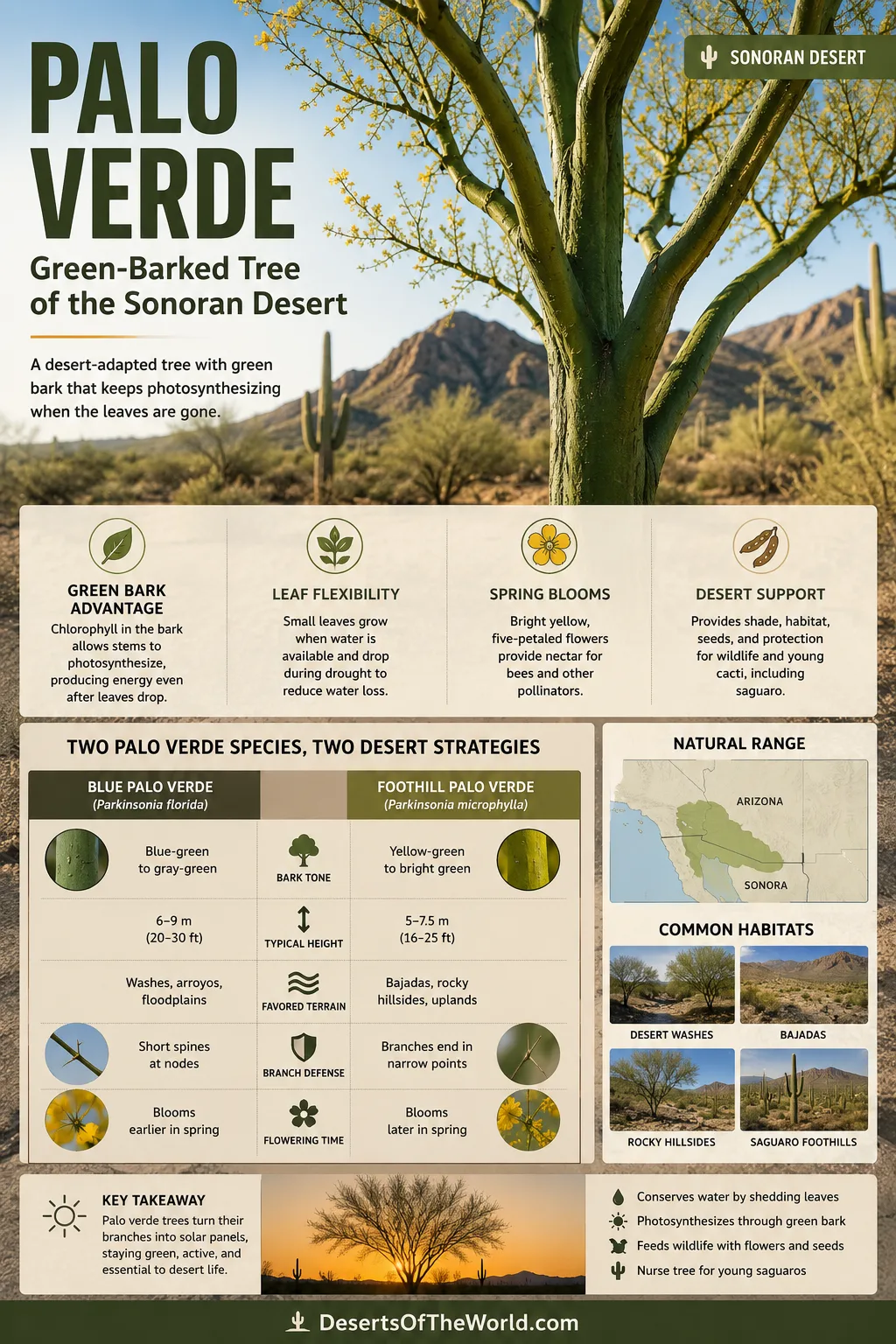
Palo verde trees give parts of the Sonoran Desert a green woody structure even during long dry periods. Their trunks and fine branches remain green after many of the leaves have fallen, so a distant slope can hold a muted green cast when the ground around it looks dry. The color is not decorative. It comes from chlorophyll-bearing tissue that allows the stems to take part in photosynthesis.
This adaptation fits a desert where water arrives unevenly. Palo verde can grow leaves when conditions permit, shed them when water loss becomes costly, and continue producing some of its energy through green stems. That flexible division of work helps explain why palo verde is so closely associated with Sonoran washes, rocky bajadas, cactus-covered foothills, and the early life of the saguaro.
Palo Verde Tree Profile
| Feature | Description |
|---|---|
| Plant Group | Small trees and large shrubs in the legume family, Fabaceae |
| Main Sonoran Species | Blue palo verde (Parkinsonia florida) and foothill palo verde (Parkinsonia microphylla) |
| Native Setting | The Sonoran Desert of the southwestern United States and northwestern Mexico |
| Most Recognizable Trait | Green or blue-green photosynthetic bark on trunks, branches, and young twigs |
| Leaf Strategy | Small compound leaves that may be dropped during dry or cold periods |
| Typical Flowering Display | Clusters of yellow, five-petaled flowers during the spring flowering season |
| Fruit | Dry seed pods, reflecting the tree’s place in the legume family |
| Desert Role | Shade producer, wildlife habitat, floral resource, seed source, and nurse tree for young cacti |
The Spanish name palo verde means “green stick.” It describes a group rather than one single species. Several Parkinsonia species occur across warm dry regions, but the blue and foothill palo verdes form the clearest pair in the Sonoran Desert. Their green bark serves the same broad purpose, while their preferred landforms reveal different relationships with desert water.
Why Palo Verde Bark Stays Green
Most tree trunks are treated as support structures covered by protective bark. Palo verde stems do more. Beneath the smooth green surface of young trunks and branches lies tissue containing chlorophyll, the pigment used to capture light for photosynthesis.
Leaves still matter when they are present. They provide a broad surface for carbon uptake, especially after rain or during milder conditions. Yet leaves also release water through stomata. In hot, dry air, maintaining a large leafy crown can become expensive. Palo verde reduces that cost by carrying very small leaves and dropping them when soil moisture falls.
Photosynthesis After the Leaves Fall
When palo verde becomes nearly leafless, it does not enter complete inactivity. Green branches continue receiving sunlight and producing carbohydrates. Stem photosynthesis does not turn the tree into a cactus, nor does the bark act as a swollen water tank. The adaptation is better understood as a shift in workload: leaves perform more photosynthesis while conditions favor them, then the stems maintain part of that activity when the leaves are gone.
This is why a palo verde can look sparse without looking dead. Leaf loss is often a water-saving response, not a sign that the tree has stopped functioning.
How the Bark Changes With Age
The youngest branches usually show the strongest green or blue-green color. As trunks age, sections of the outer bark can become grayer, rougher, or more fissured. Older bark provides more protection, while younger twigs retain a larger visible photosynthetic surface.
The change matters in field identification. A mature tree may have a gray lower trunk yet still carry an extensive network of green upper branches. Judging the species from one patch of old bark can be misleading.
Two Palo Verde Species Read Desert Water Differently
Blue palo verde and foothill palo verde often appear in the same broader desert region, but they are not distributed at random. The difference becomes clearer when the ground is read as a water map. Dry channels collect runoff. Alluvial fans spread sediment and brief flows away from mountain fronts. Rocky slopes shed water quickly. Each setting favors a different balance of growth and drought tolerance.
| Trait | Blue Palo Verde | Foothill Palo Verde |
|---|---|---|
| Scientific Name | Parkinsonia florida | Parkinsonia microphylla |
| Common Bark Tone | Blue-green to gray-green | Yellow-green to bright green |
| Typical Height | Often about 6–9 m (20–30 ft) | Often about 5–7.5 m (16–25 ft) |
| Favored Terrain | Washes, arroyos, floodplains, and larger drainage lines | Bajadas, plains, rocky hillsides, and drier uplands |
| Branch Defense | Short spines commonly occur at the nodes | Branches often end in narrow, pointed tips |
| Flowering Sequence | Usually begins earlier in the spring | Usually follows after blue palo verde |
| General Form | Taller, faster-growing, and often broad-crowned | Smaller, slower-growing, and often more densely branched |
Blue Palo Verde Along Desert Washes
Blue palo verde is strongly linked with washes and arroyos. These channels may remain dry for most of the year, yet stormwater can move through them in short pulses and soak into deep alluvial deposits. The tree benefits from moisture that is more concentrated than rainfall on nearby open ground.
This setting helps blue palo verde develop a larger crown than its foothill relative. A line of blue-green trees can mark a drainage from a distance, tracing water movement across a landscape that otherwise appears open and dry. The channel does not need permanent surface water. Its value lies in where runoff gathers and where moisture lingers below the surface.
Foothill Palo Verde on Bajadas and Rocky Slopes
Foothill palo verde occupies leaner ground. It is common on bajadas—the sloping aprons of gravel and sediment below desert mountains—as well as plains and rocky hillsides. Water is less concentrated in these places, and surface moisture can disappear quickly.
The species responds with a smaller stature, tiny leaves, dense branching, and strong drought tolerance. On many Arizona Upland slopes, foothill palo verde stands among saguaros, chollas, bursage, ocotillo, and desert ironwood. This open tree-and-cactus community is one of the characteristic plant patterns of the northern Sonoran Desert.
Small Leaves Built for an Uncertain Rain Calendar
Palo verde leaves are compound, divided into small leaflets rather than broad blades. Their reduced area limits exposure to dry air and intense sunlight. It also lets the tree build temporary foliage without committing as much water as a broad-leaved tree would.
After useful rain, fresh leaves can appear and raise the tree’s photosynthetic capacity. As the root zone dries, the leaflets may yellow and fall. The timing is flexible. It follows local moisture and temperature more closely than a fixed four-season calendar.
What Drought-Deciduous Means
A drought-deciduous plant sheds leaves in response to water shortage. That differs from a temperate deciduous tree that drops its leaves mainly as winter approaches. Palo verde may hold foliage through a favorable period, lose it during severe dryness, then produce another set after later rain.
- Leaves expand when soil moisture supports new growth.
- Small leaflets add photosynthetic surface without creating a heavy water demand.
- Leaf drop lowers transpiration during dry periods.
- Green stems continue part of the tree’s carbon uptake.
The pattern is especially well suited to the Sonoran Desert, where winter rain and summer monsoon storms can create more than one growth opportunity in a year. The response still varies by location. A tree beside a wash may retain foliage longer than one on a dry slope only a short distance away.
Yellow Flowers Mark a Desert Resource Pulse
During spring, palo verde crowns can become densely covered with yellow flowers. Each flower has five petals, and differences in petal color and form can help separate species at close range. The bloom is visually striking, but its ecological value is more useful than its appearance alone suggests.
The flowers supply pollen and nectar to bees and other insects at a time when many desert plants are also responding to seasonal moisture. Blue palo verde usually flowers before foothill palo verde, spreading the available floral resources across a longer part of spring rather than concentrating them into one brief event.
Why Flowering Changes From Year to Year
Palo verde flowering does not operate independently of rainfall. Water stored in the soil, temperatures during the preceding months, and the condition of the tree all influence the size and timing of the display. A productive season may cover the crown in yellow. A drier sequence can produce fewer flowers and fewer pods.
This variability is normal in desert plants. Reproduction follows opportunity. The tree does not spend the same amount of energy every year when the water supply changes from one season to the next.
From Flowers to Pods and Desert Seed Caches
Pollinated flowers develop into pods containing hard seeds. The pods identify palo verde as a member of Fabaceae, the same broad plant family that includes peas, beans, mesquites, and many acacias. Pod shape differs among species; foothill palo verde pods are commonly constricted around the seeds and may end in a flattened beak.
Seeds become food for desert animals. Pocket mice and antelope squirrels gather foothill palo verde seeds and may bury them in small stores. Many are later eaten, but some caches remain untouched. A forgotten seed placed below the soil surface may be better positioned for germination when moisture arrives.
Why New Palo Verde Trees Remain Uncommon
A mature tree can produce many seeds, yet successful establishment demands a narrow sequence of events. A seed must escape consumption, reach a suitable site, receive enough moisture to germinate, and survive the drying period that follows. Open soil can heat rapidly. A shallow wet layer can vanish before a young root reaches safer moisture.
For that reason, a heavy pod crop does not lead to a matching number of adult trees. Desert recruitment is uneven. A favorable rain sequence may establish a visible group of young plants, followed by years with little survival.
How Palo Verde Shelters Young Saguaros
One of palo verde’s best-known ecological roles begins beneath its canopy. Young saguaros often establish under palo verde, mesquite, or ironwood trees rather than on fully exposed ground. The overstory plant is called a nurse tree because it changes the small patch of habitat around the seedling.
The canopy filters strong summer sunlight and reduces extreme surface heating. During cold weather, the sheltered space can also soften nighttime temperature loss. Fallen leaves and fine plant material collect beneath the branches, adding organic matter to soil that may otherwise be thin and stony.
A Small Microclimate Beneath the Crown
The difference beneath a palo verde may cover only a few square meters, yet that patch can decide whether a cactus seedling survives. Shade slows moisture loss from the upper soil. Branches reduce direct exposure. Root activity and litter alter the soil environment. The canopy also offers perches to birds, which can deposit cactus seeds below.
This sheltered beginning helps explain why young saguaros are often difficult to see in open country. They may be hidden among branches, grasses, stones, and leaf litter at the base of a nurse plant.
The Relationship Changes as the Saguaro Grows
The nurse relationship is not fixed for life. A small saguaro benefits from shelter, but its shallow roots spread outward as the cactus grows. Palo verde roots occupy some of the same rain-fed soil. Over time, the plants may compete for water and nutrients.
An old saguaro can remain after the nurse tree has declined, leaving the cactus as evidence of an earlier stage in the site’s plant history. Protection came first. Competition followed.
Palo Verde Creates a Small Island of Desert Life
A palo verde crown changes more than light levels. It adds vertical structure to cactus scrub, creates nesting and resting sites, catches windblown material, and concentrates seasonal food. Flowers serve insects. Pods and seeds feed animals. Branches provide cover. Leaf litter changes the soil surface.
Like other Sonoran legume trees, palo verde can host nitrogen-fixing bacteria in root nodules. This partnership converts atmospheric nitrogen into forms used within the plant–soil system. The effect does not turn poor desert soil into rich garden earth, but it contributes to the more active patch often found beneath established trees.
Wildlife Uses Different Parts of the Tree
- Bees and other insects visit the spring flowers for pollen and nectar.
- Seed-eating mammals collect fallen seeds and may move them away from the parent tree.
- Birds use the branched crown for perching, cover, and in some cases nesting.
- Young cacti and other plants benefit from filtered shade and improved surface conditions.
The tree’s ecological value shifts through the year. Flowers may dominate in spring, foliage follows moisture, and pods become more visible as the flowering period ends. Even a leafless crown still provides structure and shade.
How to Identify Native Palo Verde in the Field
Green bark identifies the palo verde group, but it is not enough to name the species. Habitat and branch form often provide stronger evidence than color alone, especially when trees are dusty, shaded, old, or growing where their ranges overlap.
Start With the Landform
- A tree rooted in a broad wash or arroyo is more likely to be blue palo verde.
- A tree on a rocky slope, dry plain, or upper bajada is more likely to be foothill palo verde.
- Transitions occur, so landform should guide identification rather than settle it by itself.
Compare Bark Tone and Branch Tips
Blue palo verde commonly has a blue-green cast and short spines at branch nodes. Foothill palo verde often appears more yellow-green, with narrow branch tips that create a bristling outline. Older trunks in both species may lose the smooth bright color seen on young stems.
Use Flowers, Size, and Seasonal Timing
Blue palo verde is generally taller and tends to flower first. Foothill palo verde is often smaller, more compact, and later to bloom. Flower details, pod form, leaf structure, and the position of spines provide a firmer identification when several traits are checked together.
Wild Palo Verde and Landscape Hybrids Are Not the Same
Palo verde is widely planted in dry cities because it tolerates heat, offers filtered shade, and produces a strong spring bloom. Urban trees may include native species, Mexican palo verde, or cultivated hybrids selected for form, flowering, growth rate, or reduced thorns.
The widely planted ‘Desert Museum’ palo verde is a horticultural hybrid rather than a separate wild Sonoran species. Its appearance can blend traits associated with more than one parent. That makes city identification less reliable than field identification in native habitat.
Natural palo verde populations should be read in relation to landform, rainfall, neighboring plants, and local genetics. A street tree grows under a different water regime and pruning history. It may be larger, denser, or more continuously leafy than a tree on an exposed desert slope.
Why a Drought-Adapted Tree Can Still Be Sensitive to Fire
Palo verde handles heat and water shortage well, but those traits do not provide equal protection from fire. In research summarized by the U.S. Forest Service, foothill palo verde’s photosynthetic bark has been measured at roughly 3–4 mm thick. Heat that damages this living surface can also harm the cambium below it, interrupting the tissues that move water and support new growth.
Many Sonoran Desert plant communities historically had open ground between shrubs, cacti, and trees. Sparse fuel limited the ability of fire to travel across large areas. Dense annual grasses can fill those gaps after wet periods, creating a more continuous layer of dry plant material. Repeated burns then place palo verde, saguaro, and other slow-recovering desert plants under pressure.
Loss of Nurse Trees Changes More Than the Tree Layer
When palo verde disappears from a slope, the change reaches beyond the adult tree. Pollinators lose flowers, animals lose cover and seeds, and young saguaros lose one of their common nursery sites. Recovery can be slow because seedlings need suitable rain sequences and safe establishment sites.
This sensitivity shows an important limit to desert adaptation. A plant can be well fitted to drought, intense sunlight, and hot soil while remaining poorly fitted to a disturbance that was once less continuous across its habitat.
Palo Verde as a Sonoran Landscape Indicator
A line of larger blue-green crowns often marks a wash where stormwater sinks into alluvium. Smaller yellow-green trees scattered across rocky slopes point to the tighter water economy of bajadas and uplands. Saguaros rising through those crowns can also mark places where nurse trees helped seedlings pass through their most exposed years.
The green bark shows that desert survival does not always depend on storing large amounts of water in thick tissue. Palo verde reduces leaf area, moves part of photosynthesis into stems, responds to available moisture, and lets different organs carry different costs through the year.
For field surveys, the combination of palo verde species, landform, tree size, and neighboring vegetation can help describe how water moves through a Sonoran site. Blue palo verde points most strongly toward concentrated drainage moisture. Foothill palo verde is more closely tied to drier fans, plains, and slopes.
Sources
- Arizona-Sonora Desert Museum — Fabaceae (palo verde species, green bark, habitat, and Sonoran Desert ecology)
- Arizona-Sonora Desert Museum — Plant Ecology of the Sonoran Desert Region (wash distribution, seed caching, flowering, and dryland plant responses)
- University of Arizona Cooperative Extension — Mesquite and Palo Verde Trees (species descriptions, flowers, pods, bark, and ecological roles)
- University of Arizona Campus Arboretum — Parkinsonia florida (blue palo verde form, leaves, thorns, flowers, and photosynthetic stems)
- University of Arizona Campus Arboretum — Foothill Palo Verde (size, drought-deciduous growth, bark, and branching)
- U.S. Geological Survey — The Iconic Giant Saguaro Cactus (palo verde nurse-tree relationships and saguaro establishment)
- U.S. Forest Service — Parkinsonia microphylla Species Review (foothill palo verde biology, distribution, seed ecology, and fire response)
- National Park Service — Trees and Shrubs of Saguaro National Park (low-desert tree communities, nurse plants, soil moisture, and habitat structure)