
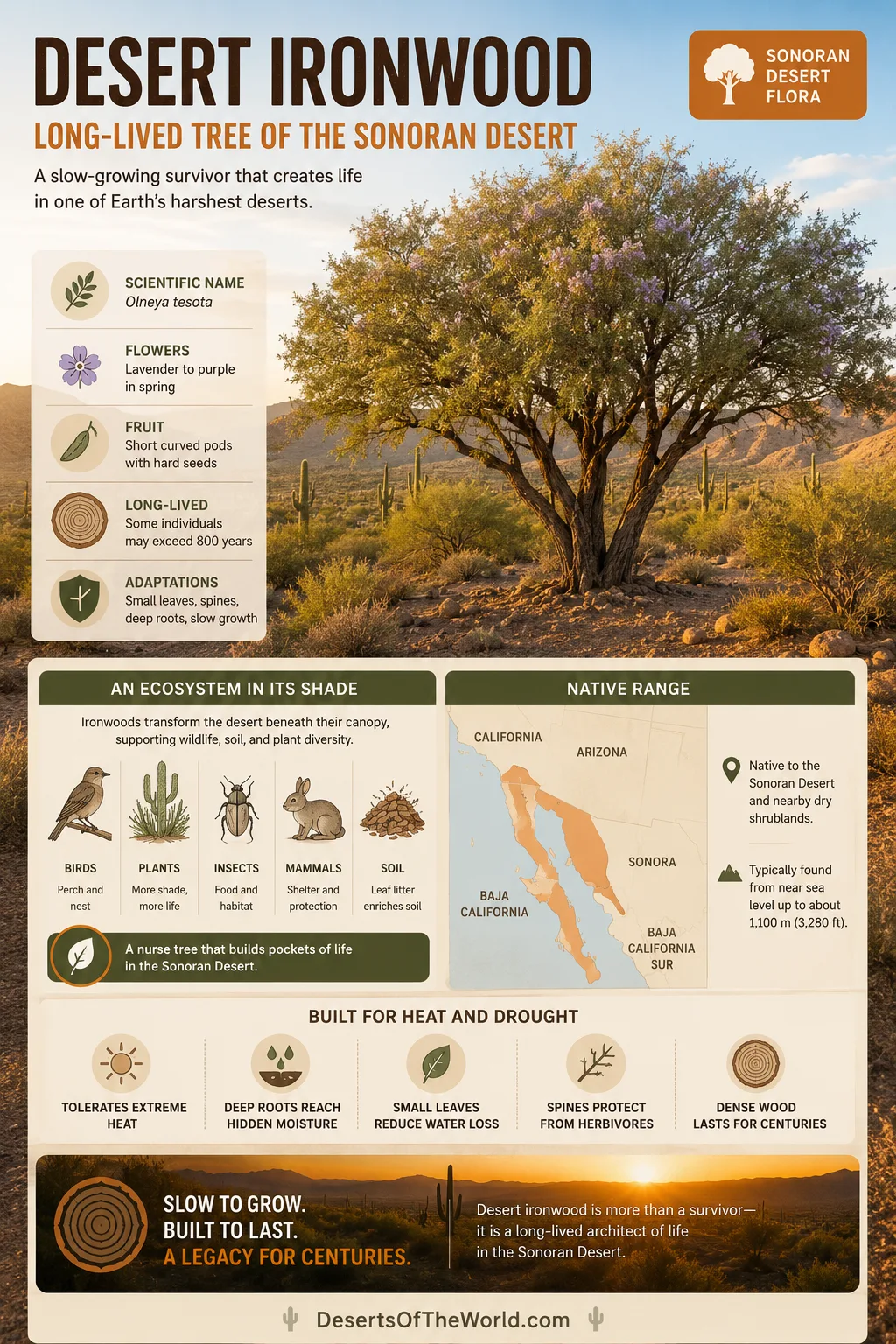
Desert ironwood grows on some of the hottest, driest ground in the Sonoran Desert, yet the oldest individuals may have remained rooted in the same landscape for many centuries. Known scientifically as Olneya tesota and as palo fierro in Spanish, it is a slow-growing legume tree with dense wood, gray-green foliage, short curved spines, and spring flowers that range from pale lavender to deeper purple.
Its long life is only part of the story. A mature ironwood changes the conditions beneath its crown. Shade reduces heat and radiation, branches catch windblown and flood-carried material, leaf litter alters the upper soil, and birds deliver seeds from the surrounding desert. The result is a small habitat patch where cacti, shrubs, insects, birds, reptiles, and mammals can find conditions that differ from the exposed ground only a few meters away.
This makes desert ironwood more than a survivor of aridity. It is a long-lived organizer of Sonoran Desert life.
Desert Ironwood Species Identity and Main Traits
Olneya tesota belongs to the pea family, Fabaceae. It is the only accepted species in the genus Olneya, so the scientific name points to a very narrow botanical lineage. The common name “ironwood” is less exact because many unrelated trees around the world receive that name when their timber is unusually hard or heavy.
| Feature | Desert Ironwood Detail |
|---|---|
| Scientific name | Olneya tesota A.Gray |
| Plant family | Fabaceae, the legume family |
| Common names | Desert ironwood, ironwood, palo fierro, tesota |
| Native biome | Primarily the Sonoran Desert and nearby dry shrubland |
| Usual form | Multi-stemmed shrub or broad-crowned small tree |
| Common height | Often below 9 meters (30 feet), though exceptional trees may reach about 15 meters (49 feet) |
| Foliage | Small, bluish- to gray-green compound leaves |
| Flowers | Pea-shaped, usually lavender, pink, or purple |
| Fruit | Short, slightly curved legume pods containing hard seeds |
| Ecological role | Nurse tree, wildlife shelter, seed-catching perch, and soil-modifying canopy |
| Age | Some individuals are estimated to exceed 800 years; exact dating remains difficult |
The species may appear as a low, many-stemmed shrub on rocky uplands or as a taller tree in washes where runoff reaches deeper soil. Size alone is therefore a poor measure of age. A short, weathered ironwood can be far older than a larger tree growing in a better-watered drainage.
A Native Range That Closely Follows the Sonoran Desert
The natural distribution of desert ironwood covers southwestern Arizona, southeastern California, Sonora, Baja California, and Baja California Sur. Its range closely tracks the Sonoran Desert, with only limited extensions into nearby dry vegetation zones.
That pattern says a great deal about the tree. Desert ironwood tolerates intense heat and long dry periods, but winter cold restricts it. Across its native range it has been recorded from near sea level to roughly 1,100 meters (3,280 feet). Near the colder northern and eastern margins, damaging freezes help determine where it can survive.
Why Washes and Drainages Hold So Many Trees
Much of the Sonoran Desert receives rain in short, uneven pulses. Water may cross a slope for only a few hours, yet those brief flows shape plant distribution for decades. Ironwoods often follow dry washes, shallow drainage lines, valley floors, and the lower portions of alluvial fans known as bajadas.
A wash does not need to contain permanent water. Its value comes from concentration. Runoff from a wide area moves through a narrow channel, sinks into sand or gravel, and leaves deeper moisture available after the surface dries. Fine organic material and seeds also collect around roots, trunks, and low branches.
In parts of the Arizona Upland subdivision, ironwoods also grow on rocky benches and slopes above cold valley bottoms. Cold air settles into low ground at night, so a slightly higher position can reduce frost exposure even when the slope appears drier.
Soil Texture Changes the Value of Rare Rain
Ironwood abundance does not depend on rainfall totals alone. Coarse, porous soils formed from weathered granite can allow water and air to move deep into the ground. In such places, roots may reach moisture that would run away or evaporate near the surface in compact soil.
This explains why two slopes under similar skies can support very different stands. One may carry scattered shrubs, while another holds ironwood, palo verde, saguaro, and dense understory patches. Desert vegetation often records how water moves through the ground, not simply how much rain falls from above.
A Growth Strategy Based on Patience
Desert ironwood grows slowly and uses water conservatively. It does not build large amounts of new wood each year. Instead, it maintains compact leaves, dense tissue, and a crown that can remain functional through repeated dry seasons.
Leaves, Spines, and a Flexible Canopy
The leaves are bipinnately compound, divided into small leaflets that give the crown a fine texture. Their bluish-green cast helps distinguish ironwood from the brighter yellow-green appearance of many palo verdes and mesquites growing nearby. Short, paired, curved spines occur where leaves attach to younger branches.
The tree is often described as evergreen, but that label needs context. Desert ironwood can shed leaves during prolonged drought, after damaging cold, or before flowering. Branches that form flower buds may yellow and lose foliage, then leaf out again when summer rains arrive. The crown responds to conditions rather than following a fixed calendar.
How the Tree Reduces Water Demand
During long dry periods, ironwood may drop leaves and smaller branches. This reduces the living surface that requires water. Slow photosynthesis and restrained growth also limit demand when moisture is scarce.
The tree does not survive because it ignores drought. It survives by reducing activity, keeping tissue for a long time, and using favorable periods without committing to rapid expansion. This is a low-speed strategy suited to a landscape where several poor rain years may follow one good season.
Why an 800-Year Age Is an Estimate
Some desert ironwoods are estimated to have lived for more than 800 years. The wording matters. These ages are not normally established by counting a neat sequence of annual rings from bark to center.
Growth rings in desert trees can be irregular, locally missing, or hard to interpret. Rainfall may trigger growth at unusual times, while severe drought can leave little visible annual change. Multi-stemmed growth, internal decay, crown death, and resprouting make the record harder to follow.
| Evidence | What It Can Show | Main Limitation |
|---|---|---|
| Trunk diameter | Relative size and a broad growth history | Growth speed changes with soil, runoff, damage, and climate |
| Observed diameter growth | An approximate rate for age modeling | A short observation period may not represent earlier centuries |
| Radiocarbon analysis | The age of sampled wood tissue | A sample may not represent the oldest living part of a complex tree |
| Old stems and resprouts | Evidence of repeated crown loss and recovery | The visible living stem can be younger than the root crown |
| Comparison with nearby trees | Relative survival through known drought periods | It gives a minimum age range rather than a birth year |
Why an Ancient Tree May Look Small
Rocky-site ironwoods often lose upper stems during rare severe droughts or freezes and then resprout from the crown. A living tree may therefore contain several generations of trunks. The current stems can look modest even when the root crown and earlier dead wood point to centuries of persistence.
Large wash-grown trees present the opposite problem. Better water and deeper soil can produce a tall, vigorous crown relatively quickly. A broad tree in a drainage may be younger than a low, battered ironwood on a stony bajada.
Age in desert ironwood is best understood as a history of persistence, damage, and renewal. A single height or trunk measurement cannot capture it.
Wood Dense Enough to Sink
The name ironwood comes from the tree’s unusually heavy, hard heartwood. Mature heartwood can be denser than water, so a piece may sink rather than float. The wood also resists decay and can remain on the desert surface long after the living crown has disappeared.
Hardness, density, and decay resistance describe different properties. Hardness concerns resistance to denting or wear. Density compares mass with volume. Decay resistance reflects how slowly fungi, insects, and other decomposers break the tissue down. Desert ironwood combines all three to an unusual degree.
Older wood is dark, close-grained, and difficult to work. Its slow formation helps explain why replacement takes so long. A newly established seedling cannot recreate centuries of dense heartwood, broad shelter, soil change, and accumulated habitat within a human lifetime.
Flowers, Pods, and Irregular Recruitment
Desert ironwood flowers generally appear in spring, with bloom progressing earlier in the southern part of the range and later toward Arizona and California. A local flowering period may last only about 10 to 18 days. The pea-shaped blossoms vary among trees from pale pink and lavender to deeper purple.
Heavy flowering does not occur with equal strength every year. Rainfall, winter conditions, stored energy, and local temperature all influence the display. Some branches drop leaves while forming buds. In poor years, a tree may produce few flowers or none.
After pollination, short knobby pods develop. Published measurements commonly place them around 3 to 6 centimeters (1.2 to 2.4 inches) long. Each pod may hold one to several hard, brown seeds. Maturation often overlaps with the approach of summer rain, giving fresh seed a chance to germinate when moisture becomes available.
Why New Generations Arrive in Bursts
A flowering tree does not guarantee a new ironwood. Seeds must escape consumption, reach suitable ground, receive enough rain, survive heat and cold, and avoid being eaten while young. Several favorable conditions may need to align in the same season.
This produces episodic recruitment: long periods with few successful seedlings, followed by occasional bursts when rainfall and seed supply coincide. A stand can contain many old trees while showing little recent replacement. That age structure is easy to miss when the canopy still looks healthy.
The Cooler and More Stable Ground Beneath the Crown
Open Sonoran Desert soil can become far hotter than the air above it. Under an ironwood, shade limits direct solar heating and reduces radiation striking leaves and stems. Research summarized by the Arizona-Sonora Desert Museum reports open soil temperatures near 65°C (148°F) in studied settings, with ground beneath ironwood canopies as much as 15°C (27°F) cooler.
The canopy also softens cold. Winter conditions beneath mature trees have been measured several degrees warmer than adjacent open ground in some studies. For a small cactus seedling, that difference can separate damaged tissue from survival.
A Thermal Buffer for Young Desert Plants
Seedlings have shallow roots, little stored water, and a small body that heats and cools quickly. Their early years are often harder than adulthood. An ironwood canopy reduces daytime heat, blocks some damaging radiation, and lessens exposure to frost.
The effect is not a constant indoor-like climate. Conditions still change sharply. Yet even a partial buffer can extend the hours when plant tissue stays within a survivable range.
How a Resource Island Forms
Shade is only one part of the altered habitat. Leaves, twigs, seed pods, windblown dust, and flood-carried debris collect beneath the tree. As organic matter breaks down, the upper soil gains nutrients and supports more microbial activity than nearby bare ground.
Like other legumes, desert ironwood can host nitrogen-fixing bacteria associated with its roots. Fallen foliage returns some of those nutrients to the surface. Exposed roots and low vegetation also slow moving material during runoff, helping the patch retain seeds and organic debris.
Over time, the area beneath the crown becomes a resource island: a localized patch with different shade, moisture, nutrients, roots, fungi, bacteria, litter, and seed supply. The border may be only a few steps wide, but it changes which organisms can live there.
How Desert Ironwood Works as a Nurse Tree
A nurse plant improves the chance that another plant will establish nearby. Desert ironwood performs this role through several linked processes rather than one simple benefit.
- Seeds arrive. Birds perch in the canopy, mammals move through the shade, and runoff carries plant material toward the trunk.
- Seeds remain in place. Roots, litter, branches, and understory stems trap material that might otherwise blow or wash away.
- Heat and radiation fall. Shade protects germinating seeds and delicate young tissue during hot hours.
- Cold exposure falls. The canopy can keep winter microclimates warmer than nearby open ground.
- Browsing becomes harder. Low branches and spines can make some seedlings less accessible to herbivores.
- Surface soil changes. Litter and trapped debris add organic matter and nutrients.
- A layered plant patch develops. Cacti, shrubs, vines, herbs, and later nurse plants may establish within the original shelter.
What Field Research Found Beneath Ironwoods
A peer-reviewed study examined five sites between Bahía Kino in Sonora and Organ Pipe Cactus National Monument in Arizona. Researchers used 75 plots, each measuring 250 square meters, and recorded 75 perennial plant species beneath ironwood canopies.
The study also found clear differences between temperatures under ironwoods and temperatures in exposed sites. Associations were especially strong among ironwood, large berry-producing shrubs, and columnar cacti. These findings support the view of Olneya tesota as a habitat-modifying tree rather than a plant that merely occupies space.
The nurse effect varies with tree size, crown density, site conditions, and disturbance. The oldest or largest ironwood does not always support the most understory species. Medium-sized mature trees can offer a useful mix of shade, low branches, open ground, and seed-catching structure.
Ironwood, Palo Verde, and Mesquite Create Different Shelters
Desert ironwood shares the Sonoran landscape with palo verdes and mesquites. All three can act as nurse plants, yet their crowns, life spans, soils, and seasonal behavior differ. One tree cannot be treated as a direct substitute for another.
| Ecological Feature | Desert Ironwood | Palo Verde | Mesquite |
|---|---|---|---|
| Typical crown | Dense, fine-textured, and often broad | Often more open, with green photosynthetic bark | Broad crown with abundant litter and pods |
| Growth pace | Very slow | Usually faster than ironwood | Varies by species and water access |
| Longevity pattern | Can persist for many centuries | Usually shorter-lived | Long-lived, but with a different growth form and soil effect |
| Common setting | Washes, valley floors, bajadas, and some rocky slopes | Slopes, bajadas, and washes depending on species | Washes, floodplains, and deeper soils |
| Nurse role | Long-term thermal shelter, seed capture, and protective branching | Frequent shelter for young saguaros and other cacti | Shade, litter, pods, and nutrient-rich soil patches |
| Visible clue | Gray-green leaves and lavender pea-like flowers | Green bark and yellow flowers | Feathery foliage and long pods |
The long life of ironwood gives its canopy unusual continuity. A seed-catching perch that remains in place for centuries receives repeated chances to collect new species, survive poor seasons, and shelter later generations.
A Tree Used Across the Desert Food Web
Different animals use different parts of the tree, and those uses change through the year. Flowers offer pollen and nectar to insects. Pods and seeds become seasonal food. Dense branches provide perches, nesting cover, and daytime shelter. Litter and dead wood support smaller organisms near the ground.
Flowers, Seeds, and Seasonal Food
Spring flowers attract bees, including both generalist and more specialized species. Once pods mature, birds and mammals consume or carry the seeds. Some rodents cache seeds underground. A forgotten cache in suitable soil may become a germination site after rain.
Seed production can be especially useful because it occurs during a season when fewer other plants offer ripe fruit in parts of the Arizona Upland. The supply is uneven, though. A heavy flowering year may be followed by a quiet one.
Branches, Shade, and Elevated Perches
Birds use tall ironwoods for resting, nesting, and watching the surrounding ground. Their movement brings seeds and fruit into the canopy zone. Beneath the tree, reptiles and mammals can avoid direct sun during the hottest hours.
Low thorny branches also create physical cover. They can protect young plants and small animals, though the same shaded patch may attract herbivores that feed on exposed seedlings. The canopy is a living habitat, not a perfect refuge.
Why Dead Ironwood Still Matters
Dense heartwood breaks down slowly. Standing dead limbs, fallen branches, and old stumps continue to add shade, crevices, perches, and hard surfaces after part of the tree has died. Insects, decomposers, reptiles, and small animals use these structures in different ways.
Some estimates suggest an ironwood stump may weather on the landscape for many centuries. The exact period varies with exposure and condition, but the broader point is clear: dead ironwood remains part of desert structure far longer than ordinary fallen twigs.
Palo Fierro in Regional Knowledge and Craft
People across the Sonoran Desert have long recognized desert ironwood for its hard timber, edible seeds, shade, and durability. Uses have included tools, fuel, household objects, and carved figures. In Sonora, palo fierro carving became a well-known regional craft.
Traditional and small-scale uses are not the same as heavy extraction. Old ironwoods grow too slowly to replace mature wood rapidly. Cutting a large tree removes both material and a living canopy that may shelter many other species. Recovery is especially weak where seedling establishment is already rare.
The tree’s cultural value therefore sits beside its ecological value. The strongest long-term relationship with ironwood is one that allows old stands, young recruits, and the habitats beneath them to remain present.
What Disappears When an Old Ironwood Is Removed
Removing an old desert ironwood does not create an empty space that a nursery-grown sapling can immediately fill. Several layers of accumulated habitat disappear at once:
- A broad crown that has moderated heat and cold for decades or centuries
- A long-used bird perch and seed-delivery point
- Low thorny shelter around young cacti and shrubs
- Leaf litter, roots, fungi, bacteria, and altered surface soil
- Dead limbs and cavities used as physical habitat
- An established cluster of plants that depends on the canopy’s microclimate
- A source of flowers, pods, and seeds during seasonal food gaps
A young replacement may carry the same scientific name, but it does not carry the same ecological history. Time is part of the habitat.
Fire, Fragmentation, and Slow Replacement
Desert ironwood has a wide range, yet local stands can still decline. The main concern is not one isolated pressure. It is the combination of slow growth, irregular seedling recruitment, land conversion, cutting, altered runoff, and a changing fire environment.
How Buffelgrass Changes Desert Fire
Native Sonoran Desert vegetation often grows with open ground between shrubs, cacti, and trees. Those gaps limit the movement of fire. Buffelgrass (Cenchrus ciliaris) can fill the spaces with continuous dry fuel.
Once established, the grass can carry flames across ground that once acted as a firebreak. Many Sonoran Desert trees and cacti do not have the traits needed to survive repeated hot fires. Ironwoods may be killed, while the grass can return and rebuild the fuel layer.
The sequence is self-reinforcing:
- Buffelgrass spreads between native plants.
- Dry grass connects separate fuel patches.
- Fire travels farther through the desert vegetation.
- Native trees, shrubs, and cacti lose cover.
- Open disturbed ground becomes easier for buffelgrass to occupy again.
Land managers in and around Ironwood Forest National Monument continue to treat buffelgrass because the altered fire pattern can reshape the plant community far faster than slow-growing ironwoods can recover.
Why Connected Desert Ground Matters
Roads, cleared land, intensive development, and changes to drainage can separate ironwood stands or redirect the runoff that supports them. A mature tree may remain alive after the surrounding habitat is divided, but birds, mammals, seed movement, and water flow may no longer operate in the same way.
Fragmentation also narrows the range of sites where new seedlings can establish. An old population without younger age classes can appear stable for years while its future quietly contracts.
Why Recovery Cannot Be Measured by Tree Count Alone
Planting young ironwoods can support restoration, but counting stems does not show whether the older ecological functions have returned. A restored site needs time for crowns to widen, litter to accumulate, soil organisms to develop, wildlife to use the branches, and understory plants to establish.
Recovery should therefore consider age structure, canopy size, native understory, seedling survival, wash function, and fire exposure. Ten young trees do not automatically replace one ancient habitat tree.
Ironwood Forest as an Old-Growth Desert Landscape
Ironwood Forest National Monument northwest of Tucson protects a broad Sonoran Desert landscape of mountains, valleys, bajadas, and washes. The monument covers about 189,600 acres, with roughly 128,400 acres administered by the U.S. Bureau of Land Management. Ironwood grows there with saguaro, palo verde, mesquite, creosote bush, and many smaller desert plants.
The phrase old-growth desert helps describe what such a place preserves. Old growth does not need to be a tall, closed forest. In the Sonoran Desert it may appear as scattered, low trees separated by open ground, each one holding centuries of wood, resprouting, shade, soil change, and biological use.
An ironwood landscape is therefore measured in relationships as much as trunks. The tree shelters seedlings; birds deliver seeds; washes bring organic material; roots hold a resource patch; dead wood remains after crown loss; and a new generation may appear only when a rare sequence of rain, temperature, seed supply, and protection aligns.
Desert ironwood survives the Sonoran Desert by enduring its extremes. Many other organisms survive because the ironwood changes those extremes beneath its crown.
Sources
- Plants of the World Online — Olneya tesota (accepted scientific name, classification, biome, and native range)
- U.S. National Park Service — Trees and Shrubs of Saguaro National Park (height, flowers, estimated longevity, and persistence of old wood)
- Arizona-Sonora Desert Museum — Natural History of the Desert Ironwood Tree (distribution, flowering, nurse-tree ecology, soils, longevity, and local pressures)
- University of Arizona — The Importance of Olneya tesota as a Nurse Plant (peer-reviewed field study of canopy associations and temperature differences)
- U.S. Bureau of Land Management — Ironwood Forest National Monument (monument area, elevation, landscape, plants, and wildlife habitat)
- U.S. Geological Survey — What Is Buffelgrass? (invasive grass effects and altered fire patterns in the Sonoran Desert)
- NatureServe Explorer — Olneya tesota (species range, ecological role, and conservation pressures)