
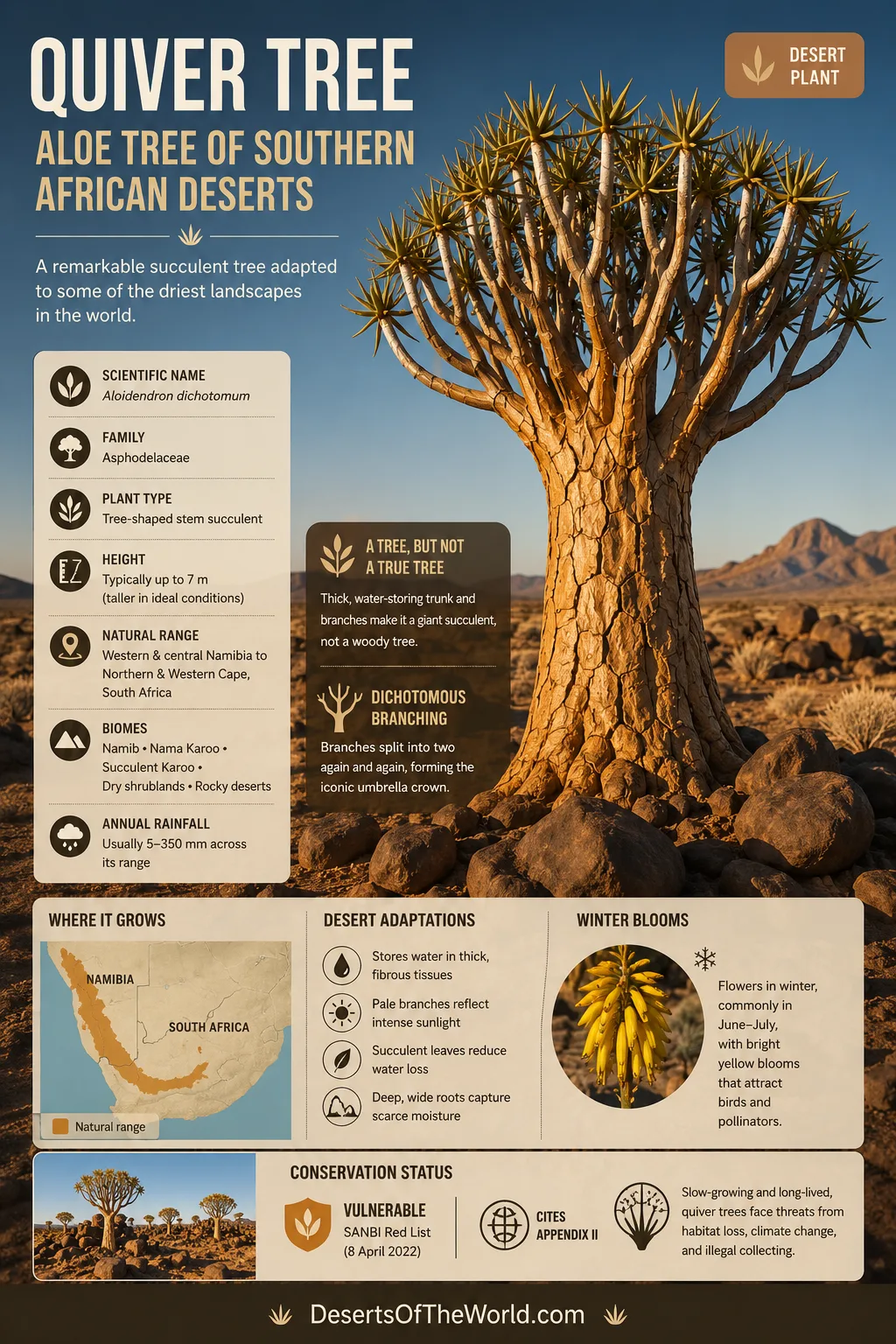
The quiver tree rises above the sparse ground of southern Africa as a thick-stemmed succulent with the outline of a small tree. Its pale branches divide again and again, each fork ending in a compact rosette of blue-green leaves. The form looks familiar from a distance, yet the plant is built very differently from an acacia, camel thorn, or other woody desert tree.
Aloidendron dichotomum belongs to a group known as the tree aloes. It grows across arid parts of Namibia and South Africa, especially where exposed rock, thin soils, intense sunlight, dry air, and irregular rainfall shape the landscape. The species links several desert and semi-desert regions, including the Namib, Nama Karoo, and Succulent Karoo. It is therefore best understood as both a plant and a record of how life adjusts to southern Africa’s dry western interior.
The Quiver Tree in Its Desert Setting
| Feature | Quiver Tree Detail |
|---|---|
| Accepted Scientific Name | Aloidendron dichotomum |
| Former Scientific Name | Aloe dichotoma |
| Plant Family | Asphodelaceae |
| Growth Form | Tree-shaped stem succulent |
| Native Range | Western, central, and southern Namibia to the Northern and Western Cape of South Africa |
| Main Biomes | Namib, Nama Karoo, Succulent Karoo, dry shrubland, and rocky desert vegetation |
| Typical Height | About 7 metres, with taller plants reported under favourable conditions |
| Flowering Season | Southern Hemisphere winter, commonly June and July in many populations |
| Flower Colour | Bright yellow |
| Current South African Red List Status | Vulnerable, based on the SANBI assessment dated 8 April 2022 |
| International Trade Listing | CITES Appendix II |
The species spans roughly 11 degrees of latitude, from the Brandberg area of Namibia in the north to the Hantam Mountains of South Africa in the south. Across that range, average annual rainfall may vary from about 5 millimetres to 350 millimetres. This wide spread does not mean the plant grows everywhere between those limits. Quiver trees occur in separated populations where terrain, slope direction, rock, soil, temperature, and moisture create suitable local conditions.
Why the Quiver Tree Is an Aloe Tree
The quiver tree is not Aloe vera enlarged to tree size. It belongs to a separate genus of tree aloes whose members develop tall stems, forked branches, and crowns of succulent leaves. The genus name Aloidendron combines the idea of an aloe with the Greek word for tree.
From Aloe dichotoma to Aloidendron dichotomum
Older books, maps, signs, and botanical records often use the name Aloe dichotoma. That name is now treated as a synonym. In 2013, taxonomic work separated the tree aloes from the larger genus Aloe, and the accepted name became Aloidendron dichotomum.
Both names still appear in public use, so they should not be read as two different species. The second part of the name refers to dichotomous branching: a branch divides into two, and those branches later divide again. Repeated over many years, this pattern forms the rounded crown that makes mature quiver trees easy to recognise.
A Succulent Built on a Tree Scale
A quiver tree does not build its trunk in the same way as an oak or a desert acacia. Its stem and branches contain thick, fibrous, living tissue that stores water. The plant holds much of its working water reserve above ground, close to its leaves and active growing points.
This structure gives the plant a broad trunk and heavy branches without turning it into a typical forest tree. It is a giant succulent. That distinction explains much of its behaviour: slow maturation, strong drought tolerance, sensitivity to poor drainage, and limited ability to recover after major stem damage.
How the Forked Crown Develops
Young plants look unlike the rounded adults seen in photographs. Juvenile leaves may stand in vertical rows along an unbranched stem. As the plant matures, branching begins. Each new fork places growing tissue farther from the centre while maintaining a compact leaf rosette at the end.
The result is a crown made of many separate succulent branch tips. Old leaf bases disappear from the lower branches, leaving much of the crown bare except at its outer edges. Against an open desert sky, those leaf clusters can resemble roots held above the ground.
Golden Bark and Pale Branches
The trunk develops golden-brown plates, while younger branches often carry a thin whitish coating. That pale surface reflects part of the intense solar radiation striking the crown. Dark tissue would absorb more heat; the lighter coating helps reduce the load on exposed branches.
The bark plates also give older trunks their layered texture. They are not merely decorative. They mark the difference between the weathered lower trunk and the smoother, younger parts of the crown.
Where Quiver Trees Grow
The natural range crosses national and biome boundaries. In Namibia, quiver trees occur from western and central areas southward through dry mountain country and rocky plains. In South Africa, they extend through Namaqualand, Bushmanland, the Richtersveld, the Orange River region, the Hantam, and parts of the inland Karoo.
The species is associated with the Namib Desert, yet it is not restricted to the narrow coastal desert. It also occupies dry shrublands, desert mountains, broken veld, arid grassland, and Karoo vegetation. Some populations receive most of their moisture in winter. Others stand in summer-rainfall zones. Their shared requirement is not a fixed rainfall calendar but a workable combination of temperature, drainage, shelter, and occasional moisture.
Rocky Slopes Rather Than Open Dunes
Quiver trees are often described simply as desert plants, which can create the wrong picture. They do not usually form stands on shifting sand dunes. Many populations occupy rocky hills, inselbergs, mountain slopes, outcrops, shallow soils, and gravelly ground.
Rock changes the desert at plant scale. Cracks collect fine soil. Shaded sides remain cooler than open ground. Rain running off bare stone may concentrate in narrow pockets. A seedling beside a rock can avoid part of the midday sun and gain some protection from browsing animals. A landscape that appears almost soil-free may contain many small sites with different moisture and temperature conditions.
Slope Direction and Local Climate
Quiver tree populations do not respond only to regional climate averages. The direction a slope faces can alter its daily heat load. Southern populations often occur on warmer north-facing slopes, while northern populations may favour cooler south-facing aspects. This pattern allows the species to adjust its position within a mountain or outcrop without moving across a large distance.
Elevation matters as well. A high rocky ridge can be cooler than a low plain nearby. That helps explain why the northernmost population occurs at high elevation on the Brandberg massif. The geographic edge of a species is rarely a straight line; in desert country, it follows pockets of suitable climate.
Fog at the Western Edge
Near the Atlantic side of the range, some quiver trees live where measured rainfall is extremely low. Frequent coastal fog may add moisture that ordinary rainfall totals do not show. Researchers have proposed that fog droplets collecting on branches and trunks can move downward toward shallow or adventitious roots.
This does not make the quiver tree a fog-dependent plant across its full range. It shows why desert rainfall alone cannot explain every population. Mist, runoff, rock shade, soil depth, and the timing of small moisture events can matter as much as an annual total.
How the Quiver Tree Manages Heat and Water
Desert survival depends on balance. A plant must collect carbon for growth, but opening pores in its leaves also allows water vapour to escape. The quiver tree reduces that trade-off through succulent storage, reflective surfaces, controlled leaf area, and a photosynthetic cycle suited to dry air.
The Night Shift Inside the Leaves
Quiver trees use Crassulacean acid metabolism, usually shortened to CAM. Many ordinary plants open their stomata during the day to take in carbon dioxide. A CAM plant moves much of that gas exchange into the night, when temperatures are lower and the air places less drying pressure on the leaf.
The process works in stages:
- Stomata open mainly at night.
- Carbon dioxide enters the leaf and is stored temporarily in organic acids.
- During daylight, the stomata can remain more tightly closed.
- The stored carbon is released inside the leaf and used for photosynthesis.
CAM saves water, but it does not remove the plant’s need for moisture. Nor does it allow unlimited heat tolerance. Photosynthesis still depends on temperature, daylight, internal storage capacity, and the condition of the leaf.
Why Night Temperature Matters
A controlled study published in 2022 confirmed CAM activity in Aloidendron dichotomum and found that nocturnal acid accumulation was highest near a night temperature of 21.5°C under the tested conditions. Carbon uptake rose with leaf temperature during the night.
This finding helps explain an unusual range pattern. The southern edge of the species may be limited partly by cold nights, not by a lack of drought tolerance. As some southern areas warm, conditions that were once too cool for efficient CAM activity may become more suitable. Farther north, the opposite pressure can occur when heat and water stress move beyond what adult trees and seedlings can sustain.
Water Held in Living Tissue
The thick trunk and branches act as reservoirs. During dry periods, stored water supports leaf function and keeps the living stem tissues active. Large adults therefore have more buffered water reserves than small seedlings.
That reserve helps mature trees survive long gaps between useful rains. It also attracts animals during severe drought, when other sources of moisture become scarce. Browsing of trunks and branches has been recorded in parts of the range, especially when dry conditions reduce other food and water sources.
Leaf Rosettes at the Ends of Branches
The leaves are concentrated at active branch tips rather than spread along the full trunk. Each rosette contains thick, blue-green leaves with a relatively controlled surface area. Old portions of the branch remain leafless.
This arrangement keeps the photosynthetic tissue in compact groups. It also limits the amount of exposed leaf surface that must be supplied with water. The crown still captures strong sunlight because it stands above surrounding shrubs and grasses.
Winter Flowers and Wind-Carried Seeds
For much of the year, colour in a quiver tree crown comes mainly from pale branches and blue-green leaves. During winter, clusters of yellow flowers rise above the rosettes. Many South African populations flower around June and July, though timing varies across the broad range.
Nectar During the Dry Season
The tubular yellow flowers produce nectar used by birds and insects. Visitors include sunbirds, weavers, white-eyes, starlings, and honeybees. In open country with few tall flowering plants, a mature quiver tree can become a concentrated feeding point.
The timing matters. Winter flowering places nectar in the landscape when other resources may be patchy. Pollination also connects trees that stand apart from one another, allowing pollen to move through scattered desert populations.
Small Seeds in a Windy Landscape
Dry fruit capsules split open and release hundreds of light seeds. Each seed has a small wing that allows wind to carry or roll it across bare ground. The seeds may remain dormant for as long as three years, waiting for a moisture event that can support germination.
Wind dispersal sounds efficient, yet most seeds do not become adult trees. Suitable establishment sites are rare. A seed may land on ground that dries too quickly, lacks shade, or leaves the new shoot exposed to browsing. Distance alone does not produce a successful range shift.
Why Seedlings Need Shelter
Young quiver trees often establish beside rocks or beneath nurse plants. These small shelters reduce direct sunlight, slow moisture loss, and hide part of the seedling from animals. Grasses such as Stipagrostis brevifolia have been linked with successful recruitment in monitored populations.
Seedlings hold much smaller water reserves than adults and may use CAM less effectively during cool nights. Their first years are therefore the narrowest part of the life cycle. A population can contain many old trees while producing very few replacements.
| Adult Survival | Population Survival |
|---|---|
| A mature plant may persist through many dry years. | New seedlings must establish often enough to replace ageing adults. |
| A large trunk stores a substantial water reserve. | A seedling has little stored water and a small root system. |
| Its height and crown are easy to see. | Missing young plants can go unnoticed without close surveys. |
| One old tree may remain standing for generations. | A population may still be ageing toward decline. |
A Living Tower for Desert Wildlife
Across many parts of its range, the quiver tree is among the tallest living structures in the landscape. That height changes how animals use otherwise open ground. Birds gain a perch, a nesting platform, a lookout point, and a seasonal nectar source.
Sociable Weaver Nests in the Crown
Large quiver trees often support the communal nests of sociable weavers (Philetairus socius). These nests may contain many chambers and remain in use for long periods. Strong forks provide support above the ground, while the height separates much of the colony from animals moving below.
The relationship is most visible in mature trees because large crowns offer thicker branches and more stable forks. A young plant cannot provide the same nesting structure. The ecological value of a quiver tree therefore grows with its size and age.
Perches, Lookouts, and Nectar
Raptors may use the crown as a vantage point. Smaller birds rest or feed among the rosettes. Flower visitors move pollen between trees. In landscapes with few upright plants, the loss of a large individual removes more than succulent biomass; it removes vertical habitat.
This role is one reason the quiver tree is described as a keystone species in parts of its range. Its physical form creates options that low shrubs and grasses cannot provide.
Insects Around the Growing Points
Long-term observations have also recorded insects that affect young growth. Weevils may damage juvenile growing points, while ant colonies living in adult branches can defend those tissues from some insect activity. These interactions show that recruitment depends on more than rain and temperature.
The desert population is a network: rocks shelter seedlings, plants modify shade, birds use old crowns, insects feed on growing tissue, and ants may protect it. The quiver tree stands above the scene, but it does not live apart from it.
Why a Quiver Tree Forest Does Not Look Like a Forest
The word “forest” usually suggests touching crowns, deep shade, leaf litter, and several layers of vegetation. A quiver tree forest is different. It is an open stand of tree aloes scattered across rock, gravel, and low desert vegetation.
The well-known Quiver Tree Forest near Keetmanshoop in southern Namibia illustrates this pattern. Mature plants may appear numerous within one rocky area, yet broad spaces remain between them. Sunlight reaches the ground. The tree layer does not form a closed canopy.
“Forest” in this setting refers to a local concentration of a tree-shaped species, not to a humid woodland structure. The same distinction applies to isolated groups elsewhere in Namibia and South Africa. Their density is shaped by geology, drainage, past recruitment events, and the survival of old plants.
Three Layers in an Open Stand
A quiver tree stand can be understood through three overlapping layers:
- The visible layer: mature trunks and rounded crowns.
- The ground layer: rock cracks, nurse plants, shallow roots, and moisture pockets.
- The future layer: seeds, seedlings, and young unbranched plants.
A photograph usually captures the first layer. Ecologists must examine all three. A stand filled with mature trees may look stable even when the youngest age classes are absent.
How the Quiver Tree Received Its Common Name
The English name comes from a traditional use of the plant by Indigenous communities of southern Africa. The soft, fibrous interior of suitable branches could be hollowed, with one end closed, to make a container for arrows. The Afrikaans name kokerboom carries the same idea: a tree associated with a quiver or case.
An early written record from 1685 described this use and recorded the plant name choje. The written account did not mark the beginning of the practice. It recorded knowledge that local communities already held about the branch structure and material properties of the plant.
Dead trunks were also used as naturally cool storage spaces. Air moving through the fibrous tissue could help keep stored items cooler than the surrounding daytime air. Both uses arose from close observation of the plant’s light, insulating stem tissue.
How to Distinguish Three Desert Tree Aloes
Three tree aloes occur in the dry borderlands of Namibia and South Africa: Aloidendron dichotomum, Aloidendron pillansii, and Aloidendron ramosissimum. Their ranges overlap in parts of the Richtersveld and adjacent desert country, but their forms differ.
| Feature | Aloidendron dichotomum | Aloidendron pillansii | Aloidendron ramosissimum |
|---|---|---|---|
| Common Form | Rounded tree with repeated forked branches | Large tree aloe with a massive trunk and fewer heavy branches | Dense, many-branched shrub |
| Typical Scale | Often around 7 metres tall | Can form a taller, heavier tree | Usually much shorter, often near or below 2 metres |
| Flower Position | Upright clusters above the leaf rosettes | Flower clusters emerge below the lowest leaves and hang outward or downward | Upright clusters above compact rosettes |
| First Visual Clue | Balanced, rounded crown | Column-like trunk and sparse large crown | Low, bushy outline with early branching |
The name “quiver tree” is sometimes applied loosely to more than one of these plants. For species identification, crown form, plant height, flower position, and branching pattern are more dependable than the common name alone.
Climate Change and the Uneven Response Across the Range
Quiver trees live in hot, dry environments, but desert adaptation is specialization rather than immunity. Each population occupies a local climate window. When heat, water balance, or cold-night limits move, the response can differ from one end of the range to the other.
What Long-Term Monitoring Shows
A monitoring program begun in 2002 has returned to dozens of quiver tree populations across Namibia and South Africa. The 2022 SANBI assessment used surveys from 40 subpopulations, while a 2024 SANParks update described work across 41 populations.
Researchers measure living and dead trees, classify age stages, repeat photographs, record recruitment, and compare patterns with climate. Dead quiver tree trunks decompose slowly in arid air and may remain standing for at least a decade, so mortality can be studied after leaves and branches have disappeared. That advantage comes with a caution: a standing dead trunk does not reveal its exact year or cause of death.
Northern Decline and Southern Recruitment
Warmer, drier, lower-elevation populations have often shown higher adult mortality and weaker recruitment. Cooler populations near the southern and south-eastern limits have shown persistence and, in some places, more young plants.
This is not a simple march southward. Populations are separated by large areas, and new suitable climate does not automatically receive seeds. Local slopes, rock shelters, nurse plants, animals, fire, and rainfall events still decide whether a seed becomes a tree.
The Distance Between Suitable Climate and New Trees
Models of past range change suggest that the quiver tree expanded at roughly 0.4 kilometres per decade after the Last Glacial Maximum. To keep pace with projected climate shifts in coming decades, some models estimate that it would need to move near 6 kilometres per decade—about 15 times faster.
Wind can carry individual seeds, yet successful migration requires a chain of rare events: arrival, germination, survival, flowering, and production of another generation. A long-lived plant with a generation length near 100 years cannot fill new habitat as quickly as climate maps can redraw it.
| Measure From the 2022 SANBI Assessment | Reported Value | What It Describes |
|---|---|---|
| Extent of Occurrence | 149,707 km² | The broad area containing known populations, not continuous tree cover |
| Generation Length | About 100 years | The slow pace at which population replacement occurs |
| Modelled Loss of Currently Suitable Habitat by 2070 | About 33% to 68% | Projected climatic suitability under different emissions pathways |
| Linear Population Decline Projected to 2102 | 26.2% | A conservative estimate based on monitored population trends |
| Expected Population Reduction Used for Listing | More than 30% within 100 years | The basis for the Vulnerable category under the assessment criteria |
What Recent Dieback Research Adds
A 2025 study examined fungi associated with symptomatic quiver tree stems and roots in South Africa. Several fungal species produced lesions in greenhouse tests, but none behaved as an aggressive primary pathogen. The study did not identify a single fungal cause for landscape-scale dieback.
This keeps the interpretation careful. Fungi may interact with stressed tissue, but association does not prove that they initiated decline. Climate, drought, physical damage, browsing, windthrow, insects, and local site conditions may act alone or together. Long-lived desert plants often record several pressures over many years.
Current Conservation Status and Protection
The SANBI Red List classifies Aloidendron dichotomum as Vulnerable. The current assessment is dated 8 April 2022 and lists the population trend as decreasing. The species is not confined to South Africa, so this national assessment covers the South African part of a wider Namibia–South Africa range while drawing on range-wide research.
The 2026 CITES appendices place Aloidendron species in Appendix II except species separately placed in Appendix I. For the quiver tree, Appendix II means international commercial trade is controlled through permits and documentation. It does not mean all trade is prohibited.
Why Recruitment Receives So Much Attention
Mature quiver trees may reach their maximum height after roughly 80 to 120 years. Some individuals may live for two centuries or longer. Long life can hide a population problem because adult survival continues long after regular seedling establishment has slowed.
In the monitoring data used by SANBI, several populations contained no juveniles during survey periods. Others retained healthy younger age classes. Conservation therefore cannot rely only on counting large trunks. The ratio of seedlings, juveniles, mature trees, and dead trees gives a more useful picture.
Protected Landscapes Across the Range
Quiver tree populations occur within areas such as /Ai /Ais–Richtersveld Transfrontier Park, Namaqua National Park, Namib-Naukluft National Park, Tsau //Khaeb National Park, and other managed landscapes. Protected status can reduce direct habitat disturbance and support long-term monitoring.
Boundaries cannot hold climate in place. A reserve may protect existing trees while future suitable conditions develop outside it. That is why researchers also study migration routes, genetic variation, seed movement, nurse plants, and the climate of potential expansion zones.
Questions Still Being Measured
Several practical questions remain open:
- How quickly do dead trunks and branches decay in different parts of the range?
- Which combinations of rain, fog, temperature, and shade allow seedlings to survive?
- How far can viable seeds move across broken desert terrain?
- Do northern and southern populations differ in heat, cold, or moisture tolerance?
- How do browsing, insects, fungi, fire, and wind interact with climate stress?
- Can new populations establish rapidly enough in areas becoming climatically suitable?
These questions matter because the quiver tree lives on a slow clock. A few years of observation can record flowering or drought injury. Understanding population direction requires decades.
What the Shape of a Population Reveals
A stand containing seedlings, unbranched juveniles, young branching plants, mature trees, old declining crowns, and standing dead trunks holds a visible record of past conditions. Each age class points to a different period of establishment and survival.
A group dominated by mature trees may reflect a favourable recruitment event many decades ago. A mixed population suggests repeated opportunities for new plants to enter the stand. A site with numerous dead trunks and few young plants may be losing more individuals than it replaces.
The quiver tree’s rounded crown is its most recognisable feature, but the small plants near the rocks carry the clearest evidence of its future. Adult endurance explains how the species remains in a desert. Recruitment explains whether it remains there for another generation.
Sources
- South African National Biodiversity Institute: Aloidendron dichotomum (botanical description, habitat, flowering, ecology, traditional use, and growth form)
- SANBI Red List of South African Plants: Quiver Tree (2022 status assessment, range, population monitoring, ecology, projected change, and research needs)
- Royal Botanic Gardens, Kew: Plants of the World Online (accepted scientific name, synonymy, plant family, native distribution, and biome)
- South African National Parks: Tracking the Survival of Quiver Trees (2024 update on long-term population monitoring and range responses)
- Journal of Experimental Botany: Bioclimatic Controls of CO₂ Assimilation (CAM photosynthesis, night temperature, and range-limit physiology)
- Frontiers in Ecology and Evolution: Range Responses to Climate Change (past range modelling, future climatic space, dispersal speed, and migration lag)
- Fungal Systematics and Evolution: Microfungi Associated With Dying Quiver Trees (2025 study of fungi isolated from symptomatic stems and roots)
- CITES Appendices, Valid From 5 March 2026 (current international trade listing for Aloidendron species)