
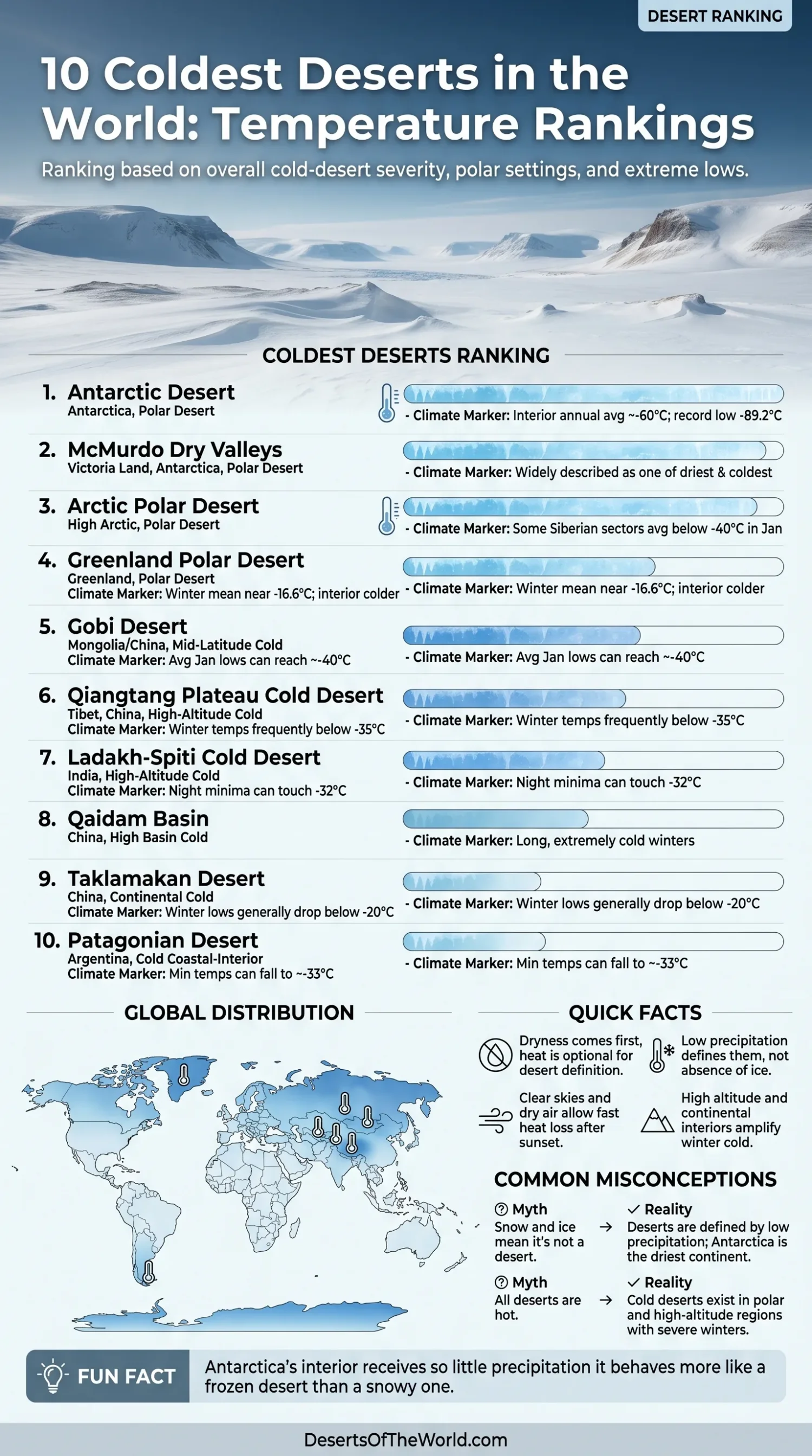
 Cold deserts confuse people for one simple reason: the word desert sounds hot, while the word cold sounds snowy. In climate terms, dryness comes first. Heat is optional. That is why the coldest deserts on Earth are found in polar regions, wind-scoured plateaus, high basins, and broad inland plains where moisture stays scarce and winters bite hard. Some are covered in ice, some in gravel and salt, some in sand. All are dry. Very dry.
10 Coldest Deserts in the World: Temperature Rankings
These rankings are based on overall cold-desert severity: polar setting, length of freezing season, documented winter lows, and very low precipitation. Exact placement below the first few entries can shift a little depending on whether a source emphasizes record lows, average winter temperatures, altitude, or exposed ice-free terrain. Cold, yes. Simple to rank, no.
| Rank | Desert | Region | Desert Type | Climate Marker | Why It Ranks So High |
|---|---|---|---|---|---|
| 1 | Antarctic Desert | Antarctica | Polar Desert | Interior annual averages near -60°C; winter can fall below -80°C; Earth record of -89.2°C | The coldest desert on the planet, with extreme elevation, very low snowfall over the plateau, and year-round deep freeze. |
| 2 | McMurdo Dry Valleys | Victoria Land, Antarctica | Polar Desert, Ice-Free Subregion | Widely described as one of the driest and coldest deserts on Earth | An exposed Antarctic desert where bare ground, fierce winds, and almost no usable moisture create Mars-like conditions. |
| 3 | Arctic Polar Desert | High Arctic of Canada, Greenland, and Russia | Polar Desert | Some Siberian Arctic sectors average below -40°C in January | Its long winter, low precipitation, and frozen ground keep it firmly in the top tier of global cold deserts. |
| 4 | Greenland Polar Desert | Greenland, especially interior and dry western sectors | Polar Desert | Kangerlussuaq averages 149 mm of precipitation yearly and mean winter temperature near -16.6°C; interior is colder | Greenland combines desert-level dryness with polar cold, permafrost, and a huge ice-sheet influence. |
| 5 | Gobi Desert | Mongolia and Northern China | Mid-Latitude Cold Desert | Average January lows can reach about -40°C | The Gobi is not polar, yet its inland position and large annual temperature swing make its winters brutally cold. |
| 6 | Qiangtang Plateau Cold Desert | Tibetan Plateau, China | High-Altitude Cold Desert | Winter temperatures frequently fall below -35°C; annual precipitation under 100 mm in dry sectors | Altitude does the heavy lifting here: thin air, relentless wind, and long frozen seasons. |
| 7 | Ladakh-Spiti Cold Desert | Trans-Himalaya, India | High-Altitude Cold Desert | Night minima can touch -32°C; elevations of about 3,000-5,000 m | A rain-shadow desert where altitude, clear skies, and very low moisture keep winters hard and dry. |
| 8 | Qaidam Basin | Qinghai, China | High Basin Cold Desert | Long, extremely cold winters; annual precipitation below 100 mm | Salt flats, enclosed drainage, and elevation make this basin one of Asia’s starkest cold deserts. |
| 9 | Taklamakan Desert | Xinjiang, China | Continental Cold Desert | January averages around -10°C to -9°C; winter lows generally drop below -20°C | Best known for sand seas and dryness, yet its winter cold is more serious than many popular rankings admit. |
| 10 | Patagonian Desert | Argentina | Cold Coastal-Interior Desert | Minimum temperatures can fall to about -33°C; annual precipitation often around 5-8 inches | Strong winds, low rainfall, and a cool southern latitude make Patagonia a true cold desert, even if it is less severe than polar and plateau rivals. |
Why Temperature Rankings Need Context
A desert can be cold in more than one way. One place may post a lower single-night reading. Another may stay frozen for far longer. A third may be drier, windier, or more hostile to plant life even with a slightly milder winter average. That is why the list above gives more weight to overall cold-desert character than to one isolated minimum.
There is another point that many short rankings skip: not every cold place is a desert, and not every desert with frosty nights is a cold desert. A snowy mountain range may be very cold but too wet to count as desert. A hot desert may dip below freezing after sunset, yet still belong to a warm desert climate overall.
Polar Deserts
Polar deserts sit at very high latitudes, where the air is cold and moisture is scarce. Antarctica and the Arctic are the clearest examples. In these landscapes, water is locked away as ice, snow, or permafrost. The dryness matters as much as the cold. Without that dryness, they would not be deserts.
High-Altitude Cold Deserts
These form where elevation strips heat from the air and mountain barriers block moisture. Ladakh, Spiti, Qiangtang, and the Qaidam Basin fit this pattern. By day, sunshine can feel sharp and intense. After sunset, temperatures drop fast. Thin air and clear skies do that.
Continental Cold Deserts
Far from oceans, inland deserts often swing between hot summers and bitter winters. The Gobi and Taklamakan show this well. Their dryness is real, their winter cold is real, and the distance from marine moisture helps lock both into place.
Detailed Look at the 10 Coldest Deserts
1) Antarctic Desert
The Antarctic Desert is the benchmark. No other desert combines such low temperatures, such limited precipitation over the interior plateau, and such a long frozen season. Average annual temperature across Antarctica ranges roughly from about -10°C on the coast to around -60°C over the highest interior, and winter readings inland can fall below -80°C. The all-time measured surface low of -89.2°C at Vostok sits here as well.
Its desert status often surprises readers, yet the logic is plain: the interior receives very little moisture. Much of the continent is ice-covered, but ice cover does not cancel desert conditions. It confirms them. In the highest plateau sectors, snowfall is so light that the landscape behaves more like a frozen desert than a snowy one.
What Makes It Different
- Extreme elevation over a vast ice sheet
- Very low annual moisture input across the plateau
- Persistent katabatic winds in many sectors
- The longest and deepest cold of any desert on Earth
2) McMurdo Dry Valleys
The McMurdo Dry Valleys sit within Antarctica, though they deserve separate attention because they are one of the planet’s best-known ice-free cold deserts. This is bare, exposed Antarctic ground: gravel, rock, frozen soils, salt, and valley floors that receive little snow and even less meltwater. NASA uses the area as a Mars analog for good reason.
What makes the Dry Valleys so striking is not just the cold. It is the combination of cold with near-absence of liquid water. Winds and surrounding topography help keep snow and glacial inflow limited in many places. The result is a desert landscape that looks almost misplaced on a continent associated with endless white ice.
Landscape Traits
- Large ice-free expanses by Antarctic standards
- Extremely low biological productivity on exposed ground
- Permafrost, patterned ground, saline soils, and frozen lakes
- A textbook example of a polar cold desert
3) Arctic Polar Desert
The Arctic Polar Desert stretches across parts of the High Arctic, including northern Canada, Greenland, and Russia. It is not one neat sand sea with a clean border. Better to think of it as a belt of very dry, cold landscapes where tundra becomes sparse, soils stay frozen, and vegetation grows thin.
Some interior Arctic sectors receive as little precipitation as the Sahara, and parts of Siberia see average January temperatures below -40°C. That puts the Arctic well above nearly all non-polar deserts in raw winter severity. Still, the Arctic is more varied than Antarctica. Some areas are stormier and wetter, especially toward the North Atlantic side.
Typical Surface Features
- Permafrost and frost-shattered ground
- Low-growing mosses, lichens, sedges, and dwarf shrubs
- Snow cover that can be thin in the driest sectors
- Short summers that barely soften the upper soil layer
4) Greenland Polar Desert
Greenland belongs in any serious cold-desert discussion. Its ice sheet is a dry, polar environment, and the island also includes ice-free sectors with cold-desert climate traits. On the western side, Kangerlussuaq offers a useful benchmark: about 149 mm of annual precipitation and a mean winter temperature near -16.6°C. Move inward toward the ice sheet and the cold intensifies.
This matters because many popular lists either fold Greenland into the Arctic and ignore it, or treat it only as ice. Climatically, that misses the point. Greenland combines desert-level dryness, permafrost, sparse vegetation in ice-free zones, and a broad cryospheric influence that shapes everything from soil moisture to local wind patterns.
Why Greenland Is Hard to Rank
- Its cold-desert zones range from ice-free valleys to ice-sheet margins
- Accessible weather stations are milder than the coldest interior sectors
- Even so, the overall desert climate remains distinctly polar
5) Gobi Desert
The Gobi Desert is the best-known non-polar entry on this list, and with good reason. It is a true cold desert, not just a place where nights get chilly. Average January lows can reach about -40°C, while summer heat may climb above 40°C. Few deserts show such a large seasonal swing so clearly.
The Gobi is also a reminder that cold deserts do not need to be sand-heavy. Much of it is stony plain, gravel, bare rock, and hard-packed ground, with dunes in selected sectors rather than everywhere. Winter in the Gobi is severe, dry, and windy. That continental setting matters a lot: far from ocean moderation, the air cools fast and hard.
Common Gobi Features
- Gravel plains and rocky surfaces
- Sparse shrubs and drought-tolerant grasses
- Big daily and seasonal temperature swings
- Dry, cold springs that slow plant growth
6) Qiangtang Plateau Cold Desert
The Qiangtang (often written Changtang) is one of the least forgiving cold-desert regions in Asia. Set across the high Tibetan Plateau, it combines altitude, wind, low precipitation, and a short warm season. In winter, temperatures frequently fall below -35°C. Even in summer, night frost is common.
This is not a classic dune desert. It is a high, stark plateau of bare ground, salt lakes, frozen watercourses, and scattered hardy grasses. The air is thin. The sunlight is sharp. Snow does not settle in the way many people expect because strong winds and dryness keep the landscape austere and exposed.
Why It Feels Colder Than the Numbers Suggest
- High elevation reduces the atmosphere’s heat-holding capacity
- Persistent wind strips warmth quickly
- Low humidity widens day-night temperature contrast
7) Ladakh-Spiti Cold Desert
The Ladakh-Spiti cold desert belt lies in the rain shadow of the Himalayas. It is one of the clearest high-altitude cold-desert regions outside the polar world. UNESCO describes this broader Trans-Himalayan landscape as a cold desert biome shaped by both low precipitation and high elevation, with winter night temperatures touching -32°C.
These valleys and plateaus are dry, open, and bright under a hard mountain sky. Water is limited and often tied to glacier-fed streams. Vegetation stays sparse except where moisture gathers. In physical geography terms, Ladakh and Spiti show how a desert can form not because the sun is fierce, but because mountains block moisture and height drains warmth from the air.
Typical Cold-Desert Signals
- Rain-shadow setting behind major mountain barriers
- Bare slopes, sparse scrub, and short growing seasons
- Large temperature shifts between sunlit afternoons and clear nights
- Settlements clustered where meltwater is available
8) Qaidam Basin
The Qaidam Basin in Qinghai is one of China’s most severe cold-desert basins. Britannica describes its climate as marked by long, extremely cold winters, great temperature variation, and annual precipitation below 100 mm. That combination puts Qaidam among the strongest cold-desert contenders in Asia.
Its surface tells the story well: interior drainage, saline flats, marshy salt zones, desert tracts, and broad basin floors framed by mountains. This is a dry interior landscape where evaporation is strong, runoff is limited, and salts accumulate. The desert character is not cosmetic. It is built into the basin’s hydrology.
Why Qaidam Matters in Cold-Desert Geography
- It links aridity with salt-basin processes
- It shows how enclosed basins amplify desert conditions
- It sits at a useful crossroads between plateau climate and inland desert climate
9) Taklamakan Desert
The Taklamakan Desert is often discussed as a sand desert first and a cold desert second. That undersells its winter climate. January averages sit around -10°C to -9°C, and winter lows generally fall below -20°C. Precipitation is tiny, dropping from about 38 mm annually in the west to around 10 mm in the east.
What keeps it below the Gobi and the highest plateau deserts is not lack of dryness. It is the overall temperature pattern. Taklamakan winters are cold, very cold by many desert standards, but its mean conditions do not usually match the polar and top-tier plateau deserts above it. Still, it deserves a place in any accurate top-ten ranking.
Desert Form
- One of the world’s great sand-sea interiors
- Strong wind activity and mobile dunes
- Sharp continental climate with cold winters and hot summers
10) Patagonian Desert
The Patagonian Desert closes the list, and it earns that spot by being both dry and genuinely cold, especially inland. Minimum temperatures can fall from -9°C down to roughly -33°C in colder sectors, and average annual precipitation in many arid areas sits around 5 to 8 inches. Add the famous wind, and the climate feels harsher still.
Patagonia differs from the Asian plateau deserts and polar deserts in one important way: its cold is shaped not only by latitude and dryness, but also by the regional interplay of Andean rain shadow, southern position, and ocean influence. The result is a broad, cool, windswept desert rather than a perpetually frozen one.
Patagonia’s Cold-Desert Signature
- Dry steppe and shrubland across wide plateaus
- Frequent frost and harsh wind exposure
- Less severe overall than Antarctica, the Arctic, or the Gobi, yet still firmly a cold desert
What the Coldest Deserts Share
Even though these deserts sit in different hemispheres and landforms, they repeat the same climate logic:
- Low precipitation keeps them in the desert category.
- Clear skies and dry air allow fast heat loss after sunset.
- Wind exposure makes surface conditions harsher.
- Short growing seasons limit plant cover.
- Frozen or saline ground restricts usable moisture for life.
That last point matters more than it first appears. A place may hold water as ice, snow, or brine, yet remain biologically dry. So it is in many of the coldest deserts on Earth.
Why Antarctica and the Arctic Are Deserts, Not Just Ice Lands
The mistake shows up often: people see snow and ice, then assume “not desert.” Climate science works the other way. A desert is defined by low precipitation, not by the absence of ice. Antarctica is considered a desert because it receives very little snowfall, especially across the interior plateau. The Arctic includes sectors with similarly scant moisture, in some places comparable to the Sahara.
Seen this way, the coldest deserts stop looking like exceptions. They become the rule. Dry first. Cold second. Sometimes extremely cold.
Sources
- Australian Antarctic Program – Antarctic Weather (average annual temperatures, winter lows, precipitation estimates, Vostok record)
- Australian Antarctic Program – Antarctic Geography and Geology (Antarctica as the coldest and driest continent, moisture over the polar plateau)
- NASA – Frequently Asked Questions About Antarctica (why Antarctica is considered a desert)
- NASA Astrobiology – McMurdo Dry Valleys (Dry Valleys as one of the driest and coldest deserts on Earth)
- National Snow and Ice Data Center – Arctic Weather and Climate (Arctic polar desert conditions, severe winter temperatures)
- National Snow and Ice Data Center – The Science of Arctic Weather and Climate (very low Arctic precipitation, polar desert comparison)
- Visit Greenland – Weather and Climate (Kangerlussuaq cold-desert climate, winter mean temperature, annual precipitation)
- Encyclopaedia Britannica – Gobi Climate (January lows, precipitation range, continental climate)
- Encyclopaedia Britannica – Qiangtang (winter cold, summer limits, low precipitation)
- UNESCO World Heritage Centre – Cold Desert Cultural Landscape of India (Ladakh-Spiti cold desert biome, altitude range, winter minima)
- Encyclopaedia Britannica – Qaidam Basin (extremely cold winters, very low rainfall, salt-basin setting)
- Encyclopaedia Britannica – Takla Makan Desert (January averages, winter lows, very low precipitation)
- Encyclopaedia Britannica – Patagonia (cold dry climate, minimum temperatures, annual precipitation)