
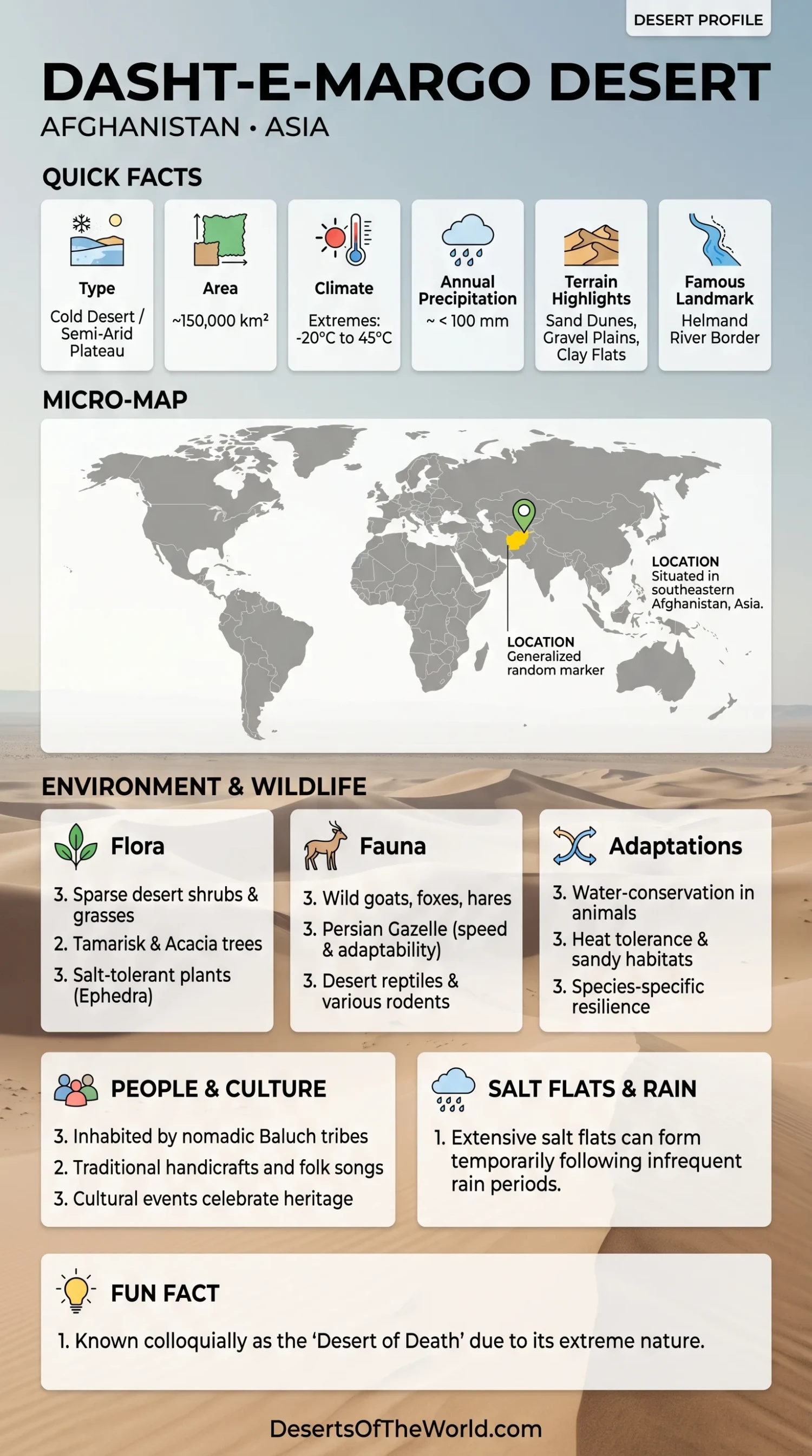
Location & Continent
Continent: Asia
Country: Afghanistan
Provinces: Helmand and Nimruz
Coordinates: Approximately 31°N, 63°E
Physical Features
Area: Approximately 150,000 km²
Length: About 650 km
Width: Roughly 150–250 km
Elevation: Around 500–700 m above sea level
Climate & Precipitation
Temperature: Extremely hot in summer, with daytime temperatures in the wider Lower Helmand Basin sometimes exceeding 50°C; winters can be cold
Precipitation: Very low and irregular—generally less than 100 mm per year, with long dry periods
Ecological Features
Ecozone: Arid desert and semi-arid plateau
Biome: Desert and dry steppe
Ecoregions: Registan–North Pakistan Sandy Desert and the wider Sistan Basin desert system
Flora & Fauna
Flora: Sparse desert shrubs, tamarisks, and salt-tolerant grasses
Fauna: Gazelles, foxes, hares, rodents, and desert reptiles; most species are adapted to extreme aridity
Geology & Notable Features
Geology: Mainly gravel-covered plains, rocky-clay surfaces, salt-affected flats, and localized wind-blown sand deposits within the Lower Helmand Basin
Notable Features: Located within the curve of the Helmand River and adjacent to the Dasht-e Khash and Registan desert regions; the landscape is strongly shaped by wind erosion
Introduction
Dasht-e-Margo, known as the Desert of Death, is a remote and arid desert located in southwestern Afghanistan. Extending across parts of Helmand and Nimruz provinces, it is known for its extreme climate, gravel-covered plains, clay flats, and wind-shaped landscapes. Across Helmand and Nimruz, Dasht-e-Margo forms part of the Lower Helmand Basin, where wind-shaped gravel plains, clay and salt flats, and localized sand deposits dominate the terrain.
Geography
Dasht-e-Margo covers approximately 150,000 square kilometers across the southern Afghan provinces of Helmand and Nimruz. It forms part of the Lower Helmand Basin and lies near the Dasht-e Khash and Registan desert regions. Its landscape is characterized by:
- Gravel Plains: Large areas are covered by dark gravel and cobbles produced by prolonged wind erosion.
- Clay and Salt Flats: Rocky-clay plains, salt-affected soils, and dry depressions occur across the region.
- Sand Deposits: Localized dunes and wind-blown sand fields form in parts of the desert.
Climate
Dasht-e-Margo experiences a severe arid climate:
- Temperature: Summer daytime temperatures in the wider Lower Helmand Basin can exceed 50°C, while winter nights can become cold.
- Precipitation: Annual rainfall is generally less than 100 mm and varies considerably from year to year.
- Wind Patterns: Strong seasonal winds erode exposed surfaces, transport dust, and shape localized dune fields.
Biodiversity
Despite its harsh conditions, Dasht-e-Margo supports flora and fauna adapted to survive in extremely dry environments:
- Vegetation: Sparse vegetation includes drought-resistant shrubs, tamarisks, salt-tolerant grasses, and other plants concentrated near seasonal water sources.
- Wildlife: Animals found in the wider desert region include:
| Wildlife | Description |
|---|---|
| Gazelles | Desert-adapted herbivores capable of surviving in open and extremely dry landscapes. |
| Desert Reptiles | Lizards and other reptiles adapted to sandy, gravelly, and rocky habitats. |
| Various Rodents | Small mammals that obtain much of their moisture from food and remain sheltered during the hottest periods. |
Human Settlement and Culture
Dasht-e-Margo is sparsely populated, with most permanent settlements concentrated near the Helmand River, seasonal streams, wells, and the margins of the Sistan Basin. Pashtun and Baluch communities have historically lived or moved through parts of the wider region. Cultural traditions include:
- Craftsmanship: Local communities produce textiles, embroidery, and practical handmade goods.
- Traditional Music: Regional folk music reflects local history, migration, family life, and the challenges of the desert environment.
- Pastoral Traditions: Some communities have historically depended on mobile or semi-mobile livestock herding along the desert margins.
Tourism and Exploration
Dasht-e-Margo is an extremely remote environment that is more commonly studied through satellite imagery, geographic surveys, archaeology, and environmental research than conventional tourism:
- Landscape Photography: Gravel plains, dry basins, wind-eroded surfaces, and isolated dunes create distinctive desert scenery.
- Scientific Research: Researchers study the region’s geology, hydrology, climate, dust activity, and environmental history.
- Archaeological Exploration: Evidence of historical canals, settlements, forts, and former agricultural activity occurs within the wider Helmand and Sistan region.
References & Sources
- National Geographic Society. (2023). Dasht-e Margo (Desert of Death). Retrieved from
https://education.nationalgeographic.org/resource/dasht-e-margo - United States Geological Survey. (2006). Geology, Water, and Wind in the Lower Helmand Basin, Southern Afghanistan. Retrieved from
https://pubs.usgs.gov/publication/sir20065182 - NASA Earth Observatory. (2021). Sand and Dust Activity in the Dasht-e Margo and Registan Deserts. Retrieved from
https://earthobservatory.nasa.gov/ - University of Nebraska–Lincoln, Center for Advanced Land Management Information Technologies (CALMIT). (2020). Remote Sensing of Arid Landscapes: The Dasht-e Margo Basin. Retrieved from
https://calmit.unl.edu/ - Afghanistan National Environmental Protection Agency (NEPA). (2019). Climate and Desertification Report of Southern Afghanistan. Retrieved from
https://nepa.gov.af/ - United Nations Environment Programme (UNEP). (2018). Desertification in Southwest Asia: Case Studies from Afghanistan. Retrieved from
https://www.unep.org/