
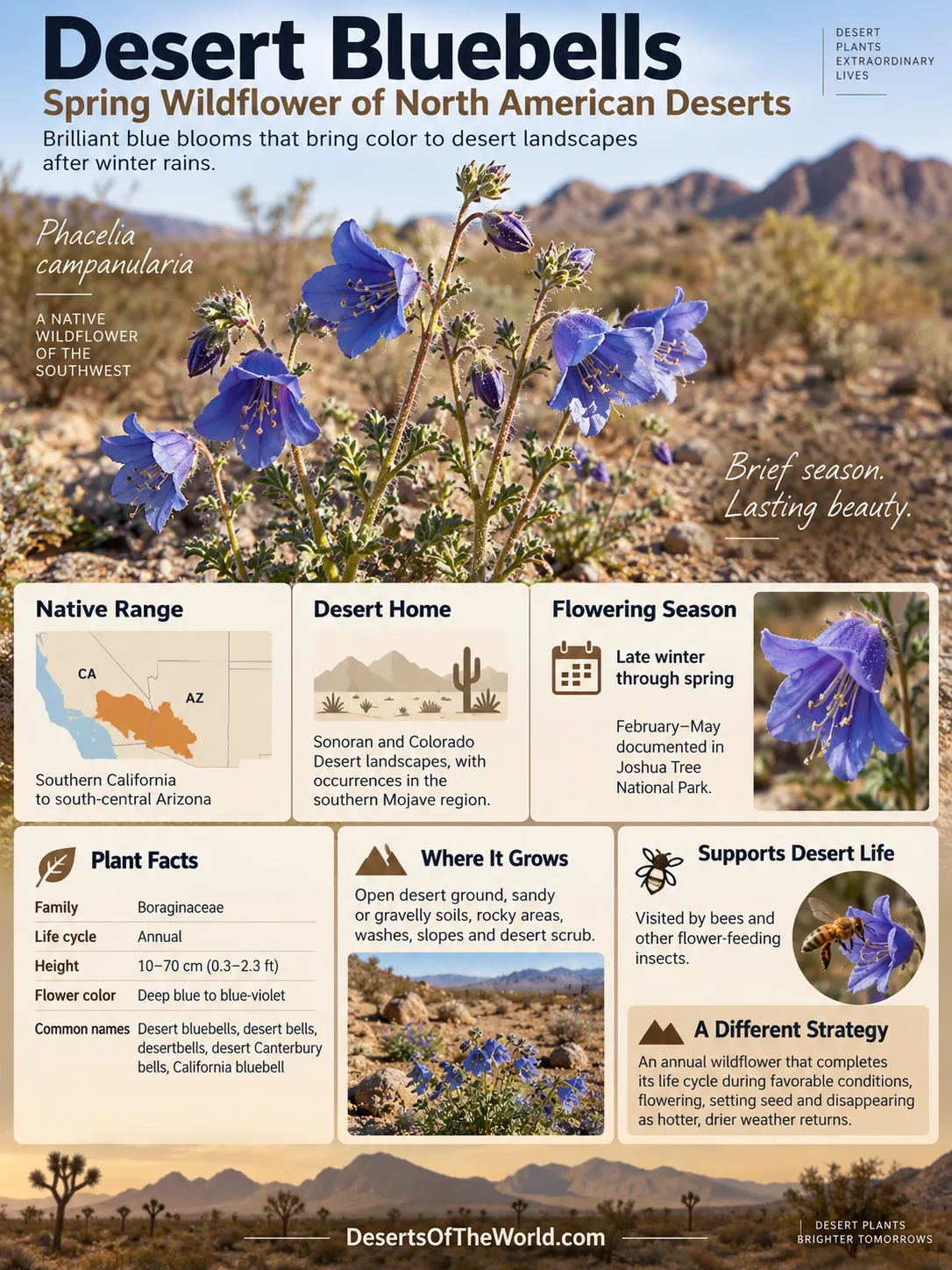
Desert bluebells (Phacelia campanularia) are annual wildflowers of the desert Southwest, known for intensely blue, bell-shaped flowers that can appear across otherwise muted desert ground after favorable cool-season moisture. Their natural range is much narrower than the name “North American desert wildflower” might suggest: the species is native from southern California into south-central Arizona, with strong ties to Sonoran Desert landscapes, the Colorado Desert of southern California, and parts of the southern Mojave region.
The plant follows a very different strategy from long-lived desert shrubs and cacti. It does not maintain woody stems or water-storing tissues through years of drought. Instead, desert bluebells complete their visible life cycle during a favorable season. Moisture supports germination, plants grow rapidly while temperatures remain suitable, blue flowers open in spring, seeds develop, and the above-ground plant eventually disappears as hotter and drier conditions return.
Desert bluebells are Phacelia, not true bluebells. Despite the common name, Phacelia campanularia does not belong to Campanula or Hyacinthoides, genera that contain other plants commonly called bluebells.
Desert Bluebell Plant Profile
| Characteristic | Desert Bluebell |
|---|---|
| Scientific name | Phacelia campanularia A.Gray |
| Common names | Desert bluebells, desert bells, desertbells, desert Canterbury bells, California bluebell |
| Current family placement | Boraginaceae in the Kew Plants of the World Online classification |
| Life cycle | Annual |
| Native range | Southern California to south-central Arizona |
| Desert association | Sonoran and Colorado Desert landscapes, with occurrences in the southern Mojave region |
| Typical flowering period | Late winter through spring; February-May is documented in Joshua Tree National Park |
| Mature height | About 10-70 cm (0.3-2.3 ft), with local variation |
| Flower color | Deep blue to blue-violet |
| Growth setting | Open desert ground, sandy or gravelly soils, rocky areas, washes, slopes and desert scrub |
| Pollinator use | Visited by bees and other flower-feeding insects |
Where Desert Bluebells Grow in North American Deserts
Phacelia campanularia is a southwestern desert plant rather than a wildflower spread across every desert of North America. Kew places its native distribution from southern California to south-central Arizona. That range concentrates the species in a relatively small part of the continent.
In California, records are especially concentrated in Riverside and San Bernardino counties. These counties include extensive desert landscapes east of the coastal mountain ranges, including the Coachella Valley, Colorado Desert, Joshua Tree region and adjoining desert basins.
Calflora also associates the species with creosote bush scrub, one of the characteristic plant communities of the warm deserts of the American Southwest.
Southern California Desert Range
Southern California forms the center of the plant’s documented distribution. Desert bluebells occur in open dry ground where seasonal moisture can briefly support annual wildflowers. Suitable sites include sandy or gravelly areas, rocky slopes, washes and open scrub.
Joshua Tree National Park provides a useful example because the park sits where Mojave and Colorado Desert environments meet. The National Park Service records Phacelia campanularia there as a native annual flowering from roughly February through May and occurring below about 1,600 meters (5,250 feet).
Park observations also describe the plant on slopes beside washes and in rocky areas. This is an important detail: a desert bluebell bloom does not require a flat field of deep sand. Small differences in drainage, runoff and exposed ground can create suitable annual-wildflower habitat.
Desert Bluebells in Arizona
The species extends eastward into south-central Arizona. The Arizona Native Plant Society recognizes desert bluebells as native to the state and records spring flowering, commonly during March-May.
Arizona populations place the species firmly within the broader Sonoran Desert system. Yet the plant should not be described as uniformly common throughout Arizona. Its distribution is localized, and annual abundance can vary strongly from place to place.
Are Desert Bluebells a Mojave Desert Wildflower?
Yes, desert bluebells occur in parts of the Mojave Desert region, including Joshua Tree National Park, but they are not evenly distributed across the whole Mojave. Their strongest geographic association lies farther south, where Mojave and Sonoran-Colorado Desert environments approach one another.
This distinction matters because several other blue or violet Phacelia species grow in the Mojave. A blue flower seen anywhere in the Mojave should not automatically be identified as Phacelia campanularia.
Why Desert Bluebells Appear After Desert Rain
The sudden spring appearance of desert bluebells reflects the annual life cycle common among many desert wildflowers. Most of the year there may be no visible adult plant at a location where bluebells later flower.
- Seeds are present in or near the desert soil.
- Cool-season moisture creates conditions suitable for germination.
- Young plants develop while soil moisture and temperatures remain favorable.
- Flowering follows during the late-winter or spring growing window.
- Pollinated flowers produce seed.
- The annual plant dries as the desert moves into hotter, drier conditions.
This strategy differs from that of creosote bush, Joshua trees or desert cacti. Those perennial plants maintain living structures through many dry seasons. Desert bluebells instead place most of their above-ground growth into a short favorable period.
Rainfall Alone Does Not Set the Bloom
A wet period can encourage germination and growth, but total rainfall by itself does not determine how impressive a bluebell display will become. Desert wildflower development also depends on when the rain falls, how deeply the soil is wetted, temperatures after germination and whether additional moisture arrives while seedlings are developing.
A single storm can affect neighboring sites differently. Water may soak into one patch of gravel, run through a wash, collect briefly at the base of a slope or miss another area almost entirely. Seed availability also differs from one piece of desert ground to another.
That helps explain a familiar desert pattern: one hillside may carry scattered blue flowers while apparently similar ground nearby remains nearly bare.
Elevation Shifts the Spring Flowering Window
Wildflower flowering tends to begin earlier in warmer low-elevation desert and later in cooler terrain. Joshua Tree National Park describes a seasonal progression in which lower alluvial fans and foothills flower first, followed by higher slopes, canyons and valleys.
| Desert Setting | Typical Seasonal Pattern |
|---|---|
| Low, warm desert basins and alluvial fans | Can begin flowering earliest when winter moisture is sufficient |
| Low desert washes and foothills | Often part of the main early-spring wildflower period |
| Mid-elevation desert slopes | Flowering commonly follows lower elevations as temperatures warm |
| Cooler upper desert terrain | Local flowering may occur later than nearby low desert |
The calendar therefore changes with location. For Phacelia campanularia, February-May is a useful documented range in Joshua Tree, while Arizona records commonly emphasize March-May. Weather can shift either window.
How to Identify Desert Bluebells
The flower color attracts attention first, but color alone is not enough for reliable identification. Desert bluebells combine several traits: broad blue flowers, protruding reproductive structures, rounded-toothed leaves and a hairy or glandular plant surface.
Deep Blue Bell-Shaped Flowers
The flowers are usually a saturated royal blue, cobalt blue or blue-violet. The corolla can appear bell-shaped, funnel-like or broadly open depending on the individual flower and viewing angle.
The flower is relatively large for a small desert annual, which helps patches stand out against pale gravel, sand and dry plant litter. Light markings can occur toward the flower throat, creating contrast with the darker blue corolla.
Protruding Stamens and Style
The stamens project beyond the corolla rather than remaining hidden deep inside the flower. This gives a close desert bluebell flower a distinctive profile, with pale filaments and reproductive structures extending beyond the blue petals.
For field identification, this feature is more useful when combined with leaf shape and overall plant form than when considered alone.
Rounded Leaves and Hairy Stems
Desert bluebell leaves are generally broad to rounded and have toothed margins. Leaves and stems carry hairs, and the plant may feel rough or glandular.
The foliage is very different from the narrow leaves of many desert grasses and from the succulent tissues of cacti. In a flowering plant, the combination of broad green leaves and intense blue flowers is often immediately noticeable.
Field note: Avoid relying on flower color alone. Joshua Tree National Park contains several blue- or violet-flowered Phacelia species, including Phacelia distans and Phacelia crenulata. Flower form, leaves, stem surface, overall growth form and location should be considered together.
Why Desert Bluebells Have Such Intense Blue Flowers
The blue coloration of Phacelia campanularia has been studied chemically rather than simply described by botanists. Researchers isolated an anthocyanin called phacelianin from the blue petals.
Anthocyanins are plant pigments involved in red, purple and blue coloration across many flowering plants. In desert bluebells, the color produced by phacelianin involves molecular association within petal cells and the chemical environment surrounding the pigment.
This helps explain why the flowers can appear unusually blue compared with many desert wildflowers, which more often produce yellow, white, pink, orange or lavender displays.
Where Desert Bluebells Fit into the Desert Landscape
Desert bluebells do not occupy every type of desert surface equally. Their annual growth depends on places where seeds, moisture, temperature and open ground line up during the cool growing season.
Washes and Runoff Zones
Desert washes can receive water from land well beyond the spot where rain actually falls. Flowing water may be brief, but runoff can wet sediments along wash margins and nearby slopes.
National Park Service observations from Joshua Tree place desert bluebells on slopes of washes, showing how drainage features can support wildflowers without becoming permanently wet habitats.
Rocky and Gravelly Ground
The species also occurs in rocky areas and gravelly soils. Desert annuals can exploit small pockets of soil among stones where moisture penetrates after winter rain.
These sites may look too barren for a dense herbaceous layer during the dry season. In a favorable spring, the same ground can support scattered plants or localized patches of flowers.
Alluvial Fans and Open Desert Scrub
Alluvial fans spread sediment outward from mountain fronts and desert canyons. Their soils, drainage channels and microtopography produce many small differences in moisture availability.
Joshua Tree’s wildflower observations place desert Canterbury bells among the plants of lower-elevation alluvial fans and foothills. Calflora also records Phacelia campanularia within creosote bush scrub, a vegetation community common across hot southwestern desert valleys.
The Annual Life Strategy Behind a Desert Bluebell Bloom
A desert bluebell does not need to solve the same survival problem as a saguaro or creosote bush. It does not remain exposed as a mature plant through years of extreme summer conditions.
Its annual strategy is based on speed. Once moisture and temperature allow growth, the plant must produce leaves, flowers and seeds within the available seasonal window.
Germination During the Cool Season
Moist soil gives seeds an opportunity to germinate. In southwestern deserts, the most favorable window is commonly linked to fall and winter moisture followed by mild growing conditions.
Early growth does not guarantee a strong spring display. Seedlings still depend on conditions remaining suitable long enough to develop. Extended dry weather after germination or an early rise in temperature can shorten the productive season.
Growth Before Desert Heat Returns
Annual wildflowers have a limited period in which to build leaves and reproductive structures. Desert bluebells can therefore change a site quickly. Ground that carried only small seedlings can later hold conspicuous blue flowers without any permanent vegetation change.
The display is temporary by design. Once reproduction is complete and seasonal moisture disappears, the adult annual plant is no longer the form that carries the population into a future season.
Flowering Leads Back to Seed
After pollination, flowers develop fruits containing the next generation of seed. This closes the seasonal cycle: seed, seedling, flowering annual and seed again.
That cycle also explains why bloom density can change sharply between years. The number of visible plants in one spring is not a simple measure of how suitable the entire region is for the species over the long term.
Desert Bluebells and Spring Pollinators
Bluebells provide floral resources during the desert’s spring growing period. Bees visit the flowers, and regional native-plant references also list the species as attractive to pollinating insects.
The flower structure leaves the stamens readily accessible. When insects move between flowers while collecting floral resources, pollen can be transferred between blossoms.
This places desert bluebells within a wider seasonal community. A productive desert spring can bring Phacelia, lupines, poppies, chia, desert gold and other annuals into flower at overlapping times, creating a temporary concentration of food resources for flower visitors.
Desert Bluebells During Strong Wildflower Years
Desert bluebells can form dense displays after favorable seasonal conditions, but a superbloom is not a normal annual stage of this one species. The term is generally used for unusually extensive flowering involving many plants over a wider desert landscape.
A bluebell population can behave differently at several scales:
- A dry or poorly timed season may produce few visible plants.
- A suitable year may produce scattered bluebells across many small sites.
- Particularly favorable local conditions can create dense blue patches.
- A broader wildflower event may place bluebells among many annual species flowering at once.
This distinction is useful when interpreting photographs of desert wildflowers. A dense field of blue flowers represents one place and one seasonal set of conditions. It does not mean the species forms continuous carpets throughout its native range each spring.
Why One Desert Slope Blooms While Another Stays Bare
Wildflower distribution can change over surprisingly short distances. Desert bluebells illustrate this well because the adult plants are seasonal and dependent on local growing conditions.
Several processes can create patchy flowering:
- Rainfall varies locally. Desert storms do not distribute water evenly.
- Runoff redistributes water. A slope can shed rainfall while a wash or low pocket receives additional moisture.
- Soil texture changes infiltration. Sand, gravel and finer sediments hold and drain water differently.
- Slope exposure affects temperature. Nearby slopes can warm and dry at different rates.
- Seed distribution is uneven. Suitable weather produces flowers only where viable seed and appropriate habitat coincide.
- Elevation changes seasonal timing. Cooler sites can remain in the growing window after warmer ground has begun drying.
For this reason, “How much rain did the desert receive?” is only part of the ecological story. Where the water went can matter just as much as the regional rainfall total.
Other Blue Phacelia in the Desert
The genus Phacelia contains many species in western North America, and several occur in the same deserts as Phacelia campanularia. Some also produce blue, violet or lavender flowers.
| Plant | Why It May Be Confused | What to Examine |
|---|---|---|
| Phacelia campanularia | Deep blue flowers are the defining visual feature | Broad bell- to funnel-shaped flowers, protruding stamens, toothed leaves and hairy surfaces |
| Phacelia crenulata | Another blue-to-purple desert Phacelia | Leaf form, flower structure and the complete plant rather than color alone |
| Phacelia distans | Blue-lavender flowers can occur in the same desert region | Flower size, arrangement, leaves and overall growth form |
| Phacelia minor | Its large purple-blue flowers also lead to “Canterbury bell” comparisons | Geographic setting, leaf characters and botanical identification beyond the common name |
Joshua Tree National Park records several of these blue-flowered Phacelia species within the same park. A close flower photograph may therefore provide less certainty than a photograph showing the leaves, stems and surrounding habitat as well.
The Two Accepted Desert Bluebell Varieties
Current Kew taxonomy recognizes two varieties within Phacelia campanularia:
- Phacelia campanularia var. campanularia
- Phacelia campanularia var. vasiformis
The first is recorded from southern California into south-central Arizona. Phacelia campanularia var. vasiformis is native to California.
Older and regional references may instead show the names Phacelia campanularia subsp. campanularia and subsp. vasiformis. Calflora now labels those subspecies combinations as inactive names and points to the corresponding varieties.
Taxonomy note: Family names also differ among references. Kew places Phacelia campanularia in Boraginaceae, while some regional databases and older treatments display Hydrophyllaceae. The difference reflects botanical classification systems rather than two different desert bluebell species.
Hairy Phacelia Stems and Skin Contact
The hairs on Phacelia leaves and stems are useful identification features, but prolonged contact can irritate sensitive skin. Regional plant references specifically note this possibility for desert bluebells.
There is little reason to handle a wild plant for identification. Flower shape, leaves, stem texture and habitat can usually be examined visually while leaving the plant undisturbed.
What a Desert Bluebell Patch Reveals About Its Site
A patch of flowering desert bluebells represents more than the presence of one attractive wildflower. It shows that several seasonal conditions overlapped at the same place: seed was available, moisture supported germination, temperatures permitted growth, plants survived long enough to flower and the site remained suitable during the reproductive period.
The plants can disappear quickly from view after that window closes. The desert itself has not become empty. Annual wildflowers simply spend much of their ecological cycle in forms that are far less visible than a spring field of blue flowers.
That contrast is one reason desert bluebells fit the landscapes of southern California and Arizona so well. They respond to temporary opportunity rather than permanent moisture, turning a short cool-season interval into leaves, flowers and another generation of seed.
Sources
- Royal Botanic Gardens, Kew – Phacelia campanularia (accepted name, family placement, native distribution and accepted varieties)
- U.S. National Park Service – Joshua Tree National Park: Phacelia campanularia (annual growth habit, bloom period, elevation and native status)
- U.S. National Park Service – Joshua Tree Wildflower Viewing (elevation-related flowering progression and desert Canterbury bells in lower desert wildflower communities)
- Calflora – Phacelia campanularia (California records, vegetation community and regional taxonomy)
- Calflora – County Records for Phacelia campanularia (California observation distribution)
- USDA Natural Resources Conservation Service – Seedling Identification Guide for Pollinator Forbs of California’s Central Valley (desertbells growth form, flowering period and mature height)
- Arizona Native Plant Society – Desert Bluebells (Arizona occurrence, flowering season, plant form and pollinator information)
- PubMed – Structure of Anthocyanin from the Blue Petals of Phacelia campanularia (phacelianin and the chemistry of blue flower coloration)