
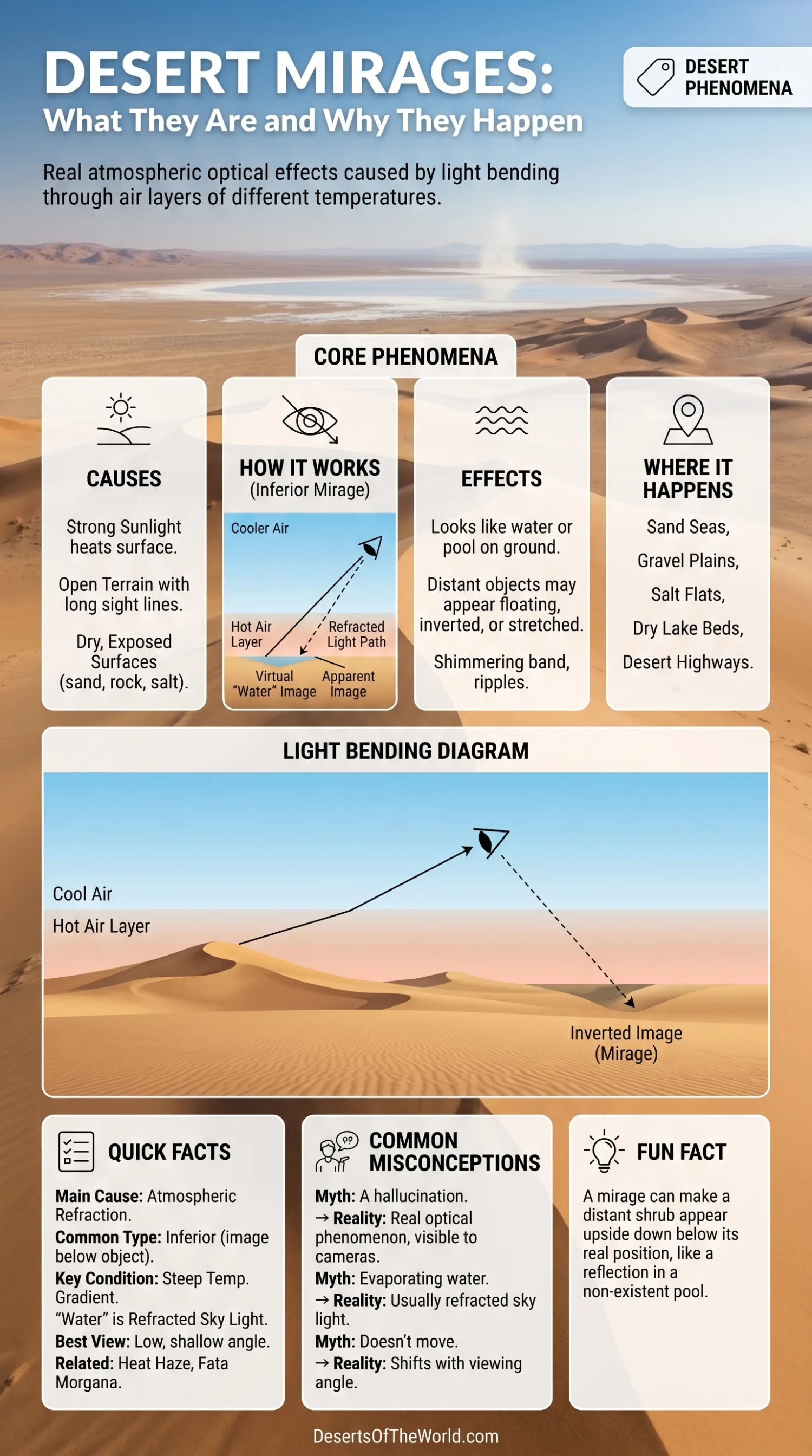
Desert mirages are real atmospheric optical effects, not imaginary scenes. They happen when light bends through layers of air with different temperatures and densities, especially above sun-heated sand, salt flats, dry lake beds, asphalt roads, and open plains. The result can look like water on the ground, a distant object floating above the horizon, or a shimmering band that makes the landscape seem to ripple.
| Feature | Explanation |
|---|---|
| Main Cause | Refraction, or the bending of light, through air layers with different temperatures and densities. |
| Common Desert Type | Inferior mirage, where the image appears below the real object and may resemble water. |
| Common Surface Conditions | Hot sand, rock, clay pan, salt flat, dry lake bed, or road surface under strong sunlight. |
| What Looks Like Water | Usually a refracted image of the bright sky, not actual liquid water. |
| Best Viewing Angle | Low, shallow lines of sight across a heated surface, often near the horizon. |
| Related Effects | Heat haze, superior mirage, looming, towering, and Fata Morgana. |
What Desert Mirages Are
A desert mirage is a refracted image produced by the atmosphere. It is not a pool, a cloud shadow, or a trick of the mind. The eye receives light that has been bent from its original path, and the brain reads that light as if it traveled in a straight line. That small mistake in interpretation creates the false-looking scene.
The classic desert mirage is the pale blue “water” seen low on the horizon. It often appears on flat, bright ground where the air closest to the surface is much hotter than the air above it. The blue area is usually the sky, bent upward into the observer’s line of sight. That is why it can look like a shallow lake even when the ground is dry.
Seen from a distance, the effect can be convincing. Move closer, and it seems to move away. Not because the “water” is retreating, but because the viewing geometry has changed.
Why Mirages Happen in Deserts
Deserts are ideal places for mirages because they often combine three useful conditions:
- Strong sunlight that heats the ground quickly.
- Open terrain with long, low sight lines.
- Dry, exposed surfaces such as sand, gravel, salt crust, and rock.
Air near the ground warms by contact with the hot surface. Warmer air is usually less dense than cooler air above it. Since air density affects how light travels, these stacked layers create a changing optical path. Light does not hit a hard mirror. Instead, it bends gradually through the air, like a road that curves so smoothly you barely notice the turn.
This is the main reason mirages are common over deserts such as the Sahara, Arabian Desert, Mojave Desert, Atacama Desert, Kalahari, and many dry basins in Central Asia and Australia. The same physics can also appear over hot highways, airport runways, beaches, salt pans, and dry lake beds.
The Science Behind the Bending Light
Light changes direction when it passes through materials with different optical properties. This process is called refraction. A simple example is a straw that looks bent in a glass of water. The straw has not changed shape; light from the straw changes direction as it passes from water to air.
A mirage uses a similar idea, but the “materials” are not glass and water. They are layers of air. Each layer has a slightly different temperature and density. Because the change is gradual, the light ray curves instead of making one sharp turn.
Temperature, Density, and Refractive Index
The refractive index of air changes with density. Cooler, denser air bends light differently from warmer, thinner air. Over a hot desert surface, the lowest air layer can be much warmer than the air just above it. This steep temperature change is enough to bend light at very shallow angles.
The effect is strongest when the viewer looks almost parallel to the ground. That low angle allows the light to travel through the heated layer for a longer distance. A person standing on a dune, looking down steeply at the same ground, may see no mirage at all.
Why the “Water” Looks Blue
The blue patch in a desert mirage is often misunderstood. It is not steam. It is not moisture rising from the sand. It is usually the image of the sky brought into the line of sight by refraction.
That is why the surface may look like a shiny pool. Nearby objects can even appear reflected in it. The brain is used to seeing blue sky reflected on water, so it gives the scene a familiar label: a lake, a puddle, a wet road. The desert has offered no water. It has bent the sky.
Inferior Mirages: The Classic Desert “Water” Effect
An inferior mirage forms when the false image appears below the real object. This is the most common desert mirage and the one most people imagine first.
Here is how it works:
- The ground becomes very hot under direct sun.
- The air touching the ground becomes warmer and less dense.
- Cooler, denser air sits above that heated layer.
- Light from the sky or a distant object bends upward before reaching the observer.
- The brain traces that light backward in a straight line, placing the image on the ground.
The result may look like a shining sheet of water. Distant shrubs, rocks, vehicles, or low dunes may appear upside down beneath their real position. On roads, this same effect makes asphalt look wet on a hot day.
Why Inferior Mirages Move as You Move
A desert mirage often seems to stay just out of reach. Walk toward it, and the “pool” shifts farther away. This happens because the mirage depends on the angle between the eye, the heated air layer, and the distant sky or object.
As the observer moves, that angle changes. The exact patch of ground where the light bends into the eye also changes. So the mirage is not located at one fixed spot. It is a line-of-sight effect.
Superior Mirages: When Objects Appear Raised
A superior mirage forms when the image appears above the real object. This needs a different temperature pattern: cooler air near the surface with warmer air above it. That setup is called a temperature inversion.
Superior mirages are more often linked with polar regions, cold seas, large lakes, and coastal horizons, but they can matter in desert regions too. Deserts are not always simply “hot ground, hot air.” Night cooling, cold-season basins, salt flats, and nearby water bodies can create unusual layers of air.
In a superior mirage, distant landforms, shorelines, or objects may look raised, stretched, or partly inverted. A feature hidden below the normal horizon may even appear visible for a time. Odd, but explainable.
Fata Morgana and Complex Mirages
Fata Morgana is a complex mirage made from stacked layers of air with changing temperature and density. It can make distant objects look stretched, compressed, repeated, or suspended above the horizon.
This effect is famous over seas and polar coasts, yet the same optical idea can occur wherever the lower atmosphere develops layered temperature patterns. In desert settings, complex mirages are more likely over broad, flat areas where surface heating and cooling create sharp layers: salt flats, dry basins, playa surfaces, and long open horizons.
How Fata Morgana Differs From a Simple Desert Mirage
| Mirage Type | Main Air Pattern | Typical Appearance | Common Setting |
|---|---|---|---|
| Inferior Mirage | Hot air near the ground, cooler air above | Water-like patch, inverted image below object | Deserts, roads, dry lake beds, salt flats |
| Superior Mirage | Cool air near the surface, warmer air above | Object appears raised or floating | Cold coasts, lakes, polar areas, cold basins |
| Fata Morgana | Several stacked layers with sharp temperature changes | Stretched, repeated, floating, or distorted forms | Open horizons, coasts, ice edges, salt flats, broad basins |
Heat Haze and Mirages Are Related, But Not Identical
Heat haze is the wavering or shimmering look above hot ground, engines, roofs, or road surfaces. It comes from turbulent air with uneven temperature and density. Light bends in changing ways as the air moves, so distant objects look wavy or blurred.
A mirage is more organized. It creates a displaced or inverted image. Heat haze may appear with a mirage, but it does not always create a clear “water” effect.
Think of heat haze as optical noise. A mirage is a clearer false image produced by the same broad family of atmospheric refraction.
Why Deserts Produce Strong Mirage Conditions
Not every hot place creates a visible mirage. The right surface and viewing conditions matter. Deserts often work well because many desert surfaces heat fast and have little vegetation to break up the view.
Flat Ground Matters
Large flat surfaces help the effect build across distance. Dry lake beds, salt pans, gravel plains, and paved desert roads are excellent examples. The viewer can look across the heated air layer at a very shallow angle, so the bending becomes visible.
Dry Air Helps the View
Dry air often gives long visibility. When dust, haze, or humidity is low, distant features remain sharp enough for refraction to distort them into recognizable shapes. If the air is dusty or the horizon is blocked, the mirage may be weaker or harder to see.
Surface Color and Texture Play a Role
Dark rock and asphalt absorb heat strongly. Pale salt crusts and light sand reflect more sunlight but can still build intense near-surface heating. Smooth, open surfaces make the water-like illusion easier to notice. Broken terrain may scatter the effect into small patches.
Where Desert Mirages Are Often Seen
Mirages can appear in many arid and semi-arid regions, especially where the horizon is broad and low. They are often reported in or near:
- Sand seas, where dune corridors create long sight lines.
- Gravel plains, also called desert pavements.
- Salt flats, where pale surfaces and flat terrain stretch for long distances.
- Dry lake beds, known as playas in many desert regions.
- Desert highways, where asphalt heats the air just above the road.
- Coastal deserts, where sea air and desert heat can form layered air masses.
The effect is not limited to famous deserts. A hot road outside a small town can show the same physics as a broad desert basin. Scale changes the scene; the optics remain similar.
Why Mirages Are Easier To See Near the Horizon
Mirages need a shallow viewing angle. Near the horizon, light travels through the heated layer for a longer path. That gives refraction more distance to bend the ray enough for the eye to notice.
Looking straight down at hot sand usually shows no water-like image. Looking far across the same sand might. The ground has not changed. The line of sight has.
What a Mirage Is Not
Desert mirages are often explained with the wrong words. A few distinctions make the subject much clearer.
A Mirage Is Not a Hallucination
A mirage is a real optical image formed by real light. Cameras can record mirages. Several observers in the same location may see the same general effect, though the exact view changes with eye height and position.
A Mirage Is Not Evaporating Water
The water-like patch is usually not water vapor rising from the ground. Hot air can shimmer, but the blue pool effect usually comes from refracted sky light.
A Mirage Is Not a Shadow
Shadows depend on blocked light. Mirages depend on bent light. A dark patch under a cloud and a bright “pool” on a heated road are different phenomena.
A Mirage Is Not Always Caused by Extreme Heat
Heat helps many desert mirages, but the real requirement is a sharp change in air density. Cold air trapped below warmer air can create superior mirages. In that case, the ground does not need to feel scorching.
Why Mirages Can Look Like Reflections
A desert mirage can look like a reflection because it often shows an inverted image below the real object. A bush may appear above the horizon with a faint upside-down version beneath it. A vehicle may look as if it is crossing a wet surface. The scene resembles a mirror, yet there is no solid reflecting surface.
The light bends smoothly through the air until it reaches the observer from an unexpected direction. The brain then places the image along a straight path. So the “reflection” is a virtual image created by refracted light.
The Role of Eye Height
Eye height can change whether a mirage appears. A person crouching near a road may see a stronger water-like patch than a person standing on a higher bank. Drivers see road mirages because their eyes are low enough and the road stretches ahead at a shallow angle.
In deserts, this means a mirage may appear different from a camel track, a vehicle seat, a dune slope, or a lookout point. Small changes matter.
Desert Surfaces and Mirage Behavior
| Surface Type | Why It Can Produce Mirages | Likely Appearance |
|---|---|---|
| Sand Sheet | Heats quickly and creates warm air close to the surface. | Low shimmering bands, pale blue water-like patches. |
| Gravel Plain | Dark stones can hold heat and create uneven air layers. | Wavy horizon, distorted shrubs or rocks. |
| Salt Flat | Wide, flat surface supports long, shallow sight lines. | Bright reflective-looking bands, distant objects appearing lifted or doubled. |
| Dry Lake Bed | Smooth terrain lets the heated air layer extend across open ground. | Strong “lake” illusion, especially near the horizon. |
| Desert Road | Asphalt absorbs heat and warms the air directly above it. | Wet-road effect, shimmering vehicles, inverted reflections. |
Why Some Mirages Look Sharp and Others Look Wavy
A sharp mirage forms when air layers are fairly stable. The light bends in a more orderly way, so the false image can look clear enough to recognize.
A wavy mirage forms when the air is turbulent. Warm air rises in small moving pockets. Cooler air slips around it. The refractive path keeps changing, so the image shakes, ripples, or breaks into fragments.
Wind can weaken or reshape a mirage by mixing the air layers. A calm hot surface often gives cleaner conditions. A gusty surface often gives shimmer instead.
Mirages in Deserts, Salt Flats, and Coastal Arid Lands
Desert mirages do not all look alike. A sandy dune field, a salt basin, and a coastal desert can each create a different visual impression.
Hot Sand and Gravel Deserts
In sandy or gravelly deserts, the most familiar mirage is a low, wavering pool on the horizon. It may appear between dune ridges or along a flat track. The image often fades quickly as the viewer changes position.
Salt Flats and Dry Basins
Salt flats can create very bright mirage scenes because the surface is pale and open. Distant mountains may appear to float above a shining band. On some days the line between land and sky becomes hard to read.
Coastal Deserts
Coastal deserts can form layered air when cool marine air meets hot land. In places where desert edges meet cold ocean currents, refraction can be more complex than a simple hot-ground mirage. Raised horizons, floating-looking ships, or distorted coastlines may appear under the right conditions.
Why Mirages Matter in Desert Geography
Mirages are more than visual curiosities. They reveal how strongly the desert surface interacts with the lower atmosphere. A mirage shows that the ground, sunlight, air temperature, wind, and viewing angle are working together.
For desert landscapes, this matters because the lowest few meters of air can change quickly. The surface may heat fast after sunrise, cool sharply after sunset, and create strong local temperature contrasts. Mirages are visible signs of that near-ground weather.
How To Recognize a Desert Mirage
A desert mirage usually has several clues:
- It appears low on the horizon or just above a hot surface.
- It looks like water, a reflection, or a wavering band.
- It changes when the viewer moves closer, crouches, or gains elevation.
- It is strongest across flat, sunlit ground.
- It may show an upside-down version of a distant object.
The simplest test is movement. If the “water” keeps shifting with the viewing angle and has no shoreline, ripples, vegetation edge, or nearby surface detail, it is likely a mirage.
Common Questions About Desert Mirages
Are Desert Mirages Real?
Yes. The image is produced by real light traveling through real air layers. The object or water-like scene may be displaced, inverted, or false in location, but the optical process is real.
Do Mirages Only Happen in Deserts?
No. Deserts are famous for mirages, but the same effect can happen on roads, runways, beaches, lakes, polar coasts, and open fields. Any place with strong air-density layering can produce a mirage.
Why Do Mirages Disappear When You Get Close?
They depend on the observer’s line of sight. As you move, the angle through the heated air layer changes. The refracted sky image no longer reaches your eye from the same patch of ground.
Can a Mirage Show a Real Object?
Yes. Many mirages distort real objects, such as shrubs, vehicles, dunes, mountains, coastlines, or ships. The object exists, but its apparent position or shape is altered by refraction.
Is a Mirage the Same as Heat Shimmer?
They are related, but not exactly the same. Heat shimmer is a wavering distortion caused by turbulent warm air. A mirage forms a more distinct displaced or inverted image.
Can Mirages Be Photographed?
Yes. A camera records the light that reaches it, so mirages can appear in photos and videos. The exact image depends on lens height, distance, focus, and the air conditions at that moment.
Sources
- Encyclopaedia Britannica – What Causes Mirages? (refraction, inferior mirages, superior mirages, air density, and temperature layers)
- Encyclopaedia Britannica – Mirage (optical definition, desert mirage explanation, and light-ray bending)
- NOAA Coast Pilot 2, Chapter 3 (atmospheric refraction, looming, towering, inferior mirages, and superior mirages)
- University of Wisconsin – Observing the Atmosphere (inferior and superior mirages, road mirages, and temperature inversion)
- Florida State University Molecular Expressions – Refraction of Light (refraction, refractive index changes, and mirages from warm and cool air layers)
- San Diego State University – Mirages and Green Flashes (mirage layers, temperature gradients, and atmospheric optics)