
People often picture deserts as empty land shaped by heat, wind, and distance. That picture misses a lot. Some deserts hold an unusual amount of life, not because they are wet, but because they are varied. A desert with fog, seasonal rain, spring-fed pools, mountain slopes, dunes, rocky flats, and plant niches packed into a small space can support far more species than its dry image suggests. So the phrase “most biodiverse desert” is best treated with care: one desert may lead in raw species counts, another in plant endemism, another in habitat turnover from one valley to the next.
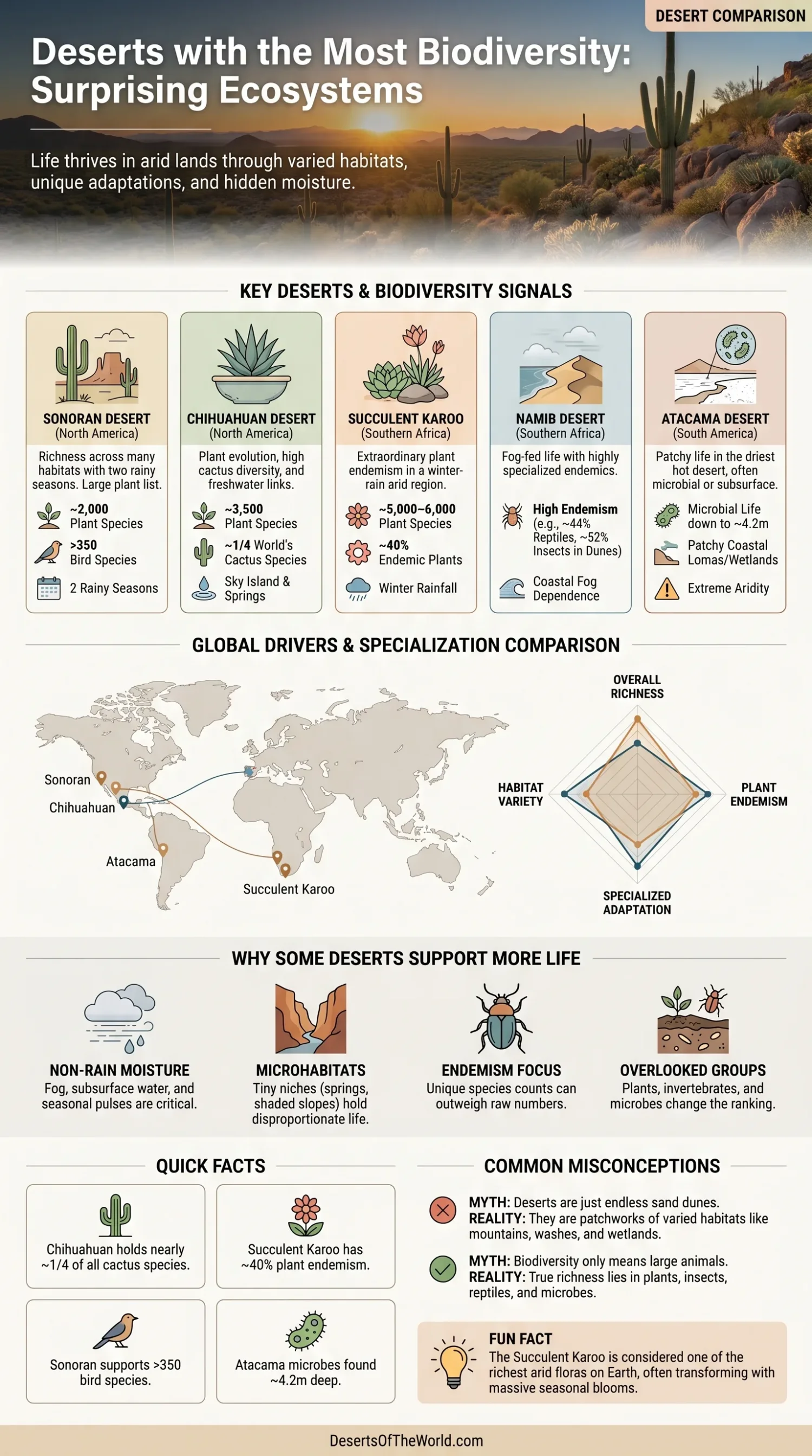
Biodiversity Measures Across Desert Regions
| Desert Or Arid Region | What Makes It Stand Out | Strong Biodiversity Signal | Habitats That Matter Most |
|---|---|---|---|
| Sonoran Desert | Species richness across many habitat types | Large plant list, rich bird, reptile, mammal, and fish diversity | Mountain slopes, washes, cactus forests, riparian corridors, transition zones |
| Chihuahuan Desert | Plant evolution, cactus diversity, desert-freshwater links | Very high plant richness and many endemic species | Playas, gypsum dunes, grasslands, springs, basin-and-range systems |
| Succulent Karoo | Extraordinary plant endemism in an arid setting | One of the richest arid floras on Earth | Winter-rain shrublands, rocky plains, succulent fields, seasonal bloom zones |
| Namib Desert | Fog-fed life and highly specialized endemics | Less about raw totals, more about rare adaptation and endemism | Coastal fog belt, dune systems, gravel plains, ephemeral river interfaces |
| Atacama Desert | Patchy but striking life in one of the driest hot deserts | Microbial diversity, high-altitude wetlands, specialist fauna | Salt flats, high Andean lagoons, coastal lomas, subsurface soils |
| Sahara | Large-scale ecological variety across a vast hot desert | Broad regional species pool across many sub-habitats | Oases, wadis, rocky massifs, dune seas, desert-steppe margins |
That is why a single global ranking rarely tells the full story. Species richness, endemism, and habitat diversity do not always point to the same winner. In deserts, this matters more than usual. One place may have more total species. Another may have fewer species overall but a far higher share found nowhere else.
Deserts Often Named Among The Richest In Life
Sonoran Desert
The Sonoran Desert is the desert most often placed near the top when people talk about biodiversity. It spreads across northwestern Mexico and the southwestern United States, and its variety is striking even within short distances. Cactus forest, thornscrub, washes, mountain foothills, dry grass patches, riparian corridors, and cooler uplands all sit within the larger Sonoran system.
Its numbers help explain the reputation. More than 2,000 plant species have been identified there. The region also supports at least 60 mammal species, more than 350 bird species, 20 amphibian species, around 100 reptile species, and about 30 native fish species. For a desert, that is a very full living inventory.
Part of the reason is climate pattern, not just climate harshness. The Sonoran has two rainy seasons in many areas, one linked to winter systems and one to summer monsoon moisture. That split spreads opportunity through the year. Some plants leaf out after cool-season moisture. Others respond to summer rain. Pollinators, annual wildflowers, columnar cacti, shrubs, reptiles, birds, bats, and desert fish all use different slices of the same landscape.
Why The Sonoran Holds So Much Life
- It contains strong elevation changes, so temperature and moisture shift fast over short distances.
- It sits in a transition zone between desert, tropical, and montane influences.
- Its water story is not one-note. Winter rain, summer monsoon pulses, springs, washes, and river corridors all matter.
- It includes both broad species richness and striking life-form variety, from saguaro stands to ferns, soil crusts, owls, tortoises, bats, and native fish.
That mix gives the Sonoran Desert an unusually layered ecology for an arid region, with many species occupying different habitats and elevation zones.
Chihuahuan Desert
The Chihuahuan Desert is one of North America’s strongest examples of desert biodiversity. It stretches across northern Mexico and the southwestern United States, and it differs from many other hot deserts in one useful way: summer monsoon rain plays a larger role.
Botanically, the Chihuahuan is exceptional. It supports as many as 3,500 plant species, including nearly a quarter of the world’s cactus species. Around 1,000 plant species are restricted to this ecoregion. That alone places it among the leading desert floras.
Its biodiversity is not just about cacti. The basin-and-range layout creates a repeating pattern of valleys, mesas, mountains, playas, and dunes. Gypsum dunes host specialist plants. Springs and isolated waters hold desert fish with tiny ranges. Grasslands and shrublands support reptiles, birds, and mammals that move across wide spaces. The region also has more than 170 amphibian and reptile species, with at least 18 endemic to the ecoregion, and its fish story is even more surprising: nearly half of the region’s 110 fish species are endemic or limited in distribution.
What Makes The Chihuahuan Different
- Plant evolution is a major theme here, especially along the eastern boundary.
- Freshwater refuges support species that would otherwise be difficult to associate with a desert landscape.
- Gypsum dunes, playas, and desert grasslands add ecological contrast that boosts diversity.
- Its mix of agaves, yuccas, cacti, grasses, springs, and basin habitats gives it a broader ecological range than its dry surface first suggests.
In plain terms, the Chihuahuan Desert is not just species-rich. It is structurally rich, and desert biodiversity often follows structure.
Succulent Karoo
The Succulent Karoo is a distinctive desert-related ecosystem. Strictly speaking, it is better understood as an arid to semi-arid winter-rain region than as a classic sand desert. Its plant diversity nevertheless places it among the richest dryland ecosystems.
European Commission material on desert biodiversity describes the Succulent Karoo as possibly the arid area with the richest desert biodiversity, with about 5,000 plant taxa, roughly 40% endemic. Conservation International gives an even higher modern summary, noting well over 6,000 plant species, again with about 40% found nowhere else. Either way, this is one of the richest arid floras on Earth.
Rainfall timing is a major reason. Much of the region receives winter rain, not summer monsoon bursts. That changes plant strategy. Succulents, bulbs, dwarf shrubs, and short-lived annuals use cool-season moisture in ways that differ from the cactus systems of North America. Rocky soils, coastal influence, and local topography add more niche space. When flowering seasons align with good conditions, the landscape can look far fuller than people expect from an arid zone.
Succulent Karoo Biodiversity
- Plant diversity accounts for much of the region’s biological richness.
- Endemism is exceptionally high, with many species found nowhere else.
- Seeds, bulbs, shrubs, and succulents allow substantial biological diversity to persist even when the landscape appears sparse for much of the year.
Among arid regions, the Succulent Karoo ranks especially high when plant richness and endemism are considered alongside total species counts.
Namib Desert
The Namib Desert makes a different kind of case. It may not lead every raw species-count comparison, yet few deserts show adaptation so clearly. UNESCO describes the Namib Sand Sea as a fog-bathed coastal dune system where plants and animals have evolved rare behavioural, physiological, and morphological ways to live in hyper-arid conditions.
This is a desert where fog can matter more than rain. Moisture arrives from the Atlantic as coastal fog, and many organisms are adapted to that rhythm. Beetles harvest condensed moisture. Plants use fog input and shallow moisture balance. Reptiles and invertebrates take advantage of surface and subsurface thermal conditions in moving sand.
The Namib is especially strong in specialization and endemism. UNESCO evaluation material notes that although the dune system does not show the highest overall species richness among desert World Heritage properties, some groups show very high endemism within sand sea habitats: 53% of the sand sea’s plant species, 84% of its arachnids, 52% of its insects, and 44% of its reptiles are known only from Namib sand sea habitats. Those figures reflect a high degree of ecological isolation.
Namib Biodiversity Patterns
- Species richness and endemism measure different aspects of biodiversity.
- Fog, dunes, and isolation have shaped many specialized organisms.
- Habitat edges also matter: dunes, ephemeral rivers, gravel plains, and coastal environments create different ecological niches.
The Namib supports relatively sparse but highly specialized biological communities, especially within its dune and fog-influenced habitats.
Atacama Desert
The Atacama Desert is usually introduced as the driest hot desert on Earth. More precisely, it is one of the driest hot deserts on Earth, yet it still supports a patchwork of life concentrated around particular moisture sources, elevations, and soil conditions.
In the high Andes and salt-flat margins, flamingos, vicuñas, foxes, shrubs, cushion plants, and wetland species use isolated water-linked habitats. Along parts of the coast, lomas vegetation can appear where fog makes plant growth possible. Beneath the ground, the Atacama is even more surprising. Recent work has shown that its soils hold diverse nematode communities, with richer genera in areas receiving more moisture. Other research from the GFZ German Research Centre for Geosciences found viable microbial communities down to 4.2 metres below the surface in one of the driest parts of the Chilean Atacama.
That does not make the Atacama lush. It makes it ecologically patchy. Life is concentrated where chemistry, altitude, fog, salts, sediments, or brief moisture pulses create suitable conditions.
Atacama Biodiversity Patterns
- Desert biodiversity includes microbial life, not only visible plants and vertebrates.
- Many of the richest habitats are localized and partly hidden: lagoons, subsurface niches, fog-fed slopes, and wetland edges.
- Moisture gradients, even small ones, can sharply change biodiversity across extreme drylands.
The Atacama shows how life can persist in isolated pockets even where long-term dryness excludes dense vegetation across much of the landscape.
Sahara
The Sahara is so large that it is often associated mainly with scale, dunes, and heat. Its size also contains substantial ecological variation. UNEP notes that the Sahara spans about 9.4 million square kilometres across 11 countries and supports about 500 plant species, 70 mammal species, 100 reptile species, and 90 bird species, along with many arthropods.
These totals make more sense once the Sahara is seen as a mosaic rather than a single plain. It includes dune seas, gravel plains, rocky plateaus, massifs, wadis, oases, steppe margins, and mountains with cooler conditions. Water concentrates life in pockets. Elevation shifts plant communities. Seasonal movement matters for birds. Desert-edge habitats matter too, because biodiversity in very large deserts often rises along transitions rather than in the harshest interior alone.
Sahara Biodiversity Across Habitats
- Its biodiversity is spread over many sub-regions rather than concentrated in one habitat type.
- A very large desert can hold a broad regional species pool even where individual sites appear sparse.
- Mountains, wadis, and oasis systems support much of the Sahara’s locally concentrated biological diversity.
The Sahara may not lead every desert biodiversity measure, but its varied terrain supports a wider range of habitats and species than its dune-dominated public image suggests.
Why Some Deserts Support More Life Than Expected
Water Does Not Need To Fall As Regular Rain
Dryland biodiversity is often shaped by water that arrives sideways, briefly, or below ground. Fog in the Namib. Two seasonal rain windows in the Sonoran. Monsoon pulses in the Chihuahuan. Winter rain in the Succulent Karoo. Subsurface moisture and salts in the Atacama. These different water sources help explain why some desert habitats support more species than their annual rainfall totals suggest.
Microhabitats Matter More Than Big Averages
Average rainfall tells only part of the story. Deserts often gain biodiversity through small habitat partitions: a spring, a shaded canyon wall, a gypsum dune, a fog line, a rocky outcrop, a wash, a saline basin, or a mountain shoulder. USGS notes that desert biodiversity is closely tied to landscape heterogeneity such as mountain tops, dry lake beds, sand dunes, caves, and isolated aquatic habitats. In deserts, a small refuge can support a large share of local biological diversity.
Endemism Can Matter More Than Raw Totals
A desert may not have the largest total number of species, yet still rank highly for biodiversity because many species are locally restricted. This pattern is especially clear in the Namib and Succulent Karoo. A region containing many species found nowhere else can have exceptional biological value even when its total species count is lower than that of another desert.
Plants, Invertebrates, Fish, And Microbes Change The Ranking
Biodiversity comparisons should also account for:
- succulent and cactus diversity,
- ephemeral annual plants,
- pollinators and other insects,
- soil crust communities,
- spring and oasis fish,
- reptiles tied to dune or rock habitats,
- microbial life in salt-rich or subsurface niches.
Once those groups are counted, several deserts show much greater biodiversity than vegetation cover alone would suggest.
Biodiversity Leaders By Measure
For broad species richness across many visible groups, the Sonoran Desert is one of the strongest examples and is often treated as a leading case in North America. For arid plant richness and endemism, the Succulent Karoo stands near the top. For specialized desert endemics shaped by non-rain moisture, the Namib is particularly notable. For plant evolution, cactus diversity, and desert-freshwater complexity, the Chihuahuan is among the clearest cases. The Atacama is especially informative for microbial diversity, moisture gradients, and isolated habitats under extreme dryness.
No single desert leads every biodiversity measure. Species richness, endemism, habitat diversity, plant diversity, freshwater specialization, and microbial life produce different patterns across each dryland system.
Sources
- U.S. National Park Service – Sonoran Desert Network Ecosystems (species counts, habitat variety, life-form diversity in the Sonoran Desert)
- Coalition for Sonoran Desert Protection – What Is The Sonoran Desert? (two rainy seasons, plant richness, broad overview of Sonoran ecology)
- U.S. National Park Service – Chihuahuan Desert Ecoregion (plant totals, endemic species, playas, gypsum dunes, freshwater habitats)
- European Commission Joint Research Centre – World Atlas Of Desertification: Biodiversity (Succulent Karoo richness and arid-zone biodiversity context)
- Conservation International – The Succulent Karoo (updated plant-richness summary and endemism note)
- UNESCO World Heritage Centre – Namib Sand Sea (fog-bathed dunes, specialist communities, desert adaptation)
- IUCN Evaluation For UNESCO – Namib Sand Sea (endemic taxa percentages and dune-habitat specialization)
- Nature Communications – Geographic Distribution Of Nematodes In The Atacama (soil-fauna diversity and moisture-gradient findings in the Atacama Desert)
- GFZ German Research Centre For Geosciences – Newly Discovered Microbial Communities Beneath The Atacama Desert (subsurface microbial biodiversity down to 4.2 metres)
- UNEP – Three Unique Desert Ecosystems (Sahara area and broad biodiversity totals)
- U.S. Geological Survey – Ecosystems We Study: Deserts (why landscape heterogeneity raises biodiversity in desert systems)