
Hot Desert vs Cold Desert: What’s The Difference? A desert is not defined by heat. It is defined by dryness. That one point clears up most of the confusion. A hot desert and a cold desert can both receive very little precipitation, lose moisture fast, and support only scattered plant cover. The real split appears in temperature, winter conditions, seasonality, soil behavior, and the way plants and animals deal with limited water.
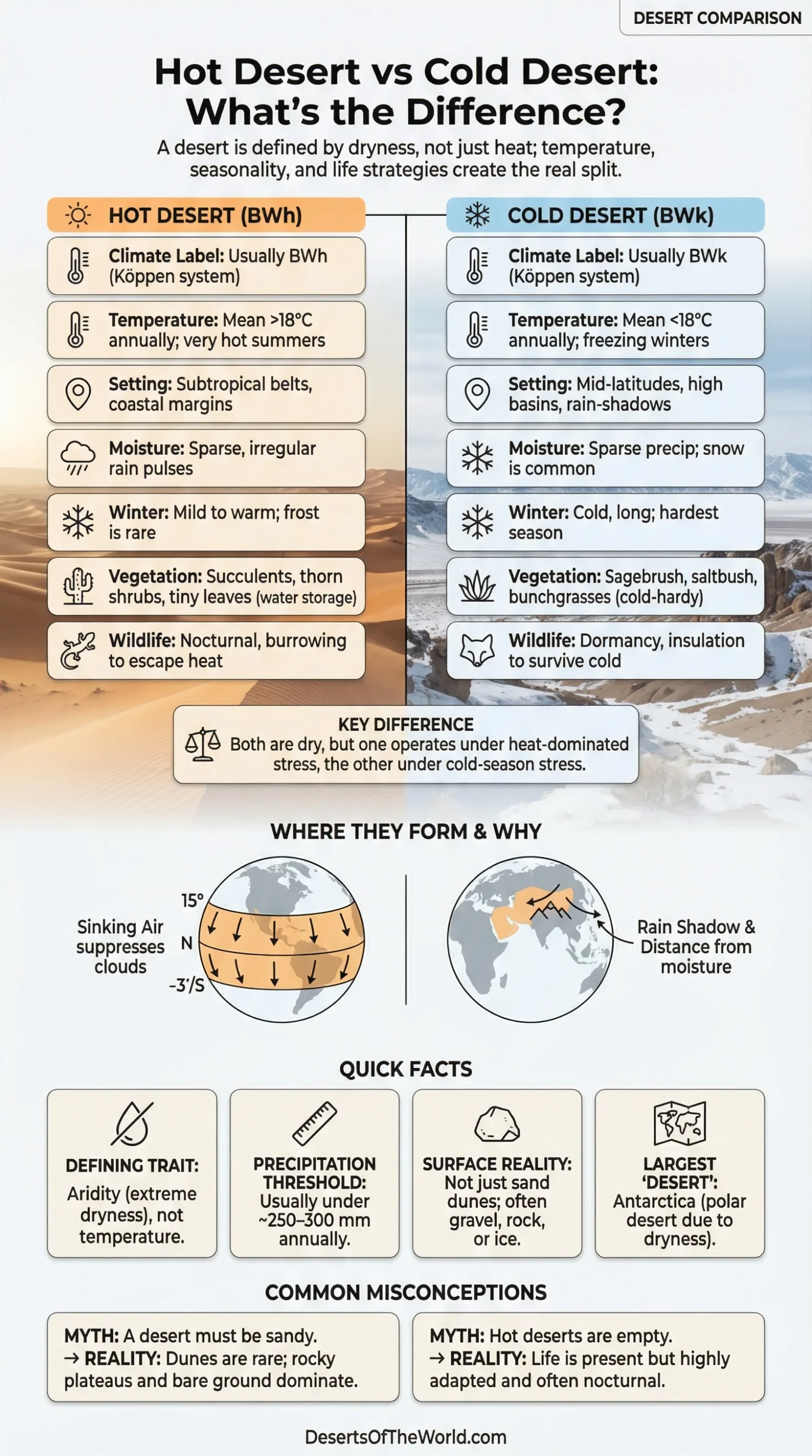
Hot Desert And Cold Desert Side By Side
| Feature | Hot Desert | Cold Desert |
|---|---|---|
| Basic Climate Label | Usually BWh in the Köppen system | Usually BWk in the Köppen system |
| Temperature Pattern | Mean annual temperature above 18°C; very hot summers are common | Mean annual temperature below 18°C; winters often drop below freezing |
| Typical Setting | Subtropical belts, many coastal margins, low-latitude interiors | Mid-latitudes, high basins, plateaus, continental interiors, rain-shadow zones |
| Moisture | Usually sparse rain, often brief and irregular | Usually sparse precipitation too, but snow can be part of the annual water budget |
| Winter | Mild to warm in many areas; frost is rare or occasional | Cold, long, and often the hardest season for life |
| Vegetation Pattern | Succulents, thorn shrubs, drought-tolerant grasses, scattered woody plants | Sagebrush, saltbush, short shrubs, bunchgrasses, lichens and cold-hardy herbs |
| Animal Rhythm | Nocturnal activity and burrowing are common responses to heat | Burrowing, seasonal dormancy, insulation, and short summer activity windows are common |
| Classic Examples | Sahara, Arabian, Sonoran, Namib | Gobi, Great Basin, Patagonian Desert, parts of the Colorado Plateau |
What Makes A Desert A Desert?
The first test is water, not temperature. Many earth science references use about 250 millimeters of annual precipitation as a practical desert threshold, while broader educational sources often describe deserts as places that usually receive under 300 millimeters a year. Either way, the idea is the same: very little water comes in, and a lot of water is lost through evaporation.
That is why a desert can be scorching, cool, or freezing. Dry first, hot or cold second.
Another point matters. Not all deserts are sandy. In fact, dunes make up only a small share of the world’s deserts. Large desert surfaces are gravel plains, rocky plateaus, salt flats, bare ground, or ice-covered terrain. A desert may look like a sea of sand, but often it does not.
How Scientists Separate Hot And Cold Deserts
In the Köppen climate classification, the two labels most people mean are BWh and BWk. The letter BW marks an arid desert climate. The final letter separates the hot form from the cold form. In simple terms, BWh deserts have a mean annual temperature above 18°C, while BWk deserts fall below that line and usually experience below-freezing winter weather.
This is useful, though real landscapes are messier. Some deserts are coastal and cooler than people expect. Some high deserts have hot days and cold nights in the same season. And some places that people call cold deserts in everyday language are actually polar deserts, which belong to a separate polar climate group rather than BWk. Antarctica is the clearest example. It is the world’s largest desert because it is extremely dry, yet in strict climate classification it is polar, not a standard BWk desert.
Why Hot Deserts Form Where They Do
Most hot deserts sit in the subtropical belts, often around 15° to 30° north and south. There, broad zones of sinking air suppress cloud growth and rainfall. The result is familiar: clear skies, intense sunshine, high evaporation, and very limited moisture at the surface.
Some hot deserts also gain their dryness from other controls:
- Cold ocean currents can help create coastal deserts by cooling the lower air, favoring fog instead of rain.
- Mountain barriers can create rain shadows, leaving dry air on the leeward side.
- Long distance from moisture sources can intensify aridity in continental interiors.
So a hot desert is not just “a very warm empty place.” It is usually the outcome of atmospheric circulation plus local geography.
Why Cold Deserts Form Where They Do
Cold deserts usually appear farther from the tropics, at higher elevations, in interior basins, or in the lee of major mountain systems. The air is still dry, but the thermal setting is very different. Winters are colder, summers are shorter, and part of the annual moisture may arrive as snow rather than rain.
Less famous, but very real, are these landscapes. The Gobi in Mongolia and China, the Great Basin in North America, and the Patagonian Desert east of the Andes show how a desert can be dry without being tropical. High plateaus and mountain basins often push the pattern even further: sunny days, sharp night cooling, long winters, and a short growing season.
Climate Differences That Shape Everything Else
Temperature
Hot deserts usually carry the stronger summer heat load. Surface temperatures soar under cloudless skies, and daytime air temperatures can climb well above comfort for long periods. In the Sahara, summer temperatures above 50°C are possible in some areas.
Cold deserts can still be warm by day, especially in summer. That surprises many readers. Yet their winters set them apart. Freezing nights, frost, snow cover in some districts, and a much shorter frost-free season change the whole rhythm of life.
Day-To-Night Range
Both hot and cold deserts often show wide daily temperature swings because dry air does a poor job of holding heat after sunset. A desert afternoon and a desert dawn can feel like two different seasons. Fast cooling is part of the package.
How Water Arrives
In many hot deserts, rain comes in brief, uneven pulses. Long dry intervals may be broken by short storms, and some rainfall can evaporate before it reaches the ground. Flash flooding is possible because hard, dry surfaces shed water quickly.
In cold deserts, moisture may come from winter snow, spring rain, or a mix of both. That changes soil moisture timing. Plants often depend less on sudden summer storms and more on what remains after snowmelt or cool-season precipitation.
Season Length
Hot deserts may have a longer biological season, but it is limited by water stress and heat. Cold deserts face a double limit: little water and a short warm period. In many high cold deserts, the window for growth is brief. Very brief, at times.
Land Surface And Soil Differences
Hot deserts often develop coarse, stony, or sandy surfaces with fast drainage and low organic matter. Repeated evaporation can leave salts near the surface. Desert pavement, dry washes, alluvial fans, and playas are common landforms in many hot arid basins.
Cold deserts can have silty or gravelly soils, seasonal freeze-thaw effects, and moisture behavior tied to snow and spring thaw. Salts may still be present, especially in closed basins, but the soil story is not exactly the same as in a low-latitude hot desert. Lower evaporation during cold months changes the pace of weathering, biological activity, and nutrient movement.
Look closely and the contrast becomes clear: hot desert surfaces are often shaped by thermal stress and abrupt runoff after rare storms, while cold desert ground also carries the marks of winter freezing, thawing, and snow-related moisture pulses.
Plant Life In Hot And Cold Deserts
Plants in both settings solve the same problem: too little available water. Still, they do not solve it in the same way.
Hot Desert Vegetation
- Succulents and stem-storing plants are common in some hot deserts.
- Leaves are often tiny, waxy, spiny, or short-lived.
- Roots may spread widely near the surface to catch brief rainfall.
- Many species space themselves far apart to reduce competition for water.
Creosote bush, cacti in the Americas, agaves, thorny shrubs, and drought-tolerant grasses fit this pattern well.
Cold Desert Vegetation
- Low shrubs and bunchgrasses are more common than large succulents.
- Plants must tolerate both dryness and freezing.
- Growth often peaks during a short cool-to-mild season.
- Snow cover, where present, can protect roots and seeds during winter.
Sagebrush, saltbush, shadscale, hardy grasses, and scattered herbs are typical cold-desert partners. Less flashy than a cactus silhouette, maybe, but very well tuned to the place.
Animal Life And Survival Strategies
Desert animals live on timing. When they move matters as much as where they move.
In Hot Deserts
- Nocturnal behavior is widespread.
- Burrowing reduces heat stress and water loss.
- Reptiles often play a larger visible role in daytime ecology.
- Some mammals obtain much of their water from food rather than open water.
In Cold Deserts
- Burrows still matter, but insulation matters more too.
- Seasonal activity windows are shorter.
- Animals often store fat, use sheltered terrain, or reduce activity in the coldest periods.
- Bird and mammal communities usually reflect stronger winter filtering.
So yes, both desert types reward water-saving behavior. Yet hot deserts push animals hardest against heat, while cold deserts push them against cold, dryness, and season length at the same time.
Famous Examples Worth Separating
| Desert | Best Fit | Why It Matters In This Comparison |
|---|---|---|
| Sahara | Hot Desert | The largest hot desert on Earth, about 9.4 million square kilometers, and a classic subtropical arid region. |
| Sonoran | Hot Desert | Shows that hot deserts can still have seasonal rainfall pulses, including summer monsoon influence in some sectors. |
| Namib | Hot Coastal Desert | Useful for showing that fog can matter almost as much as rainfall in some desert systems. |
| Gobi | Cold Desert | A clear case of an inland, rain-shadow-influenced desert with cold winters and a largely rocky surface. |
| Great Basin | Cold Desert | Shows the role of elevation, winter cold, and basin-and-range geography. |
| Patagonian Desert | Cold Desert | A good example of how the Andes create dry leeward conditions in South America. |
| Antarctica | Polar Desert | Often grouped with cold deserts in everyday language; useful because it reminds us that dryness, not heat, defines a desert. |
Common Misunderstandings
- A desert must be hot. No. Many deserts have cold winters, and some are cold year-round.
- A desert must be sandy. No again. Dunes cover only a small part of global desert area.
- Cold deserts are just hot deserts with snow. Not really. Their seasonality, plant cover, soil moisture timing, and animal behavior differ in deeper ways.
- Hot deserts are biologically empty. They are sparse, not empty. Life is present, just highly adapted and often hard to spot in daylight.
- Antarctica does not count as a desert because it is full of ice. It does count. The desert test is aridity, not bare sand.
Why This Split Shows Up In The Landscape
The core difference is simple enough: both landscapes are dry, but one operates under heat-dominated stress and the other under cold-season stress. From that split, everything else follows. Water timing changes. Soil behavior changes. The growing season changes. Plant form changes. Animal schedules change.
A hot desert and a cold desert may look similar from far away—open land, sparse cover, wide sky. Up close, they run on different climatic rules.
Sources
- NOAA JetStream Max: Addition Köppen-Geiger Climate Subdivisions (BWh and BWk definitions, 18°C split, winter freezing notes)
- U.S. Geological Survey – What Is a Desert? (desert definition, dryness thresholds, arid and extremely arid categories)
- U.S. Geological Survey – Types of Deserts (rain-shadow and coastal desert formation)
- NASA Science – Biome: Desert (desert precipitation levels, day-night temperature swing, plant adaptations)
- National Geographic Education – Desert (desert types, subtropical belts, rain shadows, polar deserts, dunes share)
- National Geographic Education – Not All Deserts Are Sandy (Sahara and Antarctica size figures, cold-desert examples, aridity emphasis)
- National Park Service – Deserts At Canyonlands (high or cold desert conditions, elevation, temperature swing, annual precipitation example)
- National Park Service – Biophysical Description Of Fossil Butte National Monument (high cold desert data, snowfall share, frost-free period, temperature notes)