
Lithops are among the smallest plants to make a home in the dry landscapes of southern Africa. A mature plant may show little more than a patterned surface level with the surrounding gravel, while most of its fleshy body remains below the soil. That exposed surface belongs to a pair of thick leaves joined together around a central fissure. From above, the plant can resemble a quartz pebble, a piece of granite, pale gravel or weathered stone.
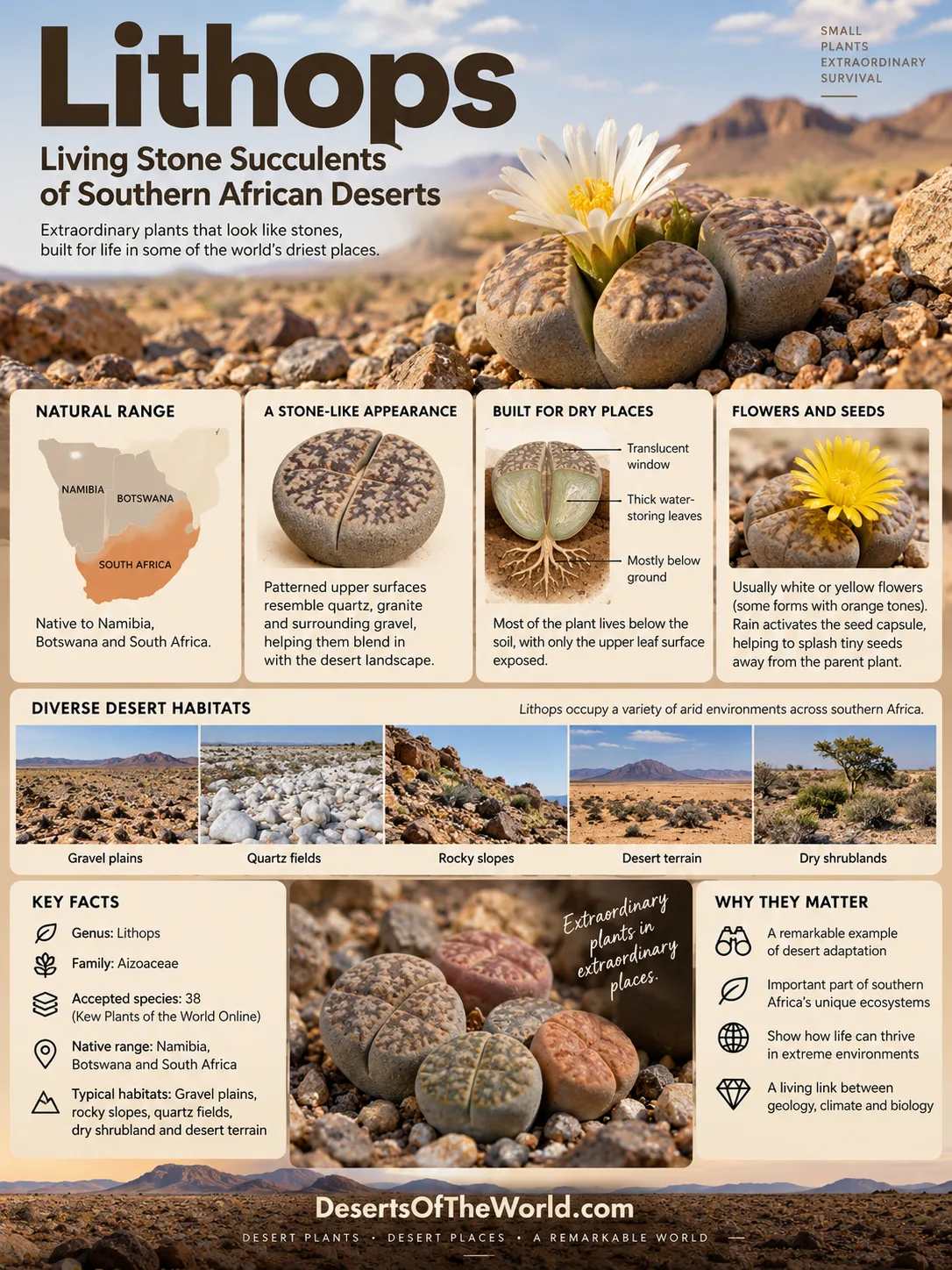
This resemblance explains the common name living stones, but the stone-like form does more than disguise the plant. Lithops combine water-storage tissue, a partly subterranean body, translucent leaf windows, seasonal leaf replacement and rain-responsive seed capsules in a compact structure suited to deserts and dry shrublands. Their ecology is especially varied across Namibia, Botswana and South Africa, where individual species occupy very different combinations of rainfall, fog, rock type and soil.
| Feature | Lithops |
|---|---|
| Genus | Lithops |
| Family | Aizoaceae |
| Accepted Species | 38 in the current Kew Plants of the World Online taxonomy |
| Native Range | Namibia, Botswana and South Africa |
| Plant Form | Dwarf succulent formed mainly by one or more pairs of thick, fused leaves |
| Typical Habitats | Gravel plains, rocky slopes, quartz fields, dry shrubland and desert terrain |
| Visible Surface | Patterned or translucent upper leaf face, often called a window |
| Flowers | Usually white or yellow, with orange tones occurring in some forms |
| Seed Dispersal | Rain activates the fruit capsule and helps splash tiny seeds away from the parent plant |
Where Lithops Grow in Southern Africa
The natural range of Lithops lies entirely in southern Africa. Kew records the genus as native to Namibia, Botswana and several regions of South Africa, including the Cape Provinces, Free State and Northern Provinces.
The distribution should not be imagined as one continuous belt of sandy desert. Lithops populations are often scattered and closely tied to small patches of suitable geology. Two areas that look similar from a distance may support very different plant communities because their gravel, bedrock, slope or moisture regime differs.
Natural Lithops habitats include:
- gravel plains in the Namib Desert;
- quartz-covered ground in the Northern Cape;
- rocky ridges and slopes;
- granite, feldspar, schist and pegmatite terrain;
- calcareous and limestone ground in some inland regions;
- Nama Karoo and Succulent Karoo landscapes;
- dry shrublands beyond the most clearly defined desert zones.
This patchy distribution is an important part of Lithops ecology. A population may occupy only certain patches within a much larger area that appears suitable to the human eye.
Desert and Dry Shrubland Habitats
Lithops are often described simply as desert plants, although their range extends into semi-arid shrublands as well. Kew classifies many species as plants of desert or dry shrubland biomes. This distinction matters because rainfall patterns, winter temperatures, summer heat and seasonal growth differ across the genus.
Some species occur close to the Atlantic coast of Namibia, where fog becomes an ecological water source. Others grow far inland where episodic rainfall matters more. Some are associated with exposed gravel flats, while others occupy low hills or rocky slopes.
Lithops Habitats Can Change at the Scale of a Pebble
The geology beneath a Lithops population can influence where plants establish and even how easily they can be seen. The upper leaf surfaces occur in grey, cream, green, brown, rust, pinkish and reddish tones, often marked by channels, dots, islands or darker windows.
Those patterns frequently resemble the immediate mineral background. A pale plant among pale quartz fragments can become difficult to distinguish even at close range. A darker form growing among weathered rock may blend into a completely different palette.
Quartz Plains and Lithops olivacea
Lithops olivacea provides a clear example of this close relationship between plant and substrate. The species is associated with Bushmanland in South Africa’s Northern Cape and is especially known from quartz-rich terrain.
SANBI describes L. olivacea as a quartz-associated Lithops found on large quartz outcrops and quartz plains. Pale pebbles around the plants reflect strong sunlight, creating a distinctive surface environment. During dry periods the plants can shrink and become harder to detect among gravel and wind-blown material. After moisture becomes available, their water-storage tissues expand again.
Granite, Feldspar, Schist and Other Rock Types
Quartz is only one part of the story. Field studies of Lithops ruschiorum in Namibia recorded plants on substrates that included quartz, granite, feldspar, schist and pegmatite combinations. Soil texture, slope, aspect and the amount of gravel were also associated with the distribution of plants within surveyed populations.
This helps explain why describing a Lithops habitat only as “dry ground” misses much of its ecology. Microhabitat can determine where a population forms inside a much larger desert landscape.
Why Lithops Look Like Stones
The genus name reflects the same feature that inspired the common name. Lithos refers to stone and ops to appearance or face. Seen from directly above, many plants look remarkably similar to the gravel surrounding them.
The visible “stone” is actually the flattened upper surface of a pair of succulent leaves. The remainder of those leaves narrows downward into the soil, where the plant connects with its root system.
Stone-like coloration can help make the succulent tissue less conspicuous in open terrain. The growth form also allows another useful desert trait: much of the plant does not need to project into the hot, dry air above the surface.
Leaf Faces Carry Species-Specific Patterns
Lithops should not be pictured as uniformly brown pebbles. Upper surfaces vary greatly between species and populations. Botanists use features such as colour, channels, spots, margins, islands and window shape when describing the plants.
The surface may be:
- almost uniformly pale;
- covered with branching darker channels;
- finely spotted;
- divided into opaque and translucent areas;
- greenish, grey, tan, reddish or olive-toned.
These visual differences make the genus remarkably varied even though its basic body structure remains simple.
The Unusual Anatomy of a Living Stone
A typical Lithops head is formed from two thick succulent leaves joined for most of their length. A fissure separates them at the top. New leaves and flowers emerge through this opening.
The stem is extremely reduced and is usually not noticeable. Water-storage tissue occupies much of the plant body, while photosynthetic tissue receives light entering from the exposed upper surface.
| Plant Structure | Function |
|---|---|
| Paired succulent leaves | Store water and form nearly the entire visible plant body |
| Central fissure | Opening through which flowers and replacement leaves emerge |
| Leaf window | Allows light to enter tissues inside the partly buried plant |
| Water-storage tissue | Provides a reserve during long intervals without rainfall |
| Subterranean leaf body | Reduces the amount of succulent tissue directly exposed above ground |
| Roots | Take advantage of moisture entering the upper soil after rain or other precipitation |
How the Translucent Leaf Window Works
The patterned top surface is often called a leaf window. Light passes through more translucent portions of this surface and reaches photosynthetic tissue deeper inside the leaf.
This arrangement allows a large portion of the plant to remain below ground while still receiving light. Yet the window is not simply a device for admitting as much sunlight as possible. Research on Lithops leaf windows indicates that too much incoming radiation can also raise light exposure inside the plant. Window characteristics vary among habitats, helping balance light capture with the intense solar conditions found in arid environments.
The exposed surface therefore performs several jobs at once: it admits light, carries species-specific markings and forms the small interface between the buried succulent body and the desert atmosphere.
Why So Much of the Plant Stays Underground
Many desert plants avoid harsh surface conditions by reducing leaves, growing protective hairs or changing leaf orientation. Lithops use a very different body plan. Much of the succulent leaf pair is embedded in the soil.
Research into the thermal ecology of Lithops found that the temperature of the plant body is closely coupled with the temperature of the surrounding soil. Deeper tissues experience smaller daily temperature swings than the exposed surface.
Three effects follow from this growth form:
- Less succulent tissue is exposed directly to dry air.
- Surrounding soil adds thermal buffering.
- Photosynthetic tissue can remain below the hottest surface layer while receiving light through the upper window.
The plant may also contract as stored water is used during prolonged dry periods. A Lithops that was clearly visible after moisture can later sit lower and become much harder to distinguish from the ground.
Fog and Rain Create Different Lithops Environments
The southern African deserts occupied by Lithops do not share one moisture pattern. The contrast between coastal Namibia and inland regions is especially useful for understanding this variation.
Lithops ruschiorum in the Namib Fog Zone
Lithops ruschiorum occurs across a long section of the central and northern Namib Desert. A field study covering nine Namibian populations recorded 8,465 plants across 94 sites. Plant abundance was associated with habitat variables including substrate, soil texture, slope, aspect and distance from the coast.
The studied distribution extended for more than 600 km along the Namibian coast and roughly 75 km inland. The research found a strong association between coastal plant density and fog-based precipitation, while rainfall appeared more influential at the farther inland population.
The climate data used in the study illustrate how sharp that coastal gradient can be. Background records cited for the survey area ranged from about 17 mm of annual rainfall nearer the coast to 87 mm farther inland, while estimated fog precipitation declined dramatically with increasing distance from the ocean.
For a desert succulent, moisture therefore does not always arrive as a conventional rainstorm. Along parts of the Namib coast, fog can be an ecological water source in landscapes where rain is sparse and unpredictable.
Inland Populations Depend More on Episodic Rain
Farther from the Atlantic fog belt, many Lithops encounter a more continental climate. Rainfall may still be low and irregular, but it becomes more important for growth, flowering, seed release and seedling establishment.
Lithops lesliei illustrates the eastward reach of the genus. Kew records its native range from southeastern Botswana through parts of South Africa, including the Free State and Northern Provinces. This is a very different setting from the fog-influenced Namib coast.
| Environment | Typical Lithops Ecology |
|---|---|
| Coastal Namib | Very low rainfall can be supplemented by frequent fog; gravel plains and rocky habitats are common |
| Northern Cape Drylands | Quartz fields, rocky plains and mineral-specific microhabitats occur across arid interiors |
| Inland South Africa and Botswana | Populations depend more heavily on episodic rainfall and local soil conditions |
A New Pair of Leaves Replaces the Old Pair
Lithops do not simply add new leaves above old ones year after year. Their normal growth cycle involves replacing one succulent leaf pair with another.
A new pair develops inside the existing body. As it expands, water and stored resources from the older leaves are transferred into the new growth. The old pair gradually shrivels until the replacement leaves take over as the functional plant body.
This recycling process is well suited to a habitat where freely available water cannot be assumed. Rather than discarding thick, water-filled leaves while they are still useful, the plant draws down their internal reserves.
Older plants may eventually produce more than one head. A single living stone can therefore become a small cluster of paired bodies while preserving the same basic structure.
The Calendar Is Not Identical Across the Genus
Descriptions of cultivated Lithops often present a single flowering and growth calendar. Wild populations are more variable. Species occupy both winter-rainfall and summer-rainfall regions, along with fog-influenced coastal environments.
SANBI notes that many South African Lithops flower during the southern autumn, commonly around March to May. Yet individual species can behave differently. In Namibia, for example, Lithops ruschiorum may begin flowering earlier, and episodic rainfall can influence flowering activity.
That variation reflects geography. There is no single southern African desert climate shared by all 38 accepted species.
Flowers Emerge Through the Central Fissure
When a Lithops flowers, the bud pushes through the fissure between its two leaves. The resulting bloom can appear surprisingly large beside the compact plant body.
Flowers are usually white or yellow, while orange shades occur less often. They commonly open during the brighter part of the day and close as light declines. The floral structure identifies Lithops clearly as flowering plants even when the vegetative body closely resembles stone.
After pollination, the plant develops a dry capsule holding many very small seeds. That capsule has its own adaptation to irregular desert rainfall.
Rain Opens the Lithops Seed Capsule
Lithops fruit capsules are hydrochastic, meaning that water causes them to open. A dry capsule remains closed. When rain wets it, the structure expands and exposes the seeds.
Raindrops striking the open capsule can splash seeds onto the nearby ground. SANBI records dispersal ranging from a few centimetres to farther distances in suitable conditions. As the capsule dries, it closes again, leaving any remaining seeds protected until another wetting event.
The sequence tightly links reproduction with weather:
- A mature capsule remains closed under dry conditions.
- Rain wets the capsule.
- The capsule opens.
- Falling droplets strike the exposed interior.
- Tiny seeds are splashed onto nearby soil and gravel.
- The capsule closes as it dries.
Rain therefore does more than rehydrate an adult Lithops. It can also control when seeds leave the parent plant and enter a landscape where moisture is temporarily available.
Lithops Species Show Different Desert Strategies
The accepted species share the same general living-stone body plan, yet their habitats differ enough to show several versions of desert adaptation.
| Species | Natural Range or Habitat | Ecological Interest |
|---|---|---|
| Lithops optica | Namibia, especially the arid coastal region around Lüderitz | Represents a coastal Lithops associated with the fog-influenced southern Namib |
| Lithops ruschiorum | Central and northern Namib Desert | Field research shows a clear coastal fog-to-inland rainfall gradient |
| Lithops olivacea | Bushmanland, Northern Cape | Closely associated with quartz outcrops and quartz plains |
| Lithops lesliei | Southeastern Botswana and inland South Africa | Shows how far the genus extends away from the Atlantic desert coast |
| Lithops julii | Namibia to the Northern Cape | Occupies desert and dry shrubland across the Namibia–South Africa region |
Lithops optica and the Southern Namib Coast
Lithops optica, sometimes called the Lüderitz living stone, is native to Namibia. The paired leaves are commonly embedded in gravelly soil so that their upper surfaces remain near ground level.
The Lüderitz region lies within the influence of the cold Benguela Current, which helps create frequent coastal fog along the Namib. This places L. optica within one of the most unusual moisture regimes occupied by the genus: an extremely dry landscape where atmospheric moisture can matter alongside sparse rain.
Lithops ruschiorum Across a Coastal Gradient
Lithops ruschiorum is especially informative because its distribution spans coastal and more inland sites. Researchers found that populations occurred on gravel plains, ridges, outcrops, slopes and hilltops. Some plants even occupied rock crevices containing very little soil.
The species also demonstrates how patchy Lithops populations can be. In the field study, apparently suitable terrain often contained occupied and unoccupied areas close together. Local combinations of gravel cover, rock type, terrain and moisture appear to help determine where colonies persist.
Lithops olivacea Among White Quartz
Lithops olivacea is strongly associated with quartz landscapes in Bushmanland. Its habitat shows how geology can shape conditions only centimetres above and below the desert surface.
Quartz fragments create a pale ground layer with different reflective properties from darker rock. The Lithops growing there occupy the gaps and shallow soils among those stones. Their subdued colours and compact profiles make them difficult to separate visually from the mineral background.
Lithops Are Succulents, but They Are Not Cacti
Lithops and cacti both store water and occur in dry environments, yet they belong to different plant families and evolved their desert forms separately.
| Lithops | Cacti |
|---|---|
| Family Aizoaceae | Family Cactaceae |
| Native to southern Africa | Native mainly to the Americas |
| Body dominated by a pair of succulent leaves | Body usually dominated by succulent stems |
| Much of the plant may remain underground | Most species keep the main succulent stem above ground |
| Translucent leaf windows are characteristic of the genus | This type of paired leaf-window anatomy is not characteristic of cacti |
The comparison shows that “desert succulent” is an ecological description rather than a single evolutionary design. Plants from unrelated families have arrived at very different solutions to water shortage and strong solar exposure.
Lithops Survive Through Specialization, Not Simple Toughness
A Lithops may tolerate long dry intervals, yet that does not mean it can thrive anywhere that is hot and dry. Wild populations can be closely associated with narrow combinations of substrate, precipitation and terrain.
The genus illustrates several forms of specialization operating together:
- Succulence stores water inside thick leaves.
- Subterranean growth keeps much of the plant below the exposed surface.
- Leaf windows bring light into buried photosynthetic tissue.
- Stone-like patterning visually matches local gravel and rock.
- Annual leaf replacement recycles water from old tissue into new leaves.
- Hydrochastic capsules connect seed release with rainfall.
- Microhabitat selection concentrates populations where geology and moisture conditions suit them.
These traits work on a remarkably small scale. A plant only a few centimetres across can depend on the colour of nearby stones, the depth of its body below the surface, the transparency of its leaf window and the brief arrival of rain or fog.
What Lithops Reveal About Desert Plant Life
Lithops show that desert survival is not limited to deep roots, thorns or tall water-storing stems. Another strategy is to become small, remain partly underground and expose only the tissue needed to receive light.
They also show why desert ecology must be studied at more than one scale. Namibia, Botswana and South Africa define the broad geographic range, but the conditions experienced by an individual plant can depend on a patch of quartz gravel, the orientation of a slope, distance from coastal fog or a brief rain event.
For Lithops, the desert surface is not empty ground between larger plants. It is the habitat itself.
Sources
- Royal Botanic Gardens, Kew — Plants of the World Online: Lithops (accepted species, taxonomy and native distribution)
- South African National Biodiversity Institute — PlantZAfrica: Lithops (plant anatomy, distribution, flowering and rain-activated seed capsules)
- South African National Biodiversity Institute — Lithops olivacea (Bushmanland distribution, quartz habitat and plant structure)
- South African National Biodiversity Institute — Lithops optica (Namibian coastal habitat, morphology and reproduction)
- Bothalia — Distribution, Habitat Profile and Genetic Variability of Namibian Succulent Lithops ruschiorum (field data, fog influence, habitat variables and Namib distribution)
- Journal of Arid Environments — Thermal Ecology of an Embedded Dwarf Succulent From Southern Africa (soil coupling, leaf temperature and subterranean growth)