
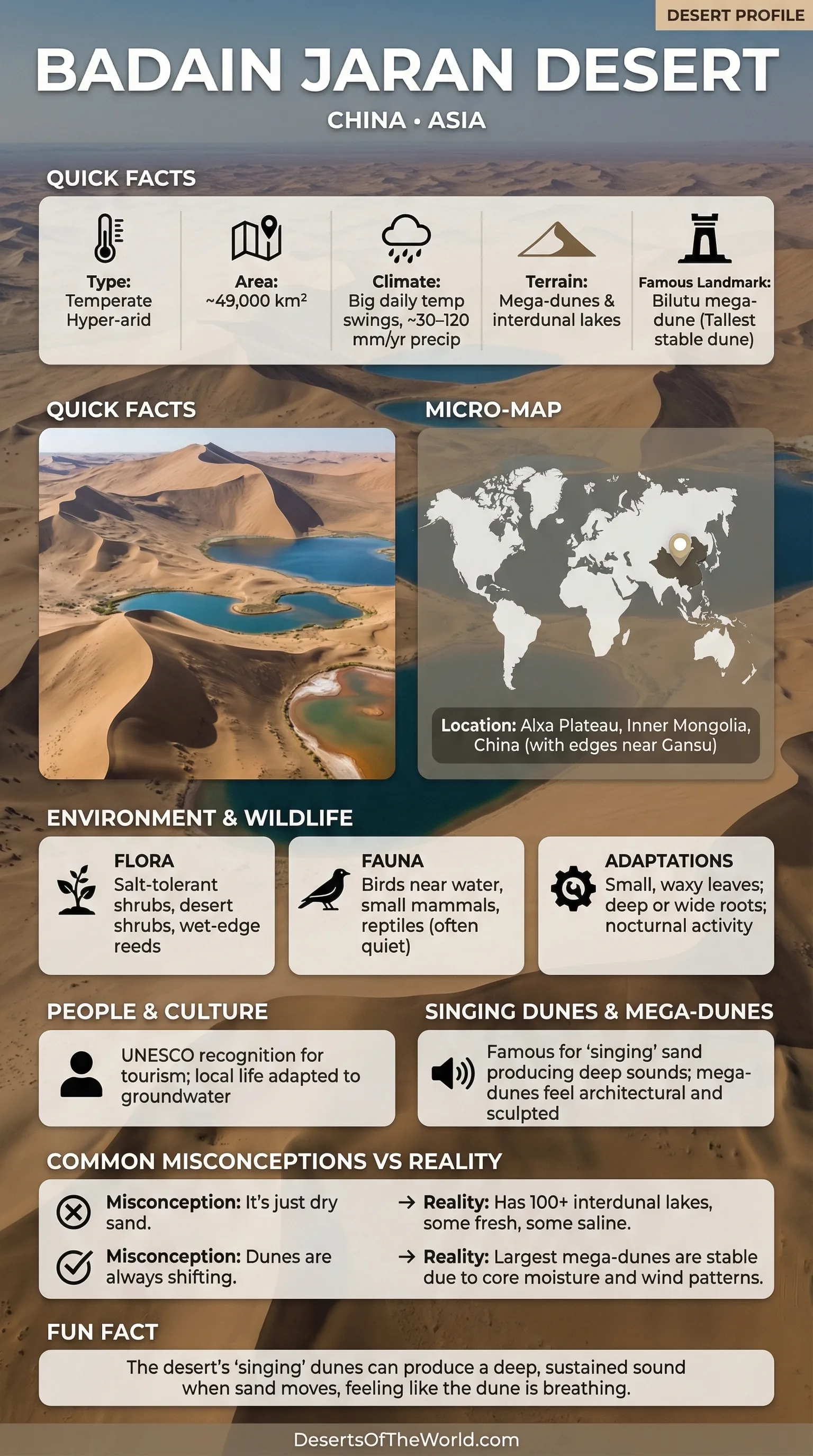
Location & Continent
Continent: Asia
Country: China
Region: Alxa Plateau, Inner Mongolia Autonomous Region (with edges reaching toward northern Gansu and nearby sandy regions)
Approximate Coordinates: 40.07°N, 102.21°E
Landscape Type: Temperate hyper-arid desert with mega-dunes and interdunal lakes
Badain Jaran Desert – Map View
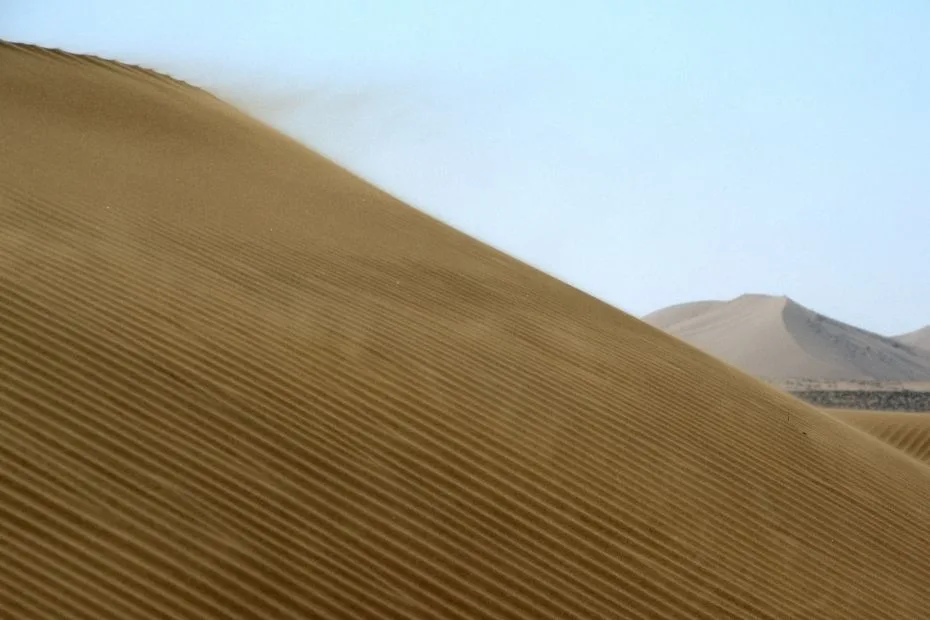
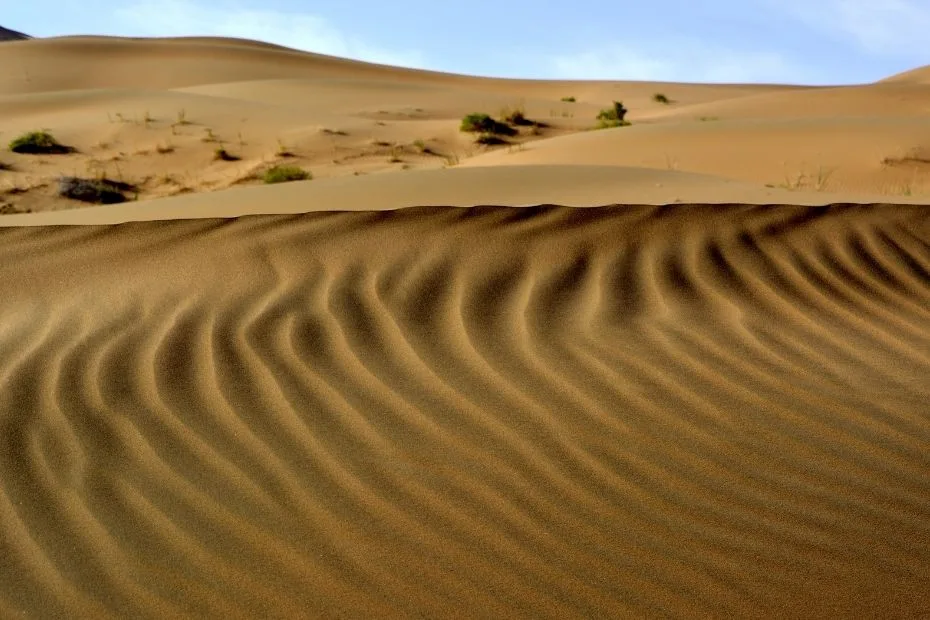
Photos of the Badain Jaran Desert
Physical Features
Area: About 49,000 km²
Elevation: Commonly around 1,200–1,700 m on the plateau; the highest dunes rise to striking local relief
Signature Landforms:
- Mega-dunes (often 300 m+ tall in key zones), forming a dense dune “skyline”
- Interdunal basins holding blue-green, pink, and pale mineral-toned lakes
- Wind-carved slopes, sharp crests, and sheltered valleys where fine sand settles like flour
Notable High Dune: The Bilutu mega-dune is widely cited as the tallest stable dune here, with a relative height around 450–500 m (measurements vary by method and reference point)
Climate & Water Balance
Climate Type: Temperate hyper-arid desert climate
Precipitation: Commonly around 30–120 mm per year, often higher in the southeast and lower deeper into the desert
Evaporation Pressure: Potential evaporation can reach roughly ~3,000 mm per year in regional estimates, which explains why groundwater matters so much here
Temperature Feel: Big daily swings are normal; summers can be hot, nights can cool fast, and winter air can bite. The desert often feels like a stone oven by day and a wide-open refrigerator after sunset.
Ecological Setting
The Badain Jaran Desert sits in a zone where life survives by using tiny advantages: a shaded dune face, a windbreak of shrubs, a ribbon of moisture near a lake edge. Around many lakes, the desert suddenly shows a green halo—thin, but real.
Biome: Deserts and xeric shrublands
Microhabitats:
- Lake margins with reeds and salt-tolerant plants
- Gravelly plains where hardy shrubs take root
- Interdune corridors that can trap cooler air and reduce wind stress
Flora & Fauna
Plant life here is built for thrift. Many species keep leaves small, waxy, or seasonal. Some push roots deep; others spread wide and shallow to catch rare moisture. Near the water, you may see reeds and lake-edge growth that looks almost impossible against so much sand.
Commonly Noted Plant Types:
- Salt-tolerant shrubs (often clustered where minerals collect)
- Desert shrubs that stabilize sand and reduce wind erosion
- Wet-edge vegetation around springs and lake rims
Wildlife is often quiet and timed to the cooler hours. Birds are the most visible near water, especially where shallow edges offer food. Small mammals and reptiles tend to use the dunes like a maze of shelter, slipping into shade and burrows. Even when the surface looks empty, the desert is rarely truly still; it’s just moving on a different schedule.
Geology & Landscape Formation
The desert’s most famous look—towering dunes beside lakes—comes from a careful balance between sand supply, wind regimes, and the hidden plumbing of groundwater. Think of the dunes as a frozen ocean swell: the surface ripples shift, yet the biggest forms hold their shape for long periods.
Why Many Mega-Dunes Stay Standing
- Compaction and older sand layers can stiffen the dune core
- Moisture within dunes can increase stability, helping steep faces persist
- Wind direction patterns can build dunes upward rather than simply pushing them away
Notable Processes:
- Aeolian transport (wind-driven sand movement) shaping crests and slip faces
- Salt concentration at lake edges as water evaporates, leaving mineral crusts
- Ongoing dune-lake interaction where basin shape and sand movement influence lake outlines
Introduction to the Badain Jaran Desert
The Badain Jaran Desert is one of the planet’s most distinctive dune landscapes: a place where mega-dunes rise like giant sand cathedrals, and lakes sit in their shadows like scattered pieces of glass. It lies on the Alxa Plateau in northwestern China, often discussed as part of the wider Gobi desert realm. What makes it stand out is not just the size of the dunes, but the way water and sand share the same stage without one erasing the other.
Mega-Dunes That Look Carved, Not Piled
Many deserts have tall dunes. Badain Jaran has dunes that feel architectural. In the core zones, mega-dunes commonly exceed 300 meters, and the tallest rise to roughly 450–500 meters of relative height depending on how the base is defined. Their crests can be narrow, their faces steep, and their sheltered valleys surprisingly calm. In the right light, the slopes show delicate banding—thin tonal shifts that hint at changing sand texture and wind conditions over time. It’s a landscape that looks sculpted, not simply accumulated.
Lakes Between Dunes
The desert’s lakes are the detail that rewrites expectations. More than 100 lakes are commonly counted, and many references mention 140+ scattered water bodies. Some are fresh to slightly brackish, others are strongly saline, and a few develop pale mineral rims as evaporation concentrates salts. In places, lakes sit so close together that different water chemistry can exist within the same small area—like a painter switching palettes every few brushstrokes. This patchwork is one reason the lake field is often described as mysterous.
Where the Lake Water Comes From
In a desert where rainfall is low and evaporation is intense, lakes do not last on rain alone. Many studies point to groundwater recharge as a key support, with springs and subsurface flow feeding the interdunal basins. The details can be complex—different lakes can have different balances, and mineral content changes the story—yet the core idea is simple: water travels underground, then appears where geology and basin shape allow it to pool. That hidden movement is the desert’s quiet engine.
Singing Dunes and Booming Sand
Badain Jaran is famous for “singing” dunes—sand slopes that can produce a deep, sustained sound when sand moves in a certain way. It is not magic, yet it feels like it. The effect depends on dry, well-sorted sand, a suitable slope angle, and the right kind of movement so grains slide together in a coordinated layer. The result can be a tone that lasts long enough to feel like the dune is breathing (just once in a while, it really does sound alive). This phenomenon is part of why the region is sometimes described as a kingdom of sound and sand.
Climate Rhythms Shaping the Surface
Annual precipitation is often reported in the 30–120 mm range, while potential evaporation can be orders of magnitude higher. That imbalance explains the desert’s sharp contrasts: dry ridges, salt-edged lakes, and occasional vegetated margins that cling to moisture like a thin lifeline. Winds do much of the visible work. They sharpen crests, smooth flats, and push ripples across the surface. Still, the largest dunes can remain remarkably stable, with only the top skin shifting like a moving veil.
UNESCO World Heritage Recognition
The landscape’s dune-and-lake pattern has been recognized internationally. The Badain Jaran Desert – Towers of Sand and Lakes was added to the UNESCO World Heritage List in July 2024. The listed property covers roughly 726,291 hectares, with a large buffer zone surrounding it. This designation reflects the site’s exceptional natural beauty and its value as a living example of desert landforms still evolving today.
Desert Features and What They Mean
| Feature | What You Notice | Why It Matters |
|---|---|---|
| Mega-Dunes | Very tall, steep sand mountains with sharp ridges | Shows long-term wind shaping and dune stability in a hyper-arid setting |
| Interdunal Lakes | Blue, green, or mineral-tinted water pockets between dunes | Signals the presence of groundwater and basin controls in an arid climate |
| Singing Sand | Deep tones during certain sand movements on steep slopes | Highlights sand grain properties and the physics of coordinated grain flow |
| Lake-Edge Vegetation | Green rings and small patches of plant life near water | Creates microhabitats that boost local biodiversity in a harsh environment |
Why This Desert Stays So Visually Diverse
Badain Jaran rarely looks monotone. A dune face can be bright gold, the next slope darker and crusted, the basin below tinted turquoise or edged with pale minerals. This diversity comes from small differences that add up: grain size, moisture in the dune interior, salt buildup around lakes, and the way wind funnels through corridors. It is a reminder that a desert is not a blank space—it’s an active surface, always being edited by air and time.
Sources
- UNESCO World Heritage Centre – Badain Jaran Desert – Towers of Sand and Lakes
- China Government Portal – World Heritage Inscription News (July 2024)
- National Forestry and Grassland Administration (China) – Badain Jaran Feature Page
- Inner Mongolia Autonomous Region Government – Badain Jaran World Heritage Coverage
- European Space Agency – Earth from Space: Singing Dunes and Lakes
- IUGS Geoheritage – Bilutu Megadunes and Lakes in the Badain Jaran Desert
- Frontiers in Earth Science – Groundwater-Recharged Lake Evolution (Badain Jaran)
- China Geology (KeAi/Elsevier) – Groundwater Characteristics and Climate Context (Badain Jaran)