
Not every desert is holy, yet many arid landscapes became places of prayer, retreat, law, memory, and pilgrimage. Deserts reduce daily life to water, shelter, route, and sky. In that setting, caves become places of retreat, springs sustain ritual and settlement, and mountain ridges can serve as sacred markers for whole communities.
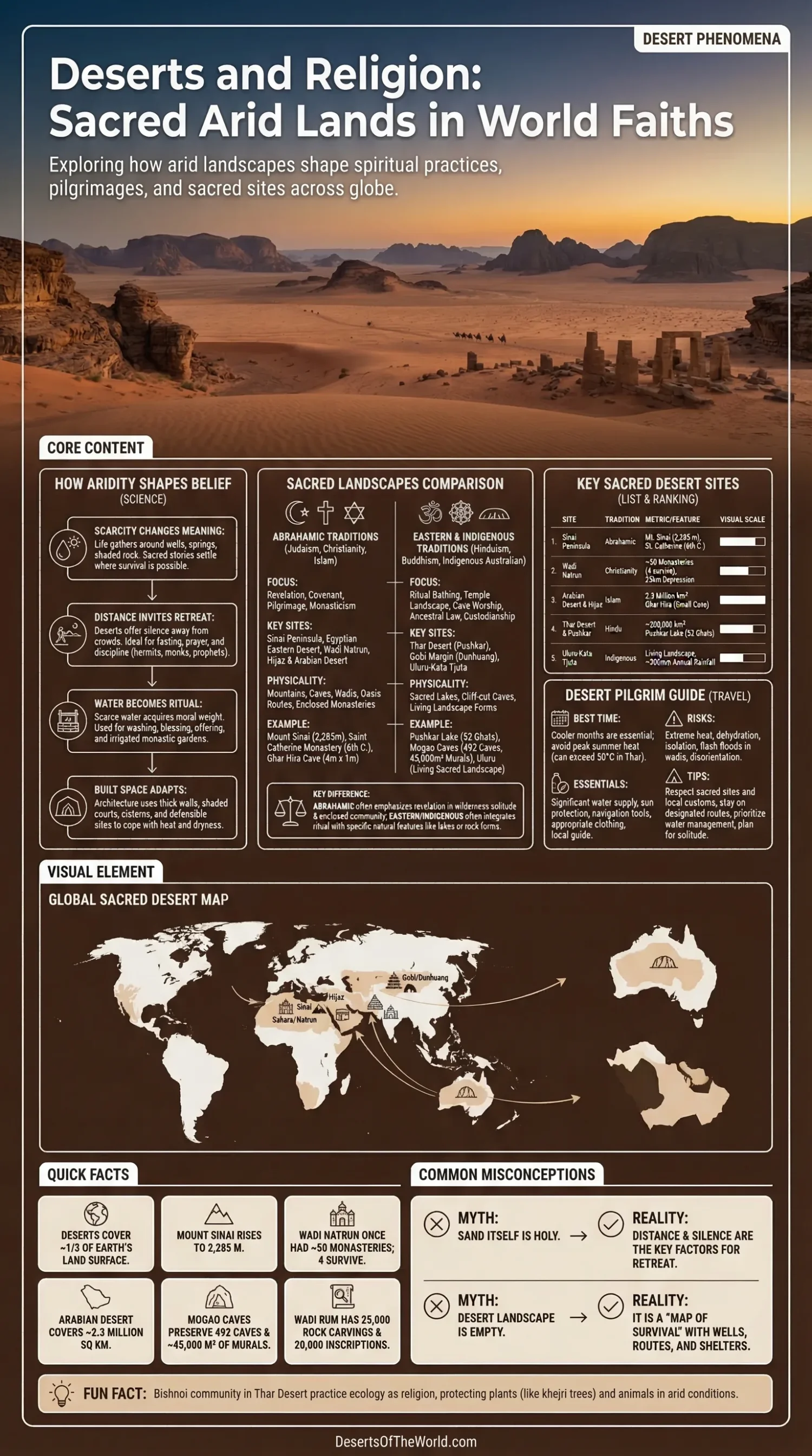
Across the planet, deserts cover about one-third of Earth’s land surface. Most authorities place a true desert below about 250 mm of annual precipitation, while many semi-arid sacred landscapes sit in the 250–400 mm band. Religion in these places is shaped by dryness, distance, travel conditions, and the need to protect scarce resources. Desert faith geography has a physical basis as well as a symbolic one.
| Tradition | Sacred Arid Landscape | Why It Matters | Useful Physical Detail |
|---|---|---|---|
| Judaism, Christianity, Islam | Sinai Peninsula | Revelation, covenant, pilgrimage, monastic life | Mount Sinai rises to 2,285 m; Saint Catherine Monastery has remained in use since the 6th century |
| Christianity | Egyptian Eastern Desert and Wadi Natrun | Hermit life, early monasteries, ascetic practice | Wadi Natrun is a 25 km depression; around 50 monasteries once stood there, 4 survive |
| Islam | Hijaz and Arabian Desert | Revelation, pilgrimage, sacred retreat, route memory | Arabian Desert covers about 2.3 million sq km; Ghar Hira is about 4 m long and 1 m wide |
| Hindu Traditions | Thar Desert and Pushkar | Sacred lake ritual, temple landscape, pilgrimage | Thar Desert covers about 200,000 sq km; rainfall ranges from about 100 mm to 500 mm |
| Buddhism | Dunhuang and the Gobi Margin | Cave worship, pilgrimage, art, scripture exchange | Mogao preserves 492 caves, about 45,000 sq m of murals, and more than 2,000 painted sculptures |
| Indigenous Australian Belief | Uluru-Kata Tjuta | Living sacred landscape, ancestral law, site responsibility | Average annual rainfall is around 300 mm |
Why Arid Lands Become Sacred
Scarcity Changes Meaning
In humid regions, settlement can spread across a wide area. In dry regions, life gathers around wells, springs, shaded rock, and seasonal water flow. Sacred stories often become attached to the places that support survival. A spring may become a place of blessing, a cave a cell for prayer, and a ridge a point of orientation for travelers crossing open country.
Desert religion often uses spatial ideas such as wilderness, ascent, retreat, solitude, testing, and return. These ideas grow from the lived conditions of arid land. A landscape that appears empty can contain routes, water sources, shelter sites, burial places, and inherited boundaries known to the people who live within it.
Distance Invites Retreat
Many faiths treat the desert as a place apart from ordinary settlement. Distance from courts, markets, farms, and crowded streets creates conditions suited to silence, fasting, prayer, and disciplined routines. Desert hermits, prophets, monks, and pilgrims used this separation in different ways across different traditions.
Rocky deserts often provide caves, escarpments, wadis, and defensible monastery sites. Sand deserts tend to direct sacred activity toward oasis towns, lakes, caravan wells, and the routes connecting them. Religious practice therefore develops in response to the form of the ground and the resources available there.
Water Becomes Ritual, Not Only Resource
Water infrastructure is central to sacred desert landscapes. Cisterns, channels, reservoirs, wells, and systems of managed access made permanent religious communities possible. In the Thar, seasonal rain was stored in tanks and reservoirs. In monastic deserts, wells and garden plots supported prayer communities. In Wadi Rum, ancient water catchment systems helped sustain settlement in a dry basin.
The pattern appears across many arid regions. Where water is scarce, it carries practical and moral weight. Washing, bathing, blessing, offering, hospitality, and fasting take place within a setting where every container of water must be found, stored, protected, or carried.
Abrahamic Traditions and Desert Revelation
Sinai and the Biblical Wilderness
Few desert sacred landscapes are as widely known as Sinai. The Saint Catherine Area in Egypt is revered in Judaism, Christianity, and Islam. UNESCO describes the area as sacred to all three monotheistic religions, centered on the holy mountain long linked in tradition with Moses and the giving of the Tablets of the Law. Mount Sinai rises to 2,285 m, and the monastery below it has remained in use since the 6th century.
Sinai ties revelation to terrain. The mountain, dry valleys, long approach routes, and steep ascent shape the experience of the place. In biblical memory, the wilderness is a zone of dependence, testing, guidance, and law. Desert topography becomes part of the sacred account rather than a passive background.
The wider Levant shows a related pattern. In the Judean Desert east of Jerusalem, monastic life spread across an austere rain-shadow landscape. By the time of Saint Saba in the 5th and 6th centuries, 73 monastic settlements stood in that desert belt. Dryness, distance, exposed rock, and limited access supported a life organized around withdrawal, prayer, and discipline.
The Christian Desert Fathers and the Birth of Monastic Space
Christianity gave sacred desert life a new institutional form through hermits, cells, lauras, and monasteries. In Egypt’s Eastern Desert, Saint Anthony left settled life in the late 3rd century and lived in a cave. The monastery that grew around his memory is often described as the oldest monastery in Egypt. Nearby, the monastery of Saint Paul formed around another cave-centered tradition in the same desert belt.
These sites show how Christian prayer communities adapted to arid ground. Walled enclosures reduced exposure to wind and heat. Towers served as places of refuge. Mills, ovens, wells, storage spaces, and gardens made remote worship sustainable. At Saint Paul’s monastery, water was supplied through an underground canal from the monastery well. Desert spirituality depended on engineering as well as religious discipline.
Wadi Natrun adds another form of desert monasticism. UNESCO describes it as a 25 km depression in Egypt’s Western Desert with saline lakes, once tied to natron extraction. Around 50 Coptic monasteries once stood there; 4 survive. Monastic life was shaped by salt lakes, isolation, fortification, and limited water. The landscape functioned as a managed religious settlement rather than an unoccupied wilderness.
Sacred Arid Places in Islam
Islam’s earliest sacred geography is closely linked to dry mountain and desert country. The Arabian Desert covers about 2.3 million sq km, and the Hijaz lies within that broader arid setting of mountains, gravel plains, valleys, and oasis routes. Retreat, pilgrimage, and route memory developed within this physical environment.
Ghar Hira, the cave on Jabal al-Nour near Mecca, is one of the best-known examples. Saudipedia describes it as the place where the first Quranic revelation was received. The cave is about 4 m long and 1 m wide, and the mountain rises to about 634 m. Its religious status comes from the memory attached to a small rock cavity in a dry mountain rather than from monumental size.
Islamic sacred space in arid lands also includes pilgrimage routes across western Arabia. These routes depended on wells, stopping points, shaded stations, and detailed knowledge of the terrain. The ritual landscape around Mecca includes open rocky and dry plains where movement, gathering, and prayer take place in exposed surroundings. Desert holiness can therefore be attached to movement through a landscape as strongly as to a single shrine.
Wadi Rum and the Memory of Caravan Religion
Wadi Rum in southern Jordan is a broad sacred-cultural desert archive rather than one narrowly defined holy site. UNESCO lists the protected area at 74,000 hectares and records 25,000 rock carvings, 20,000 inscriptions, and 154 archaeological sites, with evidence of human presence over 12,000 years. The landscape shows how belief, literacy, route-making, and desert settlement developed together.
The site also preserves traces of water catchment systems. In a dry basin, religious activity, travel, settlement, and water technology often share the same geography. Rock inscriptions, route markers, and knowledge of water sources belong to one connected desert environment.
South Asian Sacred Drylands
Pushkar and the Thar Desert Edge
The Thar Desert covers about 200,000 sq km across India and Pakistan. Rainfall is uneven, ranging from about 100 mm in drier western areas to around 500 mm in the east, with roughly 90 percent of annual rain arriving during the southwest monsoon. Summer heat can pass 50°C, and pre-monsoon winds may reach roughly 140–150 km/h. Sacred places in the Thar depend heavily on seasonal timing, storage systems, and water retention.
Pushkar shows how a dry region can form a sacred center around water. Set among desert hills in Rajasthan, Pushkar Lake is ringed by 52 bathing ghats and hundreds of temples. The lake and the Brahma temple draw pilgrims, while ritual bathing takes place within an environment where stable surface water is limited. Here, sacred water is protected basin water enclosed by a dry landscape.
Rivers dominate ritual geography in many Hindu settings. Pushkar follows a different pattern, with a lake in a desert valley serving as the central religious feature. Its enclosed setting, seasonal water balance, and concentration of temples reflect the practical value of permanent water in an arid region.
The Bishnoi and Desert Stewardship as Religious Practice
Another part of the Thar story lies outside formal pilgrimage centers. The Bishnoi community of Rajasthan shows how religion can shape desert ecology in everyday life. A 2025 study on the Bishnois in Khejarli Village in the Thar Desert describes how religious beliefs and practices support the protection of plants, animals, and local resources under arid conditions.
This is a clear example of living desert faith. Sacred value is attached to trees, wildlife, land, and restrained resource use as well as to established shrines. The khejri tree, Prosopis cineraria, is central in this setting. It provides shade, fodder, soil support, and cultural continuity under dry conditions. Religious practice and ecological care operate together within the same landscape.
Buddhist Sacred Landscapes on Arid Routes
Dunhuang and the Mogao Caves
Buddhism is often associated with forests, monasteries, and mountain temples, yet one of its largest sacred art zones stands beside an arid corridor. Near the Dunhuang oasis on the edge of the Gobi, the Mogao Caves were first cut in 366 AD. UNESCO records 492 preserved caves, about 45,000 square meters of murals, and more than 2,000 painted sculptures.
Dunhuang is a major religious route landscape in Asia. It stood where Silk Road traffic divided into different branches, bringing monks, merchants, scribes, and pilgrims through the same dry corridor. A cave complex beside an oasis became a place for storing images, manuscripts, memory, and devotional practice within a region shaped by long-distance movement.
The desert setting affected the physical form of the site. Caves provided thermal stability, shade, and protected surfaces for painting. The result was a religious art archive of unusual scale. Sacred desert landscapes are shaped not only by prophecy and retreat, but also by architecture, water storage and long-term settlement.
Indigenous Sacred Desert Country
Uluru-Kata Tjuta as a Living Sacred Landscape
Sacred deserts do not always revolve around written scripture or monastery walls. In central Australia, Uluru-Kata Tjuta is a living sacred landscape tied to ancestral law, oral transmission, site responsibility, and ongoing custodianship. UNESCO describes the park as a cultural landscape shaped by Tjukurpa, with different responsibilities held by Aṉangu men and women for particular sites and forms of knowledge.
Parks Australia notes that average annual rainfall is around 300 mm, with high variability from year to year. In this dry setting, rock forms, waterholes, caves, and travel lines preserve memory and guide responsibility. Sacred geography is expressed through the land, its features, and the knowledge needed to interpret them.
Sacred arid lands include places of retreat, established pilgrimage centers, and inhabited countries where law, kinship, ethics, and land care remain connected.
How Desert Religion Shapes Built Space
Caves, Cells, Towers, and Enclosed Water
Architecture provides another link between religious practice and arid geography. Sacred desert places use different forms, but many respond to the same environmental pressures. Heat, glare, wind, and scarce water encourage thick walls, inward-facing plans, shaded courts, cisterns, defended entrances, and compact storage. Monasteries in Egypt used towers, mills, wells, and gardens inside enclosures. Mogao used cliff-cut chambers. Pushkar organized ritual around a contained lake edge. Hira remained a small natural cavity rather than a monumental structure.
Belief adapts to geology. Sand seas, gravel plains, high mountains, and dry escarpments produce different sacred forms. Stone, wind exposure, elevation, groundwater, and access routes influence where religious communities can settle and how their buildings function.
Water Systems and Religious Time
Desert ritual also follows hydrology. In the Thar, monsoon timing governs water availability. In oases and depressions, wells and aquifers shape settlement rhythms. In Wadi Rum, catchment systems supported long-term use. In monastic deserts, gardens, wells, and storage facilities allowed retreat communities to remain in place across seasons.
Feast days, pilgrim arrivals, food storage, washing, and hospitality all depend on water security. Religious schedules in arid lands often operate within the seasonal limits imposed by rainfall, groundwater, and stored supplies.
Shared Patterns Across Sacred Arid Lands
Several patterns appear across these different traditions and landscapes:
- Revelation and retreat often occur in exposed terrain away from dense settlement.
- Water functions as a ritual element and a managed resource.
- Mountains, caves, wadis, and oases often carry more religious weight than open plains alone.
- Pilgrimage routes can matter as much as individual shrines in arid regions.
- Built forms respond directly to heat, dryness, wind, security, and storage needs.
- Living custodianship remains central in many sacred arid lands.
Deserts hold a lasting place in world religions because their physical conditions shape movement, settlement, memory, and discipline. Scarcity makes water visible, distance affects pilgrimage and retreat, and exposed terrain influences the location of caves, monasteries, lakes, shrines, and travel routes. In arid country, religious practice remains closely tied to the land that supports it.