
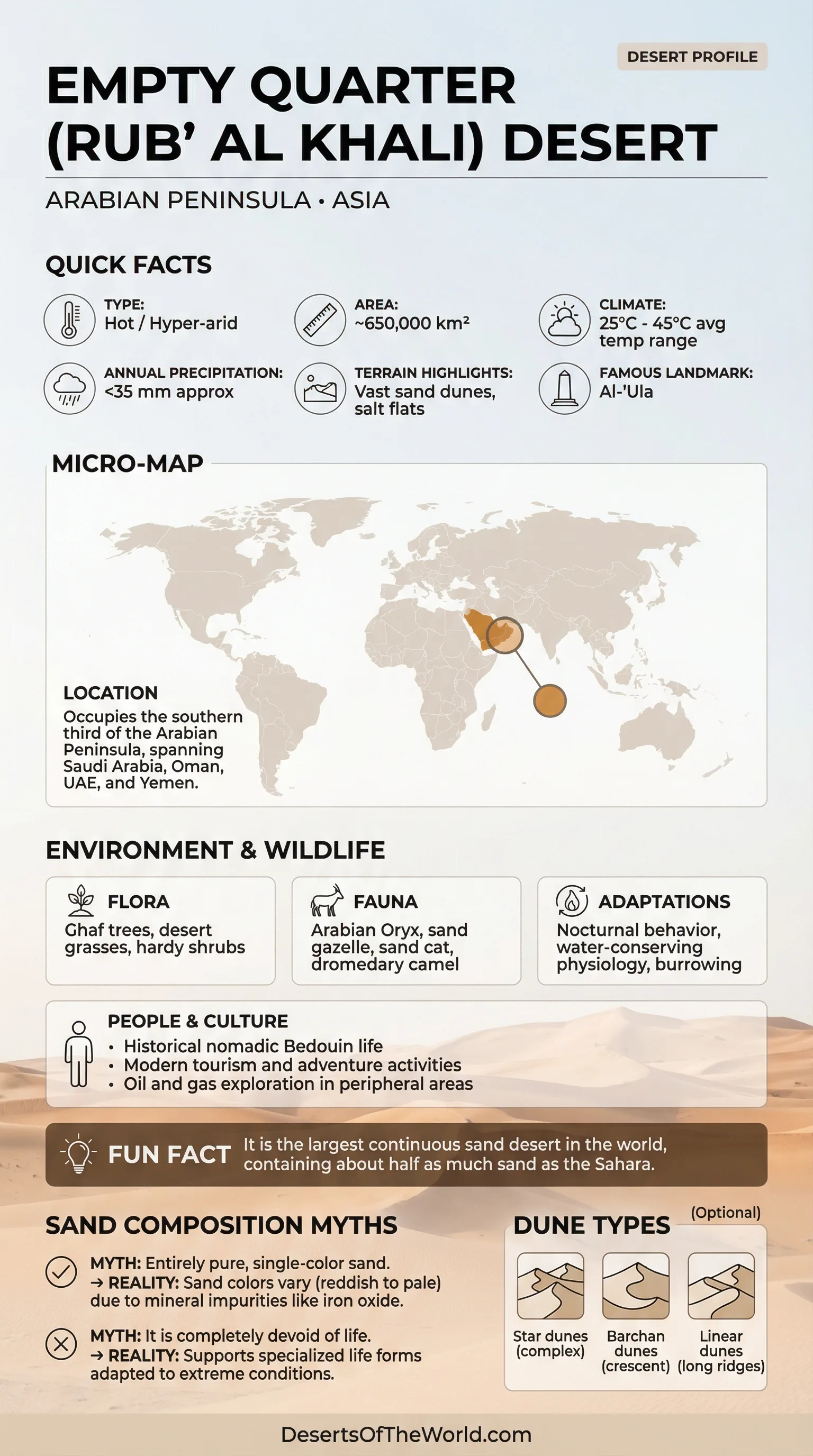
Location And Continent
Continent: Asia
Region: Arabian Peninsula in West Asia, forming a vast core of the Arabian Desert.
Countries: Saudi Arabia, Oman, United Arab Emirates, Yemen
Meaning Of The Name: Rub’ al Khali translates to “Empty Quarter”, a name that fits its open horizons and wide dune fields.
Approximate Extent: 16.5°–23.0°N, 44.5°–56.5°E
Center Point (Approx.): 20°N, 50°E
Empty Quarter (Rub’ al Khali) Desert
The Empty Quarter, also written as Rub’ al Khali, is one of Earth’s most iconic sand seas. It spreads across the southern Arabian Peninsula in broad, flowing bands of dunes, salt flats, and pale gravel corridors. The landscape can look calm from a distance, yet up close it is full of fine detail: ripples like fingerprints, dune crests like long waves, and shallow basins that hint at older stories.
In many desert lists, the Rub’ al Khali stands out as the largest continuous erg (a dune-dominated desert) on the planet. Think of it as an ocean made of sand, where the “tide” is driven by wind rather than water. Its scale is so large that different sources draw its edges slightly differently, which is why the stated area can vary while the overall picture stays the same.
Map And Street View
These embeds help place the Rub’ al Khali in context within the Arabian Peninsula, showing how the dune fields connect to surrounding plateaus and basins.
Map View
Nearby Dune Edge View
Photos Of The Empty Quarter
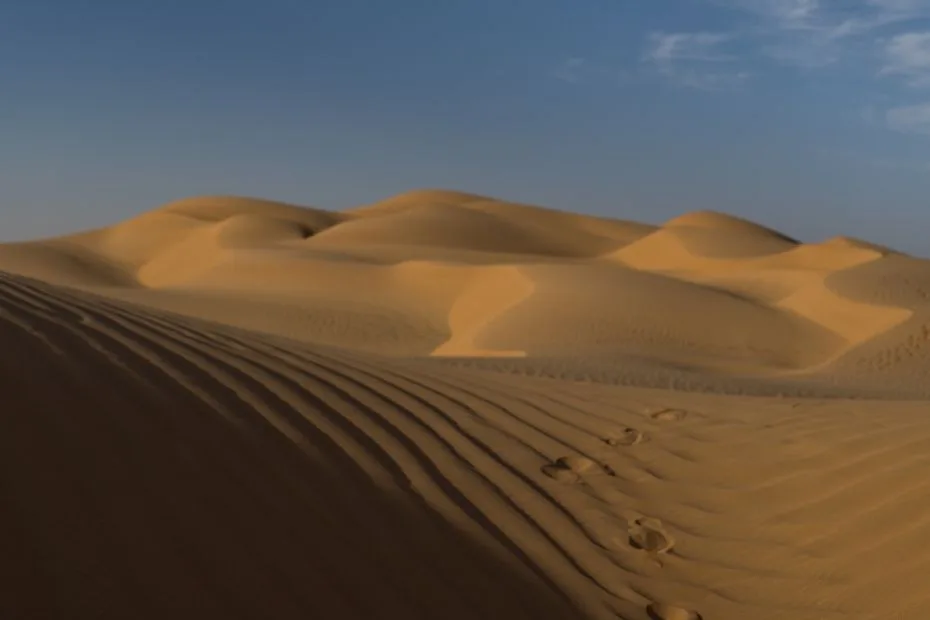
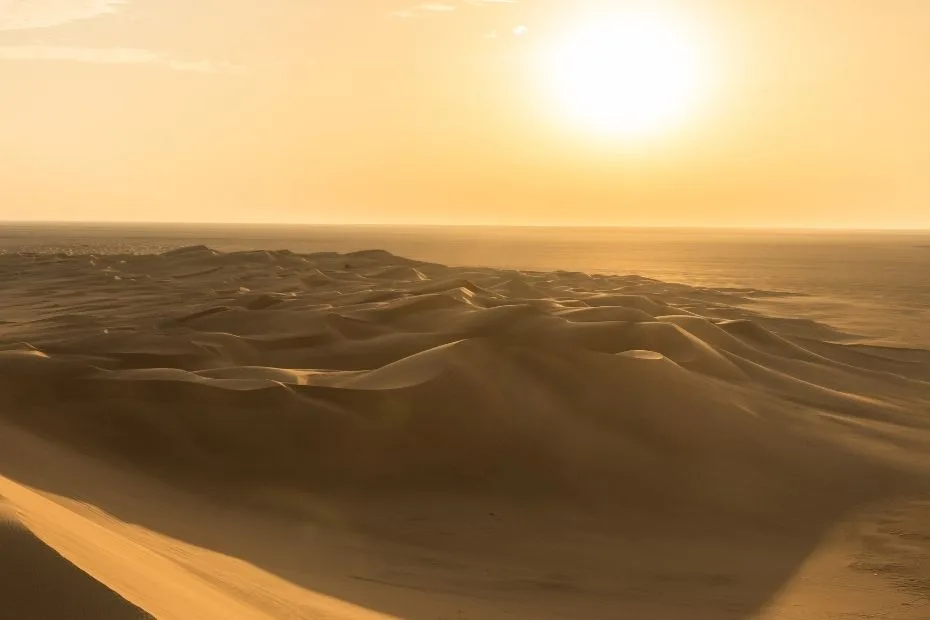
Photo galleries often show the signature look of the Empty Quarter: soft peach tones, sharp dune shadows, and long dune ridges that stretch for kilometers.
Measurements And Scale
The Rub’ al Khali is frequently described with round numbers, because it is so large that small boundary choices matter. Still, the overall scale is consistent: a thousand-kilometer-class desert of dunes and flats, shaped by persistent winds.
| Feature | Typical Value | Notes |
|---|---|---|
| Area | ~580,000–650,000 km² | Different maps define the edges of the dune sea slightly differently. |
| Length | ~1,000 km | A long span across the southern Peninsula, dominated by sand. |
| Width | Up to ~500 km | Broad belts of dunes mixed with flats and gravel corridors. |
| Highest Dunes | Up to ~250 m | Some dune crests rise like frozen waves under a wide sky. |
Elevation varies across the region, with higher sandy uplands in the west and southwest and lower plains toward the northeast. This gentle tilt helps explain why some dune fields line up in long, repeating patterns, while other areas favor taller, more complex shapes.
Climate And Precipitation
The Empty Quarter climate is usually described as hyper-arid. Rain is uncommon, and when it does arrive it is often brief and local. Many parts of the Rub’ al Khali receive well under 50 mm of rain in a year, and some years can pass with barely any measurable rainfall.
Heat is a defining feature. Summer daytime temperature can climb very high, while nights are often noticeably cooler thanks to clear skies and dry air. The result is a daily rhythm: bright, intense afternoons and calmer evenings, with cooler air pooling in lower basins and dune hollows.
Winds are the main architect here. They push sand grains along the surface, stacking them into ridges and sculpting fine ripples. Over time, these repeated motions create the signature dune corridors and wind-aligned patterns that define many satellite images of the Empty Quarter.
Ecology Snapshot
Even in a very dry desert, the Rub’ al Khali ecosystem is not empty. Life is simply spread out, tuned to short windows of moisture, and skilled at using shade, burrows, and cool nighttime air. In ecological terms, this region sits within desert and xeric shrubland systems, shaped by water scarcity and strong sun.
- Ecozone: Hyper-arid desert with patchy biological “islands” around low areas and dune edges where conditions soften slightly.
- Energy Flow: Sun-driven, with plants that grow fast after rare moisture and animals that prefer cooler hours.
- Key Limiting Factor: Reliable water, which shapes where plants cluster and where animals tend to travel.
Flora And Fauna
Vegetation in the Empty Quarter is mostly low and widely spaced, but it can be surprisingly varied when viewed close-up. Many plants are drought specialists with deep roots, tiny leaves, or waxy surfaces that reduce water loss. Near dune bases and shallow depressions, small shrubs and hardy grasses may appear after intermittent moisture.
Animal life often follows a simple strategy: stay cool and conserve water. Many species are more active at dusk, night, or early morning. Tracks in the sand frequently reveal what the eye misses: small mammals moving between shrubs, reptiles crossing warm surfaces, and insects that leave neat dotted trails like stitched lines.
Examples Of Desert-Adapted Life
- Plants: Salt-tolerant and drought-tolerant shrubs, scattered grasses, and occasional trees on the margins where groundwater sits closer.
- Mammals: Small rodents and fox-like desert mammals in suitable habitats, plus larger grazers in protected landscapes where conditions allow.
- Reptiles And Invertebrates: Lizards, snakes, scorpions, beetles, and other sand specialists that use burrows and shade.
- Birds: A mix of residents and seasonal visitors, especially around edges, plateaus, and wadis that occasionally hold moisture.
Geology And Landforms
The Rub’ al Khali landscape is often summarized as “just dunes,” but its landforms are more layered than that. The dunes sit alongside gravel plains, gypsum-rich surfaces, and hard crusts formed by minerals left behind as moisture evaporates. In places, broad flats appear between dune ridges like quiet lanes between rolling hills, colored in pale tans and chalky whites.
Major Landform Types
- Erg (Sand Sea): The main feature, made of vast dune fields with multiple dune shapes stacked and repeated.
- Linear Dunes: Long, parallel ridges that can run for great distances, often aligned with dominant wind directions.
- Star Dunes: Taller dunes with arms radiating out, forming where winds arrive from more than one direction.
- Sabkha (Salt Flat): Flat, mineral-rich surfaces where salts crystallize as moisture evaporates, sometimes appearing intermittant along desert margins.
- Gravel And Gypsum Plains: Firmer surfaces that break up the dune sea and create distinct ecological niches.
Sand color can shift from pale gold to warm orange tones. One reason is mineral mix: quartz dominates, while small amounts of other minerals can tint dunes with subtle pinks and reds, especially in strong sunlight. From above, these color bands can look like brushstrokes across a canvas, with shadow lines adding depth and rhythm.
Water, Salt Flats, And Ancient Lakes
Water is rare on the surface today, yet the Empty Quarter preserves clues that the region has not always looked the same. Hardened patches of clay, carbonate, and gypsum can mark old lake beds or shallow basins. These features act like pages in a book: each layer hints at older wet phases that came and went over long timescales, leaving behind sediment signatures.
Modern surface water, when it appears, is usually short-lived and localized. It may gather briefly in low areas after unusual rainfall, then fade as it soaks into sand or evaporates. Salt flats form where dissolved minerals stay behind, creating bright, reflective patches that stand out against the darker dune fields. The contrast is striking: white pans beside amber dunes, like a shoreline without an ocean.
Wind, Dunes, And Sand Patterns
In the Rub’ al Khali, wind is the steady sculptor. It lifts grains, rolls them forward, and sets them down again, repeating this motion millions of times. Dune crests form where sand accumulates, while slipfaces develop on the leeward side where grains tumble down. Over time, the process creates a living geometry: lines, curves, and ridges that can be read like topographic handwriting.
Not all dunes behave the same. Some fields favor long ridges, others build taller “stars,” and some areas mix both. This variety reflects wind direction changes through seasons and years, plus local influences such as nearby escarpments and plateaus. Even when the big dune shapes stay recognizable, the surface details refresh constantly, as if the desert is quietly re-drawing itself every day.
Edges, Oases, And Place Names
The Empty Quarter is often described as a central sand realm, but its edges matter. Along the margins, dune fields meet oases, plateaus, and gravel plains. Places like the Liwa area on the northern fringe are well known for dramatic dune scenery, while other edges include broad flats and salt-rich basins. These boundary zones can support denser plant pockets, creating a gentle gradient from sparse green to pure dune.
Across the region, local names often reflect what the land offers: a ridge, a basin, a salt flat, a corridor. The vocabulary of the desert becomes a map in itself, describing shape and function rather than decoration. In that sense, the Rub’ al Khali is not “empty” at all—its details are simply spread out, written in sand, and read best with patience and a careful eye.
Protected Landscapes And Scientific Interest
Parts of the Rub’ al Khali connect to protected landscapes, including areas on the western edge where dunes meet limestone plateaus. One notable example is ‘Uruq Bani Ma’arid, recognized for its natural value and its distinctive meeting point of escarpment and dune systems. These places matter because they help keep large desert processes intact, from wind-shaped dune movement to seasonal plant pulses, within a vast open setting.
Scientists also focus on the Empty Quarter because it preserves long-term records. Dune layers, mineral crusts, and sediment basins can be used to study how climates shifted in the past. Modern satellite images add another layer, revealing dune corridors and color bands at a scale the ground view cannot match. Together, fieldwork and imagery turn the Empty Quarter into a natural laboratory—quiet, spacious, and rich in signals for anyone studying desert dynamics.
References
NASA Earth Observatory: Empty Quarter (Rub’ al Khali)
U.S. Geological Survey: Empty Quarter Image And Description
KAUST: Research On Past Wet Phases In Rub’ al Khali
UNESCO World Heritage Centre: ‘Uruq Bani Ma’arid
National Center For Wildlife (Saudi Arabia): Protected Areas (Includes ‘Uruq Bani Ma’arid)
National Center For Wildlife: ‘Uruq Bani Ma’arid World Heritage Status