
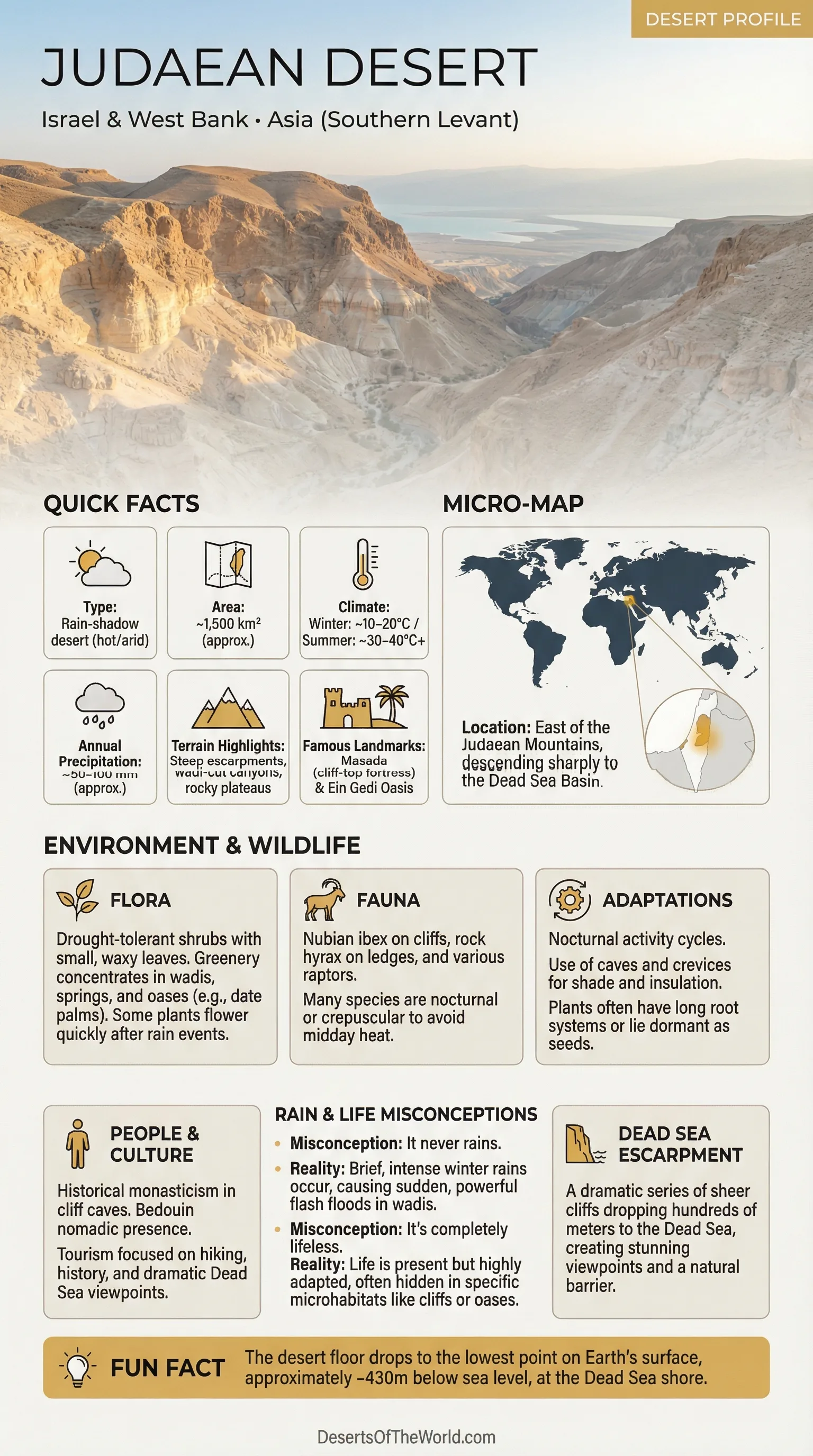
Location & Regional Setting
Region: Southern Levant
Primary Name: Judaean Desert (also written Judean Desert)
Where It Sits: East of the Judaean Mountains, descending toward the Dead Sea Basin
Countries / Areas: Israel and the West Bank
Reference Coordinates: 31.5°N, 35.3°E (central point for orientation)
Judaean Desert – Map Embed
Photos of the Judaean Desert
Physical Profile
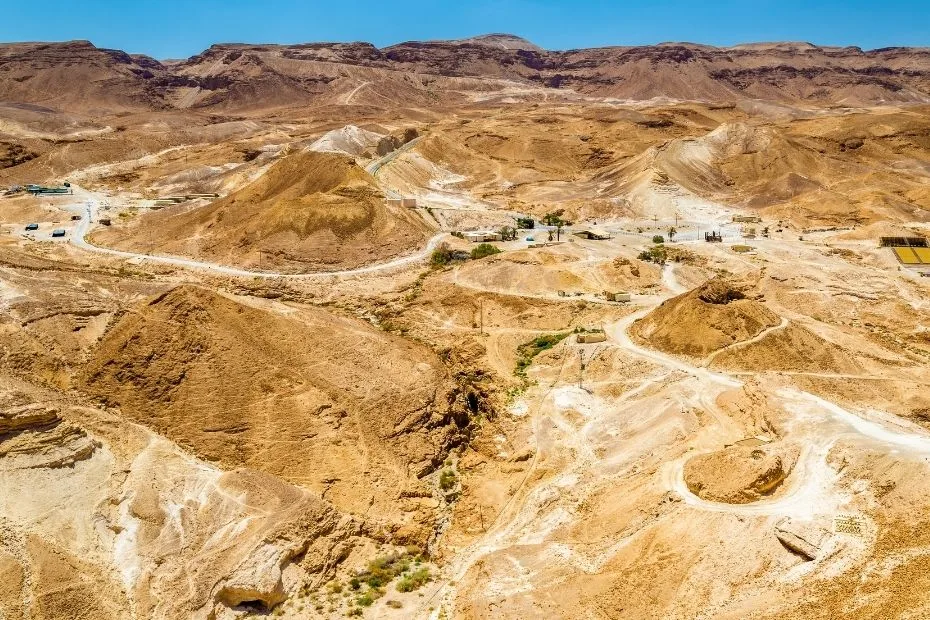
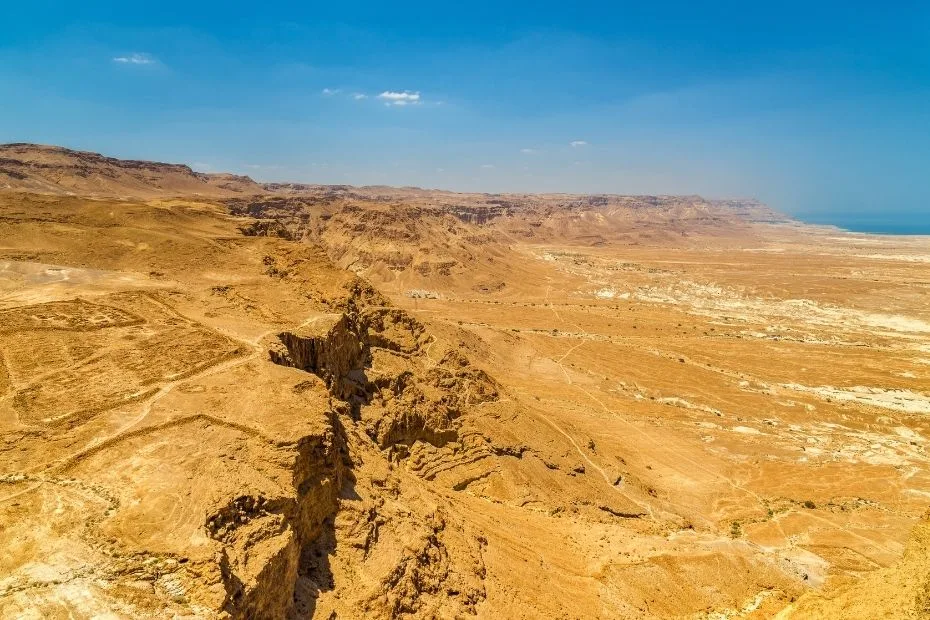
Landscape Type: Rocky desert, steep escarpments, and wadi-cut canyons
Relief: A fast drop from high ridgelines to the lowest land on Earth’s surface at the Dead Sea shore
Typical Elevation Range: Roughly 900–1,000 m near the ridge down to about -430 m near the Dead Sea
Signature Landforms: badlands, chalky slopes, limestone cliffs, and narrow gorges
Climate & Weather Patterns
Climate Gradient: From Mediterranean influence on higher western edges to true desert toward the east
Rain Shadow: Moist air rises over the mountains, then dries out, leaving the eastern slopes thirsty
Rainfall (Typical): Often around ~100 mm/year in the eastern desert zone; some Dead Sea areas are closer to ~50–65 mm/year
Summer Heat: Many days feel furnace-hot; dry air can make distances look sharper than they are
Winter Feel: Mild days, cooler nights; the sky can turn a clean, bright blue that looks painted on
| Season | What The Air Feels Like | Common Weather Notes |
|---|---|---|
| Spring | Dry, warming fast | Clear visibility; the desert’s color layers stand out |
| Summer | Very hot, low humidity | Strong sun; shade becomes precious |
| Autumn | Cooling, steadier | Long, calm evenings; cliffs glow purple at dusk |
| Winter | Mild days, cool nights | Most rain falls in this season; sudden runoff can fill wadis quickly |
Ecology & Microhabitats
The Judaean Desert is not one flat emptiness. It behaves more like a patchwork quilt stitched from rock, dust, and sudden water. One slope may be bare and pale, another dotted with shrubs that hug the ground as if trying to stay unnoticed. In the middle sits a narrow steppe belt, a transition zone where desert and Mediterranean influence shake hands.
Look at the drainage lines and the story changes. Wadis (seasonal streambeds) are the desert’s hidden arteries. For most of the year they look asleep, then a short rain can wake them up fast. The result is a landscape carved like folded paper: ridges, channels, and sudden drops that feel dramatic even from far away.
| Microhabitat | Why It Matters | What You Often Find |
|---|---|---|
| Cliff Faces | Cooler pockets, nesting ledges, wind-shaped shelters | Raptors, hardy plants in cracks, shadowed niches |
| Wadi Floors | Collects runoff and fine sediments | Shrubs, occasional acacia, tracks of desert animals |
| Oases | Reliable water turns scarcity into abundance | Date palms, reeds, springs, dense shade |
| Plateaus | Open exposure; thin soils | Low shrubs, open vistas, strong light |
Flora & Fauna
Plant life here is built around efficiency. Leaves tend to be small, waxy, or short-lived. Some shrubs wait for the right moment and then bloom quickly, like a spark in a dry fireplace. In wadis, deeper roots can reach moisture that the surface never shows.
- Common Plant Themes: drought tolerance, salt tolerance near the Dead Sea, and long root systems
- Where Green Gathers: Along springs, within wadi channels, and on shaded cliff lines
- Oasis Vegetation: Denser growth, including palm groves and riparian plants
Wildlife is shaped by timing. Many animals shift activity into cooler hours, turning the desert into a different world after sunset. In daylight, the most visible residents are often the ones that can handle exposure: Nubian ibex on cliffs, rock hyraxes on ledges, and birds riding warm air like invisible escalators.
- Signature Mammals: Nubian ibex, rock hyrax, and smaller desert-adapted carnivores
- Birdlife: Raptors and cliff-nesters; seasonal movement adds variety
- Reptiles & Invertebrates: Heat-tolerant species that use rocks and burrows as natural insulation
Geology, Rock Layers, And Desert Sculpture
The Judaean Desert is a geology lesson written in bright sunlight. Much of the terrain is built from sedimentary rocks such as limestone, dolomite, chalk, and marl-like layers that weather into smooth, pale slopes. In places, harder beds form shelves and ribs, giving hillsides a terraced look.
Wind does some shaping, yet water is the real sculptor. Not gentle water—fast water. When rain falls on hard ground, it runs instead of soaking in. Channels deepen, side-walls collapse, and gravel gets sorted like coins in a shaking jar. That is how narrow gorges and steep ravines become so accross the desert margins.
Near the Dead Sea, geology becomes even more dramatic. Falling water levels have changed groundwater pathways in the basin, and some shore zones have developed sinkholes where underground salt layers dissolve. It is a reminder that a desert can be quiet on the surface while staying busy underground, like a slow-moving machine.
Notable Natural Features
- Escarpments Above The Dead Sea: Sheer drops and cliff walls with long views
- Badlands And Chalk Slopes: Soft rock forms knife-edge ridges and smooth gullies
- Wadi Networks: Seasonal drainage lines that stitch the landscape together
- Spring-Fed Pockets: Oases that feel like small worlds inside the larger desert
Introduction To The Judaean Desert
The Judaean Desert sits where highlands lose their moisture and the land begins to crackle into aridity. It is best understood as a rain-shadow desert: a place made dry not only by latitude, but by topography. Moist air rises over the Judaean Mountains, cools, drops its rain, then moves east with far less to give. The result is a steep environmental staircase—green hills behind, sunlit rock ahead, and the Dead Sea waiting at the bottom.
For visitors and readers, the desert’s appeal is its contrast. The same horizon can hold chalk-white slopes, dark cliff bands, and a ribbon of blue water far below. The air is often clear, making the land look closer than it is. That crisp visibility is part of the desert’s signature, like a high-definition filter on the natural world.
Geography And Relief
The core shape of the Judaean Desert is a long descent. To the west, the ridge line sits high; to the east, the ground plunges toward the Dead Sea. This creates a terrain of tilted plateaus, broken ridges, and carved canyons that funnel water during rare storms. Think of it as a stone roof: when water hits, it runs fast along the grooves.
The most striking relief is near the Dead Sea escarpment. Here, cliff walls can feel immense, especially when sunlight hits them from the side and reveals every layer. In late afternoon, the rock can shift from beige to honey to a faint violet, like a slow color change on a stage set.
Water In A Dry Landscape
Water is the desert’s most important editor. Even small amounts decide where plants can root, where animals gather, and where humans historically settled. Most of the year, surface water is scarce, yet springs along certain fault and limestone zones can create stable green pockets. Ein Gedi is one of the best-known examples, where fresh water drops from cliffs into shaded channels, turning desert stone into oasis vegetation.
Wadis add another layer. They may look empty for months, then suddenly carry runoff. This on-and-off pattern is why the desert holds so many steep channels: each event is brief, but the cumulative carving is powerful. It is like sanding wood—slow overall, yet every pass leaves a mark.
Desert Life Strategies
In the Judaean Desert, survival often means avoiding the harshest hours rather than fighting them. Shade matters. Burrows matter. Cliff cracks matter. Many species treat rocks as natural air conditioners, using cool crevices during the day and moving more freely when temperatures drop.
Plants show a different kind of intelligence: they invest in roots, not in leafy display. Some hold seeds in reserve for the right rainfall window, then grow quickly, flower, and set seed before the soil dries again. When that happens, the desert can briefly look alive with color, a reminder that “dry” does not mean “empty.”
Human Footprints And Heritage Landscapes
The Judaean Desert has long attracted people for the same reasons it fascinates modern visitors: sheltering cliffs, strategic viewpoints, and an unusual ability to preserve fragile materials in dry caves. That preservation has supported decades of careful research in caves and cliff sites, helping scholars understand life, movement, and environment in the region across long time spans.
Along the desert’s edges, oasis settlements show how water changes everything. Where springs flow, agriculture and long-term habitation become possible, even in extreme heat. This contrast—bare slopes beside green channels—is one of the clearest lessons the desert offers.
Protected Areas And Landscape Care
Several protected sites in and around the Judaean Desert focus on conserving habitats, springs, and wildlife corridors. These areas also help people experience the desert without putting pressure on the most sensitive places. In a landscape where growth is slow and soils are thin, small disturbances can last a long time, so stewardship matters.
The positive side is clear: when foot traffic and infrastructure are managed, the desert stays resilient. Cliffs remain nesting sites, springs stay clean, and the quiet character of the region is preserved. The desert does not need decoration. Its best feature is its honest simplicity.
Why The Judaean Desert Feels So Distinct
Many deserts are defined by sand. The Judaean Desert is defined by stone, light, and sharp relief. It is a desert of lines: ridge lines, cliff lines, wadi lines. From above, it can look like a hand-drawn map where every stroke is purposeful. From the ground, it feels like walking through a natural amphitheater carved from chalk and limestone.
Its climate story is equally distinctive. A short drive can cross from higher, cooler air into dry heat and wide-open space. That steep gradient makes the region a powerful example of how mountains shape weather. In that sense, the rain shadow is the desert’s invisible architect.
Sources
Israel Nature And Parks Authority – En Gedi Nature Reserve (Judean Desert Oasis)
Geological Survey Of Israel – The Dead Sea (Regional Geology And Monitoring)
Israel Meteorological Service – Climate Atlas (Long-Term Climate Data)
Encyclopaedia Britannica – Dead Sea Climate And Hydrology
Hebrew University Of Jerusalem – Judean Desert Research (Caves And Environmental Study)
Gov.il – Ein Gedi: An Ancient Oasis Settlement (Springs In The Judean Desert)