
Location and Regional Context
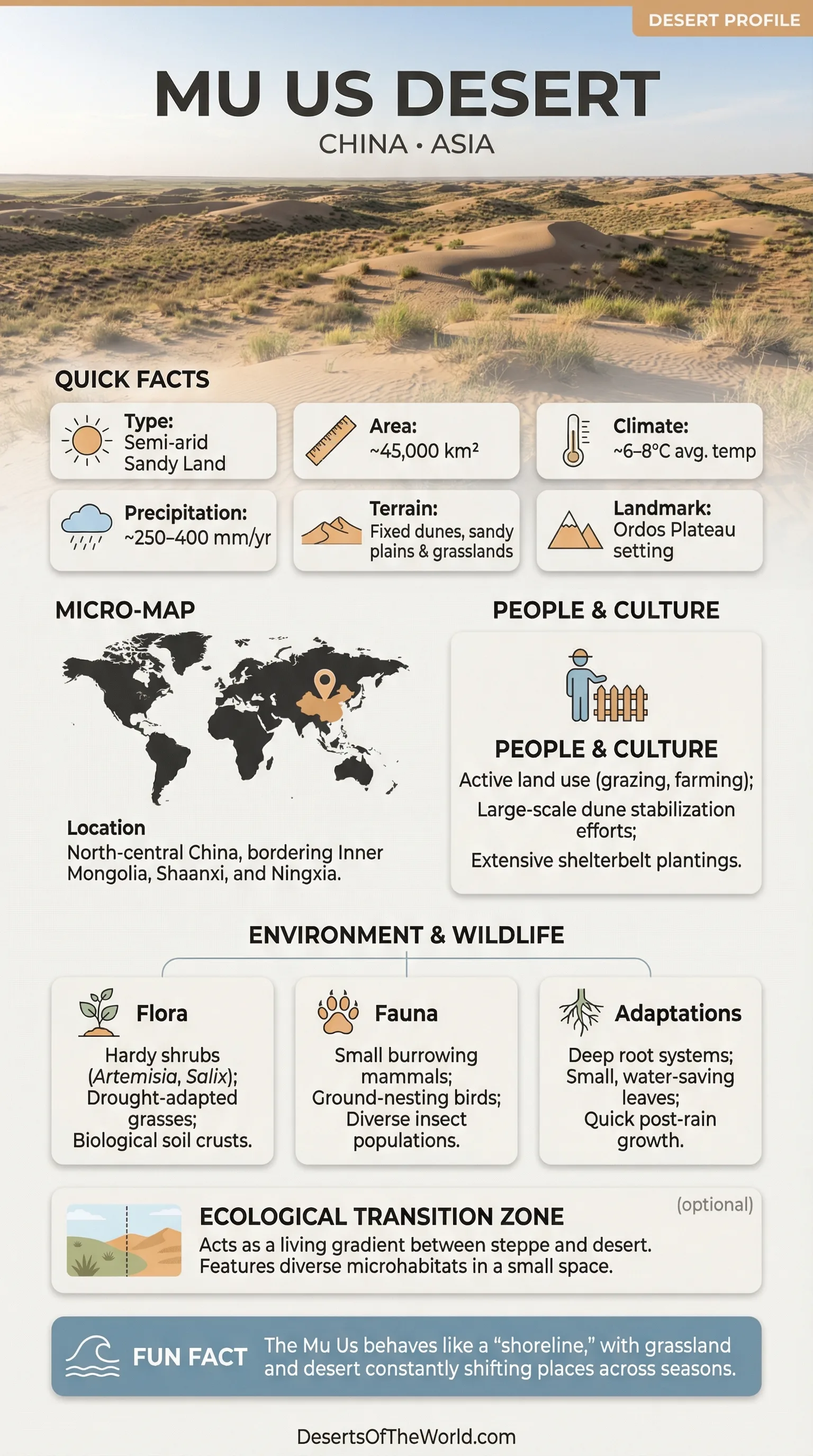
The Mu Us Desert (often described as the Mu Us Sandy Land) sits in north-central China on the broad shoulders of the Ordos Plateau. It is not a single, uniform sand sea. Instead, it behaves like a shoreline where grassland and desert trade places across the seasons and across short distances.
In plain geographic terms, Mu Us lies around the meeting zone of Inner Mongolia, Shaanxi, and Ningxia. That borderland setting matters because the landscape blends rolling dunes, sandy grasslands, and pockets of farmland in a way that feels stitched together rather than neatly separated.
Country: China
Common Name Variants: Mu Us Desert, Mu Us Sandy Land, Maowusu Sandy Land
Coordinate Range: 37°30′–39°20′N, 107°20′–111°30′E
Representative Center Point: 38.4°N, 109.5°E
Mu Us Desert – Map View
Physical Features
What stands out in Mu Us is variety. You can move from low shrub-dunes to sandy flats and then into grassy swales without feeling like you crossed into a new world. The dunes are shaped by wind, but many are partly held in place by roots and surface crusts, so the contours often look softer and more settled than in hyper-arid deserts.
Elevation: Typically 1,000–1,300 m on the Ordos Plateau, with local highs and lows across valleys and uplands
Typical Landforms: semi-fixed dunes, fixed dunes, sandy sheets, interdune hollows, low ridges
Landforms Commonly Seen
- Parabolic Dunes where vegetation pins the “arms” and wind pulls the center forward, creating a U-shaped outline.
- Gentle Crest Ridges with thin sand layers over firmer ground, often carrying shrub bands.
- Interdune Depressions that can hold moisture a litte longer after rain, turning into temporary green patches.
- Sandy Plains where wind has spread sand like flour on a countertop, leaving a broad, even surface with subtle ripples.
Climate and Seasonal Rhythm
Mu Us is often labeled semi-arid, and that label fits because rainfall is limited yet meaningful. Many sources describe annual precipitation around 250–400 mm, with much of it arriving in warmer months. That seasonal pulse is why Mu Us can support broad areas of sandy steppe and why the line between “desert” and “grassland” can look blurred.
Temperatures follow a strong continental swing: hot summers, cold winters. Average annual air temperature is commonly reported near 6–8°C, though day-to-day conditions can shift quickly with wind, cloud cover, and dry air.
| Climate Element | Typical Pattern | Why It Matters |
| Rainfall | 250–400 mm/year, seasonally concentrated | Drives short, intense greening and supports dune-stabilizing plants |
| Wind | Frequent, especially in open sandy corridors | Builds ripples and reshapes exposed dune faces |
| Temperature Range | Large seasonal swing (continental style) | Favors deep-rooted shrubs and season-timed growth |
| Evaporation Pressure | High during warm, windy periods | Makes water efficiency the core survival skill |
Ecology Built On Edges
The defining ecological idea in Mu Us is the transition zone. Think of it as a living gradient rather than a hard boundary. Some areas behave like steppe with sandy soils; other patches behave like desert dunes with scattered shrubs. That mix creates many microhabitats in a relatively small space.
A quiet star of the system is the biological soil crust in more stable spots—thin communities of organisms that can darken the sand surface, improve structure, and help hold fine particles in place. Where crusts and roots work together, sand becomes less like loose sugar and more like a stitched fabric.
Plant Strategies That Fit Mu Us
- Deep and Wide Roots that chase moisture through sandy layers, turning the underground into a hidden map.
- Small Leaves or narrow leaf shapes that reduce water loss while still capturing sunlight.
- Flexible Growth Timing that responds fast after rainfall, then slows down during dry spells.
Flora and Fauna
Vegetation in Mu Us often centers on hardy shrubs that can handle shifting sand and dry air. Two names appear again and again in scientific work on the region: Artemisia ordosica and Salix psammophila. They are well-suited to sandy soils and are widely associated with sand stabilization and community recovery in semi-arid dunes.
Plant communities also include drought-adapted grasses and legumes, forming mosaics that look different from one dune to the next. After rain, some flats can briefly resemble a green veil draped over pale sand, then fade back to muted tones as the soil dries.
Animal life is often most noticeable at cooler hours. Typical desert-steppe patterns show up here: small mammals that use burrows for temperature control, ground-nesting birds that blend into sand and grass, and a variety of insects that do the heavy work of nutrient cycling. In a place like Mu Us, the food web is less about big dramatic predators and more about many small links holding steady.
Geology and Sand Origins
The sands of Mu Us are not “mystery grains.” Modern studies trace sand sources through mineral fingerprints and river-sediment connections. The region sits near major sediment pathways linked to the Yellow River system, and parts of the sandy land include material recycled from older deposits, including dried lake sediments in some areas. This is one reason the desert can look subtly different from east to west: the sand is similar in feel, yet not always identical in mineral mix.
On the surface, wind is the main sculptor. Sand moves, settles, then moves again, creating ripple marks and small slip faces. The story underneath is longer: the Ordos Plateau setting, nearby loess regions, and river basins provide a steady background of sediments that can be reworked into dunes when conditions allow.
Why “Sandy Land” Is A Useful Term Here
Calling Mu Us a “sandy land” highlights its blend of landscapes. Some sectors are dune-dominant, others are sand-over-grass or sand-over-soil. The phrase fits because it points to process: sand is active in shaping the environment, even when the scene is partly green and partly golden.
Human Presence In A Working Landscape
The Mu Us region is not empty space on a map. It includes towns, grazing areas, and dryland farming zones that sit alongside dunes and sandy grasslands. This everyday land use is part of what makes the area so interesting: the desert here is not a distant wilderness; it is a neighboring landscape that people interact with through shelterbelts, windbreaks, managed vegetation, and seasonal land practices.
Over recent decades, the region has become a well-known example of large-scale dune stabilization and vegetation recovery work. You’ll see patterns that often appear in restoration landscapes: linear plantings that break wind, shrub belts that anchor dune edges, and recovering patches that move from sparse cover to denser, more continuous plant communities.
How Scientists Track Change Across The Dunes
Mu Us is frequently studied with satellites because the landscape has strong visual signals from above. Tools like NDVI (a vegetation greenness index), surface albedo (reflectivity), and land surface temperature help map where vegetation expands, where bare sand persists, and how patterns shift across seasons. In other words, the desert is read like a living mosaic, tile by tile, across very large areas.
Field research adds the fine detail: plant water use, soil moisture at different depths, dune mobility, and the role of crusts and shrubs in shaping sand movement. When both views are combined, local processes and regional patterns start to line up in a way that makes the system easier to understand.
What Makes Mu Us Distinct Among World Deserts
Many famous deserts are defined by extreme dryness. Mu Us stands out for a different reason: it is shaped by being near a rainfall boundary influenced by seasonal circulation, so it can support more widespread vegetation than most classic sand deserts. That creates a desert experience where sand and life appear side by side, like two colors blended on the same brushstroke.
For anyone comparing global deserts, Mu Us is a strong reminder that deserts are not a single category. Some are salt flats, some are stone plateaus, some are dune seas, and some—like this one—are a semi-arid sandy transition where ecology and geomorphology constantly negotiate the final look of the land.
Sources
U.S. Geological Survey – Sand Provenance Boundary In The Mu Us Sandy Land
NASA MODIS Science Team – Desertification Monitoring Study In Mu Us Sandy Land
Beijing Forestry University – Mu Us Desert Ecosystem And Restoration Research
USDA ARS – Dune Sand Transport Observations On The Ordos Plateau
Mu Us Desert – Wikipedia