
Photos of the Antarctic Desert
Location & Continent
Continent: Antarctica – a vast polar desert wrapped around the South Pole.
Region: Almost entirely south of the Antarctic Circle, surrounded by the Southern Ocean.
Countries / Governance: No sovereign country; the land is managed collectively under the Antarctic Treaty System. Several nations (including Argentina, Australia, Chile, France, New Zealand, Norway and the United Kingdom) maintain territorial claims, but these are held in check by the treaty, which dedicates the continent to peace and science.
Coordinates (reference point): 90°S, 0°E – the geographic South Pole at the heart of the Antarctic Desert.
Antarctic Desert – Map & Satellite View
Click to load the interactive map
Physical Features
Area: ~14 million km² (about 5.4 million sq mi), making the Antarctic Desert the largest desert on Earth by area, larger than the Sahara and almost twice the size of Australia. ([Encyclopedia Britannica][1])
Ice Cover: Roughly 98% of the surface is buried under ice and snow, forming the world’s biggest continuous ice sheet.
Average Ice Thickness: Around 1.6–2 km, with some parts exceeding 4 km thick.
Length & Width: The continent stretches roughly 4,000–5,000 km across, depending on direction, from the Antarctic Peninsula toward East Antarctica.
Elevation:
- Highest point: Vinson Massif (~4,892 m) in the Ellsworth Mountains.
- Average elevation: ~2,300 m – the highest continent on Earth on average.
Ice-Free Areas: Only about 1–2% of Antarctica is ice-free: rocky coasts, nunataks (mountain peaks poking through the ice), and the famous McMurdo Dry Valleys.
Climate & Precipitation
Desert Type: Cold polar desert – extremely dry, extremely cold.
Temperature:
- Inland plateau in winter: often below −60 °C; record lows below −80 °C.
- Coastal summer: around −2 to +5 °C, sometimes slightly warmer on the Antarctic Peninsula.
Precipitation:
- Inland: typically 25–50 mm water equivalent per year – comparable to the driest hot deserts.
- Average over the whole continent: about 166 mm/year.
- Almost all falls as snow; it seldom melts, instead it compacts into glacial ice.
These ultra-low values are why Antarctica is officially classified as a desert, despite being white, not sandy.
Wind: Powerful katabatic winds rush down from the high interior toward the coast, sometimes exceeding 90 m/s (over 320 km/h) in certain valleys – enough to blast exposed rock clean of snow. ([npolar.no][2])
Ecological Features
Ecozone: Polar desert.
Biome: Ice sheets and polar desert on land; highly productive polar seas in the surrounding Southern Ocean.
Key Ecoregions:
- Antarctic Peninsula tundra and rocky coasts.
- East Antarctic coastal oases and inland nunataks.
- McMurdo Dry Valleys – one of the driest, coldest desert landscapes on Earth.
Even in this harsh enviroment, microscopic life, lichens, mosses and a few hardy animals manage to survive.
Flora & Fauna
Flora:
- No trees or shrubs grow naturally in Antarctica.
- Most land plants are mosses, lichens, algae and liverworts, clinging to moist rock, soil pockets or bird-manured ground.
- Only two native flowering plants occur on the Antarctic Peninsula and nearby islands:
- Deschampsia antarctica – Antarctic hair grass
- Colobanthus quitensis – Antarctic pearlwort
These plants hug the ground, taking advantage of brief summer warmth and meltwater on small ice-free patches.
Fauna:
On land, the interior is almost lifeless. Along the coasts and offshore, however, the Antarctic Desert connects to one of the richest marine ecosystems on the planet:
- Penguins: Emperor, Adélie, Chinstrap and Gentoo penguins breed on sea ice or rocky shores.
- Seals: Weddell, leopard, crabeater, Ross and southern elephant seals haul out on ice and beaches.
- Birds: Snow petrels, skuas, albatrosses and many other seabirds circle the pack ice.
- Ocean life: Antarctic krill form the backbone of the food web, feeding whales, seals, fish and penguins.
Geology, Ice & Notable Features
Geology: Antarctica is a full-sized continent with ancient continental crust, divided into East Antarctica and West Antarctica by the long Transantarctic Mountains. Under the ice sheet lie mountain ranges, sedimentary basins, and deep troughs such as the Bentley and Denman subglacial trenches. ([Encyclopedia Britannica][3])
Ice Sheet & Landforms:
- Antarctic Ice Sheet: Holds around 60%+ of Earth’s fresh water, locked as ice.
- Ice Shelves: Huge floating extensions like the Ross and Filchner–Ronne shelves, from which giant icebergs calve.
- Subglacial Lakes: Hidden lakes such as Lake Vostok lie beneath kilometres of ice.
- Volcanoes: Mount Erebus on Ross Island and Deception Island in the South Shetlands are notable active or recently active volcanoes.
Introduction to the Antarctic Desert
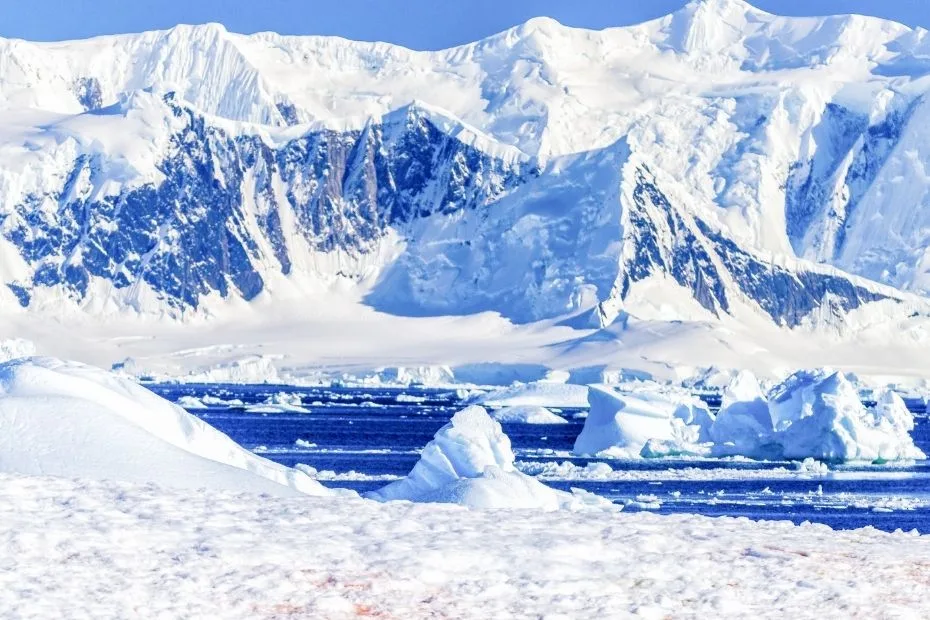
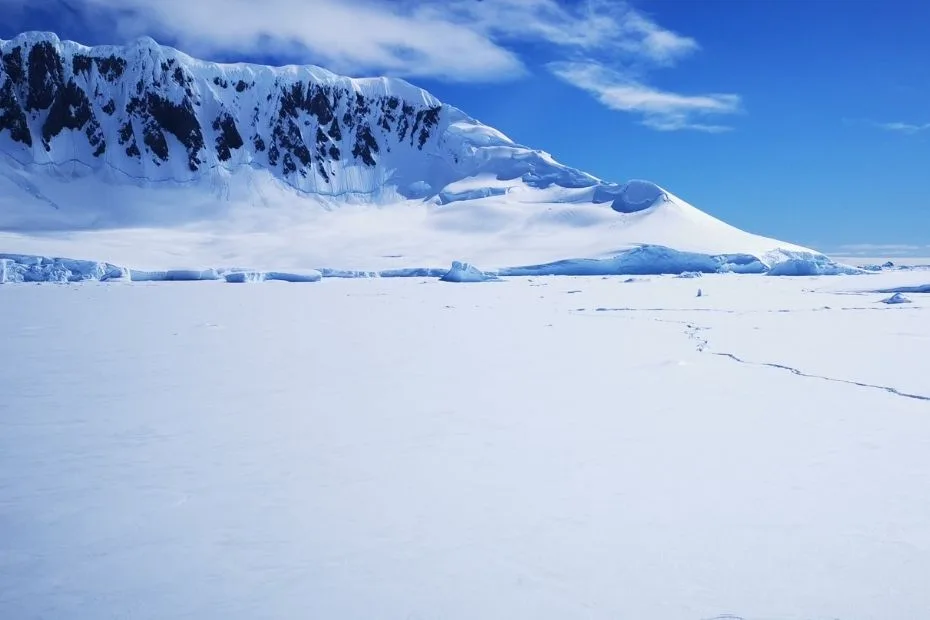
The Antarctic Desert looks nothing like the clichés of rolling sand dunes. It is a frozen ocean of ice, a continent-sized desert where water is everywhere yet almost never liquid. Air is dry, winds are fierce, and temperatures fall to levels that would destroy most life in minutes.
And still, life finds ways to persist: a few tough plants, microscopic communities in ice and rock, penguins clustered on rocky headlands, seals sprawled on sea ice. Around the edges, the Southern Ocean bursts with energy, powered by krill and swirling currents.
Among the world’s deserts, Antarctica differs from common perceptions by being defined by extremely low precipitation rather than heat. It is a polar desert composed largely of ice rather than sand.
Geography and Major Regions of the Antarctic Desert
Antarctica is roughly circular, with two deep embayments – the Ross Sea and the Weddell Sea – biting into its edges and the long Antarctic Peninsula stretching toward South America.
Key geographical regions include:
- East Antarctica: The larger, higher and colder sector, home to the thickest parts of the ice sheet and the vast polar plateau.
- West Antarctica: Lower and more fractured, with marine-based ice sheets that are particularly sensitive to warming oceans.
- Antarctic Peninsula: A mountainous arm pointing north, with a milder maritime climate and the greatest concentration of research stations and wildlife colonies.
- Coastal Oases & Dry Valleys: Ice-free patches such as the McMurdo Dry Valleys, where bare rock, gravel and frozen lakes reveal how a rock desert behaves at −20 °C.
Even though the continent is defined by ice, only a thin ring of coasts and oases provide conditions where plants and larger animals can live on land; the interior is an almost pure expression of a polar desert.
Why the Antarctic Desert Is a Desert at All
When people hear “desert”, they usually imagine heat. Scientists, however, define deserts by aridity, not temperature. A region receiving less than about 250 mm of precipitation per year is typically considered desert.

Across much of inland Antarctica:
- Annual precipitation is often below 50 mm water equivalent.
- Moist air masses rarely penetrate far into the interior.
- Cold air holds very little water vapour, so clouds and snowfall are scarce.
Because of this, Antarctica is sometimes called the White Desert, sharing the “hyper-arid” category with the Sahara, Namib and Atacama – just expressed in snow instead of sand. ([Encyclopedia Britannica][4])
Climate, Winds and Polar Light
The climate of the Antarctic Desert is shaped by three big factors: cold, height and isolation.
- Cold: The high latitude means low sun angles; much of the year, the sun barely rises or does not rise at all.
- Height: With an average elevation of about 2,300 m, the air is thin and even colder than at sea level.
- Isolation: The circumpolar current and westerly winds wrap around the continent, limiting the inflow of warmer air masses.
Seasonally, the pattern is simple but extreme:
- Summer: Continuous daylight at the South Pole; temperatures rise slightly, sea ice retreats, and research and tourism reach their peak.
- Winter: Months of darkness; temperatures plunge; sea ice expands far into the Southern Ocean.
In many places, dense, cold air slides down from the plateau under gravity, accelerating into katabatic winds. These can scour snow from ridges, polish blue ice surfaces and build intense ground blizzards even when no new snow is falling.
Ice, Rock and Hidden Landscapes Beneath the Desert
Under the Antarctic Desert’s ice lies a landscape of:
- Mountain ranges (such as the Transantarctic and Ellsworth Mountains),
- Valleys, plains and basins, some more than 3,500 m below sea level,
- And subglacial lakes like Lake Vostok, protected from the atmosphere by kilometres of ice.
The McMurdo Dry Valleys are a special case: fierce winds and low snowfall leave these valleys largely bare of ice, creating a cold, rocky desert floor with frozen lakes and patterned ground. They are often used as analogues for Mars.
Add in active volcanoes such as Mount Erebus and Deception Island, and the Antarctic Desert becomes a mosaic of ice-draped plateaus, hidden lakes and occasional volcanic heat.
Life in an Apparently Lifeless Polar Desert
At first glance, the Antarctic Desert seems empty. Look closer, and a different story appears.
Microbial Worlds
Ice, snow, rock surfaces, frozen soils and even brine channels within sea ice host communities of:
- Bacteria and archaea
- Algae and cyanobacteria (giving “watermelon snow” its reddish tint)
- Fungi and micro-animals such as rotifers and tardigrades
These organisms often enter dormant states, re-awakening when a little meltwater becomes available.
Coastal Wildlife
The real drama happens along the coasts and in the Southern Ocean, not on the high plateau:
- Penguin colonies cover rocky slopes with thousands of birds, nesting just where ice retreats in summer.
- Seals use sea ice as a platform to rest, breed and escape predators.
- Whales migrate into Antarctic waters to feed on rich krill swarms in summer.
Everything ultimately depends on the productivity of the ocean – phytoplankton feeding krill, krill feeding almost everything else.
Human Presence, Research Stations and the Antarctic Treaty
There are no permanent residents of the Antarctic Desert, only seasonal communities. In a typical year:
- About 5,000 people live at research stations in summer.
- Roughly 1,000 overwinter through the long polar night.
Major stations include:
- McMurdo Station (USA) – the largest Antarctic base.
- Amundsen–Scott South Pole Station (USA) – located at 90°S.
- Rothera Research Station (UK), Concordia (France/Italy), Casey (Australia), Great Wall (China) and many others.
The Antarctic Treaty System (in force since 1961) freezes territorial claims, bans military activity, restricts mining and treats the region as a natural reserve devoted to peace and science. Environmental protocols set strict rules on waste, wildlife disturbance and protected areas. ([CIA][5])
For a site like Deserts of the World, this makes the Antarctic Desert unique: it is not only a natural desert but also a global scientific laboratory and one of the most carefully regulated regions on Earth.
Climate Change in the Antarctic Desert
Antarctica is changing – and so is its desert.
Key observed trends include:
- Ice Sheet & Sea Ice Change: Parts of West Antarctica and the Antarctic Peninsula are losing ice as warm ocean water erodes ice shelves from below. Sea-ice extent around Antarctica, once relatively stable, has shown sharp declines in some recent years.
- Emperor Penguin Stress: In several regions, emperor penguin colonies have declined as changing sea-ice patterns disrupt breeding and foraging, raising concern that large parts of the population are vulnerable to continued warming.
- “Greening” of the Peninsula: Mosses and the two native flowering plants are spreading and growing faster on the Antarctic Peninsula as temperatures rise and ice-free ground expands.
- Ocean Ecosystem Shifts: Warming waters and changes in sea-ice cover influence krill populations, with cascading effects on whales, seals and penguins.
For students of deserts, this is a powerful reminder: even the coldest desert responds to global climate change, and what happens here can affect sea levels and weather patterns worldwide.
Travel, Safety and Responsible Tourism
Most visitors reach the Antarctic Desert by:
- Cruise ship via the Antarctic Peninsula, often from southern South America.
- Expedition vessel or yacht to sub-Antarctic islands and coastal sites.
- Aircraft to blue-ice runways or skiways near research hubs.
Because conditions are so extreme, tourism is tightly managed. Operators typically follow guidelines from the International Association of Antarctica Tour Operators (IAATO), which limit landings, set wildlife distances and emphasise biosecurity (for example, cleaning boots to avoid introducing non-native species).
For anyone fascinated by deserts, visiting the Antarctic Desert means:
- Respecting fragile moss and lichen communities.
- Keeping distance from wildlife so natural behaviour continues.
- Leaving no trace on ice, rock or snow.
In short: you are stepping into one of Earth’s last great wilderness deserts; tread lightly.
Antarctic Desert Overview
| Type of Desert | Cold polar desert (ice desert) |
| Area | ~14 million km² – largest desert on Earth |
| Ice Cover | ~98% of surface covered by permanent ice and snow |
| Average Elevation | ~2,300 m (highest continent on average) |
| Typical Inland Precipitation | 25–50 mm/year (water equivalent) |
| Governance | Antarctic Treaty System, no sovereign states |
| Native Flowering Plants | 2 – Deschampsia antarctica and Colobanthus quitensis |
| Main Wildlife | Penguins, seals, seabirds, whales, rich marine life |