
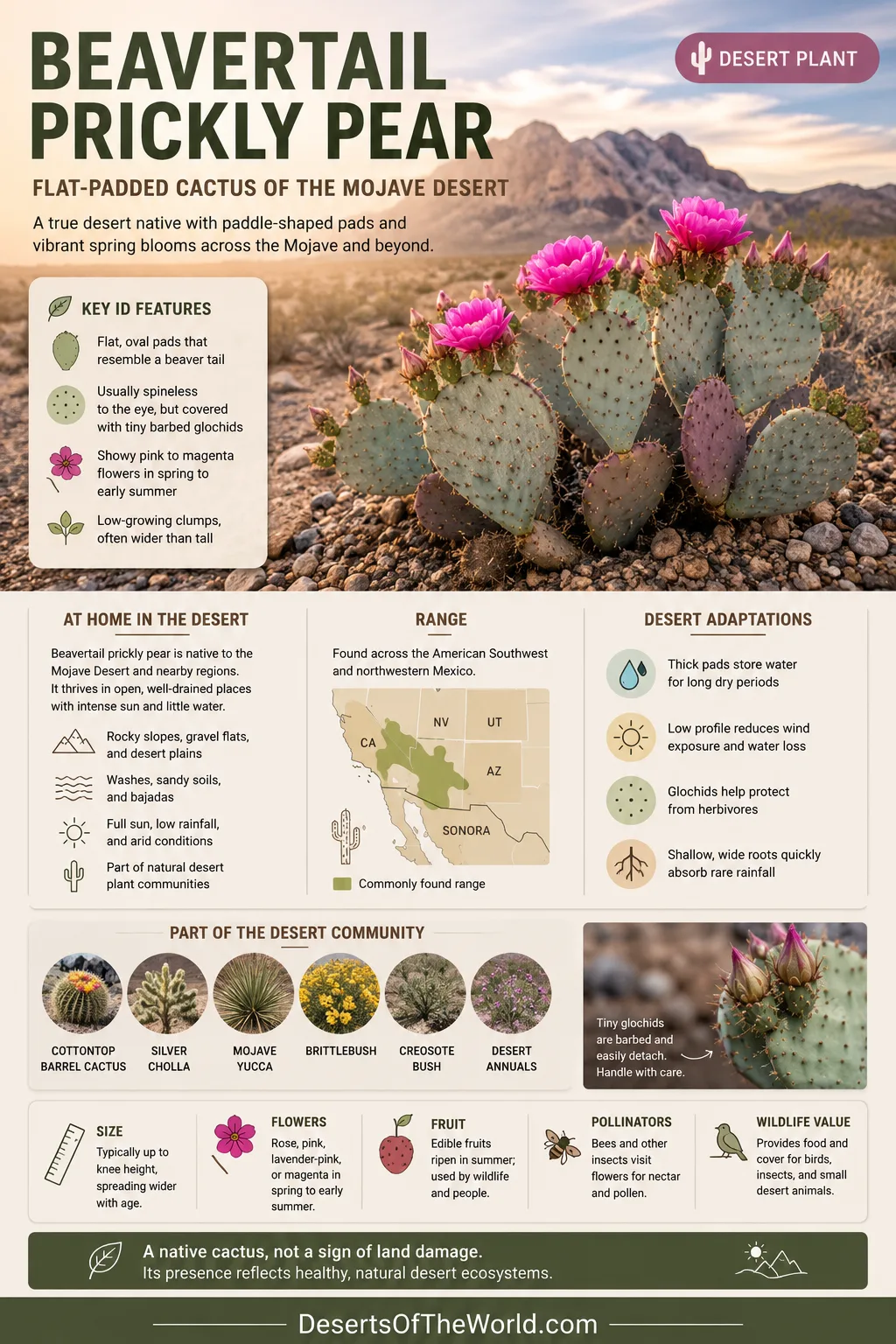
Beavertail prickly pear (Opuntia basilaris) is one of the clearest plant signals of the Mojave Desert: low to the ground, blue-gray to green, made of flat oval pads, and bright with pink to magenta spring flowers when moisture and temperature conditions support flowering. It is a true desert cactus, not a plant of newly damaged land. It belongs to natural drylands of the American Southwest and northwestern Mexico, where gravel, sun, sparse rain, and slow growth shape the plant community.
The name comes from the pad shape. Seen from the side, each fleshy segment can look like a small beaver tail set upright in the desert soil. The plant may look soft from a distance, almost padded and harmless. Up close, the tiny barbed glochids in its areoles explain why “nearly spineless” does not mean safe to touch.
Main Details of Beavertail Prickly Pear
| Topic | Details |
|---|---|
| Scientific Name | Opuntia basilaris Engelm. & J.M. Bigelow |
| Common Names | Beavertail prickly pear, beavertail cactus, beavertail pricklypear |
| Plant Family | Cactaceae, the cactus family |
| Main Desert Link | Mojave Desert, with close links to the Colorado Desert, Sonoran Desert, Grand Canyon region, and nearby drylands |
| Growth Form | Low clumping cactus, usually much wider than tall |
| Pads | Flat, oval to rounded, often blue-gray or gray-green, with dense areoles |
| Spines | Usually without long visible spines, but armed with small barbed glochids |
| Flowers | Rose, pink, lavender-pink, or magenta; usually spring to early summer depending on elevation and rain |
| Typical Habitat | Dry plains, bajadas, washes, rocky slopes, gravelly flats, sandy soil, and well-drained desert ground |
Why Beavertail Prickly Pear Fits the Mojave Desert
The Mojave Desert is not only sand and heat. It is a mixed desert of basins, rocky fans, limestone slopes, volcanic ground, Joshua tree country, creosote bush scrub, and open gravel flats. Beavertail prickly pear fits that setting well because it stays low, holds water in its stems, and does not need a leafy canopy to survive.
In places such as Death Valley National Park and Mojave National Preserve, beavertail cactus appears among the familiar cactus and succulent flora of the region. It is often part of a wider dryland scene with cottontop barrel cactus, silver cholla, Mojave yucca, desert annuals, brittlebush, white bursage, and creosote bush. Not loud, not tall. Still, when it blooms, the plant becomes hard to miss.
A Native Desert Plant, Not a Desertification Symbol
Some plants become linked with poor soil, overuse, or land decline. Beavertail prickly pear is different. It is native to natural North American deserts and desert margins. Its presence usually points to arid habitat, not to a landscape that has recently turned into desert through land damage.
That distinction matters. A native cactus in the Mojave is part of a living dryland system. It shares space with shrubs, bees, seed-eating animals, soil crusts, and seasonal wildflowers. The land may look empty at noon in July. It is not empty.
Low Growth Suits Open Desert Ground
Beavertail prickly pear usually grows as a low clump. Many plants stay under knee height, though older clumps can spread outward with many pads. This shape helps the cactus avoid the full force of desert wind, reduce exposure above the soil surface, and keep growing even where taller plants struggle.
The flat pads are not leaves. They are cladodes, or flattened stem segments. They photosynthesize, store moisture, and carry the areoles that produce glochids, flowers, and fruit. One part does several jobs. Desert plants often work that way.
Range and Habitat in the Desert Southwest
Beavertail prickly pear is most closely associated with the Mojave Desert, but its range reaches beyond that one desert. It occurs across parts of the southwestern United States and northwestern Mexico, with records and plant references tying it to California, Nevada, Arizona, Utah, the Colorado River region, and Sonora.
| Area or Desert Context | How Beavertail Prickly Pear Fits There |
|---|---|
| Mojave Desert | One of the familiar low prickly pear cacti of rocky slopes, valleys, desert washes, and open gravel flats. |
| Colorado Desert | Found in hot, low-elevation desert settings where well-drained soil and open sun favor cactus growth. |
| Sonoran Desert Edges | Occurs in parts of the broader Southwest dryland flora, often alongside other cactus-rich desert communities. |
| Grand Canyon and Colorado River Region | Appears in desert slopes, canyon country, and dry benches where drainage is fast and shade is limited. |
| Dry Grassland and Chaparral Margins | May occur beyond open desert where climate, soil, and exposure still create arid growing conditions. |
Soil and Drainage Matter More Than Rich Ground
This cactus favors lean, fast-draining ground. Gravel, sand, cobble, desert pavement, caliche-influenced soil, and rocky slopes can all work when water moves away quickly. Heavy, wet soil is the wrong kind of comfort for a desert cactus; roots that sit in water are under stress.
In the wild, beavertail prickly pear often grows where the soil looks too thin for much plant life. That thinness can be useful. Less organic matter, faster drainage, and open sun reduce the chance of rot and competition from dense vegetation.
Elevation Changes the Blooming Calendar
Spring bloom timing shifts with elevation. In low desert basins, flowers may appear earlier after suitable winter rain. Higher slopes and cooler uplands usually bloom later. Mojave wildflower notes often describe this upslope movement: lower areas first, higher areas after that.
For beavertail prickly pear, the common bloom window runs from spring into early summer. March, April, May, and sometimes June can all matter depending on location, winter moisture, and temperature. A wet year can produce dense pink flowering on some slopes, while a dry year may produce little bloom.
How to Identify Beavertail Prickly Pear
The easiest starting point is the pad. Beavertail prickly pear has broad, flattened pads that are usually rounded, oval, or fan-like. The color often leans blue-gray, gray-green, or muted green, sometimes with a purplish cast during cold, drought, or stress.
The plant is lower and softer-looking than many spiny prickly pears. That softness is misleading. The areoles hold many tiny glochids. They are small, barbed, and easy to overlook.
| Plant Part | What to Look For | Why It Helps Identification |
|---|---|---|
| Pads | Flat, fleshy, oval to rounded, often blue-gray or gray-green | The beaver-tail shape gives the plant its common name. |
| Areoles | Small dot-like patches arranged across each pad | These hold glochids and may produce flowers or new growth. |
| Glochids | Fine barbed bristles, often brown, reddish, yellowish, or pale | They replace the long obvious spines seen on many other prickly pears. |
| Flowers | Bright pink, rose, reddish-lavender, or magenta, usually near pad edges | The flower color is one of the most noticed traits in spring. |
| Fruit | Small, dry or less juicy than many cultivated prickly pears | This helps separate it from fruit-heavy food species such as Indian fig prickly pear. |
Pads, Areoles, and Glochids
The pads do the work that leaves do on many other plants. They absorb sunlight, store moisture, and keep the plant alive through long dry spells. Their smooth surface also limits water loss compared with broad, thin leaves.
Areoles are the small dots on the pads. On beavertail prickly pear, they can look neat and patterned, almost decorative. Inside those dots are glochids: tiny barbed bristles that can lodge in skin, clothing, and animal fur. They are part of the cactus defense system, even when long spines are absent.
Flowers That Mark the Spring Desert
The flowers are often the feature people remember first. They sit near the upper margins of pads and open in strong shades of pink, rose, magenta, or reddish lavender. Against gray desert gravel, that color looks clean and sharp.
Flowering depends on plant condition and weather. A cactus that stored enough moisture through winter can bloom well. A plant under harsher dry stress may bloom lightly or not at all in a given year. Desert bloom is never a fixed appointment.
Fruit Is Not the Same as Grocery-Store Prickly Pear
Many people hear “prickly pear” and think of juicy, red cactus fruit sold for food. Beavertail prickly pear belongs to the same genus, but it is not the same as the larger cultivated prickly pear often grown for pads and fruit. Its fruit is usually smaller and drier.
That difference is useful for identification. Beavertail prickly pear is better understood as a wild desert cactus with showy flowers and flat pads, not as the main fruit crop cactus of warm gardens and farms.
Beavertail Prickly Pear Compared With Similar Desert Cacti
The genus Opuntia can be tricky. Desert prickly pears hybridize, vary by place, and change shape as they age. Even trained botanists may check flowers, fruit, pad shape, spines, locality, and herbarium records before naming a plant with certainty.
| Cactus | Typical Look | Useful Separation Point |
|---|---|---|
| Beavertail Prickly Pear (Opuntia basilaris) | Low clumps, flat rounded pads, few or no long spines, many glochids, pink to magenta flowers | Broad beaver-tail pads and lack of obvious long spines are the main field clues. |
| Mojave Prickly Pear (Opuntia mojavensis) | Flat pads with more noticeable spine traits in many plants | Often looks more conventionally spiny than beavertail prickly pear. |
| Brown-Spined Prickly Pear (Opuntia phaeacantha forms) | Spreading prickly pear with stronger visible spines in many settings | Longer, darker spines help separate many plants from beavertail. |
| Silver Cholla (Cylindropuntia echinocarpa) | Cylindrical jointed stems, not flat pads | Chollas have round stem segments instead of beaver-tail pads. |
| Cottontop Barrel Cactus (Echinocactus polycephalus) | Round to barrel-shaped body with dense spines | Barrel cacti do not grow as flat pad clusters. |
Why “Spineless” Can Be Misleading
Many descriptions call beavertail prickly pear spineless because it usually lacks the long, stiff spines seen on other cactus species. In plain language, that sounds touchable. It is not.
The plant has glochids. They are smaller than spines, but they can be more annoying because they detach easily and are hard to see. The better field rule is simple: admire the pads and flowers without touching them.
Natural Variation Can Blur the Edges
Beavertail prickly pear changes across its range. Pad size, pad color, glochid color, plant height, and growth habit can vary from one desert basin to another. Nearby Opuntia species may also hybridize, which adds more variation.
For casual identification, the broad flat pads, low clumping habit, Mojave-linked range, and pink-magenta flowers are usually enough. For formal plant records, local flora treatments and specimen-based databases matter more than a single photo.
Desert Adaptations Behind the Flat Pads
Beavertail prickly pear looks simple, yet its form answers several desert problems at once: heat, dry air, low rainfall, browsing pressure, and open sun. The pads act like a set of thick green water tanks spread low across the ground.
Water Storage in Stem Tissue
The fleshy pads store moisture inside stem tissue. During dry periods, the cactus can draw on that stored water while keeping growth slow and measured. It does not need to rush. In the desert, speed can waste resources.
This water belongs to the plant’s survival system and should not be treated as a useful water source for people. The stored moisture allows the succulent stems to keep the plant alive where ordinary leaves would lose too much water.
CAM Photosynthesis and Nighttime Gas Exchange
Like many cacti, beavertail prickly pear is built around water-saving photosynthesis. Cacti commonly use CAM photosynthesis, a process in which gas exchange can happen mainly at night, when temperatures are lower and water loss is reduced.
By day, the plant can keep its pores more closed while sunlight drives sugar production from stored carbon compounds. It is a quiet trick, but an effective one: breathe more when the air is cooler, work with the sun when it returns.
Waxy Skin, Pale Color, and Reduced Leaves
The pads have a protective outer surface that helps slow water loss. Their gray-green or blue-gray tone can also soften the effect of full desert sun. Leaves, which would lose water quickly, are reduced to tiny early structures and do not function like normal foliage.
Glochids add another layer of protection. They discourage animals from eating too freely, while the plant still offers flowers, nectar, pollen, and later fruit within the wider desert food web.
Bloom Season, Pollination, and Desert Rain
Beavertail prickly pear is one of the Mojave plants that can turn a dry-looking slope into a spring color marker. Its flowers are not random decoration. They are part of the plant’s reproductive cycle and part of the feeding calendar for desert pollinators.
Rainfall Shapes Flower Displays
Winter and early spring moisture often influence the strength of desert bloom. A well-timed series of soaking storms can support annual wildflowers and help perennial plants flower more heavily. A dry season can shorten or thin the display.
Beavertail prickly pear has an advantage over annual wildflowers because it is perennial and stores water. Even so, flower production still reflects the plant’s stored energy, local weather, and site conditions. Rainfall is one factor controlling the strength of flowering.
Native Bees and Flower Visitors
The bright flowers draw native bees and other insects. In desert country, a patch of blooming cactus can become a small feeding station. The flowers provide pollen and nectar when many plants are still sparse across the ground.
Those insect visits help move pollen between flowers. Later, seeds can support the next generation of plants if they land in a suitable place: open enough for light, protected enough for a seedling, and drained enough to avoid rot.
Place in the Mojave Spring Bloom
In Mojave National Preserve, beavertail cactus is listed among spring bloom plants in areas such as the Von Trigger Hills and Piute Range. Roadside flower displays can appear in April and May in some years, while higher zones usually shift later.
Beavertail prickly pear is not the only flowering plant active in that season. Desert five-spot, Mojave aster, desert marigold, sand verbena, brittlebush, and other cacti may flower during overlapping periods. As a perennial, beavertail prickly pear remains after short-lived annual wildflowers have finished.
The Desert Community Around the Cactus
A single beavertail prickly pear clump can look isolated. It is rarely alone in an ecological sense. Around it are soil particles sorted by runoff, roots of shrubs, insect paths, seed banks, and seasonal plants waiting for rain.
Common Plant Neighbors
In Mojave and nearby desert settings, beavertail prickly pear may grow near creosote bush, white bursage, brittlebush, Mormon tea, desert senna, Mojave yucca, Joshua tree, cholla, barrel cactus, and low desert grasses. The exact mix changes with elevation, soil, exposure, and rainfall.
On rocky slopes, the cactus may tuck into pockets of gravel where runoff briefly gathers. On alluvial fans and washes, it may use open soil between shrubs. It does not need a lush place. It needs the right dry place.
Food, Shelter, and Small-Scale Habitat
Flowers serve insects. Fruits and seeds can interest animals. The low clumps can also create small protected spaces near the soil surface, especially for insects and small desert animals moving through open ground.
It would be easy to overlook that small habitat value. A cactus clump is not a forest. Still, for a ground beetle, a native bee, a lizard-sized patch of shade, or a seed caught beside a pad, scale feels different.
Scientific Name, Classification, and Local Forms
Opuntia basilaris belongs to the cactus family, Cactaceae, and to the prickly pear group within Opuntia. The scientific authority is usually written as Engelm. & J.M. Bigelow, linking the name to George Engelmann and John Milton Bigelow.
| Rank | Name |
|---|---|
| Kingdom | Plantae |
| Order | Caryophyllales |
| Family | Cactaceae |
| Genus | Opuntia |
| Species | Opuntia basilaris |
Varieties and Names Can Differ by Source
Botanical sources do not always handle every local form of beavertail prickly pear in the same way. Some treatments recognize several varieties or related local forms, while others combine or separate names differently. This is common in Opuntia, where hybridization and regional variation make clean lines harder to draw.
Names often encountered in botanical references include Opuntia basilaris var. basilaris, var. brachyclada, var. longiareolata, var. heilii, and the Bakersfield cactus, often treated as Opuntia basilaris var. treleasei or as Opuntia treleasei by some sources. For general desert readers, the main plant remains the beavertail prickly pear of Mojave and neighboring drylands.
Bakersfield Cactus Shows Why Local Context Matters
The Bakersfield cactus is closely tied to the beavertail prickly pear group and is protected under U.S. plant conservation rules. It is more local than the broader beavertail prickly pear and is linked to the San Joaquin Valley region of California rather than the open Mojave image most people know.
This does not mean every beavertail prickly pear is rare across its full range. It means local forms can have their own identity, range, and legal status. That is a useful lesson for desert plants: a widespread-looking cactus group can still contain narrow local forms that deserve careful treatment.
Human Context and Traditional Knowledge
Prickly pears have long been known by people of the Southwest and northern Mexico. Pads, buds, fruits, and seeds of some Opuntia species have been used as food in local traditions, and beavertail prickly pear appears in ethnobotanical records for desert communities.
That history should be handled with care. Desert plant knowledge is local, practical, and community-based, and traditions differ among communities. Beavertail prickly pear is part of a landscape where plants, people, pollinators, and animals have long been connected.
Respectful Viewing and Wild Plant Protection
Many desert plants grow slowly, and some places have rules that protect native plants. Observe beavertail prickly pear in place, photograph where allowed, and avoid removing or damaging wild plants.
When native plants are wanted for dry gardens, nursery-grown plants from reputable sources are the right route. Wild plants should stay wild.
Dry Garden Context Without Confusing the Wild Plant
Beavertail prickly pear is also grown in dry gardens because it uses little water once established, stays compact, and flowers vividly. In desert cities, it can fit low-water landscapes better than thirsty ornamental plants.
Garden use should not blur the wild story. A cultivated cactus in a yard is managed by people. A wild cactus on a Mojave slope is part of a natural plant community. Same species, different setting.
What Cultivation Notes Usually Emphasize
Plant references usually stress full sun, fast drainage, low water after establishment, and avoidance of wet winter soil. Those notes match the wild habitat. The cactus is built for dry air, bright light, and mineral soil rather than rich, damp ground.
In gardens outside its native range, the main point is restraint. Too much water, too much shade, or heavy soil can harm a plant adapted to dryland life.
Field Notes for Reading the Landscape
Beavertail prickly pear can provide clues about the desert around it. Its form and condition can reflect drainage, exposure, plant spacing, and seasonal timing.
- Flat pads point to water-storing stem tissue rather than ordinary leaves.
- Blue-gray color often fits open, high-light desert settings.
- Low clumps suggest a strategy built around wind, sun, and dry soil.
- Spring flowers often reflect stored moisture and recent seasonal conditions.
- Glochid-covered areoles show that cactus defense can be almost invisible.
What the Cactus Suggests About Its Site
A healthy clump on a gravelly slope usually suggests fast drainage and enough open light. A plant growing near a wash may be using short pulses of runoff after storms. A cactus tucked among shrubs may benefit from slight shade or trapped seed and litter near the shrub base.
These are not hard rules. Desert sites are patchy. Two plants a few yards apart can live under different soil depth, rock cover, and runoff patterns.
Common Questions About Beavertail Prickly Pear
Is Beavertail Prickly Pear Only Found in the Mojave Desert?
No. The Mojave Desert is one of its best-known settings, but the plant also occurs in nearby desert regions and drylands of the Southwest and northwestern Mexico. It is more accurate to call it a Mojave-linked cactus with a wider desert Southwest range.
Does Beavertail Prickly Pear Have Spines?
It usually lacks the long visible spines many people expect on a prickly pear. Yet it has glochids, the tiny barbed bristles found in cactus areoles. Those glochids are enough reason to avoid touching the pads.
When Does Beavertail Prickly Pear Bloom?
It usually blooms in spring, often from March through May, with some higher or cooler sites flowering into early summer. Local rainfall and elevation can shift the timing.
Why Are the Pads Flat?
The pads are flattened stems. They store water, photosynthesize, and support flowers and fruit. Their shape gives the plant surface area for sunlight while keeping leaf-like water loss low.
Is Beavertail Prickly Pear the Same as Nopal?
“Nopal” is often used for prickly pear pads, especially in food contexts, and many Opuntia species are called prickly pears. Beavertail prickly pear is one species in that larger group. It should not be confused with the larger cultivated species commonly grown for food.
Can It Grow Near Joshua Trees?
Yes, in some Mojave settings beavertail prickly pear can share the broader landscape with Joshua trees, Mojave yucca, cholla, barrel cactus, and creosote bush scrub. The exact neighbors depend on elevation, soil, and local climate.
Sources
- USDA PLANTS Database: Opuntia basilaris (taxonomy, plant profile, and related official plant records)
- Flora of North America: Opuntia basilaris (botanical description and species treatment)
- Jepson eFlora: Opuntia basilaris (California flora treatment and plant description)
- National Park Service: Death Valley Cacti and Desert Succulents (Mojave cactus context and beavertail cactus listing)
- National Park Service: Mojave National Preserve Wildflowers (spring bloom timing, desert wildflower areas, and beavertail cactus bloom context)
- Lady Bird Johnson Wildflower Center: Beavertail Prickly Pear (native plant profile and identification notes)
- U.S. Fish & Wildlife Service: Bakersfield Cactus (protected local form related to the beavertail prickly pear group)
- University of Arizona Campus Arboretum: Opuntia basilaris (range, growth form, habitat, and horticultural notes)