Location & Continent
Continent: North America – the northern polar fringe of the continent, entirely above or near the Arctic Circle.
Countries: United States (Alaska), Canada (Yukon, Northwest Territories, Nunavut and the northern parts of several provinces), and Greenland (Kingdom of Denmark).
Major Seas & Bays: Arctic Ocean, Hudson Bay, Beaufort Sea, Baffin Bay, and the northern North Atlantic.
Approximate Coordinates: Centre of the region near 75°N, 95°W – a belt of polar desert and tundra stretching across the top of North America.
North American Arctic – Map & Street View
Click to load the interactive map
Physical Features
Area: A vast polar belt of more than several million km² of islands, peninsulas, coastal plains and sea-ice covered shelves.
Landscape Types: Polar deserts, tundra plateaus, glacier-carved mountains, low gravel plains and wide, frozen lowlands.
Elevation: From sea level coasts and sea ice up to high peaks such as Barbeau Peak (2,616 m) in the Canadian High Arctic.
Climate & Precipitation
Climate Type: Polar desert and tundra – long, intensely cold winters and short, cool summers with the sun low on the horizon.
Temperature Range: Winter averages can plunge below -30 °C, while the warmest month (usually July) often stays near 0–10 °C.
Precipitation: Many coastal and island areas receive only 150–250 mm of precipitation a year – mostly snow – which places them firmly in the category of desert climates.
Ecological Features
Ecozone: Polar desert and Arctic tundra ecozones with continuous or discontinuous permafrost.
Biome: Cold deserts, tundra grass–moss communities, sea-ice ecosystems and coastal wetlands in the brief summer.
Flora & Fauna
Flora: Low, slow-growing plants such as mosses, lichens, dwarf shrubs and hardy sedges, with roots adapted to shallow, frozen soils.
Fauna: Iconic Arctic mammals including polar bears, muskoxen, caribou, Arctic foxes and seals, alongside huge seasonal migrations of seabirds and waterfowl.
Geology & Notable Features
Geology: A mix of ancient shields, sedimentary plateaus and rugged mountain chains like the Arctic Cordillera, sculpted by ice sheets, glaciers and repeated glacial cycles.
Notable Features: Vast Arctic archipelagos, fjord systems, patterned ground from freeze–thaw cycles, and wide coastal shelves that freeze into sea ice every winter.
North American Arctic as a Polar Desert
The North American Arctic is often imagined as endless snow and ice, but in climate terms it is largely a cold desert. Much of Alaska’s far north, the Canadian High Arctic islands and parts of Greenland receive so little moisture that annual precipitation rivals that of some hot deserts. Dry, freezing air holds little water, so instead of rain you mostly get thin, wind-blown snow that may fall quietly for days yet still only adds a few millimetres of water. This combination of very low precipitation and temperatures that rarely rise above 10 °C in summer is what makes the region a true polar desert.
Countries, Regions & Human Footprint
From west to east, the polar desert belt crosses Arctic Alaska, the northern territories of Canada, and the vast ice-dominated landscapes of Greenland. In Alaska, settlements like Utqiagvik sit on low coastal plains where sea ice forms just offshore and precipitation is so limited that the town’s climate is officially classified as desert. Across Canada, the region includes Yukon, the Northwest Territories, Nunavut and northern parts of Quebec and Labrador, with population densities among the lowest on Earth. In Greenland, most people live in narrow coastal fringes while the interior remains dominated by the great ice sheet – a frozen heart that feeds glaciers spilling toward fjords and polar seas.
These lands are home to Indigenous peoples such as Inuit, Inuvialuit, Iñupiat and Yupik, whose cultures grew around sea-ice travel, marine hunting and fine-tuned seasonal knowledge. Even where modern towns and infrastructure exist, hunting, fishing and community networks still anchor daily life to the rhythm of the polar desert environment.
Geography & Polar Desert Landscapes
At first glance the landscape can look simple: white ice, grey rock, a low sky. Look a little closer and the North American Arctic reveals a mosaic of desert landforms. High islands like Ellesmere or Devon show steep glacier-cut valleys, sharp peaks and massive ice caps. Coastal plains in Alaska and northern Canada are mostly flat, built from marine sediments and old beach ridges now frozen into permafrost. Wind and ice together shape gravel deserts where fine material has been blown away, leaving stony pavements and subtle dune-like drifts of snow or sand.
On exposed surfaces you often see patterned ground – circles, polygons or stripes of stones created as soils freeze, thaw and slowly push rocks into geometric designs. Along fjords and coasts, dramatic cliffs rise above sea ice and open water, giving nesting space to seabirds and shelter to narwhals, belugas and seals. In the interior of Greenland and the High Arctic islands, the desert becomes even starker: ice and bare rock with almost no visible plants, yet still shaped by the same quiet forces of cold, wind and time.
Climate, Light & the Desert of Ice
Life here is ruled by two things: temperature and light. In winter, the sun may not rise for weeks or months. Air temperatures can drop far below freezing, and strong winds whip up fine snow into whiteouts that feel like a sandstorm made of ice. Even then, the air stays surprisingly dry; storms can rage with almost no actual accumulation because the snow is simply being moved around the polar desert.
Summer brings the opposite extreme: the midnight sun circles the horizon, and surface temperatures climb just enough to melt the top few centimetres of soil and sea ice. Lakes and ponds appear on the tundra; cracks in the sea ice fill with turquoise meltwater. Yet the overall climate remains cold and arid, with annual precipitation often below 250 mm. Climate records from research stations across the High Arctic show that, even as the region warms rapidly, it still keeps this defining desert-like dryness.
Flora: Life Close to the Ground
Plants in the North American Arctic live very close to the edge. Most of the region sits on permafrost, with only a shallow active layer thawing each summer, so roots can’t go deep and soils stay cold and wet even in July. Typical vegetation includes carpets of mosses and lichens, cushion plants hugging the ground, dwarf willows and birches that might be decades old yet only a few centimetres tall.
Because the growing season is incredibly short, plants make fast, efficient use of the constant summer light. Many species pack their leaves with pigments and antifreeze compounds, letting them photosynthesize at low temperatures and start growing as soon as snow melts. In slightly warmer or more sheltered patches, you may find colourful blossoms of purple saxifrage, Arctic poppies or tiny sedges, each one a small flare of colour on an otherwise muted polar desert canvas. In the driest polar desert patches, only crusts of lichen on rocks and sparse clumps of grass mark the boundary between bare rock and living soil.
Fauna: Wildlife of a Cold Desert
Even with so little warmth and water, the North American Arctic supports remarkably rich wildlife. On land, herds of caribou and reindeer migrate between wintering grounds and summer calving areas, grazing on lichens and tundra plants. Muskoxen move slowly across the landscape, heavy coats shielding them from wind that would strip heat from an unprotected animal in minutes. Predators such as Arctic wolves and foxes follow these herds, while snowy owls patrol open tundra for lemmings and other small mammals.
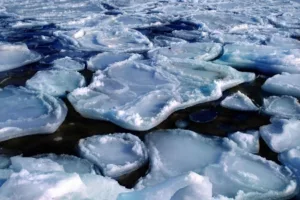
Along the coasts and sea ice, marine life is even more abundant. Polar bears travel over drifting floes in search of seals resting near breathing holes. In open leads and polynyas – patches of water that stay unfrozen in winter – you can find walruses, belugas and bowhead whales feeding on fish and plankton. Huge seabird colonies nest on cliffs above the water, adding bursts of sound and movement to what might otherwise feel like a silent desert. Many of these species depend directly on the timing and stability of sea ice, making them especially sensitive to rapid changes in the polar environment.
Indigenous Peoples & Desert Survival Skills
For thousands of years, Indigenous peoples have turned this cold, dry region into a lived homeland rather than an empty wilderness. Inuit, Inuvialuit, Iñupiat, Yupik and related communities developed detailed knowledge of sea-ice behaviour, animal migrations and subtle weather signs. This knowledge makes the difference between safe travel and danger in a landscape where a sudden storm or a cracked ice floe can change everything.
Traditional technologies are adapted to the polar desert climate. Clothing made from caribou, seal, and other furs provides insulation and breathability, which helps regulate body temperature during travel in extreme cold. Sleds, kayaks, and later snowmobiles move along routes formed by wind-packed snow and seasonal ice rather than permanent roads. Even in modern towns with shops and satellite internet, many families continue to rely on country food—hunted or fished locally—for daily nutrition and to maintain cultural practices. From a distance the region appears sparsely populated, yet it contains established systems of place names, travel routes, and oral history linked to the polar desert landscape.
A Changing Polar Desert
In recent decades the North American Arctic has been warming faster than most other regions on Earth. Satellite data and long-term records show that sea ice is thinning, winter ice forms later and melts earlier, and snow seasons across parts of Arctic Canada have shortened noticeably. For a polar desert, this doesn’t simply mean “more pleasant” weather. Warmer air can hold more moisture, and shifting storm tracks are bringing episodes of heavier snow or rain to areas that once stayed very dry.
Thawing permafrost can destabilize ground, affect buildings and roads, and release greenhouse gases from old organic matter that was locked in frozen soils. At the same time, some tundra areas are greening as shrubs and grasses expand, slowly changing the character of the cold desert ecosystem. Indigenous communities and researchers are working together to monitor these changes, combining local observations with scientific measurements. All of this makes the North American Arctic a key region for understanding how a desert of ice responds to rapid global warming – and how people can adapt without losing their deep ties to land and sea. Sometimes the changes feel suddently fast, even to those who have watched the ice all their lives.
Travel, Safety & Responsible Exploration
Visiting the North American Arctic means entering a remote polar desert where conditions can shift quickly and help may be far away. For travellers, preparation is everything: reliable communication gear, layers of cold-weather clothing, experienced local guides and emergency plans are not optional extras. Even simple tasks can take longer in sub-zero temperatures, and the dry air dehydrates people almost as efficiently as it does landscapes.
Responsible travel also means minimizing disturbance to wildlife and respecting local rules about hunting grounds, sacred places and community spaces. Many communities welcome visitors who are willing to learn and to support local economies, for example by hiring Indigenous guides or buying locally made crafts. When approached with care, a journey through the North American Arctic offers rare insight into how life can thrive in a desert made of snow, ice and stone, rather than sand and dust.
References
National Geographic – Arctic Overview
NOAA Arctic Report Card 2024
NASA Earth Observatory – World of Change: Arctic Sea Ice
NASA Earth Observatory – Tundra Biome
The Canadian Encyclopedia – Tundra
Government of Yukon – Ecosystems of the Yukon Arctic Region
Encyclopaedia Britannica – Climate of the Arctic