
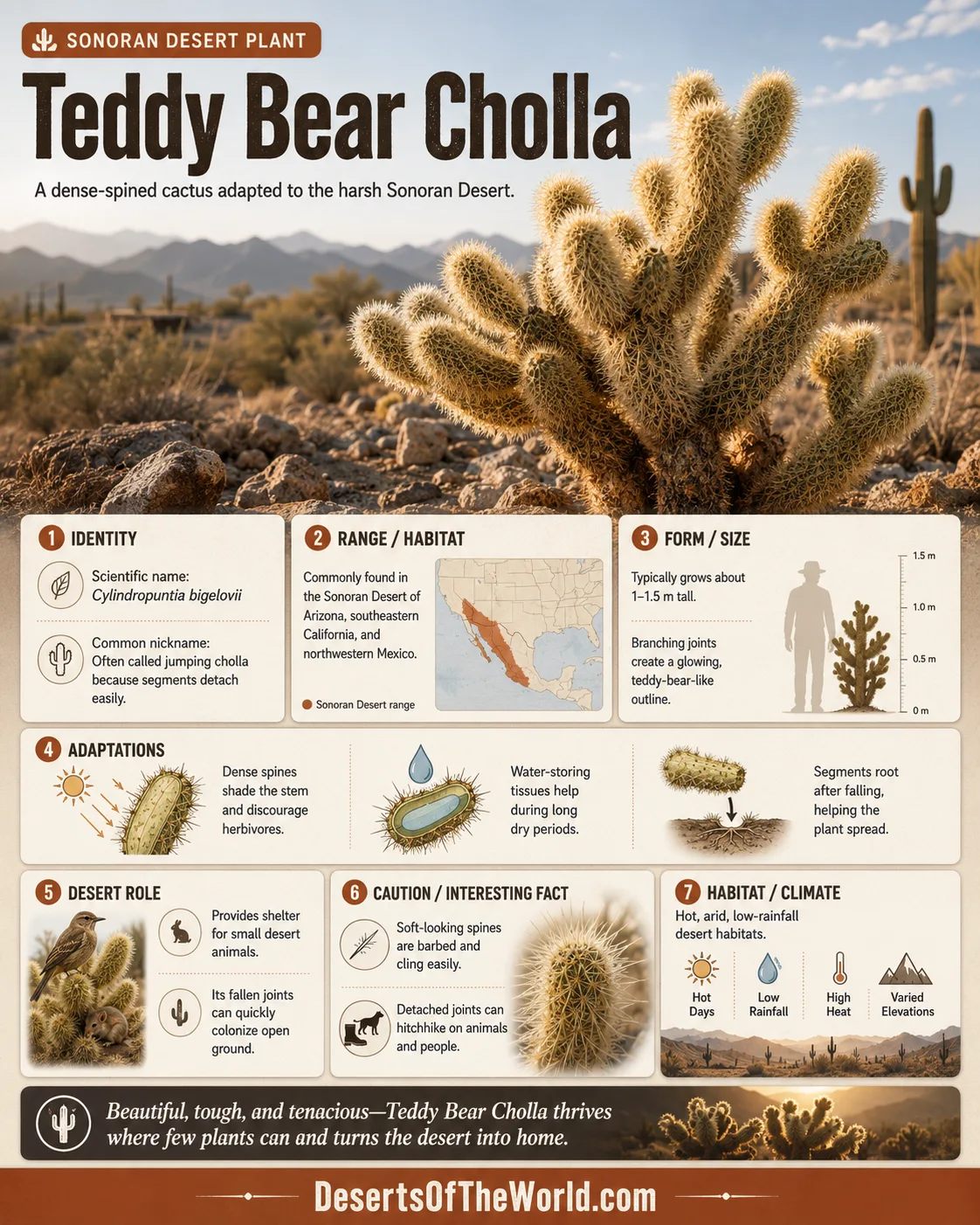
Teddy bear cholla is one of the most recognizable cholla cacti of the Sonoran Desert. Its pale yellow spines look soft from a distance, almost like fur, but the name is misleading. This is a dense-spined, jointed cactus built for dry washes, rocky slopes, alluvial fans, and open desert flats where heat, thin soil, and long dry periods shape nearly every plant.
Known scientifically as Cylindropuntia bigelovii, teddy bear cholla grows as a small tree-like cactus or upright shrub. It is especially associated with the Sonoran Desert and the Colorado Desert section of southern California, while also reaching warm desert margins of the Mojave. Its tightly clustered stem segments, dark lower trunk, and glowing spine cover make it easy to notice in the right habitat.
| Plant Detail | Teddy Bear Cholla Information |
|---|---|
| Scientific Name | Cylindropuntia bigelovii |
| Common Names | Teddy bear cholla, teddybear cholla, golden-spined jumping cholla |
| Plant Family | Cactaceae |
| Native Range | Southwestern United States and northwestern Mexico, especially parts of Arizona, California, Nevada, Sonora, and Baja California |
| Main Desert Setting | Sonoran Desert, Colorado Desert, and warm Mojave-Sonoran transition zones |
| Typical Form | Upright, segmented cactus with a visible trunk and dense upper branches |
| Usual Height | Often about 0.3–1.5 m, with some plants reported taller in favorable sites |
| Bloom Period | Mainly spring, often from March to May or June depending on location and rain |
| Flower Color | Pale green, yellow-green, creamy white, sometimes with reddish tips |
| Reproduction | Mostly by detached stem joints that root into new plants |
Why Teddy Bear Cholla Has Such a Misleading Name
The name “teddy bear” comes from appearance, not touch. Sunlight passes through the pale spine sheaths and gives the upper branches a soft, golden look. From several steps away, the plant can look fuzzy. Up close, the effect changes fast.
Each stem segment is covered with many sharp spines. These spines often carry tiny backward-facing barbs, which help detached joints grip fur, clothing, or skin. That is why teddy bear cholla is also grouped with the so-called “jumping chollas.” It does not jump. The stem joints detach easily when brushed, and the barbed spines make the contact feel sudden.
That contrast is part of the plant’s identity: soft-looking, but not soft. A desert illusion, plain and simple.
Native Range in the Sonoran and Nearby Deserts
Teddy bear cholla belongs to the warm desert landscapes of southwestern North America. It is strongly tied to the Sonoran Desert region, including Arizona and northwestern Mexico, and it is also common in the Colorado Desert of southern California. Some stands occur in warm parts of the Mojave Desert, especially where conditions resemble lower, hotter Sonoran-style desert scrub.
In Joshua Tree National Park, one of the best-known public examples is the Cholla Cactus Garden in Pinto Basin. This area sits in a transition zone between the Colorado Desert and the Mojave Desert. Thousands of teddy bear cholla plants grow there because the local soil, slope, temperature, and drainage create the right setting for dense colonies.
The Colorado Desert Connection
The Colorado Desert is often treated as the western part of the greater Sonoran Desert. That matters for teddy bear cholla because many well-known stands in California are not in the cooler Mojave high desert, but in lower, warmer desert basins and bajadas. This cactus prefers heat, open sun, and well-drained ground.
It often grows among other dryland plants such as creosote bush, brittlebush, ocotillo, palo verde, desert senna, and other cholla species. In some places it forms nearly pure stands; in others it appears as part of mixed cactus and desert scrub communities.
Habitat, Soil, and Desert Slopes
Teddy bear cholla is not random across the desert floor. It favors places where water drains quickly and roots are not trapped in heavy, wet soil. Common settings include:
- Rocky hillsides and warm slopes
- Alluvial fans below desert mountains
- Bajadas with coarse desert soil
- Gravelly washes and sandy flats
- Open desert scrub with full sun exposure
Coarse sand, gravel, and rocky loam are useful because brief desert rain can enter the soil without leaving the plant waterlogged. In dry country, drainage can matter as much as rainfall. Too much trapped moisture harms many desert succulents more than dryness does.
Why Bajadas Suit This Cactus
A bajada is a broad slope of sediment washed down from mountains. It may look bare from far away, yet it can hold a patchwork of microhabitats. Some parts are rocky and exposed. Others collect just enough runoff after rain to support desert shrubs and succulents.
Teddy bear cholla often does well on these upper, well-drained slopes. It gets sun, airflow, and short pulses of moisture without sitting in soggy ground. Harsh, yes. But for this cactus, harsh can be suitable.
How Teddy Bear Cholla Is Built
Teddy bear cholla usually has a dark, upright trunk with dense branching near the top. The older lower branches often die and drop away, leaving the plant with a more vertical, tree-like look. The upper crown may look rounded, crowded, and bright because the stem segments are packed close together.
The green stem is not always easy to see. Dense spine cover hides much of it, especially on younger, upper segments. The spines may look silvery, pale yellow, straw-colored, or golden depending on age and light. Older spines and older trunk tissue can darken, giving mature plants a two-tone look: bright upper joints over a darker base.
Stem Segments and Cholla Joints
Like other chollas, teddy bear cholla has cylindrical stem segments rather than flat pads. These joints are the working parts of the plant. They store water, carry out photosynthesis, bear areoles, and produce spines, flowers, and new growth.
The segments detach easily. Around a mature plant, the ground may be scattered with fallen cholla joints, sometimes called cholla balls. Many of these pieces do not simply dry away. Some root where they land.
Dense Spines and Paper-Like Sheaths
The dense spine cover is the feature that gives teddy bear cholla its famous look. Many spines have light-colored, detachable sheaths that catch sunlight. In early or late light, a stand may seem to glow. That glow is not decoration; the spines help shade the stem surface, reduce contact from plant-eating animals, and protect living tissue.
The barbed tips also help detached joints move with animals. This is not movement in the animal sense. It is plant dispersal by attachment.
Flowers, Fruit, and Seed Limits
Teddy bear cholla flowers are not as showy as the bright blooms of some prickly pears or barrel cacti. They are usually pale green, yellow-green, creamy white, or lightly tinted. Flowers form near the ends of stem joints, mostly in spring. Local timing depends on winter rain, temperature, elevation, and the health of the plant.
The fruit is usually yellow-green and fleshy to leathery. Many sources note that fertile seed production is limited in this species. In practical desert ecology, that detail matters: teddy bear cholla often spreads more by vegetative reproduction than by seed.
Why Some Stands May Be Clonal
When fallen stem joints root near the parent cactus, new plants form close together. Over time, a patch can become a dense colony. Some stands may contain many stems that began from the same original plant or only a few parent plants.
This helps explain why teddy bear cholla can appear in “gardens” or thick patches rather than as evenly spaced individuals across the desert. The plant’s own body becomes its main way of spreading.
Desert Adaptations That Help It Survive
Teddy bear cholla survives by using several cactus traits at once. No single feature explains the whole plant. The stem stores water. The waxy surface limits water loss. Spines shade the green tissue. The root system responds to brief desert moisture. Detached joints allow the plant to reproduce even when seeds are not reliable.
Its form also keeps much of the living crown above the hottest ground layer. The darker trunk and fallen lower joints give older plants a rough, weathered base, while the upper branches keep producing new growth where light is strongest.
Water Storage Without Broad Leaves
Broad leaves lose water too quickly in hot desert air. Teddy bear cholla avoids that problem because its leaves are reduced to spines, while the green stems handle photosynthesis. This is common in many cacti, but teddy bear cholla makes the strategy especially visible: the plant looks like a mass of spines because the usual leaf role has been replaced.
Spines as Shade and Protection
Spines are often described only as defense, but their role is wider. Dense spines can soften the force of sunlight on the stem surface, create a thin layer of still air around the plant, and reduce browsing pressure. In a desert where open sun can be severe, that protective cover is part of the plant’s water-saving system.
Wildlife Connections in Desert Scrub
Teddy bear cholla is not just a spiny object in the desert. It helps shape small habitat patterns around itself. Birds may perch on cholla branches, and some desert birds use cactus structures for nesting in broader cholla-rich landscapes. Fallen joints can also collect around animal burrows, where the spiny pieces add a defensive barrier.
Flowers may attract pollinating insects when conditions allow blooming. The plant’s dense form can create tiny shaded pockets near the base, where litter, seed, and windblown material gather. In open desert, even small pockets of shade can change the ground surface.
How To Identify Teddy Bear Cholla
Teddy bear cholla can be confused with other chollas, especially by visitors seeing desert cacti for the first time. The best approach is to look at the whole plant rather than one spine or one branch.
- Dense pale spines: the upper stems often look almost furry from a distance.
- Dark lower trunk: mature plants often show a rough, darker base.
- Tightly clustered upper joints: branches gather near the top rather than spreading loosely from the ground.
- Fallen stem pieces: cholla balls often collect around the plant.
- Pale spring flowers: blooms are usually greenish, yellow-green, or creamy rather than bright pink.
Similar Chollas in the Same Region
Several chollas share desert habitat with teddy bear cholla. Buckhorn cholla, chainfruit cholla, staghorn cholla, cane cholla, and pencil cholla may occur in overlapping regions. The differences can involve flower color, fruit form, branch pattern, spine density, and habitat preference.
| Cholla Type | General Difference From Teddy Bear Cholla |
|---|---|
| Teddy Bear Cholla | Dense pale spines, dark lower trunk, compact upper crown, many detachable joints |
| Chainfruit Cholla | Often has hanging chains of persistent fruit and can grow taller with a more open form |
| Buckhorn Cholla | Usually has longer, branching arms and more visible green stem between spine clusters |
| Pencil Cholla | Has much thinner, more pencil-like stems and a finer branch structure |
| Cane Cholla | Often more shrubby or cane-like, with different flower and spine patterns depending on region |
Field identification should stay cautious. Chollas can vary by age, rainfall, soil, and hybrid influence. A young plant may not show the same trunk shape as an older one.
Dense Cholla Stands and the “Cactus Garden” Effect
One reason teddy bear cholla is so memorable is its habit of forming dense patches. When many plants grow close together, the landscape can look like a natural cactus garden. This is especially noticeable in open basins where the cholla crowns catch low sunlight.
The garden effect comes from both habitat and reproduction. The right site gives the plant a place to survive; fallen joints give it a way to multiply nearby. Over many years, this can create a stand with hundreds or thousands of visible stems.
Why Fallen Joints Stay Near the Parent Plant
Detached joints are often too heavy to travel far by wind. Many land close to the parent cactus. Some attach to passing animals and move farther, but many simply root nearby. That local rooting pattern helps explain the thick clusters seen in certain desert basins and slopes.
Not every fallen joint becomes a new plant. Heat, drought, disturbance, and poor contact with soil can stop growth. Enough survive, though, to make vegetative spread the main story of this cactus.
Safe Viewing Around Teddy Bear Cholla
Teddy bear cholla is best enjoyed without touching it. The spines can attach quickly, and detached joints on the ground are easy to miss. Closed shoes, steady footing, and staying on marked paths help protect both people and the cactus habitat.
- Do not touch the plant, even if the spine cover looks soft.
- Watch the ground near mature plants; fallen joints can sit away from the trunk.
- Give dense stands extra space, especially on narrow trails.
- Keep pets away from cholla patches where allowed trails pass near cactus growth.
- Leave detached joints in place; they may become new plants.
In protected desert areas, staying on the trail also protects fragile soil crusts, seedlings, and slow-growing plant communities. Desert ground can look tough. Often, it is not.
Its Place in Sonoran Desert Plant Communities
Teddy bear cholla fits into the lower desert scrub pattern: open spacing, strong sun, low rainfall, and bursts of growth after moisture. It can grow with creosote bush on broad flats, with ocotillo on rocky slopes, and with other cacti in mixed succulent scrub.
Its presence often points to warm, well-drained desert terrain. In California vegetation descriptions, teddy bear cholla can even define a shrubland alliance where it dominates the shrub layer. In those stands, the cactus is not just one plant among many; it shapes the look and structure of the whole patch.
Plants Often Seen Nearby
Associated plants vary by region, but teddy bear cholla may share habitat with:
- Creosote bush (Larrea tridentata)
- Brittlebush (Encelia farinosa)
- Ocotillo (Fouquieria splendens)
- Burrobush (Ambrosia dumosa)
- Desert lavender (Hyptis emoryi)
- California barrel cactus (Ferocactus cylindraceus)
- Other Cylindropuntia species
This mix gives the desert its layered look: low shrubs, upright cactus forms, seasonal flowers after rain, and open spaces between plants where heat and drought remain in control.
Scientific Name and Classification Notes
The accepted scientific name is Cylindropuntia bigelovii. Older references may use Opuntia bigelovii, since many chollas were once placed more broadly in Opuntia. Modern treatments separate the cylindrical, jointed chollas into Cylindropuntia.
The species name bigelovii honors John Milton Bigelow, a 19th-century physician and botanist connected with early botanical work in the American Southwest. The naming history is part of the broader scientific mapping of desert plants, but for identification, the common field marks matter more: dense pale spines, detachable cylindrical joints, and an upright trunked form.
Common Questions About Teddy Bear Cholla
Does Teddy Bear Cholla Really Jump?
No. The plant does not jump or throw its stems. The nickname comes from the way stem joints detach easily and cling when brushed. Because the spines are barbed, contact can feel sudden, as if the cactus moved toward the person or animal.
Is Teddy Bear Cholla a Sonoran Desert Plant?
Yes, teddy bear cholla is strongly linked to the Sonoran Desert region. It also grows in the Colorado Desert, which is often treated as the western part of the greater Sonoran Desert, and in warm transition areas near the Mojave Desert.
Why Do Some Teddy Bear Cholla Patches Grow So Densely?
Dense patches form when local habitat suits the cactus and detached joints root close to the parent plant. Since many seeds are not fertile, vegetative spread is a major part of its life cycle. This can create clonal stands over time.
Can You Touch Teddy Bear Cholla?
No. The soft look is visual only. The spines are sharp and can be difficult to remove once attached. In desert parks and preserves, it is safer for visitors and better for the habitat to view the cactus from a respectful distance.
Sources
- National Park Service – Cholla Cactus Garden (location, trail context, reproduction by detached stems, visitor notes)
- National Park Service – Joshua Tree Cholla Cactus Garden Nature Trail (identification notes, bloom timing, dense stands, vegetative reproduction)
- USDA Plants Database – Cylindropuntia bigelovii (accepted plant profile and taxonomy reference)
- California Native Plant Society – Cylindropuntia bigelovii Shrubland Alliance (habitat, vegetation setting, growth form, clonal stand notes)
- Tohono O’odham Community College Plant Atlas – Cylindropuntia bigelovii (desert habitat, elevation notes, flowers, and growth description)
- Lady Bird Johnson Wildflower Center – Teddybear Cholla (native plant profile and general botanical description)