
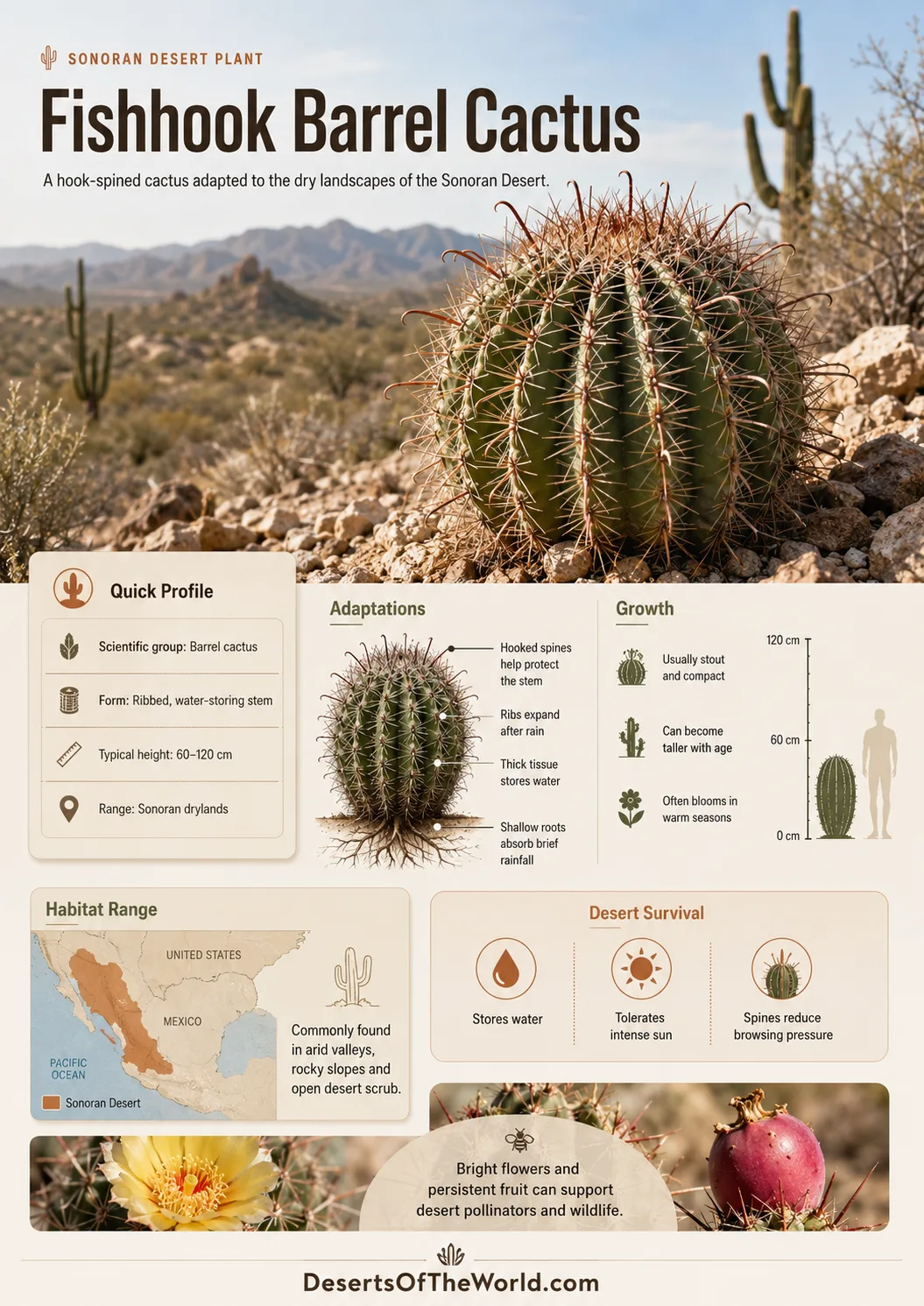
The fishhook barrel cactus is one of the most recognizable barrel cacti of the Sonoran Desert: a ribbed, heavy-bodied plant with curved central spines that look almost like fishing hooks. Its scientific name is Ferocactus wislizeni, and it belongs to the cactus family, Cactaceae. In desert scrub, gravelly bajadas and open washes, it stands as a compact water-storage plant shaped by heat, sun, shallow soil and short bursts of seasonal rain.
Unlike the tall, branching saguaro, the fishhook barrel cactus keeps its growth close to the ground. It grows slowly, often as a single rounded or column-like stem, then produces yellow, orange or reddish flowers near the crown during the hotter part of the year. Its ribs expand as water is stored, its spines shade the stem, its shallow roots capture brief moisture, and its fruit provides food for wildlife when many other plants are dry.
Main Details About the Fishhook Barrel Cactus
| Common Name | Fishhook barrel cactus |
|---|---|
| Scientific Name | Ferocactus wislizeni |
| Plant Family | Cactaceae |
| Other Names | Arizona barrel cactus, candy barrel cactus, southwestern barrel cactus, bisnaga, biznaga de agua |
| Native Range | Arizona, New Mexico, western Texas and northern Mexico, especially Sonora, Chihuahua and nearby dry regions |
| Main Desert Setting | Sonoran Desert and nearby Chihuahuan Desert grassland and shrubland habitats |
| Typical Size | Often 2 to 4 feet tall; older plants may become much taller in suitable habitat |
| Flower Season | Usually late summer into early fall, depending on rain and local conditions |
| Flower Color | Yellow, orange, reddish orange or red |
| Growth Form | Solitary, ribbed, barrel-shaped to columnar stem succulent |
Name, Identity and Taxonomy
Ferocactus wislizeni is the accepted scientific name for the fishhook barrel cactus. Older references may spell the name as Ferocactus wislizenii, and some plant records still use that spelling. Kew Plants of the World Online accepts Ferocactus wislizeni as the current species name.
The genus name Ferocactus points to the plant’s fierce-looking spines. The common name “fishhook barrel cactus” comes from the long, curved central spines that bend like hooks. These spines are not only for defense. They also shade the green stem, break up drying wind near the surface and help reduce direct sun exposure on the cactus body.
Common Names Used for This Cactus
- Fishhook barrel cactus — the most direct name, based on the hooked central spines.
- Arizona barrel cactus — often used because the plant is so closely tied to Arizona desert landscapes.
- Candy barrel cactus — a name linked to historic uses of the fruit and pulp.
- Southwestern barrel cactus — a broader regional name.
- Bisnaga or biznaga de agua — Spanish names used for barrel-type cacti in parts of the Southwest and northern Mexico.
These names can overlap with other barrel cacti, so the scientific name matters when accuracy is needed. “Fishhook cactus” alone can refer to small hook-spined cacti in other genera. Fishhook barrel cactus, by contrast, refers to the larger barrel cactus form of Ferocactus wislizeni.
Where the Fishhook Barrel Cactus Grows
The fishhook barrel cactus is native to the dry lands of the American Southwest and northern Mexico. It is strongly associated with the Sonoran Desert, especially the Arizona Upland region, but its range also reaches desert grasslands and shrublands beyond the classic Sonoran scene.
In the United States, it grows in Arizona, southern New Mexico and far western Texas. In Mexico, it is recorded from northern and northwestern states such as Sonora, Chihuahua and Sinaloa. Its range follows hot, dry country where summer rain can arrive in short bursts and soils drain fast.
Desert Habitats and Local Settings
This cactus is often found on gravelly bajadas, alluvial fans, rocky or sandy flats, wash margins, low hills and open desert grassland. Bajadas are broad, gently sloping aprons of sediment at the base of mountains. They suit the plant well because runoff may pass through the soil after storms, yet the ground does not stay wet for long.
It may grow near familiar Sonoran Desert plants such as saguaro, ocotillo, creosote bush, cholla, prickly pear, mesquite, palo verde and desert grasses. In some areas, it also reaches the edge of oak-juniper or pinyon-juniper country at higher elevations.
Elevation, Soil and Sun Exposure
Most records place this cactus in dry habitats from roughly 990 to 5,280 feet in elevation, or about 300 to 1,600 meters. Local populations can vary, but the pattern is clear: it likes open sun, fast-draining soil and dry air.
The soil does not need to be rich. In fact, rich, wet soil can cause problems. Gravel, sand, rocky slopes and desert alluvium fit the plant better because they let water move through after rain. The cactus then stores moisture inside its ribbed stem and returns to slow growth as the surface dries.
How the Fishhook Barrel Cactus Is Built
The fishhook barrel cactus is a stem succulent. Its green body does most of the photosynthesis, while its leaves have been replaced by spines. The plant’s shape is not random. Every visible part helps it survive in a place where rain is uneven, sunlight is intense and open ground can dry out fast.
Ribbed Stem and Water Storage
The stem is barrel-shaped when young and may become more columnar with age. Mature plants commonly have many vertical ribs. These ribs act like pleats. After rain, the stem can swell as it stores water. During dry periods, the ribs contract. The cactus changes size as stored water rises and falls.
Older plants may reach 2 to 10 feet in height in the right setting, with a broad diameter that can exceed 18 inches. Many are smaller, especially in harsher sites. A squat plant on a dry slope may be just as old as a taller one in a better-watered wash margin.
Hooked Spines and Surface Armor
The hooked central spines are the feature people notice first. They can be reddish, gray, yellowish or purplish, depending on age, exposure and individual variation. Around them are radial spines that spread outward from areoles, forming a dense cover over the green stem.
The spines help in several ways:
- They shade the stem surface during harsh midday sun.
- They reduce feeding by many animals.
- They slow air movement close to the cactus skin.
- They protect new growth near the crown.
Even a healthy young fishhook barrel cactus is heavily armed with spines from crown to base.
Shallow Roots That Catch Brief Rain
Like many desert cacti, the fishhook barrel cactus uses a shallow root system. Instead of sending one deep taproot far into the ground, it spreads roots through the upper soil layers. This lets the plant take advantage of brief desert rain before the moisture evaporates or moves deeper than the roots can reach.
That shallow system also explains why older barrels can lean or fall after heavy rain softens the soil. A large cactus holds a lot of weight above ground, and its roots sit close to the surface.
Flowers, Fruit and Seasonal Timing
The fishhook barrel cactus often flowers later than many Sonoran Desert cacti. While spring is famous for cactus bloom across the region, this species commonly sends up flowers in late summer and early fall. Summer rain can shape the timing and strength of the bloom.
Flowers Around the Crown
The flowers appear near the top of the stem, usually in a ring or cluster around the crown. Their color ranges from yellow to orange and reddish tones. The blooms are cup-shaped rather than long and tubular and open above the ribbed, spiny body.
Because the flowers grow at the top, they are easy to spot on mature plants. In bloom, a fishhook barrel cactus becomes a useful field marker for late-summer desert activity.
Yellow Fruit and Seeds
After flowering, the cactus produces yellow, barrel-shaped fruit. These fruits may remain on the crown for a long time. They are part of the desert food web, especially when other fresh plant material is limited.
Birds, rodents, mule deer and collared peccaries may feed on the fruit or seeds. Through this feeding, seeds can move away from the parent plant. The cactus mainly reproduces by seed, so fruit-eating animals help connect one generation to the next.
Desert Adaptations That Help It Survive
The fishhook barrel cactus grows slowly and conserves water efficiently. Its body, spines, roots and flowering rhythm all fit the stop-and-start pattern of desert moisture.
Water Storage Without Large Leaves
Broad leaves would lose water quickly in hot desert air. The fishhook barrel cactus avoids that problem by using a green stem for photosynthesis. The stem stores water, while the spines replace leaves and protect the surface. This is why the plant can remain alive through long dry spells.
The ribbed body also gives the cactus flexibility. When moisture is available, it expands. When conditions dry out, it tightens. A rigid smooth column would crack under that cycle; a pleated barrel can adjust.
Slow Growth and Long Life
Fishhook barrel cacti grow slowly. Many live for decades, and older plants may reach 50 to 100 years in favorable habitat. Age is not always easy to judge from height alone. Soil, slope, rainfall, exposure and browsing pressure all affect size.
A small barrel cactus in open desert may have spent many years growing only a little. Limited moisture can keep growth slow even when the plant remains healthy.
The Southwest Lean of Older Barrels
Large fishhook barrel cacti often lean toward the south or southwest. This has led to the nickname “compass barrel cactus.” The lean is not a perfect navigation tool and should not be treated as one. It is better understood as a growth response shaped by strong sun exposure, uneven stem growth and age.
In older plants, the shaded side may grow at a different rate than the sun-facing side. Over time, the stem tilts. On loose or rain-softened soil, very old leaning barrels may eventually topple.
Role in the Sonoran Desert Food Web
The fishhook barrel cactus provides seasonal food, seeds and physical structure within open desert scrub.
Wildlife That Uses the Plant
The fruit is the most useful part for wildlife. Mule deer may eat the fruit in cooler seasons, and birds can feed on seeds. Rodents may also take seeds or fruit material. In some places, collared peccaries feed on cactus fruits when they are available.
The flowers also matter. Cactus bees and other pollinating insects visit the blooms, moving pollen between plants. Late-summer flowers can be especially useful because many spring-blooming desert plants have already finished flowering.
Seed Movement Across Dry Ground
Seeds that fall directly under the parent plant face shade, competition and dry surface soil. Animals can carry seeds farther away. Some seeds end up near shrubs, rocks or small depressions where moisture and shade improve the chance of germination.
Seedlings are delicate compared with adult barrels. They often need partial shelter during their early stages. A mature fishhook barrel cactus may look tough, but it begins life as a tiny plant trying to survive heat, drying wind and hungry animals.
How To Tell It from Similar Barrel Cacti
Several barrel cacti grow in the Southwest, and common names often overlap. The fishhook barrel cactus is best identified through a mix of traits rather than one feature alone: hooked central spines, a large ribbed body, flowers at the crown and its range in Arizona, New Mexico, Texas and northern Mexico.
| Cactus | Useful Field Clues | Where Confusion Happens |
|---|---|---|
| Ferocactus wislizeni | Large barrel to column shape, hooked central spines, yellow to red flowers near the crown, yellow fruit | Often confused with other barrel cacti because of similar ribbed stems |
| Ferocactus cylindraceus | Common in Mojave and Colorado Desert settings; often has dense red to yellow spines and a cylindrical form | May be called California barrel cactus or compass barrel cactus in some sources |
| Ferocactus hamatacanthus | Usually smaller and more open-spined, with hooked central spines and a different range pattern | The hooked spines can cause name confusion |
| Small “fishhook cacti” in other genera | Much smaller plants, often in genera such as Mammillaria or related groups | The phrase “fishhook cactus” is broad and does not always mean fishhook barrel cactus |
Field Identification Notes
- Look for a heavy, ribbed barrel body rather than a small pincushion shape.
- Check whether the central spines are thick and strongly curved.
- Notice the crown: flowers and yellow fruit grow at the top.
- Use location as a clue. The species is closely tied to the Sonoran Desert, desert grasslands and nearby dry shrublands.
- Do not rely only on the nickname “compass barrel,” since more than one barrel cactus may lean with age.
The Desert Water Myth
Barrel cacti are often surrounded by a familiar desert story: cut one open and drink the water. That idea is misleading. The fishhook barrel cactus can contain moisture, but the liquid is not a clean, simple water substitute. It may contain compounds that can upset the stomach, and cutting wild cactus also damages a slow-growing native plant.
The cactus stores water for its own metabolism, using its pleated stem as a reservoir. That stored moisture supports the plant through long dry periods, while its flowers and fruit remain available to desert animals.
Traditional and Landscape Uses
Human use of fishhook barrel cactus appears in ethnobotanical records from the Southwest and northern Mexico. Fruit and pulp have been used in different ways, including cactus candy or jelly in some traditions. The hooked spines also explain why the plant’s name is so memorable.
Modern use is mostly horticultural. In dry-region landscaping, fishhook barrel cactus can work as an accent plant when it is grown legally from nursery stock. It suits xeriscape gardens because it handles heat and low water once established. It still needs the right soil: fast drainage matters more than frequent watering.
Garden and Xeriscape Notes
- Use full sun or very bright exposure.
- Plant in sandy, gravelly or rocky soil with fast drainage.
- Avoid wet, heavy soil around the root zone.
- Give the plant room; older barrels become wide and heavily spined.
- Use nursery-grown plants rather than removing wild cactus.
In a garden, the fishhook barrel cactus should be treated as a long-term plant. It grows slowly and may remain in the same position for decades when conditions suit it.
Protection and Responsible Viewing
Native cacti are protected by rules in many desert states, and local laws may limit collection, transport or removal. The safest rule is simple: leave wild fishhook barrel cacti where they grow. Photograph them, study their shape, notice their flowers and fruit, but do not damage the plant.
This matters because mature barrels take many years to develop. Removing a large plant from the desert takes away a food source, a seed source and a piece of habitat structure from a dry landscape that recovers slowly.
Where Visitors May See It
Fishhook barrel cactus can be seen in many protected and managed desert landscapes across southern Arizona and nearby regions, including desert parks, botanical gardens, nature trails and public lands within its range. Places around Tucson, Phoenix, Organ Pipe Cactus National Monument, Saguaro National Park and Sonoran Desert educational gardens often give visitors a chance to see barrel cacti without leaving marked routes.
Late summer is a good season to watch for crown flowers, especially after monsoon rain. In winter, the yellow fruit may still be visible on top of older plants.
Why This Cactus Fits the Sonoran Desert So Well
The Sonoran Desert is not only dry; it is seasonally complex. It can receive winter rain and summer monsoon rain, with long dry gaps between. The fishhook barrel cactus fits that pattern. It can store moisture, pause growth, flower after summer rain and keep fruit available into drier months.
Its growth form also suits open desert terrain. The low, rounded body reduces exposure compared with broad-leaved shrubs. The ribs handle expansion. The spines protect and shade. The shallow roots react fast. Together, these traits allow the cactus to persist in hot, gravelly land for decades.
Plants Often Found Nearby
- Saguaro (Carnegiea gigantea) in Arizona Upland desert scrub
- Ocotillo (Fouquieria splendens) on slopes and open desert fans
- Creosote bush (Larrea tridentata) in hot desert flats and bajadas
- Palo verde trees in washes and upland desert scrub
- Cholla and prickly pear cacti in mixed cactus-shrub communities
- Mesquite and desert grasses in grassland transition zones
These neighbors help place the fishhook barrel cactus within dry plant communities that mix shrubs, succulents, small trees and grasses, each using water in a different way.
Growth Cycle Through the Year
Growth occurs when temperature and moisture allow it. Flowering often follows the late-summer pattern that sets this cactus apart from many spring-blooming desert plants.
| Season | What Usually Happens | Desert Meaning |
|---|---|---|
| Winter | Growth is slow; fruit may remain on the crown | Fruit can still serve wildlife when fresh green food is limited |
| Spring | The cactus may resume growth if moisture is available | Many nearby desert plants bloom, but this cactus often waits |
| Summer | Heat rises; monsoon rain may trigger stronger activity | Stored water and rib expansion become especially useful |
| Late Summer to Early Fall | Flowers often appear near the crown | Pollinators find nectar and pollen later in the warm season |
Anatomy Notes for Better Understanding
The stem, ribs, areoles, spines, flowers, fruit and roots each contribute to the cactus’s growth, reproduction or survival in dry conditions.
Areoles and Spine Clusters
Areoles are small cactus structures where spines, flowers or new growth can form. On fishhook barrel cactus, the areoles sit along the ribs and hold clusters of central and radial spines. The central spines are usually thicker, and one or more may curve strongly.
The arrangement gives the plant its armored surface. It also creates thin lines of shade over the green stem, which helps reduce direct heat stress.
Crown Growth and Flower Placement
The crown is the top growing area of the cactus. Flowers and fruit form near this point. Because new growth is concentrated near the top, injury to the crown can harm the plant’s future growth.
This is one reason mature barrel cacti should be viewed without touching or climbing around them. The plant may look tough, but its growth point is limited and slow to recover.
Useful Botanical Details
| Life Form | Stem succulent cactus |
|---|---|
| Growth Habit | Usually solitary; rarely branched unless damaged |
| Stem Ribs | Commonly around 20 to 28 ribs in mature plants, depending on source and individual growth |
| Root Pattern | Shallow and spreading, adapted to brief surface moisture |
| Reproduction | Mainly by seed |
| Seed Dispersal | Birds, rodents and other fruit-feeding animals help move seeds |
| Flower Position | Near the top of the stem |
| Fruit Position | On the crown, often visible after flowers fade |
Sources
- USDA Forest Service Fire Effects Information System: Ferocactus wislizeni (botanical traits, range, habitat, wildlife use and ecology)
- Kew Science Plants of the World Online: Ferocactus wislizeni (accepted scientific name, native range and taxonomy)
- Arizona-Sonora Desert Museum: Fishhook Barrel Cactus Fact Sheet (identification, habitat, size, range and life span)
- University of Arizona Campus Arboretum: Ferocactus wislizeni (plant form, ribs, spines, water storage and landscape notes)
- SEINet Arizona-New Mexico Chapter: Ferocactus wislizeni (regional plant records, habitat notes and flowering season)