
Baja California Desert — Location & Continent
Continent: North America
Country: Mexico (Baja California; Baja California Sur)
Coordinates: ~29.8°N, 114.7°W
Baja California Desert – Map & Street View
Click to load the interactive map
Photos of the Baja California Desert


Physical Features
Area: ~77,700 km² (western slope of the Baja California Peninsula; a distinct Pacific-influenced hot desert)
Relief & Extent: Marine terraces, granite boulder fields, broad alluvial fans and desert pavements; coastal dune belts around Guerrero Negro and Vizcaíno; bounded by the Pacific to the west and the Peninsular Ranges to the east
Elevation: Sea level to ~1,500 m on bajadas and foothills (higher peaks of the ranges form the ecoregion’s eastern wall)
Climate & Precipitation
Temperature: Summers are warm to hot (35–45 °C / 95–113 °F inland) but moderated near the Pacific; winters are mild with occasional cool spells on interior plateaus
Precipitation: ~50–200 mm (2–8 in) annually, mostly in cool-season (winter) storms; late-summer/early-fall tropical moisture can bring episodic rains. Coastal fog and low marine clouds add vital moisture for plants.
Ecological Features
Ecozone: Nearctic
Biome: Deserts & xeric shrublands (hot desert with strong maritime influence)
Ecoregion / Subdivisions: Central Desert (“Desierto Central”), Vizcaíno Desert & coastal dune systems, Valle de los Cirios granite fields; transitions to chaparral in the far NW and to the Sonoran Desert across interior rainshadows.
Flora & Fauna
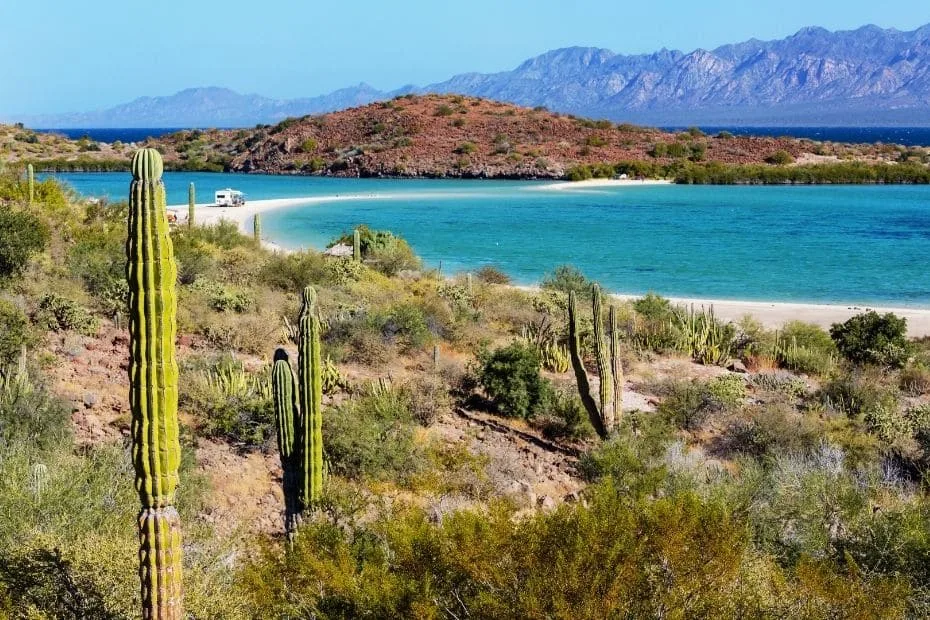
Flora: The boojum/cirio (Fouquieria columnaris)—an iconic, near-endemic spire—dominates with cardón cactus (Pachycereus pringlei, the world’s heaviest cactus), elephant trees (Bursera spp.), ocotillo (Fouquieria splendens), creosote bush (Larrea tridentata), chollas and barrel cacti. After winter rains, wildflower carpets briefly color the plains.
Fauna: Peninsular pronghorn (Antilocapra americana peninsularis, endangered), desert bighorn (Ovis canadensis), kit fox, coyote, black-tailed jackrabbit, kangaroo rats; birds like cactus wren, LeConte’s thrasher, verdin; reptiles including Baja California rattlesnake (Crotalus enyo) and rosy boa.
Geology & Notable Features
Geology: Granitic batholiths of the Peninsular Ranges weather into spectacular tors and pavements; Quaternary dunes and coastal sabkhas; volcanic centers (e.g., Las Tres Vírgenes complex to the south) influence local topography.
Notable Features: Valle de los Cirios (Flora & Fauna Protection Area), El Vizcaíno Biosphere Reserve (UNESCO-listed whale lagoons), Cataviñá boulder gardens, Ojo de Liebre and San Ignacio lagoons, expansive Vizcaíno dunes.
Introduction
The Baja California Desert (often called the Baja Californian Desert) forms a long, narrow belt of aridity along the Pacific flank of the Baja California Peninsula. Shaped by cool oceanic air and the rain-shadow of the Peninsular Ranges, it blends classic hot-desert landforms with a unique maritime touch—fog, gentler temperatures, and plant communities packed with endemics.
Geography
Stretching roughly from ~31°N to 24°N, the ecoregion covers about 77,700 km². Pacific shores and coastal plains give way to granitic foothills and interior plateaus before rising abruptly at the Peninsular Ranges. To the northeast it grades into the hotter, bimodally-wet Sonoran Desert; to the far northwest it meets Mediterranean chaparral.
Climate
Unlike many subtropical deserts, the Baja California Desert receives most rainfall in the cool season via Pacific fronts. Marine layers and fog drip help sustain iconic succulents, while rare late-summer tropical incursions can trigger short-lived green-ups. Typical annual totals are ~50–200 mm, with considerable coast-to-inland variation.
Vegetation
Plant life mirrors the climate gradient: cirio/boojum forests and cardón cactus woodlands around Cataviñá and Valle de los Cirios; elephant trees and thornscrub on rocky bajadas; creosote and mixed cholla on plains; saltbush and dune flora along lagoons and barrier dunes. After wet winters, spectacular wildflower displays erupt across granite flats.
Wildlife
Key species and adaptations:
- Peninsular pronghorn — ultrafast grazer of open flats; strictly protected and the focus of recovery programs.
- Desert bighorn — agile climber of rocky massifs and inselbergs.
- Kit fox — nocturnal hunter; uses dens to buffer daytime heat.
- Rosy boa & Baja California rattlesnake — rock-dwelling reptiles exploiting crevices and thermal refuges.
Near the coast, lagoons of El Vizcaíno host gray whale nurseries—an extraordinary juxtaposition of marine megafauna and desert dunes.
Comparison with Neighboring Deserts
| Feature | Baja California Desert | Sonoran Desert | Mojave Desert |
|---|---|---|---|
| Location | W Baja Peninsula, Mexico | U.S.–Mexico (AZ, CA, Sonora) | SW U.S. (CA, NV, AZ, UT) |
| Size | ~77,700 km² | ~260,000 km² | ~124,000 km² |
| Rainfall | Winter-dominant (~50–200 mm) | Bimodal summer & winter | Winter-dominant, very arid |
| Iconic Flora | Boojum (cirio), cardón | Saguaro, organ pipe | Joshua tree, creosote |
| Special Notes | Maritime fog influence; high endemism | Greatest cactus diversity | Hottest/coldest swings on basins & ranges |
Culture and Human Activity
The peninsula’s Cochimí heritage endures in place-names and rock-art traditions inland from coastal oases. Modern routes (Highway 1) thread through boojum forests and granite passes, while eco-tourism centers on whale-watching, desert trekking, and night skies. Responsible travel is essential to protect fragile crusts, dunes, and endemic plant stands.
Conservation
Large protected mosaics—Valle de los Cirios and the El Vizcaíno Biosphere Reserve—safeguard landscape-scale processes and habitats for peninsular pronghorn and desert bighorn. Ongoing priorities include invasive species control, careful management of off-road access, grazing, and monitoring climate-sensitive fog-dependent communities.
Conclusion
With its maritime-desert climate, sculpted granite, and surreal forests of cirios and cardóns, the Baja California Desert stands apart in North America. Its protected areas anchor one of the continent’s most intact desert coastlines—an irreplaceable refuge for endemic life and for travelers seeking wild, otherworldly horizons.
References
Government / Official Sources
- CONANP — Área de Protección de Flora y Fauna Valle de los Cirios (overview, size, habitats)
- UNESCO World Heritage — Whale Sanctuary of El Vizcaíno (biosphere reserve context & lagoons)
- IUCN Red List — Peninsular (Baja California) pronghorn status (Antilocapra americana peninsularis)
- CONABIO EncicloVida — Fouquieria columnaris (boojum/cirio) species record
University / Museum Sources
- University of Arizona Arboretum — Boojum (Fouquieria columnaris) distribution notes
- UABC Institutional Repository — Growth of Fouquieria columnaris near Cataviñá (thesis, methods & coordinates)