
Location and Setting
El Djouf is a hyper-arid desert region on the western edge of the Sahara, stretching across northeastern Mauritania and into northwestern Mali. It is best understood as a broad, open desert basin where sand, salt, and stone share the same stage—sometimes in neat layers, sometimes in messy patches that look like the Earth was brushed with a dry paintbrush.
| Continent | Africa |
| Countries | Mauritania, Mali |
| Region Type | Saharan desert region with dunes and salt-rich surfaces |
| Representative Coordinates | 21.42°N, 6.67°W (approximate center point) |
| Typical Elevation | ~320 m above sea level |
El Djouf Desert Map
On a map, El Djouf sits where the Sahara opens toward the Atlantic side—still firmly desert, still intensely dry, but positioned in a way that matters for winds and dust.
Click to load the interactive map
Click to load the interactive map
Physical Features
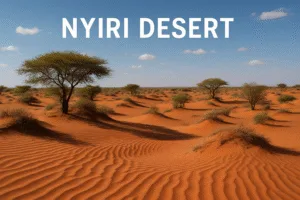
El Djouf Desert is not one single “sea of sand.” It behaves more like a wide tabletop with pockets of dunes, salt, and gravel—each surface changing how heat, wind, and water (when it appears) move across the land. The landscape can look calm, but it is constantly being edited by wind and evaporation.
- Sand dunes (erg-like patches) shaped into long ridges by prevailing winds
- Salt-rich flats and crusts where dissolved minerals concentrate as moisture disappears
- Gravel plains that resist wind, acting like a protective skin over older sediments
- Low divides and ridges that break the basin into subtle compartments
Climate and Wind
The climate is classic hot desert: bright skies, strong sun, and long stretches with little to no rain. Rainfall tends to arrive as rare, brief events, and then the desert quickly returns to its usual silence. Day-to-night swings can be sharp; the temperature doesn’t just drop, it can feel like someone turned down the whole world.
Wind is the real architect here. In the broader region, dry seasonal flows such as the harmattan can lift fine particles, pushing dust across huge distances. That same wind also “combs” dunes into lines, the way a rake pulls patterns through sand at the beach—only slower, and on a continental scale.
| Climate Element | What It Feels Like in El Djouf |
|---|---|
| Rainfall | Very scarce and irregular; long dry spells are normal |
| Heat | Strong sun, high daytime warmth; big day-night contrast |
| Wind | Frequent dust-raising episodes; dunes and surface crusts are constantly reshaped |
Ecology and Desert Life
Ecologically, El Djouf sits within the Sahara’s deserts and xeric shrublands, where life survives by being clever, small, and patient. Vegetation is sparse, but it is not absent. In places where soils hold a little moisture or minerals, tiny plants appear after rare rain—brief, bright moments of green that can vanish as quickly as they came.
Flora
Plant life in and around El Djouf Desert tends to be drought-adapted: hardy shrubs, occasional acacia near better soils, and salt-tolerant species where crusts form. Many survive with deep roots, waxy leaves, or life cycles timed to sudden moisture.
Fauna
Animals in this kind of Sahara terrain often rely on night activity and efficient water use. Expect desert-adapted mammals (small rodents are common), reptiles that handle heat well, and birds that cross wide open spaces. The desert looks empty at noon; at dawn or night, it can feel quietly alive.
- Nocturnal behavior is common: cooler hours are safer and cheaper for energy
- Burrowing helps animals escape heat and wind-driven sand
- Wide-ranging movement allows wildlife to track scattered resources
Geology and Landform Story
One of the most useful ways to picture El Djouf is as a shallow sedimentary basin—a broad, low-tilt container filled over time with sands, gravels, and mineral-rich layers. Fault-block divides, plateaus, and ranges nearby shape how materials collect, so the basin is not perfectly smooth; it’s interrupted by subtle steps and ridges, like a giant floor with uneven thresholds.
Salt appears where water once lingered, even briefly. When shallow moisture evaporates, minerals remain behind, forming crusts and hard pans. Sand then drifts over or around these surfaces, creating sharp contrasts: soft dune edges next to cement-like salt flats.
Dust, Sky, and Long-Distance Connections
El Djouf is not only shaped by wind—it also feeds the wind with dust. Satellite observations and atmospheric studies have highlighted the region as a meaningful dust source in West Africa. Fine particles can be lifted by strong surface winds, forming plumes that travel far over the Atlantic.
This matters because dust is not just “dirt in the air.” It affects sunlight, cloud formation, and ocean nutrients. When you read about Saharan dust reaching distant shores, El Djouf Desert is one of the places often mentioned in that bigger story.
- Why dust lifts easily: dry ground, little vegetation, and fine sediments stored in basins
- Why plumes travel: persistent winds and layered air flows that carry particles westward
- What dust changes: visibility, sky color, and how sunlight warms the surface
Water and Salt in a Place That Rarely Rains
In El Djouf, water is mostly a hidden topic. Surface water is uncommon, but groundwater can exist in deeper layers, and occasional runoff may briefly trace dry channels. Where moisture touches mineral-rich sediments, salt becomes the lasting record. Over time, repeated wetting and drying can build crusts that influence everything: how vehicles move, how dunes anchor, even how heat radiates at night.
These salt surfaces can look like snow from a distance. Up close, they are often brittle, cracking into polygon patterns—nature’s way of shrinking a wet skin into a dry shell.
A Notable Scientific Footnote
The name El Djouf also appears in scientific catalogs beyond geography. In meteorite records, El Djouf 001 is a documented carbonaceous chondrite find from the Sahara. It’s a small reminder that extremely dry landscapes can preserve rare materials on the surface for long periods, like a quiet outdoor archive under a hard blue sky.
Sources
Encyclopaedia Britannica – El-Djouf
NASA Earth Observatory – A Dusty Journey
Lunar and Planetary Institute (USRA) – Meteoritical Bulletin Entry for El Djouf 001
U.S. Department of Energy – Publication Page on Dust Transport Research
Princeton University CIMES – Publications Tagged “El Djouf”
Wikipedia – El Djouf