
Location & Continent
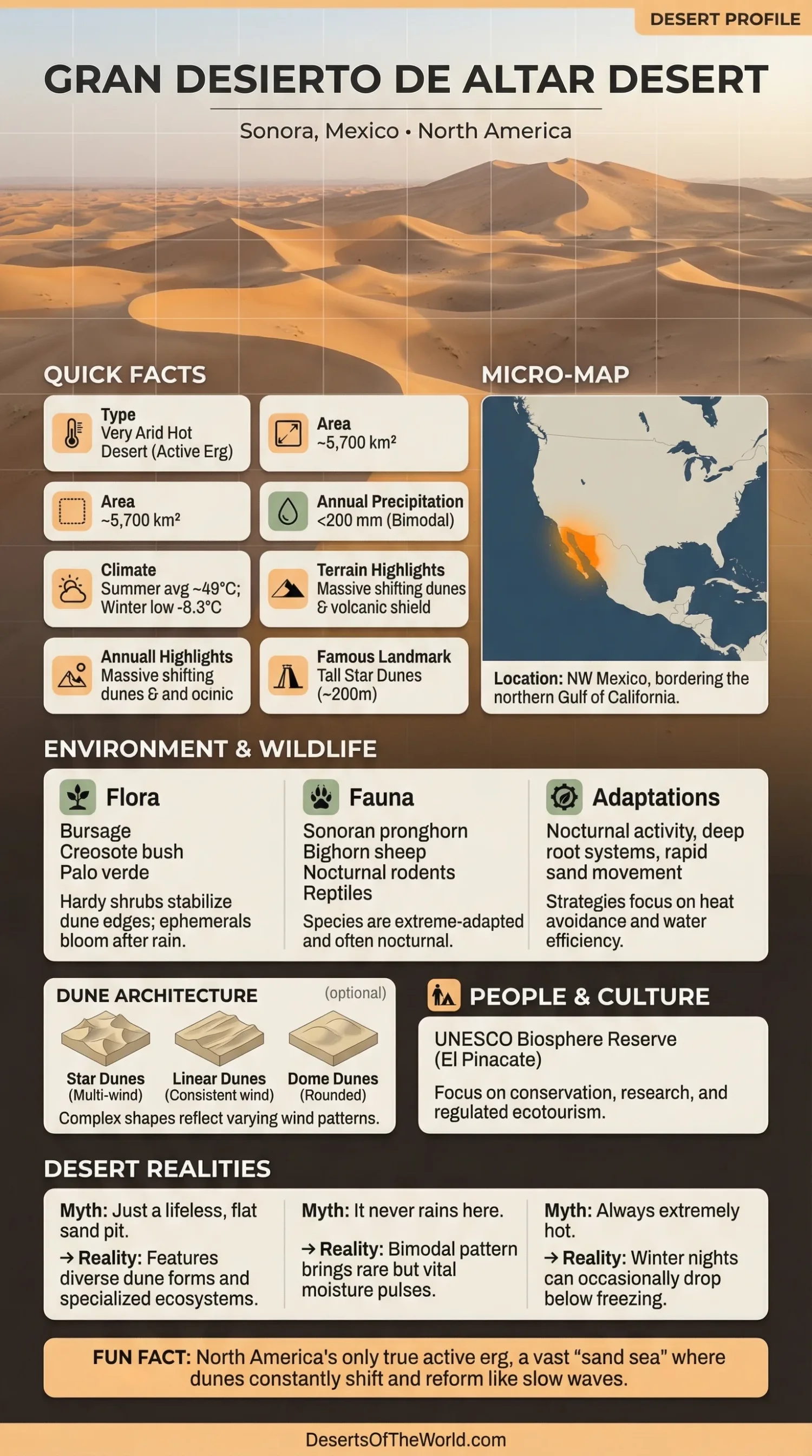
Continent: North America
Country: Mexico
State: Sonora
Desert System: Sonoran Desert
Nearest Well-Known Places: Puerto Peñasco, Sonoyta, San Luis Río Colorado
Approximate Coordinates: 31–32°N, 113–115°W
Landscape Context: Along the northern Gulf of California and the Colorado River Delta lowlands
Gran Desierto de Altar – Map & Street View
Photos of The Gran Desierto de Altar
Physical Features
Core Desert Area: ~5,700 km² of sandy desert terrain
Signature Landform: North America’s only active erg (a true sand sea)
Typical Spread: Over 100 km east–west and more than 50 km north–south
Dune Heights: Up to ~200 m in the tallest dune ridges
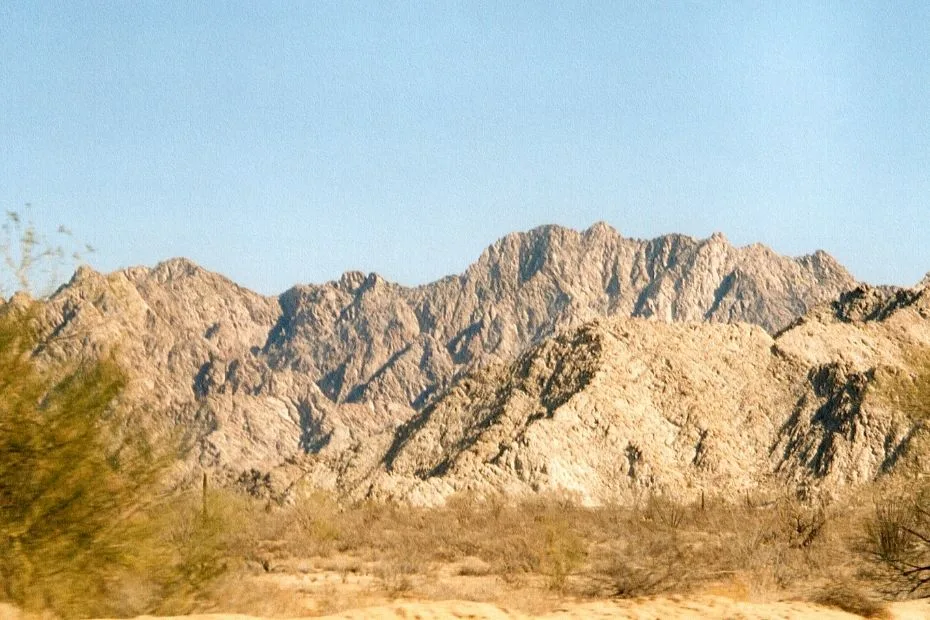
Neighboring Landforms: The dark volcanic surfaces of the Pinacate Shield and scattered granite massifs
Climate & Precipitation
The Gran Desierto de Altar sits in a hot desert climate where sunlight can feel almost solid. Summer heat is intense, humidity is low, and evaporation works like an always-on fan over a shallow pan.
Even so, the wider Sonoran Desert influence can bring a bimodal rain rhythm—two rainy windows rather than one.
Climate Type: Very arid hot desert
Summer Heat: Average summer maximums around 49°C (June–July); extreme records up to 56.7°C
Winter Cold: Rare night lows down to -8.3°C
Annual Rain: Typically under 200 mm (often far less in the driest stretches)
Dry Spells: Documented stretches of roughly 34 months with little to no meaningful rainfall
| Seasonal Pattern | What It Often Looks Like | Why It Matters Here |
|---|---|---|
| Winter-leaning rains | Gentler storms and cooler days | Supports vegetation pulses on dune margins and desert pavements |
| Summer monsoon influence | Short bursts, local downpours | Triggers rapid ephemeral growth where moisture lingers |
| Wind seasons | Persistent directional shifts | Rebuilds dunes like slow-motion surf on a beach of sand |
Ecological Setting
As a major sandy sub-region of the Sonoran Desert, the Gran Desierto de Altar is not a single uniform “blank page.” It is a patchwork: active dunes, firmer sand sheets, desert pavements, and hard-edged volcanic ground nearby.
Each patch behaves differently, like rooms in the same house with their own temperature and light.
Biome: Deserts and xeric shrublands
Key Microhabitats: interdune flats, dune slipfaces, vegetated dune margins, desert pavement, volcanic slopes
Water Rarity: Moisture appears briefly, then fades fast—sometimes like a mirrage, sometimes like a promise kept for a day
Why The Dunes Matter: Dunes can act as “moving islands,” creating separate pockets of plant and wildlife communities
Flora & Fauna
Life in the Gran Desierto de Altar is built around timing. Many species wait, conserve, then respond quickly when conditions soften.
On the dune margins, shrubs and small desert plants can anchor sand the way stitches hold fabric together—subtle, but powerful.
Plant Life
- Dune-edge shrubs such as bursage and other hardy desert species help stabilize sand in pockets.
- Creosote bush and other drought-tough plants appear where sand is thinner and soils are more developed.
- Wash and slope vegetation (where runoff occasionally concentrates) may include palo verde-type desert trees and related Sonoran plants.
- After rain, short-lived wildflowers and grasses can appear quickly—bright notes in an otherwise muted landscape.
Wildlife
- Sonoran pronghorn is closely tied to this region’s broader protected landscape, a symbol of extreme-adaptation rather than brute strength.
- Bighorn sheep are associated with the rocky and volcanic terrains that frame the dune field.
- Small mammals (including nocturnal rodents) often act as quiet engineers, moving seeds and shaping food webs.
- Reptiles, insects, and ground-nesting birds rely on heat management, shade, and careful daily timing; many are most active when the sand cools.
- In the wider reserve, isolated water pockets can support specialized freshwater fish in rare, localized settings.
| Adaptation Theme | Common Desert Strategy | How It Fits Gran Desierto de Altar |
|---|---|---|
| Heat Avoidance | Nocturnal activity, burrows, shade use | Matches peak summer extremes |
| Water Efficiency | Waxy leaves, deep roots, dormancy | Key during long dry gaps |
| Sand Living | Low profiles, rapid movement, anchoring roots | Essential in an active erg |
Geology & Landscape Formation
The Gran Desierto de Altar is a place where geology shows its handwriting in bold strokes. To the west, sand dunes shift and reform; to the east, volcanic ground holds its shape like cooled metal.
Put together, it feels like two planets sharing one horizon.
Where The Sand Comes From
A major piece of the story is sediment. Research on regional dune systems shows the Colorado River has been an important source of sand for several large dune fields in the Sonoran Desert.
Over long timescales, wind takes that supply and arranges it into ridges, arms, and stars of sand.
The result is the famous sand sea character of the Altar region.
Dune Architecture
- Star dunes form where winds arrive from multiple directions, building tall peaks and radiating ridges.
- Linear dunes stretch like drawn lines when winds are more consistent across seasons.
- Dome dunes appear as rounded sand forms, often where sand supply and wind balance differently.
Pinacate Volcanic Neighbor
The wider protected landscape includes the Pinacate Shield, known for dark lava flows and a striking set of nearly circular craters.
This volcanic “counterweight” matters because it creates sharp contrasts in soil, reflectivity, and habitat—differences that can shape where plants and animals thrive.
Introduction to The Gran Desierto de Altar
The Gran Desierto de Altar (often called the Great Altar Desert) is one of the most distinctive sandy landscapes in North America. It belongs to the broader Sonoran Desert, yet it stands apart because it contains a true active erg—a living sand sea where dunes shift, merge, and reappear like waves that never quite break.
This is not just “a lot of sand.” The region includes dune fields, sand sheets, and nearby volcanic terrain that together form a world of contrasts: pale dunes against black lava, smooth slipfaces beside rough desert pavement.
The eye notices it fast. The science behind it runs deep.
And it stays fascinating.
Protected Landscape: El Pinacate and Gran Desierto de Altar
Much of the broader landscape is recognized within the El Pinacate and Gran Desierto de Altar protected area, a large reserve that brings the dune sea and volcanic shield into one conservation frame.
UNESCO describes the site as 714,566 hectares of dramatic contrast, with dunes that can reach 200 metres and a volcanic zone marked by deep, round craters.
In practical terms, this matters because the dunes and volcanic terrains support different communities.
The dunes can behave like “islands” rising from a sea of sand, each with its own plant cover and animal use.
That mix supports surprisingly high ecological variety for such an arid place.
Why The Gran Desierto de Altar Feels So Different
Many deserts are defined by rock and open plains. Here, motion is part of the identity. Dunes shift under seasonal wind patterns, and dune shapes tell you about wind direction the way tree rings tell you about time.
A steep dune face is a quiet record of yesterday’s gusts.
A star dune is a record of many winds arguing, then agreeing.
That is the charm.
- Active dune field behavior is visible on the surface: ripples, slipfaces, and drifting sand tongues.
- Color contrast can be dramatic, especially where pale sand meets dark volcanic ground.
- Habitat variety comes from surface differences: loose sand, firm pavement, rocky slopes, and rare water pockets.
References
UNESCO World Heritage Centre – El Pinacate and Gran Desierto de Altar Biosphere Reserve
UNESCO World Heritage Centre – Nomination 1410 (Inscribed 2013) Documents Page
CONANP (Mexico) – Climate Notes for El Pinacate and Gran Desierto de Altar
CONANP (Mexico) – Protected Area Profile: El Pinacate y Gran Desierto de Altar
U.S. Geological Survey – Eolian Sand Transport Pathways and The Colorado River as a Sand Source
U.S. National Park Service – Sonoran Desert Network: Ecosystems and Bimodal Precipitation
INAH (Mexico) – World Heritage Detail: El Pinacate y Gran Desierto de Altar