
Location & Continent
Continent: South America
Countries: Mainly Argentina, with smaller steppe areas extending into Chilean Patagonia
Region: Southern Patagonia, between the Andes and the Atlantic coast
Approx. Coordinates: 41°–51°S, 65°–71°W
Patagonian Desert – Map & Street View
Physical Features of the Patagonian Desert
Area: Around 670,000 km², making it the largest desert in Argentina and one of the ten largest deserts on Earth
Landscape Type: Cold desert and windswept steppe plateau
Elevation Range: From sea level on the Atlantic coast up to about 2,000 m on basalt plateaus and foothills of the Andes
Boundaries (generalised):
Andes Mountains to the west, the Atlantic Ocean to the east, roughly the Colorado River in the north and the Strait of Magellan in the south
Key Data
| Feature | Value / Description |
|---|---|
| Desert type | Cold winter desert and semi-arid steppe |
| Annual precipitation | Mostly < 200 mm in the central plateau; locally up to 300–400 mm towards the Atlantic and Andean fringes |
| Average temperatures | Roughly 3–10 °C annually; frequent frosts and cold winds, occasional summer heat waves |
| Main geomorphology | Basalt mesetas (tablelands), wide gravel plains, river canyons and coastal cliffs |
| Major rivers crossing the desert | Río Negro, Chubut, Deseado, Santa Cruz and others flowing east from the Andes |
Climate & Precipitation
The Patagonian Desert is a cold, dry and windy desert.
Most of the region lies in the rain shadow of the Andes, where moist Pacific air drops its rain and snow on the western slopes before reaching the plains. As a result, much of central Patagonia records less than 200 mm of rain per year, with small coastal and foothill zones receiving slightly more.
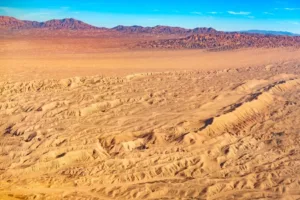
Winters are long, with frequent frosts and occasional snow, especially closer to the Andes. Summers are short and cool to mild, though hot days above 30 °C can occur in northern valleys. Strong westerly winds – part of the famous “Roaring Forties” and “Furious FFifties” – blow across the plateau for much of the year.
Another key player is the cold Falkland (Malvinas) Current in the South Atlantic, which cools the air above the coastal plain and helps maintain the desert’s aridity.
Ecological Features
Ecozone: Neotropical (temperate South America)
Biomes:
Deserts and xeric shrublands plus temperate grasslands, savannas and shrublands
Key ecoregion: Patagonian Steppe
Flora & Fauna
At first glance the steppe looks empty, but it is covered by hardy tuft grasses such as Stipa and Poa, low thorny shrubs, and iconic cushion plants like Mulinum spinosum that hug the ground to escape the wind.
Typical animals include:
- Guanaco
- Lesser rhea (choique)
- Patagonian mara
- Puma and Patagonian gray fox
- Pygmy armadillo
- Birds of prey including Andean condors
This mix of steppe specialists creates a food web that survives on sparse vegetation, patchy water sources and the ability to move long distances.
Geology & Notable Landforms
Geologically, the Patagonian Desert is built on a stack of ancient basalt plateaus formed by volcanic eruptions during the Miocene and later periods. Rivers such as the Río Negro and Chubut cut deep canyons across these plateaus.
Glacial periods left their mark too. Meltwater shaped outwash plains, gravel terraces and enclosed basins that now host saline lakes and wetlands. Some sectors contain petrified forests.
Introduction to the Patagonian Desert
The Patagonian Desert is a vast, rough plateau of grasses and shrubs, stretching across southern Argentina and dipping into Chile.
Despite its climate, the region has long supported wildlife, indigenous peoples and modern ranchers.
Geography & Regional Context
The desert covers most of the Argentine Patagonia plateau, spanning provinces like Río Negro, Chubut, Santa Cruz and parts of Neuquén.
Though Patagonia is often pictured with glaciers, most of it is actually semi-arid desert plateau.
Weather, Winds & the Andean Rain Shadow
Moist Pacific winds release their rainfall on the Andes and descend dry on the east, forming the desert.
Strong winds, often 80–100 km/h, shape the land and challenge wildlife.
Life in a Cold Desert: Adaptations of Plants & Animals
Many plants grow as low cushions or spiny shrubs to resist wind and conserve water.
Animals such as guanacos, maras and pumas roam large territories and adapt behaviorally to wind and temperature.
People, Culture & Land Use
Indigenous groups like the Tehuelche lived here for thousands of years. Later, sheep ranching dominated land use.
Overgrazing led to desertification in many areas. Today, conservation efforts and regenerative grazing practices are expanding.
Protected Areas & Wildlife Watching
Examples include:
- Patagonia National Park
- Monte León National Park
- Other grassland and wetland reserves
Travel Tips
- Best seasons: Spring & autumn.
- Wear layered clothing.
- Bring protection against strong winds.
- Distances are large; plan carefully.
Environmental Challenges & Conservation
- Overgrazing & erosion
- Desertification
- Oil, gas & mining impacts
- Climate change
Conservation aims to keep the desert wild, functioning and resilient.