
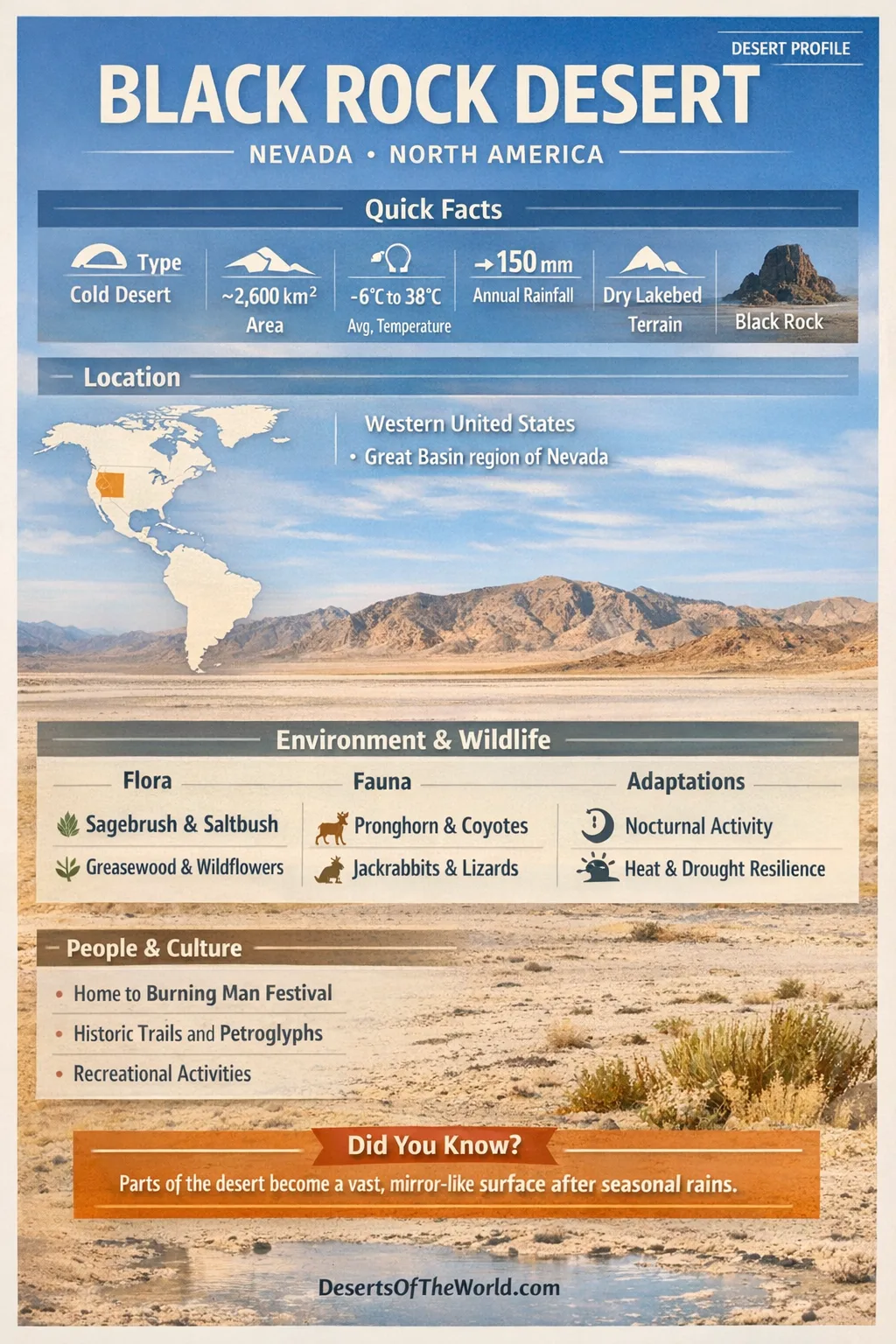
Location & Continent
Continent: North America
Country: United States
State: Nevada
Counties: Washoe, Pershing, Humboldt
Region: Great Basin (high desert of the American West)
Closest Gateway Community: Gerlach
Coordinates (Central Playa Approx.): 40.86°N, 119.18°W
Black Rock Desert – Map & Street View
Physical Features
Landscape Type: Playa (dry lakebed) within a broader basin-and-range desert setting
Estimated Area (Wider Desert Basin): ~2,600 km² (about ~1,000 sq mi)
Central Playa: several hundred km² of mostly flat, alkaline clay
Typical Playa Elevation: ~1,190 m (about ~3,900 ft) above sea level
Surrounding Relief: ranges and highlands rise well above the basin floor, shaping wind and drainage patterns
Signature Surface: pale alkali crust, polygon cracks, and hardpan that can feel like a natural runway when dry
Climate & Precipitation
The Black Rock Desert sits in Nevada’s high-desert belt, where skies are big, air is dry, and weather can switch moods fast. Many climate maps classify it as a cold desert (often described as BWk), shaped by elevation and distance from the ocean.
Summer: long days with hot afternoons, commonly 32–38°C (90–100°F), paired with surprisingly cool nights.
Winter: crisp, open cold; nighttime temperatures can drop below freezing, and the basin occasionally sees snow.
Annual Precipitation (General Range): ~100–200 mm (about 4–8 inches) in nearby low-elevation areas, varying by storm track and year.
Wind: a constant sculptor—breezes to strong gusts that lift fine silt into thin veils across the playa.
Ecological Setting
At first glance, Black Rock Playa looks empty, almost like a blank page under the sun. Zoom in—literally and figuratively—and life appears in edges, pockets, and timing. The playa itself is harsh: salty, alkaline, and often too waterlogged or too dry for most plants to settle long-term. The surrounding desert margin supports classic Great Basin communities.
Ecozone: Great Basin Desert (high-elevation desert and shrublands)
Biome: Deserts and xeric shrublands
Playa Ecology: seasonal wet-dry cycles that favor short-lived, highly adapted organisms and microbial films
Flora & Fauna
Away from the brightest white of the playa, the land turns into a patchwork of shrub steppe—the kind of ecosystem that survives by being smart, not flashy. Plants here often carry their water-saving tools in plain sight: tiny leaves, waxy coatings, and deep roots.
Common Plant Types Around the Playa:
- Sagebrush and other aromatic shrubs that define much of the Great Basin
- Saltbush and greasewood in more saline soils, built for alkaline ground
- Seasonal wildflower bursts in good moisture years, often brief but memorable
Wildlife is equally practical. Many species lean into timing—moving at dawn, dusk, or night—and using shade like a currency.
Animals Often Associated With the Region:
- Pronghorn and mule deer in the wider basin-and-range landscape
- Coyotes, jackrabbits, and small mammals that thrive on open terrain
- Reptiles and insects adapted to heat and dry air
- Birdlife that can spike seasonally, especially when nearby wetlands and seeps hold water
Some years, after rain leaves shallow water on the playa, the desert can feel quietly alive—a thin sheet of water reflecting clouds like a temporary sky on the ground.
Geology & Notable Features
The story of the Black Rock Desert is tied to an older, wetter chapter of the Great Basin. During the last ice age, a vast lake system—often discussed under the name Lake Lahontan—covered large parts of northwestern Nevada. When that water retreated, it left behind sediments that now form the playa’s flat, clay-rich surface. Think of it as a dried fingerprint of an ancient inland sea.
Key Geological Themes:
- Pluvial-lake legacy: fine-grained clays and salts deposited over long wet periods
- Basin-and-range motion: stretched crust creating alternating valleys and mountain blocks
- Volcanic influence: regional volcanism contributing dark rock outcrops and varied soils
Notable Features in and Around the Black Rock Desert:
- Black Rock itself: a dark, rugged landmark rising from the pale basin, a sharp contrast that gives the place its name
- High Rock Canyon area nearby: dramatic volcanic rims and canyons within the broader landscape context
- Hot springs and geothermal hints in the region: reminders that heat still moves under the surface
Geology here is visual. White crust against black stone. Straight horizons cut by distant ridges. It’s a landscape that explains itself in shapes.
Introduction to the Black Rock Desert
The Black Rock Desert in northwestern Nevada is often described through its famous center: Black Rock Playa, a broad, nearly level dry lakebed that can look like a giant sheet of porcelain from a distance. Yet calling it “just a flat place” misses the point. The playa is the stage, and the surrounding Great Basin ranges are the amphitheater—quiet, wide, and full of detail once the eye slows down.
Unlike many deserts defined by dunes, this one is defined by absence of relief. When it’s dry, the ground breaks into polygon patterns, as if the earth is sketching geometry for fun. When water spreads thinly across the surface, reflections become so sharp they feel like a mirage that decided to stay for a while. It’s surpisingly easy to understand why this place captures attention.
Playa Dynamics and Seasonal Change
A playa is a desert basin that collects water in wet moments and turns it into a salt-and-clay memory when the sun returns. In the Black Rock Desert, this cycle is the main rhythm. Water arrives from winter storms, snowmelt, or a strong spring system upstream. It settles, spreads, then evaporates. What remains is an alkaline surface that can be firm and smooth one week, then soft and muddy the next.
The most important detail is simple: flat does not mean stable. The playa surface is a living texture—crust forming, cracking, healing, and cracking again. Winds push fine sediments into new arrangements. Shallow water can redistribute salts into fresh patterns. Over time, these small changes add up, shaping how the playa looks, how it feels underfoot, and how plants and animals use its margins.
Water, Salts, and the Desert’s Chemistry
Deserts are not always about “no water.” In places like Black Rock Playa, water shows up—then leaves behind a signature. As evaporation concentrates minerals, the ground develops alkaline and saline conditions. That chemistry matters. It explains why the playa center stays mostly plant-free, while tougher shrubs gather around the edges where soils are slightly less intense.
The mineral crust can look delicate, almost like powdered sugar from afar, yet it comes from a long chemical conversation between water, sediment, and sun. On calm days, the desert feels clean and crisp. On windy days, fine dust can lift easily, reminding everyone that this “floor” is made of tiny particles with places to go.
Land Management and Protected Landscapes
Much of the Black Rock Desert and its surrounding corridors fall under public land management, with a strong conservation identity in the region. The wider area includes the Black Rock Desert–High Rock Canyon Emigrant Trails National Conservation Area, a protected landscape recognized for its desert ecology, scenic geology, and historic travel routes across the Great Basin.
This matters for anyone learning about the desert because it connects the playa to a bigger map: canyons, volcanic rims, springs, basins, and long, open valleys. The desert is not a single feature; it’s a network of landforms working together. In that network, the playa is the brightest node, but not the only one.
Human Presence and Cultural Footprints
People have moved through this part of Nevada for a long time, drawn by water sources, travel corridors, and the practical logic of basins and passes. In more recent decades, Black Rock Playa has also become known as a place where large, temporary gatherings can happen because the surface is so open and expansive when dry. The most famous is an annual arts-focused event that uses the playa’s scale like a canvas.
Seen from the desert’s perspective, these moments are brief. The land returns to quiet. Wind and sun continue their steady work. The bigger story remains the geology, the climate, and the way life holds on at the edges.
What Makes Black Rock Desert Stand Out Among World Deserts
Many people imagine deserts as seas of sand. The Black Rock Desert offers a different definition: a desert of space. Its centerpiece is a dry lakebed so flat and pale it can make distances feel strange, like the horizon moved farther away overnight. This is a desert shaped by water that used to be here, not by sand that blew in from elsewhere.
That contrast—ancient lake story, modern arid reality—is the desert’s signature. It also makes the Black Rock region a useful example for understanding how deserts form in multiple ways: not only through heat, but through elevation, rain shadows, basin geology, and the slow chemistry of evaporation.
Black Rock Desert Data Table
| Category | Details |
|---|---|
| Desert Type | Cold high desert with a major playa (dry lakebed) |
| Core Surface | Alkaline clay hardpan, seasonal shallow water, salt crust |
| Elevation | Playa around ~1,190 m (~3,900 ft) |
| Rainfall | Low annual totals, often ~100–200 mm (4–8 in) in the basin region |
| Key Formation Story | Remnant basin of a Pleistocene pluvial lake system (Lake Lahontan legacy) |
| Typical Vegetation | Edge-zone sagebrush, saltbush, greasewood; sparse to none in central playa |
References
Bureau of Land Management – Black Rock Desert–High Rock Canyon Emigrant Trails NCA
U.S. Geological Survey – Lake Lahontan (Background and Geologic Context)
National Park Service – Lake Lahontan Overview Article
University of Nevada, Reno Extension – Great Basin/High Desert Ecology Resource
National Weather Service – Regional Climate and Weather Data (Nevada)