
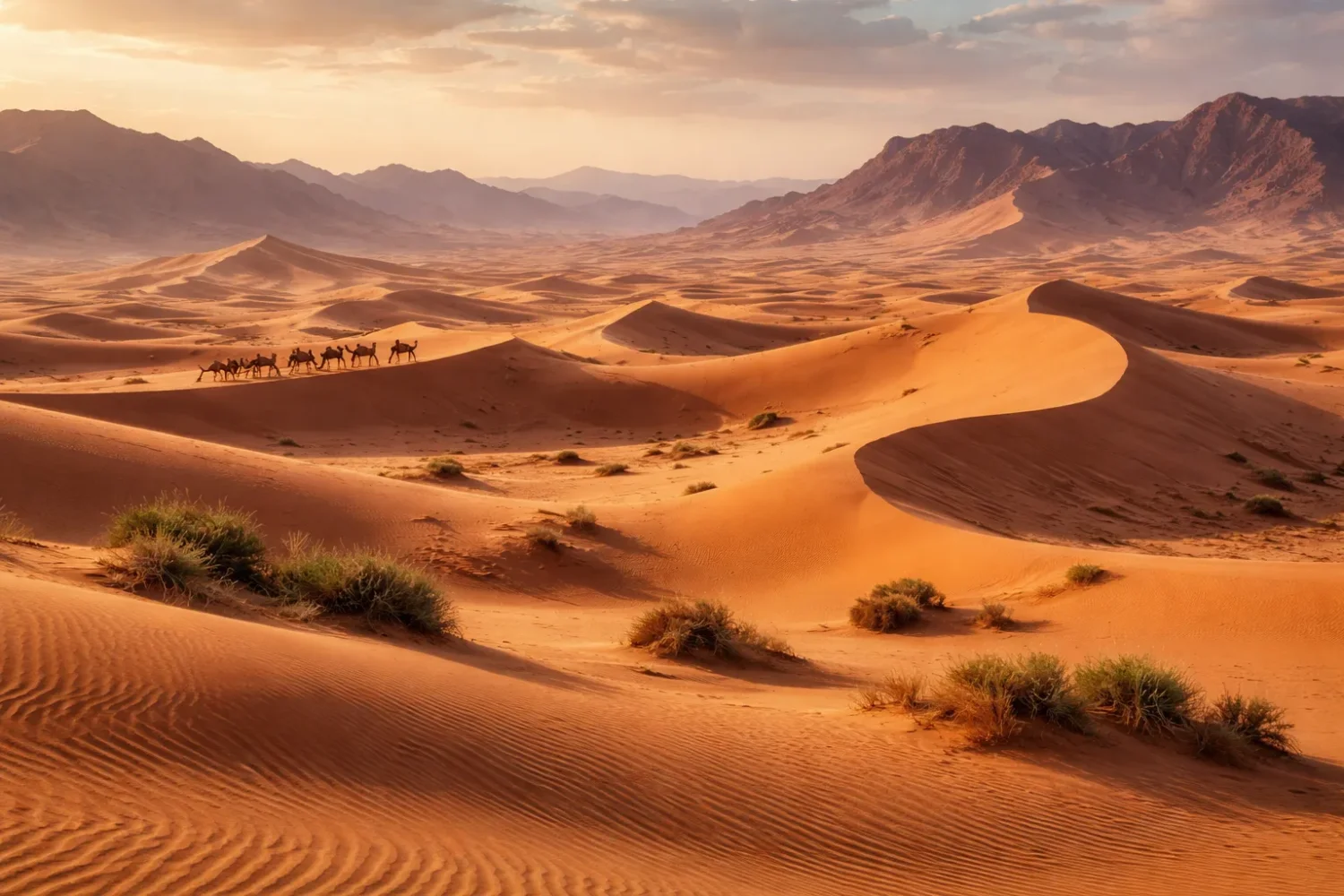
Hot deserts are often pictured as endless dunes under a white sky. That image is only half right. A true hot desert belt includes sand seas, gravel plains, bare rock plateaus, chalk fields, salt pans, wadis, alluvial fans, volcanic basins, and fog-fed coasts. In other words, the hot-desert world is broad, dry, and full of contrast.
Gran Desierto de Altar
Location & Continent Continent: North America Country: Mexico State: Sonora Desert System: Sonoran Desert Nearest Well-Known Places: Puerto...
Read More →Colorado Desert
Location and Continent Continent: North America Countries and Regions: United States (Southern California), Mexico (Northern Baja California) Often-Referenced...
Read More →Death Valley
Location & Continent Continent: North America Country: United States Region: Eastern California and southern Nevada, within the Mojave...
Read More →Negev Desert
Location & Continent Continent: Asia Region: Southern Levant Country: Israel Nearby Landscapes: Sinai Peninsula, Mediterranean Coastal Plain (northwest),...
Read More →Judaean Desert
Location & Regional Setting Region: Southern Levant Primary Name: Judaean Desert (also written Judean Desert) Where It Sits:...
Read More →Sharqiya Sands
Location and Setting Continent: Asia (Arabian Peninsula) Country: Oman Region: Ash Sharqiyah (Eastern Oman) between the interior plains...
Read More →Ramlat al-Sab`atayn
Location & Continent Continent: Asia Region: Arabian Peninsula Countries: Yemen (main area), Saudi Arabia (southwestern edge) Administrative Areas:...
Read More →Nefud Desert
Location and Regional Context The Nefud Desert—often written as An Nafud or Al Nafud—is a vast red-sand desert...
Read More →Empty Quarter (Rub’ al Khali) Desert
Location And Continent Continent: Asia Region: Arabian Peninsula in West Asia, forming a vast core of the Arabian...
Read More →Al-Dahna Desert
Location & Continent The Al-Dahna Desert (also written Ad Dahna) is a narrow, bow-shaped sand corridor in Saudi...
Read More →Al Khatim Desert
Location & Continent Continent: Asia Region: Arabian Peninsula Country: United Arab Emirates Emirate: Abu Dhabi Nearby Cities: Abu...
Read More →Atlantic Coastal Desert
Location & Continent Continent: Africa Countries / Regions: Mauritania, Western Sahara (region) Desert System: Western Sahara Edge of...
Read More →Sinai Desert
Location and Regional Context Continent: Asia (Western Asia) Country: Egypt Region: Sinai Peninsula Central Coordinates: 29.50°N, 33.83°E The...
Read More →Bayuda Desert
Location & Continent Continent: Africa Country: Sudan Region: Northeastern Sahara / Eastern Sahara Setting: Inside the Great Bend...
Read More →Nubian Desert
Location & Continent Continent: Africa Region: Eastern Sahara / Northeast Africa Countries: Sudan, Egypt Core Position: Between the...
Read More →Eastern Desert
Location And Continent The Eastern Desert is a wide belt of arid land on Africa’s northeast edge, stretching...
Read More →White Desert National Park
Location & Setting The White Desert is a chalk-sculpted landscape in Egypt’s Western Desert, closely tied to the...
Read More →Libyan Desert
Libyan Desert Location & Continent Continent: Africa Region: Eastern Sahara Countries: Libya, Egypt, Sudan Approximate Coordinates: 25°N, 25°E...
Read More →Tin-Toumma Desert
Location and Continent The Tin-Toumma Desert is a vast dune plateau in southeastern Niger, set along the Sahel–Sahara...
Read More →Djurab Desert
Djurab Desert Location & Continent The Djurab Desert is a broad Sahara landscape in northern Chad, set in...
Read More →El Djouf
Location and Setting El Djouf is a hyper-arid desert region on the western edge of the Sahara, stretching...
Read More →Tanezrouft
Location & Continent Continent: Africa Countries: Algeria, Mali Region: Tanezrouft (part of the Sahara Desert) Approximate Coordinates: 22.251°N,...
Read More →Ténéré Desert
Location & Continent Continent: Africa Countries: Niger, Chad Region: South-central Sahara Desert, between the Aïr Mountains and the...
Read More →Eritrean Coastal Desert
Location & Continent Continent: Africa Countries: Eritrea, Djibouti Coordinates (approx.): 13°N, 42°E – along the southern Red Sea...
Read More →Jalapão Microregion
Location & Continent Continent: South America Country: Brazil State: Tocantins (eastern part of the state) Region: Semi-arid Jalapão...
Read More →Sechura Desert
Location & Continent Continent: South America Countries: Mainly Peru; parts of the broader ecoregion extend into coastal Ecuador...
Read More →La Guajira Desert
Location & Continent Continent: South America Countries: Mainly Colombia (La Guajira Department), with a smaller portion in Venezuela...
Read More →Atacama Desert
Photos of the Atacama Desert Location & Continent Continent: South America Countries: Mainly northern Chile; some broader definitions...
Read More →Pedirka Desert
Location & Continent The Pedirka Desert is a compact dune field in the far north of South Australia,...
Read More →Tirari Desert
Location & Continent Continent: Australia Country / State: Australia – South Australia, Far North region Biogeographic setting: Part...
Read More →Strzelecki Desert
Location & Continent Continent: Australia (Oceania) Country: Australia States: South Australia, Queensland, New South Wales Region: Northeastern Lake...
Read More →Little Sandy Desert
Location & Continent Continent: Australia Country / State: Australia – Western Australia Region: Interior of Western Australia, part...
Read More →Gibson Desert
Location & Continent Continent: Australia (Oceania) Country: Australia State / Territory: Western Australia Approximate Coordinates: 23°S, 125°E Neighbouring...
Read More →Tanami Desert
Location & Continent Continent: Australia (Australasia) Country & States: Australia — Northern Territory and Western Australia Approx. Coordinates:...
Read More →Great Victoria Desert
Location & Continent Continent: Oceania Country: Australia (Western Australia & South Australia) Coordinates: 29°S, 129°E (approximate geographic center)...
Read More →Chihuahuan Desert
Location & Continent Continent: North America Country: Mexico (Chihuahua, Coahuila, Durango, Zacatecas, Nuevo León, San Luis Potosí) ;...
Read More →Baja Californian Desert
Baja California Desert — Location & Continent Continent: North America Country: Mexico (Baja California; Baja California Sur) Coordinates:...
Read More →Sonoran Desert
Location & Continent Continent: North America Country: United States (Arizona, California); Mexico (Sonora, Baja California, Baja California Sur)...
Read More →Mojave Basin and Range
Location & Continent Continent: North America Country: United States (California, Nevada, Arizona, Utah) Coordinates: 35°N, 115°W Mojave Desert...
Read More →Dasht-e-Margo
Location & Continent Continent: Asia Countries: Afghanistan Coordinates: 30°N, 63°E Map previewClick to load the interactive map Load...
Read More →Thar Desert
Location & Continent Continent: Asia Country: India & Pakistan (primarily Rajasthan in India; stretching into Sindh and Punjab...
Read More →Syrian Desert
Syrian Desert (Badiyat ash-Shām): Location, Climate, Ecology & Highlights A concise, research-backed guide to the Syrian Desert—its geography,...
Read More →Maranjab Desert
Location & Continent Continent: Asia Country: Iran (Isfahan Province – Aran va Bidgol County, near Kashan) Coordinates: 34.3003°N,...
Read More →Dasht-e Lut
Location & Continent Continent: Asia Countries: Iran (Kerman, Sistan-Baluchestan, South Khorasan Provinces) Coordinates: ~30.216°N, 58.839°E (UNESCO property reference)...
Read More →Dasht-e Kavir
Location & Continent Continent: Asia Countries: Iran Coordinates: ≈34.73°N, 52.23°E (Kavir Biosphere Reserve centroid) Map previewClick to load...
Read More →Arabian Desert
Location & Continent Continent: Asia Countries: Saudi Arabia, Oman, Yemen, United Arab Emirates, Jordan, Iraq, Qatar, Kuwait Coordinates:...
Read More →Lompoul Desert
Location & Continent Continent: Africa Country: Senegal Coordinates: 15°55′N, 16°40′W Map previewClick to load the interactive map Load...
Read More →Nyiri Desert
Location & Continent Continent: Africa Country: Kenya Coordinates: 2°S, 36°E Map previewClick to load the interactive map Load...
Read More →Chalbi Desert
Location & Continent Continent: Africa Country: Kenya Coordinates: 3°30′N, 37°30′E Map previewClick to load the interactive map Load...
Read More →Grand Bara Desert
Location & Continent Continent: Africa Country: Djibouti Coordinates: 10°30′N, 42°55′E Map previewClick to load the interactive map Load...
Read More →50 inventions in Hot Deserts
What ties these landscapes together is not sand. It is aridity: very low rainfall, high evaporation, strong sunshine, open skies, and sparse surface water. Many hot deserts sit under the subtropical high-pressure belt. Others stay dry because of cold ocean currents, rain shadows, inland position, saline basins, or monsoon edges that fail more often than they deliver.
That is why the Sahara, the Arabian Desert, the Atacama, the Sonoran, and the Namib can all belong on the same page while looking nothing alike. Some are furnace-hot in summer. Some are cooler along the coast because fog replaces rain. Some carry shrubs and grasses after short wet pulses. Some remain bare for years. Dry, yes. Uniform, no.
Search intent for a page like this is informational, so a useful pillar page has to do more than list names. It has to explain why hot deserts form, how they differ, what the numbers mean, and where each desert fits inside the wider global dry belt. It also has to clear up one common misunderstanding: many of the world’s hot deserts are not dune oceans at all. Rock, gravel, clay, and salt can matter more than sand.
Another point matters just as much. Some deserts in this page sit in the pure BWh hot-desert zone, while others occupy hot-arid transition country where altitude, winter chill, coastal influence, or local topography soften the classic picture. That does not weaken the page. It makes it more accurate. The hot-desert world is a connected system, but it is never a single template.
Numbers That Set the Scale
| Desert System | Approximate Area | Useful Climate Signal | Why It Stands Out |
|---|---|---|---|
| Sahara | About 8.6 million km² | Average rainfall in many sectors is around 76 mm a year | The largest hot desert on Earth |
| Arabian Desert | About 2.3 million km² | Many areas average under 100 mm of rain yearly | The main hot-arid mass of the Arabian Peninsula |
| Rub’ al Khali | About 650,000 km² | Among the driest regions in the desert belt | The world’s largest continuous sand area |
| Kalahari | About 930,000 km² | Dry, but with stronger ecological variation than many core deserts | A sandy southern African basin with pans and dune fields |
| Chihuahuan Desert | About 450,000 km² | Roughly 235 mm of annual rainfall on average | One of the most species-rich desert regions in North America |
| Sonoran Desert | About 310,800 km² | Rain can come in both winter and summer, depending on sector | Famous for giant columnar cacti and mixed-season rainfall |
| Thar Desert | About 200,000 km² | About 100 to 500 mm rain, with most of it in the monsoon season | A hot desert shaped by the monsoon margin rather than pure hyper-aridity |
What Makes a Desert “Hot” Rather Than Just Dry
A hot desert is usually tied to the BWh climate type: evaporation stays well ahead of rainfall, average temperatures remain high, and frost is absent or limited in many sectors. Yet heat alone is not the test. The test is the long-term water balance. When the sky stays clear, humidity stays low, and moisture input fails year after year, bare ground takes over. That bare ground then heats fast under strong sun. The land and air push each other harder. Hotter by day. Drier over time.
The classic global position lies near 15° to 30° latitude on either side of the equatorial rain belt. Air rises over wetter tropical zones, loses moisture, then sinks farther poleward. As that air sinks, it warms and suppresses clouds. This is why the Sahara, the Arabian dry belt, and much of the world’s major hot-desert country line up with the descending arm of the Hadley circulation. Broad sky. Strong radiation. Thin chances for rain. Rare are the places where this set-up fails for long.
Still, the label hot desert can blur at the edges. Some sectors run cooler because of altitude. Some coastal stretches are foggy and almost chilly at the surface while staying extremely arid. Others, such as the Thar or parts of the Kalahari, receive more rain than a classic hyper-arid core but remain unmistakably desert or desert-fringe landscapes in vegetation, soils, and hydrology. Those transition zones matter. They show how deserts really work in the field, not just on a climate chart.
Four Main Controls Behind Hot-Desert Conditions
- Subtropical subsidence: sinking dry air suppresses cloud growth and limits rainfall over wide belts.
- Cold-current coasts: fog and low cloud can form, but rainfall still stays tiny because the lower atmosphere remains stable.
- Continental interiors and basin settings: long distance from moisture sources and strong summer heating raise evaporation.
- Rain shadows and monsoon margins: mountains strip moisture, while weak or erratic seasonal rains leave the ground dry most of the year.
Why Some Hot Deserts Are Sand Seas and Others Are Bare Rock
Dunes are only one surface style. Wind can pile sand into ridges, stars, crescents, and linear chains, but sand needs a supply, an open pathway, and time. Without that supply, a desert may be mostly reg or hamada: stony pavement, gravel plain, or bare rock plateau. On satellite images, these surfaces can look severe and simple. On the ground, they are anything but simple. Pebble veneers, salt crusts, ventifacts, lag gravels, and fractured bedrock tell the real story.
Hot deserts also generate landforms that many short articles skip. Wadis cut through plateau margins where brief storm runoff races across the surface. Alluvial fans spread outward from mountain fronts as coarse sediment drops out of flash floods. Sabkhas and playas mark basins where water gathers briefly, then evaporates and leaves salts behind. Yardangs, carved by wind abrasion, align with prevailing flow and reveal how fierce dry air can be over long spans of time.
This matters because a hot desert is best read as a surface system, not only a climate zone. The White Desert is famous for chalk sculpture. The Rub’ al Khali is known for dune mass and sand sheets. The Lut is admired for giant yardangs and a wide spread of desert landforms packed into one area. The Kalahari is built around deep sands, pans, and seasonal drainage paradoxes. Put simply, one dry climate can build many kinds of desert ground.
Surface Types You Keep Seeing in Hot Deserts
- Erg: broad dune sea, often with large mobile or semi-fixed dunes.
- Reg: gravel plain or desert pavement with a tight stone cover.
- Hamada: exposed rock plateau or rocky high surface.
- Playa or pan: flat basin that stays dry most of the time but may flood after storms.
- Sabkha: saline flat with evaporite crusts, common in low, poorly drained basins.
- Wadi: dry channel that may carry intense flash floods after short rain bursts.
What Those Surfaces Tell You
- Dunes point to sand supply, wind direction, and dry open transport corridors.
- Gravel pavements suggest surface deflation, long stability, and scarce plant cover.
- Salt flats show closed drainage and intense evaporation.
- Fans and wadis remind you that even very dry deserts can be shaped by brief violent runoff.
- Fog deserts may look dry from above but still support life through atmospheric moisture.
Water, Soil, and Life in the Hot-Desert Belt
Low rainfall does not mean no water pathways. In many hot deserts, surface water is rare, but subsurface water, fossil aquifers, spring systems, mountain runoff, coastal fog, and short seasonal floods still shape where life gathers. Oases grow around groundwater access. Wadis concentrate brief recharge. Salt basins hold shallow standing water after storms, then turn back into mineral crust. A desert can look empty from a distance and still hide a very active hydrologic rhythm.
Soils follow the same rule. They are not absent. They are thin, weakly developed, often saline, often alkaline, and usually low in organic matter. On older stable surfaces, hard crusts and pavements can form. In basin floors, fine silts and salts pile up. In mountain-fringe fans, coarse sediment dominates. Add just a little more moisture, or a little more elevation, and plant communities change fast. That is why some hot deserts carry sparse grasses and shrubs while others remain nearly bare.
Life strategies differ from region to region. In the Sonoran, large stem succulents and thorn scrub store water or wait it out. In the Namib and parts of the Atacama, fog does part of the work that rain fails to do. In the Chihuahuan, elevation range and summer rainfall support a surprisingly rich mix of yuccas, agaves, cacti, grasslands, springs, fish, and birds. In the Kalahari, deeper sands and variable rainfall create mosaics rather than a single monotone plant cover. The hot-desert belt looks harsh, but it is not biologically blank.
Human use follows water lines. Wells, tanks, qanats, canals, artesian flow, seasonal grazing, irrigated margins, and oasis farming all appear across the dry belt. Some systems rely on ancient groundwater. Some depend on rivers born outside the desert. Some work only for a breif period after rain. That practical side matters because many hot deserts are not empty voids. They are working landscapes, even where settlement stays thin.
African Hot Deserts and Desert Margins
Africa holds the largest concentration of classic hot-desert landscapes on Earth. The scale runs from the Sahara down to the Namib, across the Kalahari, through the Red Sea dry belt, and into smaller coastal or basin deserts near the Horn and the Sahel margin. This is where the hot-desert idea becomes easiest to see: falling air, broad plateaus, giant basins, coastal fog, salt flats, and long rainless sectors all sit side by side.
Sahara Core, Margins, and Related African Systems
- Sahara Desert anchors the global hot-desert map. It stretches across North Africa, covers about 8.6 million km², and includes dunes, regs, hamadas, mountains, plateaus, wadis, and oases. It is the largest hot desert, not the sandiest single landscape.
- Atlantic Coastal Desert marks the Sahara’s western ocean-facing edge. Here, marine influence can soften temperatures and add fog or low cloud, yet the land still remains dry, open, and sparsely vegetated. Coastal deserts often look cooler than inland cores, but not wetter.
- El Djouf lies on the western Sahara side, spanning a broad dry tract where low relief, open stony surfaces, and scattered dunes show how much of the Sahara is rock and gravel, not just sand.
- Tanezrouft is one of the starkest inner-Sahara sectors, known for its severe dryness, sparse water access, and wide barren surfaces. It is a reminder that distance from reliable water can define a desert as strongly as heat.
- Ténéré Desert sits in the south-central Sahara and mixes dune fields, gravel plains, and oasis islands. Rainfall is tiny and erratic, and some sectors may go very long stretches with little useful surface water.
- Djurab Desert in northern Chad is flatter and less famous than the giant dune seas, yet it matters for the way it shows Sahara basin structure: dry ground, fossil-bearing sediments, and an open, low-relief desert plain.
- Tin-Toumma Desert belongs to the Sahel–Sahara transition on the southeastern side of the wider Sahara system. It blends deep dryness with dune plateaus and low biological productivity away from scattered water points.
- Libyan Desert is one of the driest sectors in the entire Sahara region. Vast tracts carry almost no dependable rainfall, and the landscape includes dune seas, rocky tablelands, and basins where evaporation dominates every hydrologic step.
- Eastern Desert runs between the Nile and the Red Sea. Mountain blocks, dissected wadis, mineral-rich rocks, and sharp escarpments give it a far more broken look than the flatter western Sahara sectors.
- Nubian Desert occupies the eastern Sahara zone across Sudan and Egypt. It is a dry plateau-and-wadi desert where relief, bedrock, and drainage corridors matter more than giant sand masses.
- Bayuda Desert sits inside the great bend of the Nile in Sudan. That position makes it a fine example of a desert enclosed by a major river arc while still staying largely arid, sandy, and water-poor away from the river corridor.
- White Desert National Park stands out because chalk, not sand, creates its best-known scenery. Wind and weather have shaped pale rock into towers, caps, and mushroom-like forms, giving a sculpted mineral landscape that looks unlike the usual dune image.
- Lompoul Desert in Senegal is small on the global scale, yet it matters as a compact coastal dune field where Atlantic influence, sandy ground, and short transport corridors produce a desert look far from the huge Saharan core.
Red Sea and Horn of Africa Dry Belt
This side of Africa shows a different hot-desert formula. Here the Red Sea corridor, coastal lowlands, rift basins, and saline depressions shape the landscape. Heat remains high, but the surface story shifts from giant ergs to coastal plains, faulted depressions, salt flats, volcanic terrain, and inland dry pans.
- Eritrean Coastal Desert runs along the southern Red Sea margin, where very low rainfall, high evaporation, and coastal heat produce a hard dry strip between sea and interior highlands.
- Danakil is one of the world’s most extreme hot-desert environments. Parts of the larger depression sit well below sea level, and the landscape includes salt flats, volcanic zones, hydrothermal fields, and air so hot that evaporation rules the day almost nonstop.
- Grand Bara in Djibouti is famous for its broad gravelly or clayey plain rather than dune scenery. It shows how a hot desert can look open and flat, with a hard surface that responds quickly to rare storm water and long dry intervals.
- Guban Desert forms a narrow coastal desert along the southern Gulf of Aden side. It is hot, dry, and low, with maritime influence at the edge but little moisture reaching inland ground.
- Chalbi Desert in northern Kenya is a hot, saline basin desert where dry lake-bed surfaces and ephemeral flooding define the land more than tall dunes do.
- Nyiri Desert belongs to Kenya’s dry interior and shows how hot-desert conditions can merge into thorn scrub and semi-arid country across an elevated East African setting.
Southern African Hot and Hot-Edge Deserts
Southern Africa gives the hot-desert world one of its best lessons: desert does not always mean lifelessness. The Namib, Kalahari, and Karoo differ sharply in rainfall pattern, surface style, and plant cover, yet all sit within the larger hot-arid story of descending air, dry seasons, and water stress.
- Namib Desert is the classic fog desert. The cold Benguela Current chills near-surface air, builds fog, and helps keep the coast almost rainless. That combination creates one of the strangest hot-desert settings on Earth: air moisture without much rain.
- Kalahari is not a pure hyper-arid core like the central Sahara. It is a vast sandy basin where rainfall is low and erratic, vegetation varies widely, and pans, dune chains, and deep sands shape both ecology and movement across the land.
- Karoo Desert sits closer to the desert-steppe edge, with shrub-rich drylands and rocky open country. It belongs in a hot-desert pillar page because it shows the transition from true desert into hot semi-arid terrain without losing the dryland signal.
Arabian and West Asian Hot Deserts
If the Sahara is the largest hot desert, the Arabian dry belt is perhaps the clearest example of a connected regional desert system. It combines a huge peninsula-wide arid mass with internal dune corridors, sand seas, sabkhas, basalt fields, gravel plains, and desert margins shaped by plateaus and escarpments. This is a world of open sky, mobile sand, episodic runoff, and broad barren basins.
Arabian Core and Connected Sand Systems
- Arabian Desert is the main hot-arid body of the peninsula. With an area of about 2.3 million km², it covers a huge share of Southwest Asia and includes sand seas, gravel plains, rocky uplands, and enclosed basins under very low annual rainfall.
- Nefud Desert is known for reddish sand and broad dune fields in northern Arabia. It shows the desert’s sand-rich face, but it also links physically and climatically to stony plains and plateau margins around it.
- Al-Dahna Desert is the long sandy arc that links northern and southern desert masses in Saudi Arabia. Narrower than the giant sand seas, it works like a bow-shaped corridor of red sand connecting larger arid regions.
- Empty Quarter (Rub’ al Khali) Desert is the world’s largest continuous sand area. Its dunes, sabkhas, sand sheets, and low-relief basins make it a textbook example of what a mature sand sea looks like on a continental scale.
- Sharqiya Sands in Oman is smaller and more contained than the Empty Quarter, yet it is a fine case of a desert where dune form, sand supply, and coastal-near interior circulation can be read clearly on the ground.
- Ramlat al-Sab’atayn in Yemen belongs to the southern Arabian sand belt. It helps show how the peninsula’s dune systems do not stop at one national boundary; they are part of a wider dryland engine.
- Al Khatim Desert in the Abu Dhabi interior represents lower-relief desert country with sandy stretches, gravelly surfaces, and a location close to major settlement zones yet firmly inside the hot-arid environment.
Levant, Sinai, and Adjacent Hot-Arid Country
This part of the dry belt is more broken by relief. Plateaus, escarpments, rift margins, limestone country, and closed basins give the deserts a cut, stepped, and dissected look. Flash floods can be sharp. Rainfall can change fast across short distances. A map may call the area one desert belt; the ground tells a more detailed story.
- Sinai Desert combines broad plateaus, mountain blocks, gravel fans, and wadi networks. It is a classic place to see how desert relief controls runoff, slope wash, and the patchy distribution of water and plants.
- Negev sits in the southern Levant and shows strong desert zoning over short distance. Central plateau sectors receive only a few inches of rain, while wadis and local basins bring out the region’s pulse-like hydrology.
- Judaean Desert is a steep desert margin rather than a vast open erg. Escarpments, dry valleys, saline lowlands, and sharp elevation change make it one of the clearest examples of how topography can sharpen aridity.
- Syrian Desert spreads across a broad interior plateau system. Much of its identity comes from stony ground, steppe-desert transition, and large open expanses shaped by limited rainfall and long dry seasons.
Iranian and Afghan Hot Desert Interiors
The Iranian and Afghan interior deserts deserve more attention than they usually get in broad desert roundups. They show three things very well: continental dryness, closed basins, and landform variety. Some areas are sandy. Some are salt-encrusted. Some are gravelly. Some are intensely sculpted by wind and thermal stress. So the picture shifts fast.
- Dasht-e Kavir is famous for vast salt flats, clay pans, and desert basin surfaces in central Iran. It is a basin desert where drainage failure and evaporation leave mineral-rich crusts and difficult travel ground.
- Maranjab Desert sits near the Kavir edge and is often linked with dunes, caravan routes, and saltland scenery. It works well as a smaller-scale example of how sand and saline flats can sit together in one dry basin setting.
- Dasht-e Lut is one of the hottest desert landscapes on Earth and is especially noted for giant yardangs, dark surfaces, and a striking mix of erosion forms. It is not just hot. It is geomorphically vivid.
- Dasht-e-Margo in Afghanistan belongs to the interior dry belt where basin structure, sand, gravel, and weak drainage combine under harsh evaporation and sparse rainfall.
Monsoon-Edge Hot Desert
- Thar Desert is the hot-desert system that best explains the monsoon margin. It is dry, but not dry in the same way as the central Sahara. Rain falls mainly in the summer monsoon season, totals vary sharply from west to east, and people have used tanks, wells, canals, and adapted cropping systems for a long time.
The Thar matters because it breaks the lazy desert stereotype. A hot desert can support large rural populations, shifting field use, canal-fed agriculture, pastoral movement, and dense settlement pockets while still remaining unmistakably desert in climate, dust activity, and plant structure. Sparse rain, strong heat, and water stress still rule the system. They just do so with a different rhythm.
North American Hot Deserts
North America’s hot-desert zone is not one flat block. It is a stitched landscape of basins, ranges, river valleys, bajadas, dune fields, volcanic patches, and desert plains. Summer monsoon influence, winter Pacific moisture, elevation changes, and cold-air drainage all add local variety. That is why the Sonoran feels different from the Mojave, and why the Chihuahuan behaves differently again.
This is also where the old “desert equals sand” idea falls apart fast. The Basin and Range structure, fault-bounded valleys, fan aprons, dry washes, salt basins, and rocky pediments often define the surface far more than dunes do. Where sand does gather, it does so in specific transport corridors or basins rather than as one unbroken sandy ocean.
- Sonoran Desert is the most iconic hot desert in North America for many readers because of its giant saguaro landscapes, thorn scrub, and mixed rainfall regime. It is hot, species-rich, and structurally varied, with both low basins and rugged uplands.
- Gran Desierto de Altar is one of the major dune regions within the Sonoran system. It is the sandy, high-relief dune expression of a wider desert that also includes volcanic surfaces, rocky slopes, and alluvial plains.
- Baja Californian Desert shows how peninsula position, marine influence, and arid air can combine into a desert with coastal transitions, cactus-rich ground, and strong environmental gradients from shore to interior.
- Colorado Desert occupies the low, hot southeastern California part of the wider Sonoran region. Basins, irrigated margins, dry lake beds, and fan surfaces define much of its geography.
- Mojave Basin and Range belongs partly on the warm-desert edge of this page rather than in the tropical core, yet it remains essential for understanding how basin-and-range topography shapes North American desert climate and surface processes.
- Death Valley is the technical extreme inside that wider system. It holds the famous 57°C air-temperature record at Furnace Creek, lies below sea level in its lowest parts, and receives less than 5 cm of rain in an average year. Hot, dry, and topographically enclosed—few places show desert physics so clearly.
- Chihuahuan Desert is drier in image than in ecological reality. It receives more summer rain than many hyper-arid deserts, yet its great elevation spread, basin structure, grass-shrub mosaics, springs, and very high plant diversity make it one of the most interesting hot-desert regions anywhere.
Why North America’s Hot Deserts Feel So Varied
- Elevation range: valley floors and mountain blocks sit close together, changing temperature and rainfall over short distances.
- Seasonal moisture split: some sectors receive winter rain, some summer monsoon storms, some both.
- Closed basins: water often ends in playa floors instead of reaching the sea.
- High biodiversity: mixed rainfall and topographic variety create more habitat types than the word “desert” suggests.
The Chihuahuan and Sonoran comparison is especially useful. The Sonoran is hotter at many low elevations and is famous for large stem succulents. The Chihuahuan sits higher overall, carries more grasses and shrubs in many sectors, and supports exceptional plant richness, including a very large share of the world’s cacti. Same dry belt. Different ecological expression. That is a big point, and too many broad desert pages rush past it.
South American Hot Deserts
South America gives the hot-desert world its clearest lesson in coastal aridity. Cold upwelling water off the Pacific lowers lower-atmosphere temperatures, builds fog and low cloud, and helps keep rainfall tiny along stretches that sit at latitudes where people often expect more heat-moisture energy. Add the Andes as a giant topographic wall and the result is a chain of very dry coastal and near-coastal deserts.
- Sechura Desert occupies Peru’s northwestern coastal desert zone. It is warmer and lower than many interior deserts, with dry plains, dunes, river valleys, and a close relationship to both Pacific influence and Andean runoff.
- Atacama Desert is the most famous South American hot desert because of its near-rainless sectors, its foggy coast, and its hyper-arid core. The Humboldt Current, thermal inversion, and the Andes together help explain why so little rain reaches the ground.
- La Guajira Desert on the Caribbean side of northern South America shows that not all hot deserts on the continent depend on the same Pacific cold-current story. Peninsula geometry, trade winds, and regional dryness create a distinct coastal desert setting there.
The Atacama is especially instructive. It is often used as the shorthand for “the driest place,” but the better lesson is how it becomes so dry: cool upwelled water, stable lower air, fog instead of rain, and mountain barriers inland. That mechanism also helps explain other coastal deserts, from the Namib to smaller marine-edge dry zones elsewhere.
What Hot Deserts Share Across Continents
Once you step back from the regional names, a few patterns repeat again and again. First, lack of rainfall is only part of the story. The other part is evaporation. Strong sun, low humidity, warm air, and open skies pull moisture from soil and surface water very fast. A place can receive a burst of rain and still behave like a desert if that moisture vanishes almost at once.
Second, storms still matter. People often imagine hot deserts as climatically still, but a lot of their shaping power comes from short violent events: cloudbursts, sheet floods, debris flows, dust outbreaks, and flash runoff in wadis. A dry channel may sit silent for months, then rearrange its bed in one afternoon. A playa may stay white for years, then turn briefly into shallow water. Short event. Long mark.
Third, deserts are not empty ecosystems. They are selective ecosystems. Life concentrates around microhabitats: dunes with deeper stored moisture, fog belts, saline flats, spring-fed pools, mountain fronts, canyon shade, alluvial fans, and ephemeral wetlands after rain. In that sense, hot deserts are landscapes of sharp contrast rather than landscapes of total absence.
Fourth, many hot deserts are linked by transition rather than hard boundaries. One part may be pure dune desert, another gravel plain, another thorn scrub, another steppe-desert. The line moves with rainfall, land use, and time. So do the desert margins. That moving edge is one reason the hot-desert world never fits neatly inside a postcard image.
Fog Without Much Rain
Namib and Atacama are the clearest examples. Marine cooling builds fog, yet stable air limits actual rainfall. Moisture arrives, but not in the usual way.
Sand Without Uniformity
Rub’ al Khali, Nefud, and Gran Desierto de Altar show that dune fields can be huge, but they still sit beside fans, sabkhas, plains, and rock.
Life Without Abundance of Water
Sonoran, Chihuahuan, and Kalahari prove that desert biodiversity can be rich where rainfall timing, elevation, and groundwater create habitat variety.
How to Read the Desert List on This Pillar Page
This page works best when the deserts are read as systems inside systems. The Sahara is not just one blank mass; it contains inner cores, coastal edges, mountain-fringe deserts, chalk deserts, stony plains, and near-empty sectors such as the Libyan and Tanezrouft regions. The Arabian belt is not just the Empty Quarter; it also includes dune corridors, inland basins, gravel plains, and desert margins shaped by plateaus and escarpments. The North American hot deserts are not interchangeable; each reflects a different mix of rainfall seasonality and relief.
That layered reading fixes a common content gap. Many broad desert articles lump famous names together without showing hierarchy. Yet hierarchy matters. A very large parent desert may hold several named subregions. A coastal desert may look mild in temperature but remain drier than many hotter inland places. A desert margin may support more people than a hyper-arid core while still being deeply desert in water balance and ecology. The page becomes more useful the moment those relationships are made plain.
Another gap is the role of surface type. Readers often search for “hot deserts of the world” expecting a list, but what actually helps them is knowing whether a desert is mainly sandy, rocky, gravelly, saline, chalky, or fog-fed. That difference explains travel conditions, plant cover, drainage behavior, and the visual identity of the place. A chalk desert like the White Desert and a sand sea like the Rub’ al Khali are both hot deserts, but they operate on very different ground rules.
The third big gap is human adaptation. Deserts are often written as scenic emptiness. In reality, people work with tanks, canals, spring lines, oasis chains, seasonal grazing routes, and groundwater stores across much of the hot-desert belt. The Thar, the Arabian margins, the Nile-adjacent deserts, and parts of the North American and South American drylands all make that clear. The land is dry, yes. It is also lived with.
Regional Desert Directory for Internal Reading
Africa on this page includes the Sahara family, its inner sectors, eastern plateaus, chalk and coastal variants, Horn lowlands, and southern African dry systems. Asia includes the Arabian core, Sinai-Levant margins, Iranian basin deserts, Afghan interior desert, and the monsoon-edge Thar. North America covers the Sonoran, Mojave-linked low basins, Death Valley extreme, and the Chihuahuan high desert. South America focuses on the Pacific coastal dry chain and the Caribbean-edge La Guajira.
Read that way, the list is not random. It is a global pattern of heat, air circulation, ocean control, topography, and water stress. Some deserts share descending subtropical air. Some share coastal inversion. Some share saline basin floors. Some share dune mobility. Some share the monsoon edge. What makes the hot-desert world worth studying is that all of those dry mechanics can appear in different combinations from one continent to the next.
And that is the real shape of the hot-desert planet: giant parent deserts, smaller named sectors, hard rock uplands, dune corridors, foggy coasts, salt pans, oasis strings, summer dust, flash-flood wadis, and life hanging on where the water budget allows it. Not one image. Many. Not one desert. A whole linked belt of them.