
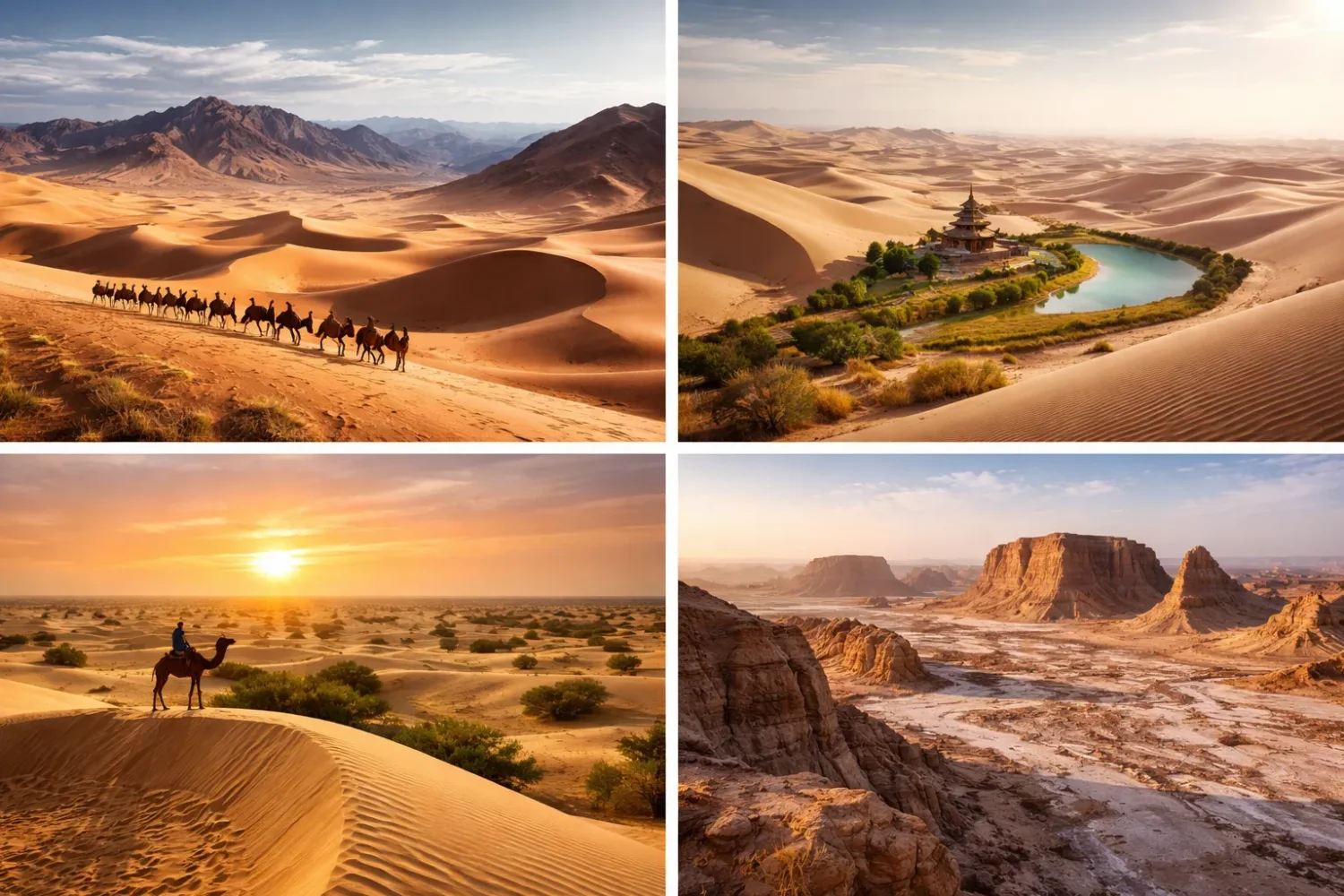
Asia holds the planet’s longest dryland chain. It starts in the Levant, swells across the Arabian Peninsula, breaks into salt basins on the Iranian Plateau, stretches over the open interiors of Central Asia, then runs into the cold basins and dune seas of Xinjiang, Inner Mongolia, and Mongolia. Read that belt on a map and you can almost see the logic of it: mountains rise, moisture falls on the windward side, and the land behind turns dry.
Tengger Desert
Location & Continent Continent: Asia Country: China Primary Regions: Inner Mongolia (Alxa League), Ningxia, Gansu Approximate Coordinates (Center...
Read More →Hami Desert
Location & Continent Continent: Asia Region: Eastern Xinjiang, northwestern China Desert System: Gobi Desert (often described as the...
Read More →Badain Jaran Desert
Location & Continent Continent: Asia Country: China Region: Alxa Plateau, Inner Mongolia Autonomous Region (with edges reaching toward...
Read More →Mu Us Desert
Location and Regional Context The Mu Us Desert (often described as the Mu Us Sandy Land) sits in...
Read More →Kubuqi Desert
Location & Continent Continent: Asia Country: China Region: Inner Mongolia Autonomous Region (Ordos area) Broader Setting: The Kubuqi...
Read More →Cholistan Desert
Location and Continent The Cholistan Desert sits in South Asia, spread across southern Punjab, Pakistan, mainly within the...
Read More →Negev Desert
Location & Continent Continent: Asia Region: Southern Levant Country: Israel Nearby Landscapes: Sinai Peninsula, Mediterranean Coastal Plain (northwest),...
Read More →Judaean Desert
Location & Regional Setting Region: Southern Levant Primary Name: Judaean Desert (also written Judean Desert) Where It Sits:...
Read More →Sharqiya Sands
Location and Setting Continent: Asia (Arabian Peninsula) Country: Oman Region: Ash Sharqiyah (Eastern Oman) between the interior plains...
Read More →Ramlat al-Sab`atayn
Location & Continent Continent: Asia Region: Arabian Peninsula Countries: Yemen (main area), Saudi Arabia (southwestern edge) Administrative Areas:...
Read More →Nefud Desert
Location and Regional Context The Nefud Desert—often written as An Nafud or Al Nafud—is a vast red-sand desert...
Read More →Empty Quarter (Rub’ al Khali) Desert
Location And Continent Continent: Asia Region: Arabian Peninsula in West Asia, forming a vast core of the Arabian...
Read More →Al-Dahna Desert
Location & Continent The Al-Dahna Desert (also written Ad Dahna) is a narrow, bow-shaped sand corridor in Saudi...
Read More →Al Khatim Desert
Location & Continent Continent: Asia Region: Arabian Peninsula Country: United Arab Emirates Emirate: Abu Dhabi Nearby Cities: Abu...
Read More →Taklamakan Desert
An immense sea of sand in China’s Xinjiang Uyghur Autonomous Region, the Taklamakan is one of Earth’s largest...
Read More →Gurbantünggüt Desert
Location & Continent Continent: Asia Country: China (Xinjiang Uyghur Autonomous Region) Coordinates: 45°N, 86°E Gurbantünggüt Desert – Map...
Read More →Kumtag Desert
Location & Continent Continent: Asia Country: China (Xinjiang Uyghur Autonomous Region) Coordinates: 40°N, 91°E Kumtag Desert – Map...
Read More →Karapinar Desert
Location & Continent Continent: Asia Country: Turkey Coordinates: 37°42′N, 33°33′E Karapınar Desert – Map & Street View ...
Read More →Ordos Desert
Location & Continent Continent: Asia Countries: China (Inner Mongolia Autonomous Region) Coordinates: 39°N, 108°E Ordos Desert – Map...
Read More →Lop Desert
Location & Continent Continent: Asia Countries: China (Xinjiang Uyghur Autonomous Region) Coordinates: 40°N, 90°E Lop Desert – Map...
Read More →Karakum Desert
Location & Continent Continent: Asia Countries: Turkmenistan (mainly), with smaller portions extending into Uzbekistan and Kazakhstan Coordinates: 39°N,...
Read More →Kyzyl Kum
Location & Continent Continent: Asia Countries: Uzbekistan, Kazakhstan, Turkmenistan Coordinates: 41°N, 64°E Kyzyl Kum – Map & Street...
Read More →Dasht-e-Margo
Location & Continent Continent: Asia Countries: Afghanistan Coordinates: 30°N, 63°E Physical Features Area: Approximately 150,000 km² Length: About...
Read More →Gobi Desert
Location & Continent Continent: Asia Countries: China, Mongolia Coordinates: 42°N, 105°E Gobi Desert – Map & Street View...
Read More →Thar Desert
Location & Continent Continent: Asia Country: India & Pakistan (primarily Rajasthan in India; stretching into Sindh and Punjab...
Read More →Thal Desert
Location & Continent Continent: Asia Country: Pakistan (Punjab Province – between the Jhelum and Indus Rivers; districts including...
Read More →Syrian Desert
Syrian Desert (Badiyat ash-Shām): Location, Climate, Ecology & Highlights A concise, research-backed guide to the Syrian Desert—its geography,...
Read More →Kharan Desert
Location & Continent Continent: Asia Country: Pakistan (Balochistan Province) Coordinates: near Kharan town ≈ 28°35′N, 65°25′E Physical Features...
Read More →Indus Valley Desert
Location & Continent Continent: Asia Country: Pakistan Province: Punjab Coordinates: 31.250°N, 71.667°E Physical Features Area: 19,501 km² (WWF...
Read More →Katpana Desert
Location & Continent Continent: Asia Country / Region: Pakistan — Gilgit-Baltistan (Skardu District) Coordinates: 35.3105°N, 75.5907°E Katpana Desert...
Read More →Maranjab Desert
Location & Continent Continent: Asia Country: Iran (Isfahan Province – Aran va Bidgol County, near Kashan) Coordinates: 34.3003°N,...
Read More →Polond Desert (Kavir-e Polond / Mozaffari Desert)
Location & Continent Continent: Asia Countries: Iran (South Khorasan Province – within Mozaffari Protected Area) Coordinates: ~34.16°N, 57.70°E...
Read More →Dasht-e Lut
Location & Continent Continent: Asia Countries: Iran (Kerman, Sistan-Baluchestan, South Khorasan Provinces) Coordinates: ~30.216°N, 58.839°E (UNESCO property reference)...
Read More →Dasht-e Kavir
Location & Continent Continent: Asia Countries: Iran Coordinates: ≈34.73°N, 52.23°E (Kavir Biosphere Reserve centroid) Photos of the Dasht-e...
Read More →Bromo Sand Sea
Note: Although the Bromo Sand Sea is commonly described as a “desert” due to its vast sandy appearance,...
Read More →Arabian Desert
Location & Continent Continent: Asia Countries: Saudi Arabia, Oman, Yemen, United Arab Emirates, Jordan, Iraq, Qatar, Kuwait Coordinates:...
Read More →Oleshky Sands (Oleshky Desert)
Location & Continent Continent: Europe/Asia (Ukraine) Country: Ukraine Coordinates: 46°37′N 34°57′E Photos of the Oleshky Sands Physical Features...
Read More →37 inventions in Asia
Still, an Asian desert is not one single thing. Some are ergs, true sand seas with long dune ridges and crescent forms. Some are gravel deserts. Some are salt deserts where crusted plains hide mud below the surface. Some are cold deserts that can sit under snow in winter. One of the most unusual entries here, the Bromo Sand Sea, is not a classical climatic desert at all but a volcanic sand field that looks and behaves like one on the ground.
This page brings together 37 deserts tied to Asia, from giant systems such as the Arabian Desert and the Gobi to smaller but very distinct landscapes such as Karapinar, Al Khatim, Katpana, and Polond. Most are fully Asian. One, Oleshky Sands, sits on the Eurasian margin and fits better as a borderland case, yet it still appears in extended Eurasian desert lists often enough to deserve a short place here.
Why Asia Has So Many Deserts
Distance from oceans, strong rain-shadow effects, high summer evaporation, weak surface water in closed basins, and the fading edge of the monsoon all work together. Put simply, mountains steal the rain and continental interiors keep the dryness.
How the Asian Desert Belt Is Built
Continentality, Rain Shadow, And Closed Basins
Large parts of inland Asia sit far from steady marine moisture. Then come the mountain walls: the Himalaya, Karakoram, Kunlun, Tian Shan, Alborz, Zagros, and Hajar. Moist air rises over these ranges, cools, and drops water on one side. The leeward side dries out. That is why the Tarim Basin, the Junggar Basin, much of central Arabia, and the Iranian interior can stay arid year after year.
Many Asian deserts also sit in endorheic basins, places where water does not reach the sea. Rivers weaken inland, spread into fans, disappear into sand, or end in playas and salt lakes. The old Lop Nur basin is a fine example. So is the central part of Dasht-e Kavir. Water arrives, but it often has nowhere permanent to go. It evaporates, salts stay behind, and the land becomes more hostile to dense vegetation.
Not All Deserts Are Sand Seas
When people picture deserts, they usually imagine tall dunes. That image fits the Rub’ al Khali, the Nefud, or parts of Badain Jaran. Yet many Asian deserts are mostly stony, gravelly, or salt-crusted. The Gobi is famous for broad gravel plains. The Syrian Desert is largely a stony and basaltic dryland. The Judaean Desert is cut by wadis and steep escarpments rather than dune oceans. Even the Negev mixes hammada-like surfaces, loess areas, and erosional craters.
Then there are special landforms. Yardangs in the Lop, Hami, and Kumtag sectors show what wind can do to soft sediment over a long span of time. Megadunes in Badain Jaran show the opposite story: huge sand bodies held in place by terrain, moisture conditions, and internal structure. Salt pans in Dasht-e Kavir and Dasht-e Lut remind you that a desert can be shaped as much by evaporating water as by blowing sand.
Why Temperatures Swing So Hard
Dry air stores little heat and clouds are sparse, so many Asian deserts jump from hot days to cold nights with surprising speed. In the Gobi, winter cold can be brutal and summer afternoons can still climb high. In the Taklamakan, rainfall is tiny and the basin interior amplifies heat in summer. In Katpana, altitude flips the pattern: sunlight warms the sand by day, but cold mountain air drops fast after sunset. Same desert logic, different setting.
Desert Comparison Table
The list below uses rounded figures because several deserts have fuzzy edges, linked sub-deserts, or different map definitions. Each entry still captures the landform style and geographic role of the desert clearly.
| Desert | Main Location | Approx. Scale | Terrain Style | What Stands Out |
|---|---|---|---|---|
| Tengger Desert | Inner Mongolia, Ningxia, Gansu, China | About 36,700 km² | Sand sea with lakes and dunes | Large dune field on the southern Alxa side |
| Hami Desert | Eastern Xinjiang, China | Broad basin sector | Gobi-style gravel and yardang country | Rain-shadow corridor between major mountain ranges |
| Badain Jaran Desert | Inner Mongolia and nearby Gansu, China | About 49,000 km² | Megadune sand sea | Dunes rising above 500 m and more than 100 lakes |
| Mu Us Desert | Inner Mongolia, Shaanxi, Ningxia, China | About 48,288 km² | Sandy land and dune-steppe transition | One of China’s classic desertification and recovery zones |
| Kubuqi Desert | Inner Mongolia, China | About 18,600 km² | Yellow River-side dune desert | Well-known restoration and solar-desert projects |
| Cholistan Desert | Punjab, Pakistan | About 25,800 km² | Sandy Thar-margin desert | Derawar Fort and old Hakra-linked settlement belt |
| Negev Desert | Southern Levant | Most of southern Israel | Rocky plateau, loess, wadis | Sharp north-south rainfall drop and erosional basins |
| Judaean Desert | East of the Judaean Hills, west of the Dead Sea | Compact regional desert | Escarpments, marl, wadis | Extreme relief toward the Dead Sea margin |
| Sharqiya Sands | Eastern Oman | About 12,500 km² | Linear dune sand sea | Long north-south dune ribbon close to the Arabian Sea side |
| Ramlat al-Sab`atayn | Yemen with a Saudi fringe | Regional dune belt | Sand plain and dune system | Part of the old Sayhad dry belt of southern Arabia |
| Nefud Desert | Northern Saudi Arabia | About 65,000 km² | Red-sand erg | Brick-red dunes and wind-shaped crescent forms |
| Empty Quarter (Rub’ al Khali) Desert | Saudi Arabia, Oman, UAE, Yemen | About 580,000–650,000 km² | Hyper-arid giant sand sea | Largest continuous erg on Earth |
| Al-Dahna Desert | Saudi Arabia | About 45,000 km² | Narrow red-sand corridor | Links the Nefud to the Rub’ al Khali |
| Al Khatim Desert | Abu Dhabi interior, UAE | Local to regional dune field | Low dunes and alluvial desert plain | Easy-to-read transition between sand and hard ground |
| Taklamakan Desert | Tarim Basin, Xinjiang, China | About 320,000 km² | Large shifting sand desert | One of the biggest sandy deserts in the world |
| Gurbantünggüt Desert | Junggar Basin, Xinjiang, China | About 48,800–50,000 km² | Cold desert with dunes and fixed surfaces | China’s second-largest desert by many counts |
| Kumtag Desert | Xinjiang and Gansu margin, China | About 22,900–25,000 km² | Dune desert and yardang zone | Desert edge near oasis towns and bare ridges |
| Karapinar Desert | Central Anatolia, Türkiye | About 260 km² | Sandy-saline steppe desert patch | Small, dry, and shaped by lake-bed history |
| Ordos Desert | Inner Mongolia, China | About 90,000 km² | Plateau desert with sandy lobes | Contains the Mu Us and Kubuqi sectors in the wider Ordos setting |
| Lop Desert | Lop Nur depression, Xinjiang, China | Roughly 50,000 km² | Playa, clay, yardang, gravel | One of Asia’s classic dry terminal basins |
| Karakum Desert | Turkmenistan with Uzbek and Kazakh margins | About 350,000 km² | Hot sand and gravel desert | Covers about 70% of Turkmenistan |
| Kyzyl Kum | Uzbekistan, Kazakhstan, Turkmenistan | About 298,000 km² | Red-sand and clay desert | Lies between the Amu Darya and Syr Darya |
| Dasht-e-Margo | Southwestern Afghanistan | About 150,000 km² | Remote sandy and gravel desert | Harsh inland basin with very low rainfall |
| Gobi Desert | Mongolia and China | About 1.3 million km² | Cold desert and semi-desert complex | Huge gravel-dominant dryland with wild temperature swings |
| Thar Desert | India and Pakistan | About 200,000–260,000 km² | Hot subtropical sand desert | One of the world’s most populated deserts |
| Thal Desert | Punjab, Pakistan | About 12,000–16,000 km² | Dune belts and inter-dunal plains | Dry lobe between the Jhelum and Indus rivers |
| Syrian Desert | Syria, Jordan, Iraq, Saudi Arabia | About 500,000 km² | Stony plateau and gravel desert | Broad basaltic and limestone drylands |
| Kharan Desert | Balochistan, Pakistan | Regional sandy desert | Sand and barren plain | Dry upland basin west of the Indus drylands |
| Indus Valley Desert | Punjab, Pakistan | About 19,501 km² | River-margin desert ecoregion | Dry desert between major Indus tributary zones |
| Katpana Desert | Skardu, Gilgit-Baltistan, Pakistan | About 1,500 km² | High cold desert | Sand dunes at about 2,226 m above sea level |
| Maranjab Desert | Isfahan Province, Iran | Regional desert tract | Dunes, salt flats, and lake-margin desert | Classic central Iranian sand-and-salt scenery |
| Polond Desert | South Khorasan, Iran | Protected-area desert tract | Dunes, clay pans, and rocky margins | Little-known Iranian desert with wildlife value |
| Dasht-e Lut | Central-eastern Iran | About 51,800 km² | Hyper-arid desert of yardangs, regs, and dunes | Surface temperatures measured above 70 °C by satellite |
| Dasht-e Kavir | Central Iran | About 60,000 km² core; broader system larger | Great salt desert | Salt flats, marshy depressions, and basin-floor crusts |
| Bromo Sand Sea | East Java, Indonesia | About 52.5 km² | Volcanic sand sea | Desert-like floor inside the Tengger caldera |
| Arabian Desert | Arabian Peninsula | About 2.3 million km² | Multi-country desert system | Asia’s largest desert region |
| Oleshky Sands | Southern Ukraine, Eurasian margin | About 160–1,600 km² depending on unit used | Sandy semi-desert | Borderland case often discussed in Eurasian sand-desert lists |
East Asia: The Gobi Arc, the Tarim Basins, and Northern China’s Sandy Lands
Main Pattern
This region mixes cold-desert climate, huge inland basins, winter cold, and wind-driven landforms. Here, desert does not always mean soft dunes. Very often it means gravel plains, yardangs, dry lake beds, sparse shrubs, and dust paths that can travel far beyond the desert itself.
The Gobi Family: Gobi, Hami, Tengger, Badain Jaran, Mu Us, Kubuqi, and Ordos
The Gobi Desert is the big regional anchor. At roughly 1.3 million km², it is one of the world’s largest deserts and one of its clearest examples of a cold desert. Rainfall often sits between 50 and 200 mm a year, with many western areas staying below 100 mm. Winter values can dive toward −40 °C, while summer highs can climb near 45 °C. That is a huge annual swing. It is also why the Gobi is more than a sea of sand: freeze-thaw, sparse vegetation, dust, and gravel pavements all matter here.
Inside the wider Gobi sphere, the Hami Desert shows the desert as corridor land. It lies between the Tian Shan and the Nan Shan, where mountain rain shadow and strong insolation weathering create a stony, wind-worked surface. Many sectors get only 20–50 mm of precipitation in a year. The surface often looks armored, almost polished from a distance, because finer sediment has long been stripped away. A desert like this teaches an important lesson: wind does not only build dunes, it also removes them.
The Tengger Desert, by contrast, is much more recognizably sandy. It covers about 36,700 km² and occupies a southern part of the Alxa drylands. Dunes, interdunal lowlands, and seasonal water pockets give it a more varied texture than people expect. In places, the surface shifts from open sand to firmer ground in a short distance. That mixed texture matters for both plant survival and dune movement. It keeps the desert from acting like one uniform sheet of sand.
Then there is Badain Jaran, one of Asia’s standout dune landscapes. Its area is often given as about 49,000 km², yet the raw size is not the main story. The real story is relief. Some of its stationary dunes rise above 500 m, among the tallest fixed dunes on Earth, and more than 100 interdunal lakes sit between those sand giants. That pairing—very high dunes and persistent lakes—is unusual enough that the desert has drawn strong geomorphology interest. In plain terms, it is one of the few places where the sand towers and the hollows still hold water. Strange balance. Beautiful one, too.
The Mu Us Desert sits farther southeast and works more like a desert-steppe transition belt. Its mapped area is about 48,288 km². Annual rainfall often falls in the 250–400 mm range, which is far wetter than the big hyper-arid deserts, yet wind erosion and shifting sand can still dominate when plant cover weakens. That is why Mu Us matters so much in any discussion of desertification: it sits close to the threshold where grassland, shrubland, sandy land, and managed recovery zones trade places.
The Kubuqi Desert is smaller, around 18,600 km², but it punches above its size in land-restoration debates. It lies along the great bend of the Yellow River in Inner Mongolia and has become known for dune control, planted shelter belts, and solar-linked restoration projects. Between 2000 and 2020, more than 583,000 hectares of desert ecosystem there were reported as conserved or restored. That does not mean the desert vanished. It means certain sectors shifted from unstable sand toward more managed ground cover, wetlands, farmland, and fixed surfaces. A useful distinction.
The larger Ordos Desert wraps around several of these sandy systems. Think of it less as one tidy dune sea and more as a plateau desert complex shaped by the Yellow River loop, loess margins, and sandy lobes. Its broad footprint is often placed near 90,000 km². Within it, the Mu Us and Kubuqi act like distinct chapters of the same regional story.
The Tarim and Junggar Basins: Taklamakan, Gurbantünggüt, Kumtag, and Lop
If the Gobi is the image of the cold desert plateau, the Taklamakan Desert is the image of the enclosed sand basin. It fills most of the Tarim Basin in Xinjiang and covers roughly 320,000 km². Rainfall drops from about 38 mm in some western sectors to near 10 mm in the east. That is very dry even by desert standards. It is also one of the world’s biggest sandy deserts, with long dune chains, buried channels, and oasis margins fed by rivers descending from surrounding ranges. The Silk Road skirted its edge for a reason. Crossing the core was never the easy choice.
The Gurbantünggüt Desert in the Junggar Basin is smaller than the Taklamakan, around 48,800–50,000 km², but it is still one of China’s largest deserts. It sits at lower elevation than many imagine, often around 300–600 m, and because it lies in a colder northern basin it keeps a distinct cold-desert signature. Snow can play a bigger seasonal role there than in hotter basins, and vegetation can be patchier but more seasonally responsive. This is one reason the surface can look less like bare hyper-arid wilderness and more like a broken mosaic of dunes, crusted soils, and semi-fixed ground.
The Kumtag Desert sits east-southeast of the Lop region and is often placed around 22,900–25,000 km². It is famous for dune masses that climb against surrounding hills and for its position beside oasis settlements, where the contrast between cultivated land and advancing sand is sharp. Geographically, Kumtag is a lesson in desert edge behavior: the margins matter as much as the center. Sand transport, runoff channels from mountain feet, and subtle topographic breaks all shape what the desert looks like on the ground.
The Lop Desert is flatter, more severe, and more skeletal. It occupies the former Lop Nur terminal basin and is tied to one of the world’s classic playa landscapes. Depending on how the boundary is drawn, figures vary, but a regional footprint near 50,000 km² is often cited for the desert, while the core playa zone is smaller. Here, the main visual grammar is not towering dunes but clay flats, salted surfaces, and yardangs—long wind-cut ridges that look as if the ground itself has been combed into parallel lines. One of Asia’s most technical desert scenes. No exaggeration.
What East Asian Deserts Show Best
- Badain Jaran shows how dunes can become gigantic and still remain partly fixed.
- Taklamakan shows what deep basin isolation does to rainfall and sand accumulation.
- Kubuqi shows how human land management can alter dune mobility at the margins.
- Gobi and Hami show that many deserts are mostly gravel, not sand.
- Lop and Kumtag show how dry lakes, yardangs, and dune corridors belong in the same basin story.
West Asia: the Levant and the Arabian Dry Belt
Main Pattern
West Asian deserts often combine very low rainfall, plateau relief, wadis, and erg corridors. The map shifts from rocky deserts in the Levant to giant dune systems in Arabia. In between, there are escarpments, gravel plains, and old drainage lines that only wake up briefly after rain.
The Levantine Deserts: Negev and Judaean
The Negev Desert is not only dry; it is a study in how rainfall fades over distance. On the central Negev plateau, annual precipitation can sit around 76–102 mm, while the far south near Eilat is much drier. The land mixes plateaus, wadis, rocky slopes, and erosional basins often called makhteshim. That is why the Negev matters beyond its size: it is a clean example of how structure, runoff, and aridity interact in a compact space.
The Judaean Desert sits along the eastern rain-shadow side of the Judaean Hills and drops toward the Dead Sea. Rainfall there can be sparse enough to support only patchy vegetation, and relief becomes the big visual force: cliffs, ravines, marl slopes, and alluvial fans. It is not a classic erg. It is an escarpment desert, a place where gravity and flash-flood incision matter as much as the wind. Short basin-to-basin distances do not make it simple. They make it sharper.
Arabia’s Sand Corridors: Sharqiya Sands, Ramlat al-Sab`atayn, Nefud, Al-Dahna, and Al Khatim
The Sharqiya Sands in Oman cover about 12,500 km², extending roughly 180 km north to south and 80 km east to west. It is a compact but vivid sand sea of long ridges and open interdunal corridors. The proximity of the Arabian Sea does not make it wet in the usual sense, yet the regional setting influences humidity, fog patterns in some seasons, and the life that survives at the margins. That is one reason Sharqiya feels different from the bigger inland ergs.
The Ramlat al-Sab`atayn occupies a drier southern Arabian position across parts of Yemen and the Saudi fringe. It belongs to the old Sayhad desert belt, where sands, open plains, and basin-floor deposits meet. It gets less attention than the Empty Quarter, yet it helps explain the southern Arabian transition from mountain forelands to open dune country. In desert geography, middle-sized systems like this matter because they connect the map. They are not side notes.
The Nefud Desert in northern Saudi Arabia covers around 65,000 km² at an average elevation near 900 m. Its sand is famously reddish, with iron oxide giving the dunes a warm brick tone. Violent winds can reshape the surface quickly, and the dune forms range from sweeping arcs to more broken masses. This is a true erg. It also works as the northern bookend of central Arabian sand systems.
Between the Nefud and the Empty Quarter runs the Al-Dahna Desert, a narrow, bow-shaped corridor around 1,200–1,300 km long and often just 20–80 km wide. Its area is commonly estimated near 45,000 km². If the Arabian sand seas are chapters, Al-Dahna is the spine that binds them together. Its red sands form a ribbon more than a block, and that shape tells you a lot about wind alignment, basin relief, and sediment pathways across the peninsula.
The Al Khatim Desert in the interior of Abu Dhabi is smaller and quieter in scale, but it is a good field example of a low-dune desert plain. Sand ridges, alluvial surfaces, and open gravelly sectors sit close together. That makes Al Khatim a useful desert for reading process rather than size. You can see how water once spread sediment, how wind later organized sand, and how vegetation hangs on where moisture conditions improve even a little. Subtle place. Very instructive.
The Big Arabian Systems: Rub’ al Khali and Arabian Desert
The Empty Quarter, or Rub’ al Khali, is the star sand sea of western Asia. Its area is usually placed between 580,000 and 650,000 km², with a length close to 1,000 km and widths up to 500 km. Some dunes rise toward 250 m. Many parts receive well under 50 mm of rain in a year, and some years bring barely any measurable moisture. This is why it is so often called the world’s largest continuous erg. The phrase fits. The scale really is that large.
Yet the Empty Quarter is still only one part of the Arabian Desert, the much broader desert system that covers roughly 2.3 million km² across the peninsula. Summer highs can push above 45–50 °C, and some sectors receive under 30 mm of annual rainfall. The Arabian Desert includes not just ergs but gravel plains, stony uplands, lava fields, escarpments, and coastal desert margins. In other words, Arabia is not one desert texture. It is a linked desert continent in miniature.
The Syrian Desert
The Syrian Desert, often estimated near 500,000 km², spreads across parts of Syria, Jordan, Iraq, and northern Saudi Arabia. Large sectors are stony or gravelly rather than sandy, and plateaus around 700–900 m dominate much of the central area. It is a desert of open horizons, wadis, basaltic tracts, and broad dry plains rather than giant dune walls. Put simply, the Syrian Desert is the opposite of a postcard erg. That is exactly why it deserves more attention in Asia-wide desert writing.
Central Asia: Interior Basin Deserts and Red-Sand Plains
Main Pattern
Central Asian deserts are shaped by distance from oceans, continental temperature swings, and river systems that weaken inland. The result is a region of big sand sheets, clay flats, takirs, and desert-steppe transition zones that sit between major rivers and isolated uplands.
Karakum and Kyzyl Kum
The Karakum Desert occupies about 350,000 km² and covers roughly 70% of Turkmenistan. July averages can range from the upper 20s °C to the low 30s °C depending on sector, and rainfall is generally sparse. The land mixes sand, saline hollows, and low-relief desert surfaces. Its scale is easy to underestimate because many maps present it as one blank space. It is not blank. It is textured by old channels, dune forms, crusts, and human water engineering along the margins.
The Kyzyl Kum, the “Red Sand,” covers around 298,000 km² between the Amu Darya and Syr Darya. That interfluvial setting is central to its identity. Some sectors are dune-covered, others show clayey or takir-like surfaces, and isolated uplands break the horizon in places. Kyzyl Kum is not as globally famous as the Gobi or Rub’ al Khali, yet it is one of Asia’s major deserts by area and one of its cleanest examples of a river-bounded continental desert.
Dasht-e-Margo
The Dasht-e-Margo of Afghanistan, often listed at about 150,000 km², sits in a remote southwestern basin environment with temperatures that can reach 45 °C in summer and fall far below freezing in winter. Precipitation is usually under 100 mm a year. Sand, gravel, clay flats, and sparse shrub cover dominate. Its remoteness is part of its geography; it is one of those deserts where distance itself acts like a physical force.
Dasht-e-Margo also helps fill a gap that many Asia desert roundups leave open: Afghanistan is not only mountain country. It also contains dry basin landscapes that connect the Iranian Plateau, Sistan-related lowlands, and the sandy deserts of Pakistan. Leave that out and the map of Asian aridity feels incomplete.
South Asia: Monsoon Edge Deserts and River-Margin Drylands
Main Pattern
South Asian deserts sit close to the monsoon world but outside its reliable reach. That creates a strong tension between seasonal rain pulses and long dry spells. Human settlement is denser here than in many other desert belts, so agriculture, grazing, forts, canals, and settlement history appear close to dune fields.
Thar, Cholistan, and Thal
The Thar Desert is one of Asia’s best-known hot deserts and also one of its most lived-in. Depending on the map, its area is often placed between roughly 200,000 and 264,000 km². Average annual rainfall can range from about 100 mm in the driest west to around 500 mm toward semi-arid eastern margins, though the overall desert core stays far drier than the monsoon plains nearby. Most rain arrives in a short summer window. That short wet season shapes grazing, cropping, soil crusts, and dune stabilization. Miss the season and the land feels wholly different.
The Cholistan Desert, often described as the western part of the greater Thar system in Pakistan, covers about 25,800 km². It stretches for close to 480 km in length and includes both sandy sectors and alluvial flats. Cholistan also carries an older fluvial memory through the Hakra dry channel and the settlement traces once tied to it. That makes Cholistan more than a sand belt. It is a desert-palimpsest, with old water lines still visible in the geography if you know where to look.
The Thal Desert is smaller, around 12,000–16,000 km², lying between the Jhelum and Indus rivers in Punjab. Rainfall often sits near 150–250 mm a year, and summer temperatures commonly reach 38–45 °C. Thal is a classic example of a river-bounded dune plain, where low-relief belts of sand and inter-dunal ground interact with irrigation margins and patchy shrub cover. It is less famous than Thar, but from a landform point of view it is very clear and very useful.
Kharan, Indus Valley, and Katpana
The Kharan Desert in Balochistan is a drier western Pakistani desert that reads as a sparse sandy-barren plain near the uplands around Kharan. It is not usually the first name people list, yet it helps explain how Pakistan’s deserts are not one single belt. There is a western dry interior, there are central river-margin sands, and there is the larger Thar-Cholistan system to the east. Kharan is one of the pieces that makes that pattern legible.
The Indus Valley Desert is smaller but very important because of its ecoregional position in Punjab. Its area is often given as about 19,501 km². This is not a fully isolated dune ocean. It is a river-margin desert ecoregion, where aridity, alluvium, sparse scrub, and adjacent cultivated lands all live close together. That edge quality makes it different from a classic basin desert. It is a desert built beside a major fluvial world, not far beyond it.
The Katpana Desert flips the usual South Asian desert image on its head. Near Skardu, at about 2,226 m above sea level, it is one of the world’s highest cold deserts. Sand dunes can lie under snow in winter. Summer warmth is real but short, and winter air can sink far below freezing. This is what makes Katpana so memorable: desert dryness and mountain cold share the same ground. Rare combo. Very photogenic, but the geography matters more than the photos.
Iranian Plateau Deserts: Salt, Heat, Yardangs, and Interior Basins
Main Pattern
Iran’s deserts are not just dune fields. They are a wide mix of salt flats, playas, yardang corridors, protected desert tracts, and mountain-ringed basins. This is one of Asia’s best regions for seeing how geology and evaporation shape a desert from the basin floor upward.
Maranjab and Polond
The Maranjab Desert sits in central Iran near Aran va Bidgol and the salt-lake world of the interior plateau. It is known for classic Iranian dune scenery, salt-flat margins, and caravan-route geography. As a landform lesson, Maranjab shows how sand belts and saline flats can sit side by side in a closed basin setting. It is approachable in scale, which makes its desert patterns easy to read.
The Polond Desert, also called Kavir-e Polond, lies in South Khorasan within the wider Mozaffari Protected Area. The protected area figure often cited is about 92,808 hectares. The desert plain itself mixes dunes, clay pans, salt flats, and rocky uplands nearby. That mix matters. Polond is not a one-material desert. It is a transition zone where sand, salt, stone, and wildlife habitat overlap in a fairly compact space. For topical depth, it is one of the better Iranian deserts to include because so many lists skip it entirely.
Dasht-e Lut
The Dasht-e Lut, or Lut Desert, is one of the most physically intense deserts in Asia. Its area is commonly listed near 51,800 km². Satellite observations made it famous for land-surface temperatures above 70 °C, and later observations reported a peak of about 80.8 °C for the surface itself, not the air. That distinction matters, meausred ground skin temperature is not the same thing as air temperature taken in a weather shelter. Even so, Lut remains one of the harshest desert surfaces ever observed from orbit.
Lut is also a landform desert in the purest sense. Yardangs, regs, dark lava-influenced surfaces, dune fields, and hyper-arid corridors all meet there. This is why it became a UNESCO World Heritage site. It is not only hot. It is geomorphically clean, almost textbook-like in how wind and desiccation write on the land.
Dasht-e Kavir
The Dasht-e Kavir, the Great Salt Desert of Iran, has a central salt-playa core often placed around 60,000 km², while the broader dryland system around it is larger. The basin floor includes salt crusts, muddy depressions, and seasonal wet patches that can become treacherous under the surface. This is not a desert where every bright white plain is safe footing. Salt crust can hide soft ground below, and that simple field fact shapes movement, drainage, and habitat.
The larger Iranian story becomes easy to see when Lut and Kavir are read together. Lut is the harsher, hotter, more sculpted desert of famous surface extremes. Kavir is the broader salt-basin world where evaporation, marshy low points, and enclosed drainage take center stage. Two deserts, same plateau, very different personalities.
Southeast Asia and the Eurasian Edge Case
Bromo Sand Sea
The Bromo Sand Sea in East Java sits inside the Tengger caldera, whose volcanic setting defines everything about it. The sand sea itself covers about 5,250 hectares, or 52.5 km², at roughly 2,100 m above sea level. Rainfall in the wider caldera zone is far higher than in a true climatic desert, and that is the whole point: Bromo is a desert-like landscape made by volcanism, not by a dry subtropical climate.
Its bare, ash-rich floor, sparse cover, active cone, and surrounding steep walls create one of Asia’s most unusual sandy environments. Many desert lists ignore volcanic sand seas because they do not fit the cleanest climate definition. That leaves a gap. In real-world landscape reading, Bromo belongs in the conversation because the eye meets a desert form even when the climate backstory is different.
Oleshky Sands
The Oleshky Sands sit outside the main Asian dry belt and belong more properly to the Eurasian borderland. Depending on whether one is counting the central sands, the wider sandy massif, or the protected unit, figures range from about 160 km² to roughly 1,600 km². It is best understood as a semi-desert sand complex, not a giant Asian erg. Even so, it appears often enough in broad Eurasian desert discussions that it is worth placing clearly rather than ignoring it.
Its inclusion here also helps sharpen a useful point: not every “desert” in regional lists belongs to the same climatic family. Some are fully hot deserts, some cold deserts, some saline basins, some volcanic sand seas, and some semi-arid sand masses on the edge of steppe country. Categories help, but ground truth matters more.
Patterns That Connect All 37 Deserts
1) Asia’s Deserts Are More Diverse Than A Single “Sand Sea” Image
From the gravel Gobi to the salted Dasht-e Kavir, from the snow-touched Katpana to the volcanic Bromo Sand Sea, the continent keeps overturning the simple dune stereotype. This matters for readers because desert travel, ecology, geology, and even photography all change with surface type. Sand behaves one way. Salt crust another. Gravel plains another again.
2) Water Is Scarce, But It Still Shapes Everything
Even in the driest sectors, old and modern water paths leave marks. Oases ring the Taklamakan. Ancient lake basins define the Lop. Interdunal lakes appear in Badain Jaran. Wadis carve the Judaean and Negev. The Hakra memory still matters in Cholistan. In deserts, water often matters most where it is least visible.
3) Mountains Sit Behind Many Of The Biggest Drylands
The Tian Shan, Kunlun, Karakoram, Himalaya, Alborz, and Zagros all help create dry interiors. When you line up the basins and ranges on a map, the pattern becomes hard to miss. The desert is not random. It is structured.
4) Some Of The Most Interesting Deserts Are Not The Biggest Ones
Al Khatim, Karapinar, Polond, and Katpana prove that small deserts can be some of the best for reading fine-scale process. They show transition zones, salinity, protected habitat, high-altitude aridity, and the meeting point of old water work and modern wind work. Big deserts impress. Small deserts explain.
What to Notice When Reading an Asian Desert Map
- Look for basin walls. If tall ranges ring the dryland, rain shadow is probably part of the story.
- Check whether the desert touches rivers. River-margin deserts behave differently from enclosed-basin deserts.
- Watch the surface color. Red sands, white salts, black volcanic ash, and pale gravel often point to very different geomorphic histories.
- Ask whether the desert is hot or cold. The answer changes vegetation, seasonality, and even dune activity.
- Notice edge zones. Oases, loess margins, alluvial fans, and steppe transitions are often more revealing than the absolute core.