
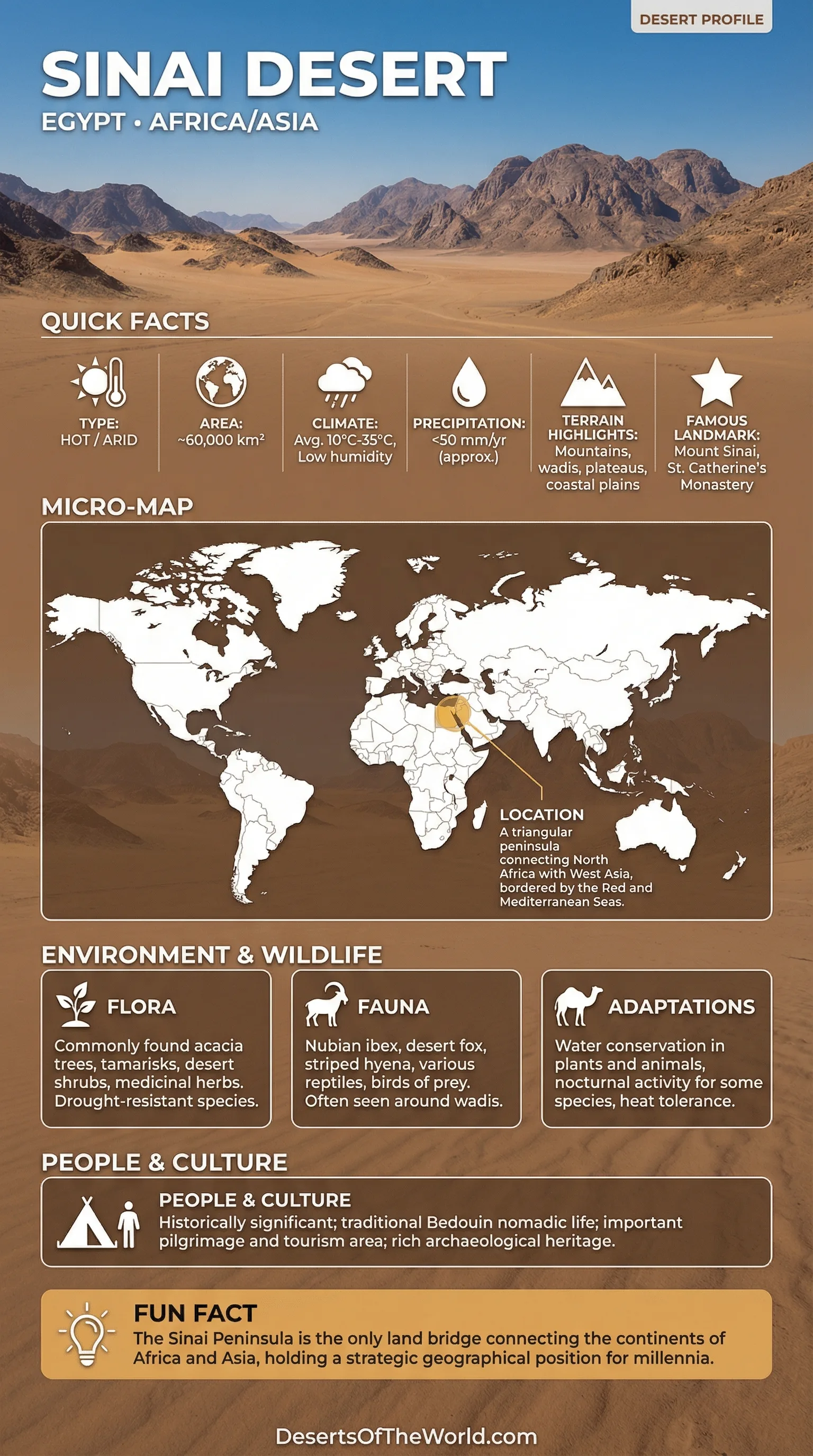
Location and Regional Context
Continent: Asia (Western Asia)
Country: Egypt
Region: Sinai Peninsula
Central Coordinates: 29.50°N, 33.83°E
The Sinai Desert sits on the Sinai Peninsula, a rugged, triangular land bridge between two continents. With the Mediterranean to the north and the Red Sea to the south, Sinai’s desert landscapes feel like a natural “hinge” where coast, plateau, and mountains meet in a tight space.
Sinai Desert – Map Views
Physical Features
Land Area (Sinai Peninsula): About 60,000–61,000 km²
Approximate Dimensions: ~380 km north–south; ~210 km west–east
Elevation Range: Sea level to about 2,642 m (Mount Catherine)
Calling Sinai “just sand” misses the point. The Sinai Desert is a mosaic: rock deserts dominate much of the interior, while sand sheets and dunes are more common in the north and some low basins.
Climate and Seasonal Weather
Climate Type: Predominantly arid desert; local cold-desert traits at high elevations
Rain Pattern: Sparse overall; most rain arrives in cooler months as short-lived storms
Typical Conditions: Hot sun, low humidity inland; cooler and windier near coasts and peaks
Sinai’s air can feel like a dry, clean flame in summer, then turn surprisingly crisp on high ground in winter. The big story is low rainfall paired with sharp day–night contrasts. The desert’s temperature swings shape everything from plant timing to how wadis behave after rare storms.
Ecological Setting
Realm: Palearctic
Biome: Deserts and xeric shrublands
Common Habitats: Rocky slopes, limestone plateaus, sandstone plains, gravel fans, coastal desert
Ecology here is built around patches. Life clusters where shade, stone, and moisture line up—like finding small “islands” of green in a sea of stone and sand. Many species lean on microhabitats: cracks in rock, wadi beds, and pockets of deeper soil.
Flora and Fauna
Plants Often Associated With Sinai’s Desert Landscapes
- Acacia (notably umbrella-shaped desert forms) in wadis and runoff zones, acting like living shade sails under a hard sun.
- Tamarisk and salt-tolerant shrubs in drier flats and some coastal pockets, where salt-laced winds are common.
- Ephemeral wildflowers that appear after rain, brief but bright—like confetti on stone.
- Hardy grasses and low shrubs on plateaus, built for scarcity and wide skies.
Wildlife Commonly Found Across Sinai Desert Habitats
- Mountain and cliff specialists in the southern highlands, using ledges and gullies as natural highways, with granite walls as cover.
- Small mammals and nocturnal foragers that avoid midday heat by shifting life into the cooler hours.
- Reptiles adapted to dry ground and sudden bursts of activity, often blending into sand and gravel like moving camouflage.
- Migratory birds passing through seasonally, because Sinai’s geography funnels travel between larger landmasses.
The most striking pattern is timing. Many animals and plants run on a desert clock: rest when the sun is loud, move when the air cools, and burst into growth when rain briefly rewrites the rules. That rhythm makes Sinai feel less empty and more like a quiet stage waiting for the right cue.
Geology and Landforms
Sinai’s desert landforms reflect the distribution of rock types across the peninsula. The region consists of three main geological zones: crystalline mountains in the south, broad limestone plateaus in the center, and sandstone plains in parts of the north. Differences in rock structure and erosion produce marked variations in elevation, surface texture, and landform patterns over short distances.
| Zone | Typical Terrain | What It Looks Like | Why It Matters |
|---|---|---|---|
| Southern Highlands | Granite and metamorphic massifs | Jagged peaks, narrow valleys, rocky slopes | Creates cooler microclimates and pockets where plants can persist |
| Central Plateau | Limestone tablelands and gravel plains | Wide horizons, pale rock “floors,” wind-shaped textures | Channels runoff into wadis; forms broad catchments |
| Northern Lowlands | Sandstone, sand sheets, and coastal plains | Sandy expanses, gentle ridges, dune patches | Closer to Mediterranean influences; more frequent plant flushes after rain |
Wind is the steady sculptor, but water is the dramatic artist. When rain arrives, it can carve, shift gravel, and refill shallow channels. Those rare moments leave signatures—fresh fans of stone, cleaner rock faces, and wadi beds rearranged like a deck of cards.
Understanding the “Desert” in Sinai Desert
The phrase Sinai Desert usually describes the peninsula’s broad arid interior rather than a single, clearly defined desert unit. Sinai includes several desert types: rock deserts dominated by exposed stone, sand landscapes shaped by wind deposition, and wadi networks that channel seasonal water flow.
On a map, Sinai can look simple—an outline between two seas. On the ground, it is textured and layered. Think of it as a stone library: each cliff and plateau is a page, and the wadis are the margins where the story gets rewritten when storms arrive.
Wadis, Water, and Desert Hydrology
In Sinai, there are no permanent rivers. Water is mainly stored in groundwater and small springs, and it flows through dry channels after rainfall. A wadi is usually dry but can carry water and sediment for a short period following a storm, reshaping the surface of the land.
Wadi floors often contain deeper soils, scattered vegetation, and occasional trees. These areas form narrow green corridors across the surrounding desert. In Sinai’s desert ecology, wadis support many plant and animal communities.
Coasts, Gulfs, and Edge Effects
Sinai’s desert is bordered by water on multiple sides, and those edges matter. The Gulf of Suez and the Gulf of Aqaba frame the peninsula’s southern reaches, while the Red Sea and Mediterranean create shifting wind patterns and humidity gradients. Even a small change in moisture can decide whether a shrub survives or fades.
Coastal desert zones can feel different from the interior: more wind, more salt in the air, and a sharper boundary between bare ground and life. These “edge effects” help explain why Sinai shows such variety in a relatively compact region.
Human Footprints in a Harsh Landscape
People have interacted with Sinai’s desert for a very long time, often following the logic of water and shade. Traditional knowledge focuses on routes, seasonal grazing, and the best use of scarce resources without exhausting them. In a place where rainfall is unreliable, planning is less about calendars and more about reading the land.
Sinai is also linked to ancient stonework and early mineral use, including areas known for turquoise in the broader peninsula. The desert preserves traces well—dry air and low vegetation can keep old pathways, walls, and working sites visible longer, like a faded pencil sketch that never fully rubs away.
Protected Landscapes and Biodiversity Hotspots
Several protected areas in Sinai highlight how desert value is not only scenic; it is ecological. The Saint Katherine region is known for rugged highlands and distinctive habitats, while coastal protected areas showcase how marine and desert systems can sit side by side, each influencing the other.
Protection matters most in deserts because recovery can be slow. A damaged shrubland may take many seasons to return, and a disturbed soil crust can change how water infiltrates the ground. In a dry world, small disturbances can echo for years.
How Scientists Read the Sinai Desert
Sinai is a natural classroom for understanding arid landscapes. Researchers use satellite imagery to track shifting sand, seasonal vegetation pulses, and the after-effects of storms. Field geology adds the close-up view: rock textures, fault lines, and the way valleys cut through plateaus.
A good mental image is a two-scale lens. From space, Sinai is patterns—light and dark, smooth and rough. On the ground, it becomes details—gravel size, soil crust, plant roots, and the subtle places where life keeps a foothold.
References
UNESCO World Heritage Centre – Saint Catherine Area (Sinai)
NASA Earth Observatory – Dry Country of Turquoise (Sinai)
NASA Earth Observatory – Fisheye Over Sinai
Egyptian Environmental Affairs Agency (EEAA) – Welcome to St. Katherine (PDF)
Egyptian Environmental Affairs Agency (EEAA) – Ras Mohammed National Park Document (PDF)
Copernicus Publications – Sinai Peninsula Rainfall and Extremes (Open Access Paper)
Springer (PDF) – Overview of Sinai Geology and Rock Provinces